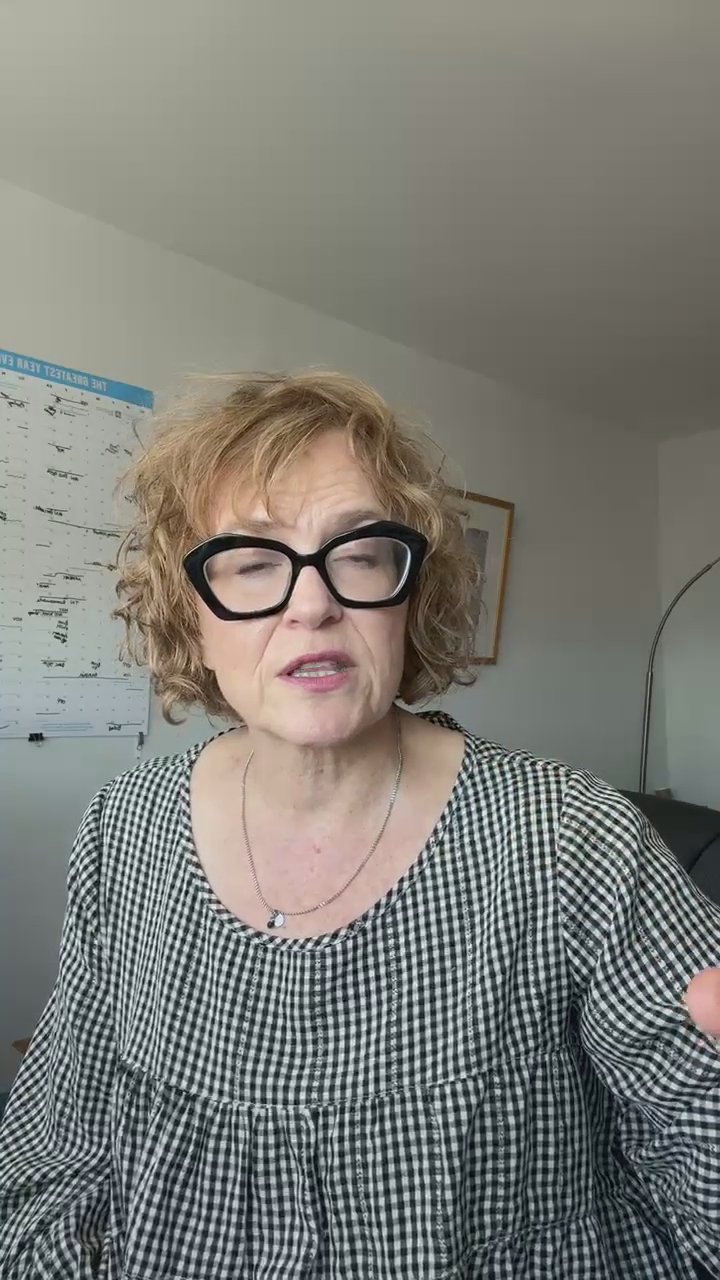
The host opens the episode, welcomes the audience, and previews that she will revisit last week's topic about the skills of receiving. This establishes the show's tone and what to expect.
The host opens the episode, welcomes the audience, and previews that she will revisit last week's topic about the skills of receiving. This establishes the show's tone and what to expect.
The host describes her habit of using 'walk-on' and other upbeat playlists to shift her mood and mark the start of her day. She lists specific favorite songs and explains why lyrics matter for her energy and routine.
She summarizes the seven receiving skills—allowance, tolerance for ease, completion, somatic softening, non-urgency, noticing without managing, and receiving without identity conflict—and briefly explains each. This serves as a refresher for viewers who missed the prior episode.
The host contrasts her long-practiced skills of rejection (dissociation, addiction, repression) with the newer work of receiving, describing how trauma trained her brain to reject good things. She recounts therapy and recovery steps used to unpack and reorganize those coping mechanisms.
She emphasizes daily review and practice of receiving skills, notes how the brain looks for what it is told to find (reticular activating system), and shares a recent experience at the American Music Honors as a practice opportunity. The segment underscores persistence and the universe's cooperation.
The host introduces guideline number 21—'If I don't stay on top of it, it will stay on top of me'—and explains practical baseline supports like morning spiritual time, regular exercise, and nutritious food. She stresses that maintaining these routines preserves capacity to handle stress and enjoy life.
She describes gaining distance from anxiety by observing it rather than believing it, uses the example of post‑weekend anxiety to plan supports, and encourages iterative self-management. The episode ends with travel notes, a farewell, and a reminder to practice receiving skills.
Good morning, cadre. Hello, team. Welcome back to Rules of Engagement with Betsiologists. The awesome place every week where we come together to talk about, I don't know, guidelines and ways to live that we've learned either the easy way or the hard way. Hello, Mel Myers. I am so glad you are here. Welcome to Rules of Engagement. And last week we talked about the skills of receiving. I'm going to revisit those. But as I was getting ready for this live stream, I was listening to my walk-on music.
I have a playlist that I call walk-on songs. Now I suggest this. That's why I'm bringing it up. because walk-on music, if you're a politician, and somebody introduces you and then you're gonna walk across the stage and shake hands with people and wave at someone in the audience, there's a song playing, right? Your walk-on music or at an award show or whatever it is. You know, you wrestlers have the walk-on music. You know, I don't know what they are. I don't watch wrestling. More power to you if you do, but you know, performers have this walk-on music.
And Maybe I saw a suggestion about it somewhere. I don't know. I've been keeping a list of theme songs for over 20 years now. Songs that help me remember that life is good. And I have my zesty playlist, which is songs that I can't help but move to. They don't have to be about anything, but if I hear the song, it's like all of a sudden I'm right there with the song. And walk on songs, which are, I had walk on music as an elected official. when I did my first endorsing convention for mayor and I had people introduce me and then I came on, it was the Joan Jett version of the Mary Tyler Morris theme song.
If you are not familiar with that, I suggest you look it up. It is a badass rock'n'roll version of the Mary Tyler Moore theme song. And of course, Mary Tyler Moore Show was set in Minneapolis and I was running to become the mayor of Minneapolis. And this was this badass version of this theme song. It was just great. So that's what I walked onto. But I work from home now. I work for myself. And so in the morning, one of the things that I've adopted in the last few months as just a regular routine is having walk-on music.
It helps me know my day has started. Now my day started a while ago, but I was about to come talk to everybody and I thought, you know, I could use a little extra walk-on music. So I'll give you examples of what's on mine. You should have whatever you want for your walk on music. The goal of it is to just pump you up and remember that good things are possible and like I can do anything. So on my list right now, the one that was just playing was the Bruce Springsteen Shine Little Light This Little Light of Mine from the Dublin.
He did a whole tour with the Seager Sessions Band and the whole Dublin album of that tour is like oral, A-U-R-A-L, uppers, I guess. Just gets you right into whatever good mood you need to be in. But that song in particular, This Little Light of Mine, I'm gonna let it shine, great version. The song Back in the Saddle, by Luke Combs. The song No Backup Plan. Who does that? I think it's Luke Combs is definitely on it. It's like two or three different male country music artists. Backup plan to Bailey Zimmerman and Luke Combs.
That's who I want to say it is. Or Brandon, someone. Anyway, those are some of the songs. Oh, Dig Down by Muse. and could have been me by the struts could have been me by the struts there have been a couple other songs I've tried out on the list and then it didn't stay if it doesn't have words it's not great even though that music from the Wonder Woman movie where she's going across the no man's land that scene for anybody who's familiar that music is amazing but it didn't have words in that I'm a singer and so I just need the words I need lyrics so walk on music but last week we talked about the skills of receiving and how I'm practicing those.
And to review, in case there's anybody who wasn't here for it, they are allowance, let it be, you know, let whatever it is come to you. Tolerance for ease, it doesn't have to be hard for the thing to come to you. And by thing, I mean it could be a gift, it could be an opportunity, it could be a moment in time. Completion, let it resolve, let it complete itself. Somatic softening. Let your nervous system relax into the reception as opposed to rejecting it or getting all tense. Non-urgency. There's nothing urgent happening.
You've received something. It's okay to be with it. There's nothing urgent that you need to do. Noticing. I'm looking over here because I have them written on my whiteboard. Noticing without managing the outcome. Oh, I got this thing. Now I have to X, Y, Z. And finally, receiving without identity conflict. Meaning, I am the kind of person who gets good things. I'm the kind of person who gets this particular thing. But if I, in my head, I'm like, well, that isn't for people like me. No, it is absolutely for people like you.
right? Buy the ticket to the show even though when you were young you didn't have the money to buy tickets to shows and you just think that those kinds of shows are not for you. I say this to people who want to go see Bruce Springsteen. For example, you'll never regret A Springsteen show. That I will say. I haven't met anybody who did. But as I was Pondering this because I am reviewing these skills every day and I'm practicing them every day just receiving a good moment receiving the benign reality around me nothing bad is happening I Realized something I am very very adept at the skills of rejection Not the skills of reception yet, but the skills of rejection because my young life left me These are tools I used to get through, to navigate the difficulties of my young life.
Dissociation, that is a rejection of what is happening. Addiction, that is a rejection of being present in the moment as I am. That is me. These are all about just getting away. Occlusion and repression, like just forgetting wholesale, like certain parts, you know, memories, parts of my life. that I just couldn't get back. I am very good at rejection. I'm very good at rejecting things in my life. And because trauma, I'm not the only one for whom trauma has left something good happening feels like a threat.
It feels like danger. And what do I do with threat and danger? I reject it. You know, I dissociate. I no longer have active addictions, but in the past I would use my addictions, active addictions that I know about. Or, just stuff it down the memory hole and just hope I can deal with it later. I've had to do a lot of unpacking. I had, the trauma when I was young, for me, your mileage may vary. It was so overwhelming for so many years that once it reached a certain point, it's like when you're in your house, and you get a notification that guests are coming over in 15 minutes and your house is a mess and you do not have time to clean your house.
You just start shoving stuff in rooms and closets and cupboards and just shutting the door and slamming the door so that you have a clear enough space. space that you feel okay being with your guests. Well, my brain was just a bunch of closets and cupboards and under bed space that I had just shoved every experience into. And I needed professional help to open those, you know, open those cupboards with help, open those closet doors, let the stuff out, parse through it, send a lot to charity, send a lot of that energy away and organize what was left.
And for me, that was very, sorry, I thought somebody opened the door. For me, that was an extraordinarily powerful process and one that I've done through many, many, many modalities. You know, recovery has helped me do that. Peer counseling has helped me do that. Various modalities of therapy, I did brain spotting, was where I really understood that that's what was happening. So I have the skills of rejection and they are grooved ruts in my brain and in my life are the skills of rejection. And it is delightful to me that I have figured out not to just get rid of the skills of rejection, some things need rejecting, but to bring on the skills of reception, the skills of receiving, to learn how to receive and receive well.
And I list out those seven, I review them every day because I forget them. part of what happens in our brains is we forget what works, we forget what's good, and we get lost in the old bad feelings. For me, your mileage may vary, I get lost in those old bad feelings and I forget. They confuse me. I don't always know how to take action on them, but what I have learned is that if I persist, If I allow myself to keep moving forward with the new skill, things change over time. I've also found my experience is the universe is very cooperative.
So if I say I'm working on something, all of a sudden there's a lot of opportunities to work on that thing, right? There's science about it, about the reticular activating system. You know, once we've told ourselves that something happens, we look for it, You think about a VW and all of a sudden you see them everywhere. Okay, whatever it is, the universe is very cooperative in my experience. And so all of a sudden I'm just receiving stuff and I get to practice those skills. This past weekend I was at something called the American Music Honors put on by the Bruce Springsteen Center for American Music and it was an extraordinary time and I am still practicing the skills of receiving.
I'm still practicing this idea that I can receive those moments. And so I just want to close out, and this is related to both things. The Walk On songs are more about how do I need ways to get my brain in a good place. It doesn't naturally go there yet as often as I would like. And so I just have to keep practicing. And music is one of the quickest ways for my brain to jump tracks to the good track, which is why I have walk on songs and a zesty playlist and a theme songs playlist, etc. But I have this guideline.
I have this guideline. It's guideline number 21. If I don't stay on top of it, stays on top of me. If I don't stay on top of it, will stay on top of me. Meaning, if I am not setting up my life so that I am doing the things that grease the skids for positivity, forward movement, being centered, being able to handle things inside my window of tolerance, if I'm not regularly doing those things, I'm not staying on top of those things, then the anxiety, the fear, the freeze state, those are the biggest things I grapple with, will stay on top of me.
They will stay on top of me. And I don't say that punitively to myself. It's just a reminder. Like, sometimes it's just a lot. the things that I have to do to put the bumpers in the gutters of my bowling lane, to keep the ball moving forward. Some days it feels like a lot and I don't want to do it. And what I found is vacations are good, but there is a baseline of my regular stuff I need to do if I want to be able to enjoy the vacation. Meaning, I can't go for more than one or two days without doing morning spiritual time.
I can't usually go for more than one or two days without doing some form of physical exercise. I can't usually go for one or two days eating food that doesn't have a lot of nutrients in it or micronutrients in particular in it. Like I need a salad after a couple days. I can go longer, but my capacity and my ability to meet life on life's terms and to match calamity with serenity and my ability to stay inside my window of tolerance even when things are happening around me as opposed to like dissociating and getting in a functional free state and just doing that.
My ability to do that decreases after a couple days without my core supports. So if I don't stay on top of it, it'll stay on top of me. If I don't stay on top of it, will stay on top of me. That's guideline number 21 that I wanted to share with everybody today. So cadre, it's been a week. It's been a week. I am still practicing receiving skills. Like I said, I had this amazing weekend and then yesterday my anxiety was through the roof in part because I had an amazing weekend. So I got to practice my receiving skills, you know, keep practicing my receiving skills from the weekend because I also had we were in New Jersey and my brother lives nearby and I got to have brunch with him and his great girlfriend and it was just a great weekend.
And so yesterday my anxiety was very high. I know this. One of the things I wanted to say, or one of the things I've learned is that one of the key moments in the last few years with me and anxiety was realizing that I was experiencing my anxiety as though it were real and I had no ability to observe my anxiety from the outside because I was just experiencing it as though my brain were telling me the truth about my reality. And even the second I understood that gave a little, little sliver in between me and what was going on in my brain.
to observe it a little bit and that crack's just been getting wider and wider and wider the more that I'm working on it. And so now I can really observe that the Monday after a great weekend, my anxiety is going to be pretty high. Now I have to remember how am I going to set myself up for success? What do I need to have in place before I go to make sure Monday goes as smoothly as I can? So if I don't stay on top of it, stays on top of me. It's a constant iterative process, but my life and my capacity to be present in my life and enjoy the good things and capably handle, navigate, metabolize the stressful things or the challenging things are all increasing all the time.
It doesn't mean challenging things aren't in my life. It just means my capacity to navigate them, metabolize them has gotten better. So I hope you have a great week, Cadre. I think I'm on the road. I'm on an airplane next week and won't be able to be here with you next Tuesday, but I will see you in two weeks reporting back on another great set of travels I'm having and I really look forward to it and I will see you in the app. I hope it continues to be a beautiful, beautiful spring wherever you are.