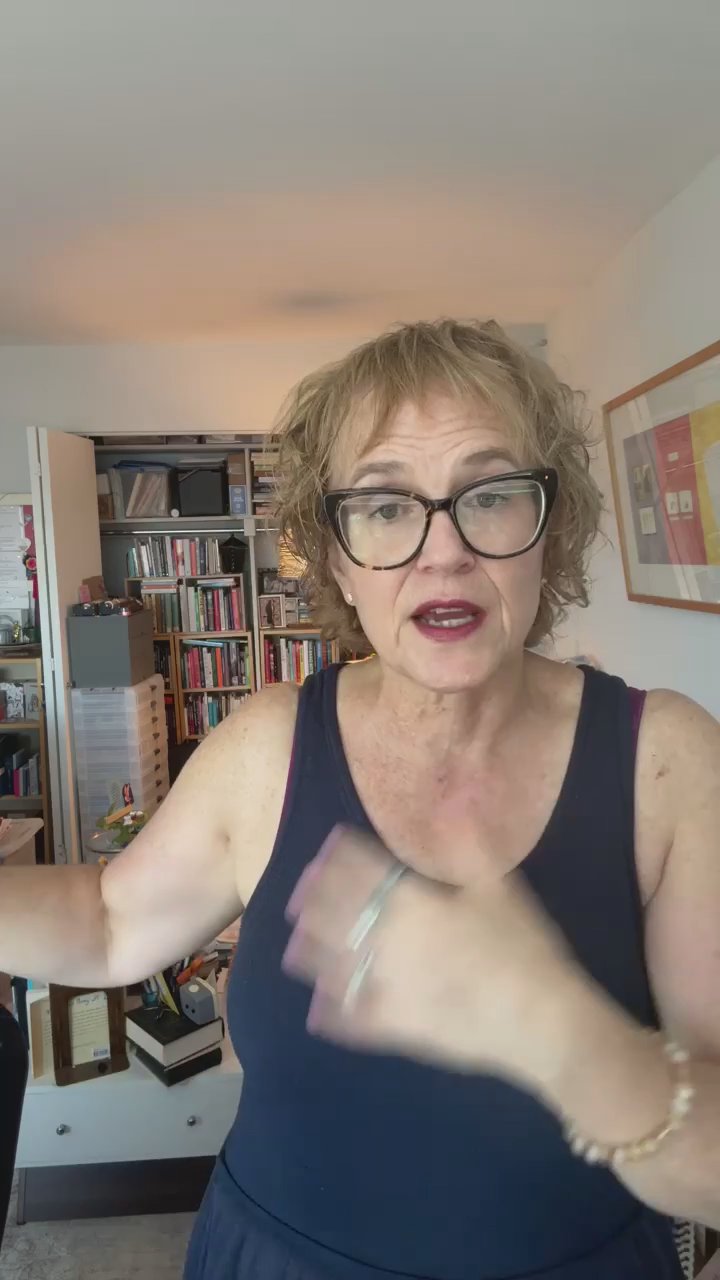
Thoughts about creating a life you want to live in, from someone who has had to do it herself.
The host opens the livestream, describes repeated technological issues and thanks the Cadre tech team, and names the talk 'Rules of Engagement.' This orients viewers to the session and establishes persistence as a theme.
She recounts experiencing anxiety since childhood linked to abuse and mentions diagnoses like PTSD and dysthymia to set context. This provides viewers with the personal background that shapes her approach to anxiety.
Using a Matrix metaphor, she describes the 'wedge' that allowed her to observe anxiety rather than be swept by it, and explains shifting from imagining worst-case futures to practicing pronoia—the belief the world is conspiring in her favor. Viewers learn the cognitive shift that created choice and opened up alternative responses.
She details writing down every way anxiety shows up, reading it to a sponsor, and posting the list to recognize early cues (e.g., withdrawal, repetitive food choices, hand‑wringing). The aim is not to dwell on causes but to notice signs early so one can regain mental control.
She urges treating immediate symptoms while continuing deeper healing work, notes anxiety often appears amid success, and outlines routines—spiritual practice, exercise, recovery meetings—as 'bumpers' that keep her functioning. These practical supports help prevent anxiety from overwhelming daily life.
She defines 'zest' as being positive and present, shares a zesty playlist and in‑the‑moment actions (noting that feeling follows action), uses the passenger metaphor for anxiety, and thanks the tech team before signing off. Viewers receive quick tactics to shift mood and a warm conclusion.
Okay, Cadre, I'm crossing my fingers that this works this week, that I actually, I have been bedeviled by technological issues, some chunk of them user error. And I'm hoping that we have fixed them with the help of the fine folks at Cadre. We'll see. We'll see. But here I am. This is Rules of Engagement. And I am ready to talk about some rules of engagement as pertains to my experience of anxiety. I saw some hearts, which means somebody is probably here. Hello, whoever you are, I'm glad you're here.
And I hope that we can see you. Hey, speak wonder. It has been a minute, speak wonder, but not for lack of trying. As I said, I have been bedeviled by technological issues. Like I did a whole live stream last week, but apparently no one can watch it. And then the weeks, two weeks, twice before that, I started, something went wrong, it stopped, I couldn't get it back. I mean, it was just a whole thing. I told the fine folks at Cadre that I was feeling a little cursed. But that August would be my time for renewal and refreshment with my experience at the last year on Cadre as well as my whole Cadre experience.
So here we are and you're here. So something's going right. Persistence. Persistence. One rule of engagement. For every problem there is a solution better than the one that did not work. Keep finding the solution to the problem. But today I want to talk about rules of engagement and anxiety. I talked a lot about anxiety last week in my live stream that did not go live. And I'm going to talk a little bit about my experience of anxiety and the things that I do around it that are in addition to any sort of intervention I've gotten from therapy or medicine.
Yes, the Cadre Tech team is amazing. They really are always working to make things better and they always deserve a round of applause. So I have had some form of anxiety, experienced anxiety since I was at least eight years old. That's when the abuse started in my life and I didn't know that's what it was. for years and years. I don't think any of my official diagnoses were actually anxiety. I have a diagnosis of PTSD, which makes sense to me, and dysthymia, which made sense to me at the time. It doesn't quite make as much sense now.
But I'm going to take these. I can see there's tons of reflection because I got all these windows right in front of me. Let's see if this is any better. And then It was a few years ago now, maybe three or four, when I realized this crucial insight that I had for other things but never applied to my experience of anxiety, which was this, that I was experiencing my anxiety as though it were real and true and I could in no way observe it. I couldn't observe it, I just experienced it as real. It's like air.
If you just breathe air, right, then you don't observe air, you just sort of walk around breathing it. I don't know what a better metaphor would be. I'll have to find one. But I couldn't I mean, it's a little bit like The Matrix, right? Everybody was just experiencing that reality as reality. And once he took the pill, and I hesitate to do that because it's taken on such political connotations, but the metaphor is such a good one. He could see, oh, there's a whole world behind this world that I'm experiencing.
And that was my experience with that anxiety. The second I had that thought, I just got a little emotional about it. The second I had that thought, that was the first wedge into my capacity to observe my anxiety and not just experience it. And all I need is the littlest wedge to understand that there is a difference between what my brain is telling me and what is possible beyond what my brain is telling me. That little wedge. And once I had that little wedge, I could start thinking, okay, then maybe there's a chance that there's something else I can do besides just being buffeted by the mean voices in my head and the unkindness and the, you know, dwelling, you know, sometimes people talk about dwelling in the wreckage of the past, you know, sitting around in the wreckage of my past.
Anxiety is sitting around dwelling in the wreckage of my future for the most part, sometimes the past, right? Because something embarrassing I did in third grade is one of the ways my anxiety likes to try to keep me safe. But dwelling in the wreckage of the future, anxiety through the course of this process, I'm going to tell you, anxiety for me is setting an intention for the worst possible outcome. And I realized at some point, if I'm going to set an intention, I might as well set an intention for the best possible outcome.
That me making up stuff about the future is just the things I make up that are bad are just as likely to come true as the things I make up that are good. And so what would I rather have going tumbling around my brain, but this practice of thinking making up positive futures, which takes a lot of practice on my part. My brain is very wired for these negative futures, as many human brains are. The idea is to keep us safe. But I adopted at the end of this, I worked the steps, which I've talked about here before.
I worked the steps on anxiety, which means at some point I had to decide that something bigger than I am was gonna help me with this, and that I decided that my spiritual principle around anxiety, well, no, that my spiritual principle, period, is pronoia, the belief that the world is conspiring in my favor. Everything is always working out for me. That if I'm gonna make up a future, I might as well make up a positive one, better than, oh, the world is conspiring for everything to turn out badly for me.
So pronoia, I've adopted that as my spiritual principle. One of the things I did, so there's two rules of engagement that I want to talk about regarding anxiety today. One of them is the lesson I learned because my anxiety, I did an inventory. I wrote down every single way my anxiety shows up. And then I read that out loud to my sponsor to a trusted person in recovery, every way that it showed up. And then I typed that list up and I have it on the wall because what I learned when I did that is that I could notice at that time, I noticed my anxiety active when it was really bad, when it got so bad that I just couldn't really function anymore.
And all of a sudden it's like, I'm just sitting here scrolling instead of doing what needs doing today. I am just sitting here reading this book that it doesn't ask very much of me instead of doing what needs doing today. There's a whole bunch of ways that freeze date shows up for me. But the freeze date was when I noticed that the anxiety was a problem. But once I wrote a list, which I have on the wall and I've added many, many things to since that initial inventory that I took, which reminds me I should probably read the rest of them to my sponsor too to make sure I'm not sitting alone with them.
Once I did that, I realized that the beginning of an anxiety decline has some aspects to it that I could notice when they started. I'll like, if I'm wringing my hands, I'm anxious. If what are some I'm looking at the I took it off the wall so I could look at this. What are some early ones? If I stop, if the urge to just stay in my house gets bigger than usual, there's sort of a baseline since leaving office. There's just this baseline of, oh, I just like to be at home because I had to leave the house.
I just was never home for so many years, and now I'm at sort of a balance. If my food choices start to vary a little bit, or stop varying, really, actually more to the point. If I really just want to eat the same thing every day, which is generally fine, my relationship with food is pretty fraught, but when the usual like 35 things that are options, that are the main options for me turn into like 10 things, or even 20 things, then it's like, oh, that's a sign for me that it's coming down the road.
And the goal for me is not to find out why I'm anxious. Oh no, why is my anxiety up? Here's what I've learned about that over the years. If I ask my brain to figure out why I'm anxious, my brain takes that opportunity to tell me all the reasons I should be. And that's not useful if I'm trying to get my attention out, if I'm trying to not act like anxiety is a good basis for decision making or a good guide for my day. And so the goal is not to find out why. The goal is to get my mind back. That is my goal.
Get my mind back, feel better, re-engage my ability to make choices, that are upward trend for me in my life. So what did you say? You had an epiphany in a similar way. You've all these years been experiencing your grief but not observing it and you've turned a corner. Your heart is ready to see your loss and peer at it with curiosity to learn from it. Exactly. Yes. Once I can observe something, once I can get any kind of critical distance on it, I can start making choices about it. If I'm just experiencing it as real, I have relinquished my ability to make choices about it.
If I experience my anxiety as real and inevitable and the things in my brain are true and oh my god, you know, I have relinquished my ability to make choices about it and I'll... and since my anxiety is so wound up in victim material, not just survivor material, but like victim material, it really kicks into gear. This feeling of I can't do it, I don't know how, which is one of the signs that my anxiety is gearing up is if I'm saying I can't do it, I don't know how, there's something I want, but I don't know how to do it.
Not in a, oh, I don't know how, let's figure it out, but in I don't know how, that's just not gonna happen. That is a sign that my anxiety is on the rise. It's on the rise. So rule of engagement number 39, treat the symptom, heal the wound. Treat the symptom, heal the wound. Because that's what I mean when I say I don't sit around trying to figure out why I'm anxious. That is a symptom of all the early hurts that I had. And I do a lot of healing work on the early negative experiences of my life.
A lot of healing work. right? And it's just, the anxiety is a byproduct of all of that and it shows up when it's going to show up. And I can usually, oh, right, usually right now my anxiety shows up when things are going very, very well and when I've really put myself out there. Those are two things that I know, oh, my anxiety is going to show up. And so now I'm figuring out as I'm taking these big swings, as I, you know, because I've got to I'm waiting on a contract for a book deal and on and on.
I've been taking these big swings and good things are happening. And I know that my anxiety is going to rise. And A, that's part of the price of admission for me at the moment. That's part of the price of admission for having a big, good life. But also, what can I put in place to make sure that it doesn't overwhelm me so much that I stop functioning. And that's where my daily habits come into play. my spiritual time in the morning, regularly working out, going to my recovery meetings, connecting with other people, on and on.
I have a whole list because I have my zesty list, but I also have my list of practices that keep me moving forward. I've referred to them and still do as the bumpers in the gutters on my bowling lane to keep my ball moving forward even when it's wobbly. Even if I don't hit a pin, at least I got to the end of the alley. So those are a couple rules of engagement that I've really, that really apply to how I exist next to my anxiety. That's one of the tools that I've incorporated recently is I imagine my anxiety is sitting next to me.
Like I'm driving and the anxiety is just sitting next to me. It's like you're a passenger in the car. I'm not trying to kick you out because it turns out the more critical distance I get from my anxiety, the more I realize it's a very young, person who is very upset all the time with very limited tools. And so I just, you are there, but I am, the grownup is driving today. The grownup is driving today to the best of my ability. It doesn't always work, so it can feel very overwhelming. So I'll end on this zesty list.
One of the things I learned for myself as I was doing the steps on anxiety was that to me, the opposite of anxiety is zest. that zest is being positive and present. To me, zest is being positive and being present. And that if I am neither of those things, I am anxious. And if I'm only one of those things, I'm struggling. But positive and present. And so I also have a zesty list on my wall that I, things for me, one column on the list is daily practices and habits I need in my life to keep myself in the best shape possible, like mentally.
And the other is things I can do in the moment when I notice that anxiety is on the ascension. What can I do to change my brain space like right now? I created a zesty playlist on my phone, songs that get me moving, among other things. And I've had to use those tools a lot lately. Part of what happens though when the anxiety really has a hold of me, especially if I'm so far gone, it's in the free state. I don't want to do those things. But because I don't feel them and then I have to remind myself feeling comes from action sometimes, it doesn't precede action.
It comes from action. It comes from action. So Those are the things I wanted to say about rules of engagement this week. I mean, I could go on about this forever because I've had to grapple with it for almost 50 years, going on 50 years, 49 years in September. So yeah, it's delightful to be here. Yes, your grief sits next to you. It's your companion and your teacher. My hope is that someday my anxiety decides to go to greener pastures and be the teacher and companion for someone who needs it more.
But until then, I mean, I invite it to transform itself in me and then go find the person who needs it more. But until then, yeah, it sits next to me. It sits next to me. So that's what I have for you this week, Cadre. It looks like things worked. Again, the wonder, speak wonder of The Cadre Tech folks, thank you, thank you for all the help, and I'll see you next week, Cadre. Look at us, we figured it out.