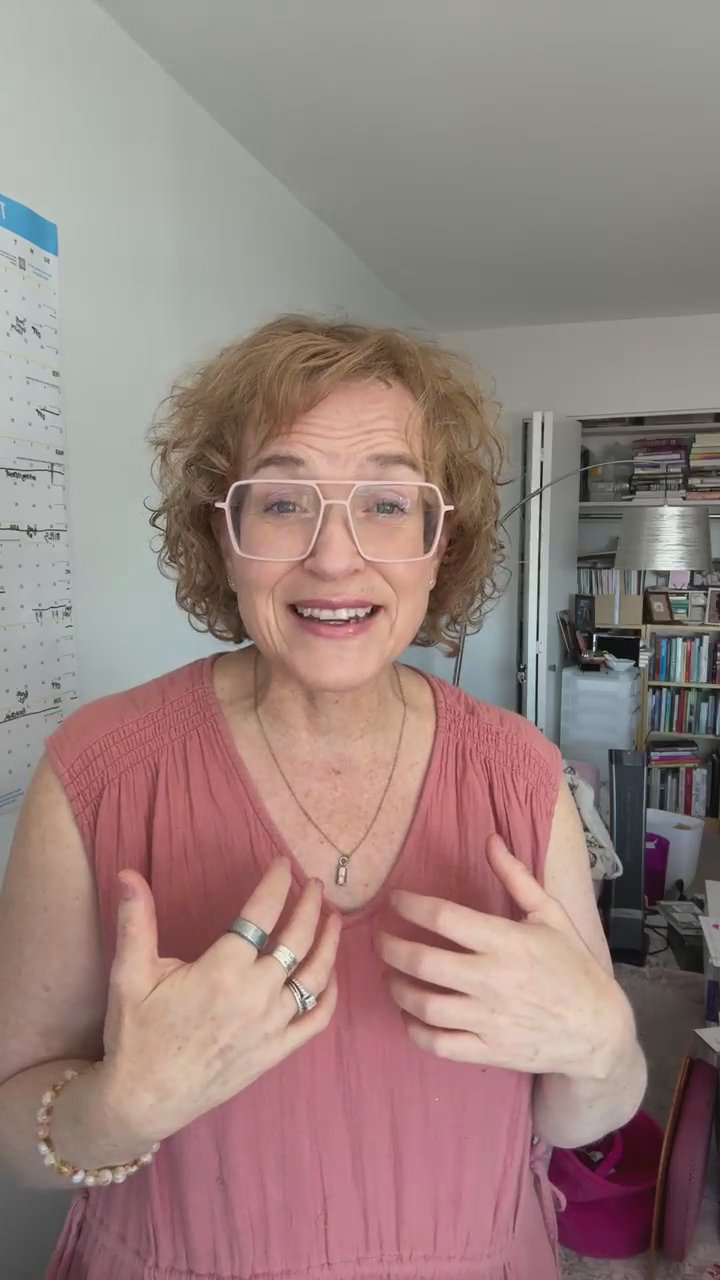
The speaker greets viewers, shares a bit about their morning (including new glasses and self-care choices), and introduces the subject they plan to explore: the skills of receiving good things.
The host explains their focus on learning to receive good things, recounts asking an AI for a skills list, and runs through initial receiving skills like allowance, tolerance for ease, completion, and somatic softening.
This section unpacks how to soften to positive experiences, avoid urgency or outcome-managing, and use noticing without control—illustrated by the speaker’s book contract negotiation as a real-world example.
The speaker reflects on how familial patterns (specifically their mother's publishing history) shaped discomfort with success, and explains how they worked to separate identity from outcomes to better accept positive developments.
Drawing on The Big Leap and personal anecdotes, the speaker describes the upper-limit problem and the added skills of tolerating active joy and consciously celebrating wins—ranging from small gestures to deliberate habit-forming celebrations.
Good morning, Cadre. Good morning. I hope that you are doing really well wherever you find yourself. I'm doing a little thinking and I'm at my standing desk and I've already had a morning I feel good about. That's one of the things I used. How do I feel good about it? Good morning, Ro. For the food that I eat, it's like food that I feel good about. And sometimes I feel good about food that is not particularly healthy because I enjoy it so much or whatever. But in general, food that I feel good about means food that is within my eating plan, not too much of it.
We heart you back, Ro. We heart you back. So welcome to Rules of Engagement, everybody. Welcome to my new glasses. Turns out I had a little HSA, health savings account. that I had forgotten about from my time at the city. So this year I could, I splurged on another pair of frames since my prescription had changed anyway. As my mother always said, don't mess around with your eyes. Take care of them. Take good care of them. Because if something's going a little bit wrong, it means it could go a lot wrong soon.
So What am I going to talk about today? Well, I have been working on receiving and becoming and the skills of receiving, becoming better at receiving good things. I am very skilled at receiving bad things. I have lots and lots of practice and I have lots and lots of skills I've honed over time and it was useful in my career as an elected official to be able to to respond well to negative things, to receive them well, to metabolize them, to take action on them. I am not as skilled at receiving good things, receiving them, metabolizing them, taking action on them.
And I've already talked a couple of times in here about what it turns out what happened was I just asked an AI, what are the skills of receiving? And it gave me the skills with, um, I'll have to go back and look at them because some of them had, uh, references or people that they were that the AI was citing. But I'll just run through them quickly here because today I'm going to talk about the ones that I have added myself as I've been working this practice. What do I think are the additional skills of receiving?
The good news is, for the most part, the ones that AI gave me are the ones that I'm not so great at, which include allowance, allow the good thing. Let's see, tolerance, I'm looking over there because I have them written on my whiteboard. Tolerance for ease, that it's okay if it's easy. I don't have to make it hard if it's being easy. I can just let it be easy. Completion, let it come to completion. If someone gives me a compliment, I can metabolize it and I can also say thank you. I can let the good thing come to me and metabolize it.
Somatic softening. This is a big one for me, allowing myself to soften rather than brace against something good that is coming my way. Because in the past, something good felt very threatening. It felt like risky because if I felt too good, I was at risk of showing what was going on with me. And that felt very risky for a variety of reasons. If people really knew the bad things that were happening, which I was more likely to show if I was being exuberant, then there would be consequences to that.
I understood that as a young person and that no longer serves me, but which is why, but I've continued practicing that until I realized, oh, I could practice something else. So here's what I'm doing. Non-urgency, if something good is happening and coming my way, it doesn't mean there's any urgency. It just means, you know, that's the somatic softening, that's the allowance. I don't have to make it urgent. and just because it feels urgent doesn't mean it is. Rule of engagement, feelings are a great data point but not a great guide to action.
Um noticing and noticing without managing the outcome. Like right now, as we speak, you know, my agent is negotiating a book contract with the publisher after six and a half years. I think I talked about it here last week, it's one of the reasons I've been practicing receiving that good news, but I don't have to manage the outcome. I know that sometimes contracts fall apart and it's okay. I can allow the good thing. I don't have to feel urgent about this good thing. I am softening into it. I actually feel when I do that, it's easier for me to sense.
I really do think that will be a good outcome and that I will have a signed contract and I'll get to write this book and share it with all of you and the world. but without managing the outcome, receiving without identity conflict, receiving without identity conflict. Those are the original seven that were named. I can think of myself as a person who gets a book deal and publishes a book with an actual publisher, and it doesn't have to conflict with my identity as a good daughter to my mother who passed away five and a half years ago.
She wrote books, fiction, and had a great agent, and people loved the book, but in the 70s and 80s, the market for really good, dense fiction books that were well researched about World War II was not big, and those books never got published by a publisher. My brother, a couple years ago, put the first one online, so you can actually buy it on Amazon if you want to take a look. It's called That Mad Game by AJ Hodges. Confession, I've never read it. But I had to do a lot of work over time about allowing myself to be successful as a published author in a world where that did not happen for my mother, where that never happened for my mother.
in the traditional publishing sense. That just didn't happen for my mother. And it's okay that it's happening for me. I think she would be delighted. I know that I am delighted and I actually don't have to take on her disappointment and live within it. So it's not an identity conflict of being a good daughter and a published author. I can receive, I can receive this. You see what I'm saying? So those are the original. What have I added on? Some of these I'm contemplating, one or two of them I feel very certain about.
One of them I feel very certain about that I have added is not only a tolerance for ease, but a tolerance for feeling actively good. If you have ever read the book The Big Leap, I'm looking right now to see if I can see it. Usually I have it very much to hand. It's on, oh, right here it is. If you have ever read The Big, oh, this is A Year of Living Consciously, also by Gay Hendricks, but The Big Leap should be around there somewhere. I won't point it up. The traditional cover has a goldfish leaping from one bowl to another.
One of the great gifts inside that book is the idea of the upper limit problem. This idea that all of us have a set point of how good we'll allow ourselves to feel, and if we get above it, we will engage in behaviors that bring us down to our set point. And there's a lot of other wisdom in that book, but that piece of wisdom has really struck with me. My friend Olga, years ago, this would have been 2018, 2016, pardon me. Anyway, when President Obama was leaving the White House, he had an event at the White House for something called My Brother's Keeper, which I had been a big champion of and had been very involved in and mayor from day one.
I helped a little bit, a little bit to shape the program. And I was invited to this farewell thing, knowing that it was going to transfer over. So this was 2016, that it was going to transfer over to President Trump. And As I was sitting there at some point in the afternoon, it's in this small little theater, Elias, who is still a friend, I met him when he was on the staff. He pokes his head out and he says, Mayor Hodges, would you come with me? And I was like, what's going on? It was near the end of the day.
I was like, should I bring my stuff? What's going on? And he just was like, Mayor Hodges, please come with me. And I immediately got a migraine. immediately because I understood why he was being low-key and what he was asking I was gonna have a clutch with the president of the United States Barack Obama who I had met and worked with you know I mean but I hadn't had that sort of solo one-on-one picture you can actually oh if my if we were in my other let's see that picture right there is the picture we took that day I immediately got a migraine.
And when I, and it was great, it was great to meet him. We had a nice conversation, et cetera, et cetera. But I told that to my friend Olga, and she was like, well, talk about an upper limit problem because one of the behaviors we'll engage in is physical illness, also bickering with our spouses, also worry, anxiety, those are the big ones. And I use anxiety very much as a tool to bring me down to my set point. So a tolerance for feeling good is, I've decided it's a receiving skill, receiving good things skill, because I really get to Lean into learning how to just feel good without feeling the threat, without breaking into all the other things, urgency, managing the outcome, identity conflict.
Those are all things I will use to bring myself down to my set point. So I really could not recommend the book The Big Leap more. It is one of the books that has transformed my life the most in my whole life. The other one that I know for sure I am adding to the skills of receiving are celebration. It's related to allowance, it's related to completion, it's a way to complete. It's related to tolerance for ease and feeling good, especially feeling good, is to just celebrate. This good thing has come my way.
Celebrate, even if it's little BJ Fogg, who wrote the book Tiny Habits, great book, he's very big on celebration. That celebration is one of the things that help us lock our habits into place, the habits that we choose for ourselves and lock them into place. And if I wanna lock into place my receiving, I've gotta celebrate everything, every time I receive something, right? And it's a little tricky because I'm always receiving something good right now. I can see a cat right there. I am receiving this happy window here.
Let's see if I can show you my cat in the window. Ta-da, there he is. There's my little buddy. I'm receiving that, so let's celebrate. It can be simple. That is how I often celebrate is that gesture right there. Y'all get to see the mess in my office. That's fine. I am. One of the things I celebrate is I am now so busy taking big swings and doing the work that is the result of the big swing that tidiness, which would be useful and I will find some time to do is not top of my mind. So those are the two I know.
Tolerance for feeling good and celebration because celebration first feels good. Two is warranted when I've received something big and three, it's fun. Fun is fun. So here are some others that I am considering. One is deciding and the other is asking. I don't know if these are receiving skills, these are sort of the pre-receiving skills. But I do know that there are things that I have decided, and I don't mean I'm controlling the outcome. What example do I want to give you? This book. I just decided when I started the book proposal that this book was somehow going to be published and in the world.
It just was. And I have faced many, many, many moments along the way where that seemed silly. Uh, it took two years to find an agent. I got, uh, I think I have a list, 36 or 38, you know, rejections from agents. I was running out of like agencies to approach and, um, rejection after rejection from publishers as well. Um, But I just decided one way or another, at some point I was going to say I will either break this up for parts and just write a whole series of articles that this book would have been, maybe I'll self-publish, but I got nothing to lose and I hit that point this spring.
I've got nothing to lose and somehow that, but I decided this is going to be out in the world and all of a sudden, all of a sudden, this offer came through. It had been sitting on her desk since the winter. She'd been on maternity leave and she just came back. Like, I don't know when, but she reached out a couple weeks after I had this moment of, all right, maybe it's not going to be published in a traditional way. Maybe I'll self-publish, but the ideas in it I have to get out there one way or another.
And here we go. So deciding is very important to me. I decide a lot of things in my life. And very few, some of them have just not happened. But I will tell you this, the fact, like if I've decided 10 things and like seven of them have happened, well, that's pretty important because usually those are the things that if I don't decide, I don't pursue. So deciding is a skill that's important to me. I don't know if it's a receiving skill or not, but I offer that to you. And then asking. One of my rules of engagement, rule of engagement number 28, you don't ask, you don't get.
That comes from politics. If I don't ask for your vote, I don't get your vote. If I don't ask for your financial support, I don't get your financial support. You don't ask, you don't get. And I'm taking 100 big swings right now on that principle. You don't ask, you don't get. It's hard to receive things I haven't asked for. It's not impossible because the world is generous and huge and things come out of nowhere. But if I'm not in this mode of asking, I can't be in a mode of reception either. Because this last year before I was like, oh, take 100 big swings or what have you.
I was not asking enough. And so I wasn't receiving as much as I am receiving now. And I'm getting nos, but it turns out I'm also getting yeses. So asking and deciding. I don't know if those are receiving skills, but I know they are skills that are important to me. The last couple that I'll talk about are also related to each other. I think they are receiving skills, but I'm still thinking about them. One of them is pay it forward. A skill of receiving is understanding that I get to pay forward the bounty that the world has given me.
It doesn't have to be, oh, if I'm given $50, I have to, if I'm given $50, I have to in turn give someone else $50. It could just be, I've been poured into by mentors my whole life. And I understand that part of receiving that is that because now there's just this overflow that I get to use that to support other people. It could be, out of nowhere, somebody sent me a book that was a great book that has made a difference to me from the same press. It was the same week that I got this book that had been languishing somewhere for six weeks because they sent it to the wrong address.
The same week that I got the offer from the press I'm talking to, I got a book from that press that had also been languishing for six weeks. It was very eerie. It was in a good way. But paying it forward, I think, is a skill of receiving. understanding, for me, the cycle continues, that give ebb and flow, ebb and flow, for me are sort of a spiritual concept of receiving. And then finally, generosity. That a spirit of generosity is a receiving skill. And I know that may seem counterintuitive, but my ability to be open to the world, to be able to give of what I've received, again, related to pay it forward, they may be the same thing.
But this idea of generosity and having a generous spirit with what I do have, rather than this mindset of loss and I have to hoard things and I have to keep them for myself, my little precious. I'm very good at that. But I think it's a receiving skill to also know how to be generous. I'll leave on this story about generosity. John Acuff, who I talk about here a lot, tells the story of He was giving a speech. And this couple who really admired him, they were talking outside the garage or something.
They pulled up with the with a Porsche, which is his dream car. And they said, hey, we're going to be out all night. Do you want to drive it until the morning? And he was like, You want me to drive your Porsche? And what they said to him, truncating the story, but what they said to him was, if we can't share it, has too much power over us. If we can't share it, has too much power over us, which I just find that story fascinating, this idea of generosity. If I can't share it, might have too much power over me.
So that's what I'm leaving you with. I'm still on the receiving, and you're getting a sense. This is how I operate. I sort of Find something, what is the next horizon for me where if I figured out how to do it, my whole life would be different and go better. And right now the horizon is if I knew, if I were more skilled at receiving, everything would go better. in my life. So that's why I'm on this kick and that's why you're hearing about it. So I am, as always, so delighted to be here with you, Cadre.
Thank you for sharing the time. Thank you for sharing the space. Thank you for the work you're doing in your life because it just puts every good thing out in the world. And I'll see you next week.