Helping you navigate minimalism and money and why having financial planning document is essential
And we're live Cadre. My evenings have been a little bit kerfuffled because last week was a bit of an overwhelming week. So little housekeeping items that we have to get fixed and dealt with. This is gonna be really brief. I'm still on my lunch hour.
Alexandre: I want to do a very brief wealth wisdom Wednesday for you. And it's about minimalism and money. Always pay your debts first. Do a for saving strategy. And then was this last piece is insurance or estate planning.
And we're live Cadre. My apologies for not being live on my last couple lives. Scheduling conflicts. I'm just gonna do the live right now. This is gonna be really brief. I'm still on my lunch hour. These tend to work the best for me. My evenings have been a little bit kerfuffled because last week was a bit of an overwhelming week. Me and my wife's. Our fence panel from our last windstorm that we had. Hey, Victor Frazier, how you doing? Our fence panel got like. So we gotta get that repaired. Our dishwasher went and our washing machine is on its last leg.
So little housekeeping items that we have to get fixed and dealt with. So the evenings have been taken up by that. But I want to do a very brief wealth wisdom Wednesday for you. And it's about minimalism and money. The reason why I say minimalism and money is because a lot of us, we might overcomplicate our financial planning or budgeting or whatever our financial goals are. We don't need to, we don't need to complicate it. We don't need to do more than we think. We can actually keep things very simple, very concrete and have an action plan.
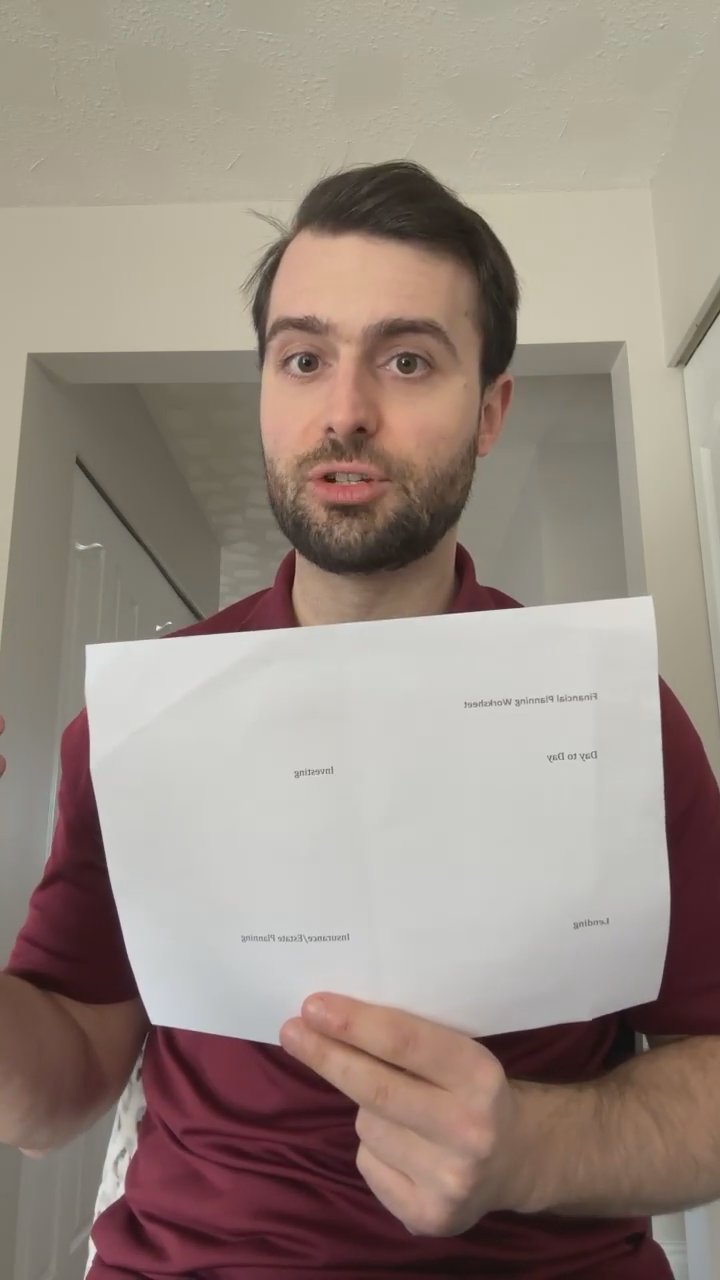
And the way that I do that, and I've done it with all of my clients as a formal financial advisor, I'm an insurance. Now this is just a financial planning worksheet. Right. I've got day to day banking. Right. That could be your, your oh, Cadre. Nice. Right on. I've got day to day banking which could be your checking account, savings account, etc. Or that or savings could go under investing. I've got an investing account that could be your tax free savings account, your RSPs registered retirement savings plans, 401ks.
If you're in the US lending says if you ever need to borrow money or credit cards, lines of credit, that kind of thing. And then was this last piece is insurance or estate planning. So the reason I say insurance or estate planning is because as we get older, if we're someone that doesn't have life insurance, that's an additional component of your financial plan. So you want to ensure that you have all these little pieces together as part of your holistic financial plan. Right. It's not just one thing that helps you accumulate wealth, it's a variety of different things.
Right? Making sure our debts are down, making sure our cash flow is healthy. Right? Because if our cash flow is not healthy, we're not going to be able to afford the things that we want. We're not going to be able to go on that vacation. We're not going to be able to pay down our credit cards, right. And my wife was always like, because I'm the banker in the relationship, she's always like, oh Alex, like what's our priority? What's our focus? And then we talk about it and I say, well we've got our credit card balance to pay off, right.
So I always go top down approach. I always go our day to day, right. Or lending what's our high interest debt? Pay your highest interest debt first so you don't accumulate any interest. Or if it's let's say a line of credit, for example, like we had to, me and my wife got a new fireplace and we had to put that on our line of credit because cash flow, right. Because it's more affordable to. It's like the minimum payments, only 2% of the balance every month. So you want to ensure that you're paying down your debts or you're managing the debt that you have very well.
Always pay your debts first. Do a for saving strategy. So Tristan, hey, welcome to the Live, thanks for tuning in. You always want to ensure that you're paying your debts first or your high interest debts. So that's credit cards, lines of credits, loans, right? Right off the top. Get those paid first. Second force saving or investing strategy. The easiest way to do that, if you work or you're self employed, create a 401k that you can invest in. Automate it, automate it every month, bi weekly, weekly, whatever works for your cash flow.
And an easy way to determine how much you can afford. Do. So about it's I think it's 50% to necessities, right? Like if we're talking about 100 of your money, 50 will go to living, 20 will go to bills or, or stuff like that. So 50 towards living. And that's food, that's utilities, that's all that stuff. That's 50% of the hundred percent. Another 20 to 25% or 30% for. Yeah, 25 to 30% for like wants and then do the four saving strategy for so what was that? 30 and then 20 for savings if you can. And if you can't do 20, cut that in half, do 10.
If you can't do 10, cut it in half, do 5 if you can't do 5 you're like oh man, I can't even do 5%. Do two and a half percent, half of five. So you got to start somewhere. It's the forced habit of automated savings or investing. And again, nowadays you can invest in mutual funds, stocks. There's a lot of free free commission, so no brokerage fees. When I first started to buy a share of stock, it was like $29 plus the share price. It was insanely expensive. So start small, save regularly, pay your debts first and create a financial plan.
And this is super basic. Anyone can do this. If you go to any bank, any credit union, you will be happy to know that they all are going to put are. If they're a good advisor, they're going to tell you we need to have a plan. And they're going to and they're going to Like I talked about my previous lives, the three levers of your financial plan that will be adapted to what your goals are, time, objective and risk. Hopefully enjoyed this live. Again, I can't do my live tonight and some other times when I have scheduling conflicts, so I just want to get it done now.
I'm going to shorten my live so it's more consistent. So most likely I might have to change my live so they're at around lunchtime because I feel like it can be a lot more consistent. So hopefully enjoy this live. Make yourself a little financial sheet. I use AI to create this. It created in a word, you can do it in Excel, whatever works for you. And I'm telling you it's a game changer and will help you with your tunnel vision towards your financial goals and living a financially minimalist lifestyle.
All right, thanks Cadre. This is your host Alex of the Mindset podcast. Also at mind-sep YouTube channel. I post all my content there which is lifestyle design, lifestyle hacks with helping you flex your mind, body and soul.