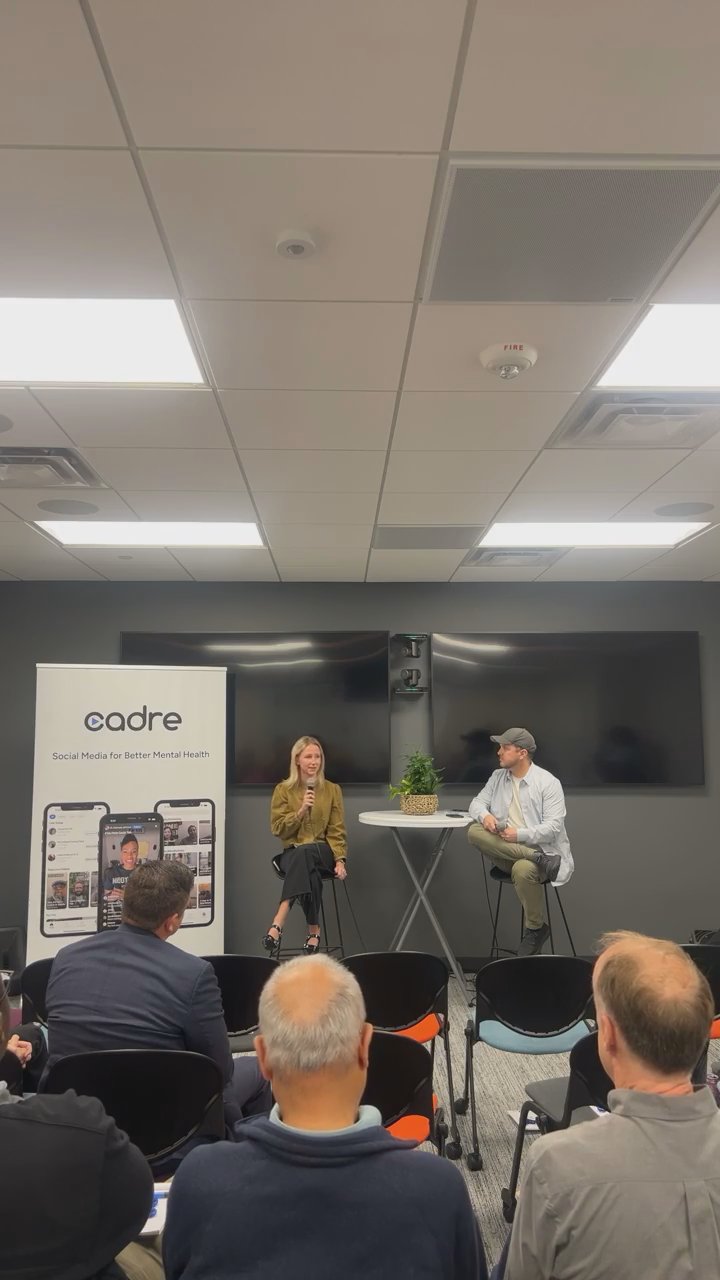
A conversation from Cadre founder Luke Wendlandt & TurnSignl Co-founder Myke Frelix on increasing access to support resources.
Murphy. We are an insurance brokerage. We do property casualty and employee benefits insurance. Today we have around 15 offices in twelve different states. Employees demand a lot from their employers. Creating a benefits program that is inclusive, is comprehensive is key.
Michael: How do you see, like you say, like, Cadre as a disruptor. What is that disruption actually doing for the people at the, you know, that we're serving with organizations. Treating the whole person that comes in to work for you every day is absolutely critical.
Turn signal was created in response to tragedy that we saw four years ago in Minnesota. The goal is to make sure that folks can really be safe in those interactions. Now we have an attorney that can actually advocate on behalf of that driver.
Turn signal is a platform that is truly inclusive of everyone. 33% of our user base today is white. Depression, loss, grief, being a caregiver, diversity, equity, inclusion, professional development. We've built from the community down.
"It's my job to make sure you two guys have an opportunity to continue to grow in this world, too, " he says. How can we build some level of normalcy with it? And we believe that can happen.
Both apps are built around creating space. Any time business becomes personal, I believe with all my heart it can innately become safe. For me, it's my job to echo the safety of their business to more than just Cadre world, the whole world.
When we built turn signal, it was one, we had a lot of conversation with law enforcement on the front. It's a five step vetting process before somebody would even have a content piece on our platform. We want to make sure that safety is at the forefront of what we're doing.
It takes a village to raise a child, but at the same time, sometimes that child can raise a village. We have to make sure that as we're going out into the world as leaders, organizations, we have to raise that child. I encourage you to figure a way to make this real tomorrow.
These are three questions that may be firing your brain. Nancy raised the idea of what is your opportunity in being open. Thirdly, history is important. Where do we move forward? Any questions? Hopes, worries? Fears? Concerns, desires before we break.
Upstairs you can go outside. If you want to pull some chairs around here, you do you 7th or 11th. Fill up the coffee cups. We'll be back in 15.
Murphy. We are an insurance brokerage. We do property casualty and employee benefits insurance. So partner, of course, with Roswell Shield in Minnesota as well as Cadre. So, you know, we started our office in Minnesota on the benefits side about five years ago through an acquisition of a property casualty insurance brokerage called CSDZ. So this is our space on the side, 7th floor. We have about 120 employees that sit here, 1200 across the country. So today I think we have around 15 offices in twelve different states.
So we are a national organization. I would say we make a ton of investments in real estate, as you can see. So we were in downtown Minneapolis over the summer. We moved to the west end, and it's been just a great experience. I think when you talk about workplace safety and just making sure that our employees have a collaborative space to work together to serve, serve our clients, really make an impact in our community, that's exactly why we moved here. So I'm glad all of you have gotten to enjoy it.
When I think about just employee benefits and how that fits into the broader conversation, a lot of employers know that their job is not just give their employees a paycheck, it's much more comprehensive than that. Employees demand a lot from their employers. And when you think about just creating a benefits program and strategy that is inclusive, is comprehensive, and is really, you know, a testament to their culture and investment that they make in their people, that's really the core of what we do at home.
Smurfy. I always tell my clients, if I'm just telling you that your benefits program looks great, no changes you need to make. There's nothing new happening in the market. I'm not doing my job bringing new ideas like Cadre and really market disruptors that are making a difference for employees and your people, their family members, that's really what we believe to be the most important role that we have in working with employer organizations. Awesome. Thanks, Annie. You know, and I wonder if this resonates with anyone else in the room.
You know, as someone who grew up out of the context of having the 40 hours a week job, the person who's been a coach consultant side of things, whenever I think of employee benefits, when I think of what hometown Murphy does, I. As that consumer or as that person go, that. How do you see, like you say, like, Cadre, as a disruptor turns to as a disruptor going like, what? What is that disruption actually doing for the people at the, you know, that we're. That we're serving with organizations. I think the difference that I see with a Cadre, and even, I would say Blue Cross, for example, is improving access to resources and support for your people.
And Cadre does that in a way that's very different. And I always use the term kind of that white glove level of service and care, truly, for your members. I would say Blue Cross, you think about just Coop Health and the accessibility to high quality healthcare that that product offers. Really focusing on how are you delivering on access, because, again, an employee looks at their company and says, I need help with X, Y, and Z. I'm not just a claims consultant or account manager at Holmes Murphy, but I'm a wife, I'm a mom.
I have needs outside of just, you know, being a performing and productive employee at this organization. So really kind of treating the whole person that comes in to work for you every day, I think, is absolutely critical. Awesome. And I think that's a perfect segue, right? The connectivity that people start seeing within the brands or the entities, even though they may not know all of the inner workings that they can go. There's. There's a name, a space, a community that I can find solace, that I can be seen, that I can be known in.
I think that's. That's the root of all these wonderful conversations today so far. So me and Annie will step on down, Luke and Mike will come up, and miss Shannon will facilitate the conversation of the mic. Look at the love between founders. We get it. So, Michael, one, it's always good to see you again. You are well blazered, as usual, but can you please. I had an opportunity to learn a little bit more about turn signal when you spoke at Angel Fest two years ago. And so just when you're talking about it from the concept of building, I mean, one of the fastest growing startups, and, like, I mean, you hit the ground running.
What was that like? So give us a little bit of the history of that, and we'll just kind of dovetail into how it works with other founders, like, this perspective, like we have over at Codrick. Good morning, everyone. Good morning. I'm getting over a little bit of a cold, so you'll have to bear with me. But I think as we think about our journey to turn signal, it started like, a lot of initiatives started, right? It was in response to tragedy that we saw four years ago in Minnesota. And so as we came together, we said, let's really first look at the problem.
And so we deep dive into the problem. We knew that there was disparities between how law enforcement really interacts with the community as a whole. And so we built turn signal as a platform to really help bring the temperature down during those interactions, to really humanize that, make those connections, and really give a voice to folks in situations that may not necessarily feel that their voice is being heard. That's why we wanted to put an attorney there in the driver's seat with our drivers, with our employees, with our sons, with our daughters.
And that's really what it was all about, is making sure that folks can really be safe in those interactions. And safety is going to be the bread of this emotional safety, physical safety. Turn signals is a platform to hopefully to really help make sure and maintain a high level of safety for the. So can we talk through how that interaction would look before turn signal was created and now how it can look if somebody utilizes turn signal in that interaction? Yeah. So when we think about a situation, I can actually draw from my own experiences.
Right? I grew up in St. Paul, and throughout college, I worked at so many times I worked at caribbean property, I worked at Macy, and I did a lot of commuting, and that was in between class. And I remember one particular instance where I'm driving to work, and I get pulled over, and the officer really, he was elevating that situation. He said, actually, I need you to step out of the vehicle. And I go, officer, why are you asking me to step out of the vehicle? Well, there was a robbery in the area, and you fit the description.
Right. It's the classic thing that we hear. And I said, you know what, officer? I'm just getting off work. I'm heading to class. You see my St. Thomas bumper sticker on the back of my car? And he goes, oh, my daughter stick. My. Going to St. Thomas. Right? And immediately we had that common thread. And thankfully, I had the ability to say, yeah, I'm going to school at St. Thomas. In the situation. He let me, you know, I went along my way, probably made it to class on time, maybe not. But now when we think about turn signal, I was able to advocate for myself.
Now we have an attorney that can actually advocate on behalf of that driver, specifically when we know their situation where folks really don't know, there's a lot of stress that's happening during those interactions. And so putting someone there is something, something that's really important to us because we want to make sure that we're creating the best possible outcomes of those interactions. And I wish I could say that that doesn't just happen. I've gotten pulled over just for somebody being nosy, too.
And I, and you know, I keep weird hours, so they're like, nothing else is going on. So let's go ask her some questions. I used to live in Eden Prairie, and then I just would be coming home, and they're like, that was back, you know, a long time ago when the Vikings were still there. Let's see what this lady's doing driving up an nothing. And they would barely make it back to the car until they walked back, you know? And the most interesting one, I think I did. I was on my way to speaking engagement in North Dakota.
So I was driving to Fargo, and there's nothing going on in the highway. I know I wasn't speeding. And I happen to be on the phone with my friend, who's former law enforcement as well. And so I see, I get. I get pulled over, and I'm like, okay. And so my friend, because he used to law enforcement, and he's also a person of color, starts panicking on my behalf. He's like, you call me the minute they drive away. I'm like, okay. And so I have this interaction, and it was really just a hey, nothing was going on on the highway.
I decided to pull her over conversation because it's like, hey, he's leaning in my car. He's asking me some questions on where I'm going. Ends up saying, well, I pulled you over for two things. One, I don't like your air freshener. It literally was barely a tag, and it was shaped like darth Vader. How scary. And the car window on your window is to your tent is too dark. So how did my window. Tent is too dark. How do you even see the black. Whatever. Nosy question of all the people that passed by, because I literally saw kias passing me, going faster than me that didn't get pulled over and had giant air fresheners swinging back and forth.
So I'm like, okay. And then I got back on the road and was mad, but I'm like, nope, stay calm. There's no point. You're out in the middle of nowhere. Don't start a ruckus. Just, they're like, well, I'm like, well, I bought my car in Minnesota. It should be legal. Well, they should have never sold it to you. Okay, you gotta, like, what else you gonna say? You know, kind of thing. But it would have been good to have somebody else. So again, like, I was able to advocate for myself. I know how to chill.
I really felt like he. He was in my car too deep, clearly stiff, just sniffing around, wondering to see if he found something, smelled something, doing something, and if not, he just happened to find this lady. I'm like, I'm literally about to go speak on cultural sensitivity, and you're up in my car. So if you don't think that this happens, it can happen to anybody. And as we've mentioned in other Cadre events, not only can it cause anxiety for that, but we work with neurodiverse optimists. We work with people that have a variety of different anxiety, and they can't always advocate for themselves the way that we do.
So if I know that I'm in that situation, how do I tap into terms of. So there's a lot of work that's being done. I think about cities like Brooklyn center, for example. Right? They're looking at changing some of the statutes around this. Precontection stops. Right. But there's a lot more work to be done in that space. And so, you know, when we think about turn signal and bringing this on, Shannon's right. I think a lot of people think about turn signal as an app that's just for people of color. They see three black men that founded this organization, and they draw a lot of lines.
And we did follow turn signal on the premise that we want to make sure that people of color want to make sure that black folks in general are safe. But however, we know that these issues are for everyone. Right? Everyone has these issues. In fact, we looked at some of our data. Thank you, Cree. Thank you. Damien put some of that together. 33% of our user base today is white. And actually, if I actually look at the number of times that folks actually press the button, a majority of those users are actually, are also white.
Right. And so this isn't just the black and white white thing. This is a platform that is truly inclusive of everyone, because that stress, that fear, that anxiety that comes with being on the road is prevalent. And it's real. Especially as a woman, I found it very impactful, too, as a woman, where I'm like, I don't want to feel like I'm alone in this situation. That's a good point. So while I grew up in St. Paul, I now traversed out into the suburbs of Minnesota. So I'm on Jaska. And even for my wife, like her having turn signal when she's coming back from an event, just being pulled over in an accident can just be in an unsettling proposition.
So for her to have access to it, if you go past the last exit, I don't know if you guys live on the West Metro 212 past my exit, England. There's not a light post or so just be in those situations to have someone there as that common presence is something that we're really excited that we're able to do for folks. Right. So when we were having these conversations and a lot of what we were talking about today was some legacy organizations like Bukata, so, and a startup. Well, now that you're building it, and we got a little piece of it from Nancy, when you're creating safety in yours as especially since they're both apps that speak about a variety of safety and creating safe spaces for the user base, was that important to you as you were building your organization and even the internal culture for you as well?
Absolutely, of course. But let's just take a step back real quick. Who here suffered from postpartum depression? Who here has lost somebody in the last year or two, substance abuse? Who here has lost somebody to cancer? Who here has struggled through their own grief and loss? Who here has anxiety? So we have about 75% so far that have raised their hand. And let me guess what you did. Who googled it? So we gotta google it, right? Maybe some other individuals went to a corporate website, blue cross blue shield, something along those lines.
And you probably had a lot of roads to nowhere. Couldn't find the answers, couldn't figure it out, couldn't go. Right. So that's why we built contract. There's a safe home for you to go for all the things, right? Depression, loss, grief, being a caregiver, diversity, equity, inclusion, professional development, all of the things that people are trying to find, there's now a home for, right? There's a home. And whether it's our live streaming, curated content, prerecorded content, you name it, to be able to support individuals through all those topical areas, consideration, we call them our big twelve, right?
And so as we continue to develop and grow and evolve, we've built from the community down. So again, speaking to the world in masses, whether live streams are prerecorded, ultimately breaking down the communities, why we're here, why we're here, why is because this is what people told us they want. And so let's develop it, let's build it, let's have this opportunity, right? And then last but not least is the one to one services, right. And our world typically blue cross blue shield. How does this, how does this usually look?
We flip that triangle over and somebody just tries to hop in and get the one to one service, which has cost us a s*** ton of money. We don't know if it's going to work, it's expensive. And last but not least, is the outcome. Is he going to be there? So why do we flip that triangle over and say, let's learn, let's evaluate, let's prevent, let's educate, let's start there? Because you never know. Doctor Charryse Johnson, based out of Charlotte, might just ring a bell for me. That might work, right?
Or that individual talking about professional development goals, outcomes you need, right? Or maybe someday the man over here on the right can be talking about dei stuff, right. And whatever that looks like for you. So you never know what somebody wants to come onto. But at the end of the day, it's all been fragmented in niches. And now we're app. There's thousands of apps. I mean, let me ask that, who has 30 or more apps on their phone? 50 or more apps on their phone? I see some hands still, right?
And we're apt out. And you know who else is act out? Holmes market. You know who else is act out? Blue Cross Bushiel. So that's why we're here, is to have one spot, a landing spot for y'all to land. It's not perfect yet. We're two and a half years in. But we're making it to get to the point where we believe there will be a central hub for everybody. And that's our goal. You can be safe. It can be no stigma. It can be this spot. You can land however you look, whatever you look, wherever you're from, you can say, there's somebody like me, talks like me, shows up like me, communicates like me.
And to me, I think that's half the battle in this world. So that's Cadre. But how do you build it? Everything's intentional. Everything's intentional. Mission, vision, values, you know, are words people like to say. And let me guess, blue cross, your organization. Our organization probably talk a lot about diversity or respect, right? But are we. Are we divorced? You know, I've been on a board of seven white teens. I don't want to do it again. I didn't learn much. I could have talked to my brother and got the same response.
But I want to set tables. The people that don't look like me, I want to be in rooms where there's four individuals, three individuals that are black, brown, one individual who's queer, and a white dude. I want to be there, and I want to build organizations that sit there, too. And I admire and respect, and I'm privileged to be here, and I know that, but it's my job to make sure you two guys have an opportunity to continue to grow in this world, too. It's a job of mine. Right. And I take that very seriously.
I mean that. Right. Your son growing up, right. All the things, like, we have all these things happening, and they're stressors, and our life is stressful. It's chaotic. But how can we build some level of normalcy with it? And we believe that can happen. So that's us when we're talking about the definition of safety, though, since that's key to both these. Creating a safe space. We hear that concept so often about creating safe spaces, and that to the point that I think it's gotten very watered down.
But literally, both of these apps are built around creating space. So how do you go. No, this literally has the ability to make you more safe and how you communicate that to people. I can take yours. Okay. Okay. You can try ours. Two and a half, three years ago, I reached out to your co founder, Jazz, and I just saw something on LinkedIn. I was like, holy s***. These guys are actually really trying to make a difference. It's not just about cash. It's not just about making a buck. It's not about the $4 app.
It's not about all that. It's like they actually really want to make an impact. So I reached out to jazz. I sat down, talked to jazz, and you get to know more. It's like, any time business becomes personal, I believe with all my heart it can innately become safe. It's personal to them. It's personal to a family. It's personal to people that they surround themselves with. Quite frankly, it's personal for me. Right. The conversation I had with other individuals when they come into Minnesota talking about apps, platforms, you name it, I always bring a turn signal.
Why? Because it's a conversation that, to be honest, I don't have to have with my kids. I don't. I get to talk about, you know, what. What's your grades and what. What, you know, sports. Do you want to play? I don't have to sit them down and say, well, oh, and by the way, this is how you have to participate in traffic stuff, right? That's not on my agenda, but it's on other individuals in this room and beyond that return signal and working with those folks. So, for me, it's my job to echo the safety of their business to more than just Cadre world, the whole world, because I think what they're doing is invaluable.
So I really mean that. Thank you. That's his answer. Let me try to replicate that. So, I actually remember when you reached out to jazz, and even back then, even before some of the platform, you gave us a platform to speak and talk and converse amongst each other. I remember it's actually one of the most fun interviews that I did, just jazz and I having a back and forth conversation. But that platform was the foundation of safety. Right. And so think about what Cadre is doing. They built a platform where folks can go in and have conversations around, really topics that in a lot of times are stigmatized.
And so, you know, when I think about Cadre, when I think about the work that you're doing, platform that you built to really drive home the fact that you're not alone in some of the things that you. There's safety in those numbers. And so echoing that, I love the work that you're doing. And before we move on to our next course of the day, one of the things I think is interesting and a good time for both of you is that it just disrupts the way that we use social media because we've seen situations where we have lots of people who are ad hoc mental wellness practitioners that are on all of our social media platforms, and some of them are great and some of them are not so helpful.
And that may be where you landed. And same thing, we've seen unfortunate situations where people like, I don't have anything to do right now in this situation, other to live livestream and to social media. And each of these platforms takes that conversation to a next, tangible, valuable step. So how was that process, as you were creating each of these, saying, well, we're going to take what was just being set out into the universe in social media, but then actually make it a value and provide a resource.
So how was that thought process for turn signal and then new contract? Yeah, when we built turn signal, it was one, we had a lot of conversation with law enforcement on the front, and we had conversations with Rondo. And one of the things actually, social media can actually make these interactions less safe. Right. You're pinpointing where locations are, telling people to come to the site. And some of the work that we did, it was being really intentional, because not only is our mission to get that driver home safe, our mission is to get law enforcement at the same time.
And so it was intentional for us to say, this isn't a record. The cops stream the cop platforms on social media. In fact, if I'm pulled over and I called my mom, she wouldn't know what to tell me about the situation. Right. And so, and not much up there. And so having an attorney there that actually knows the law, intimately knows the law in these situations can, again make our platform more safe, make our drivers more safe, make law enforcement more safe in those interactions. And so while social media is important for us to get the word out there, we want to make sure that, again, safety is at the forefront of what we're doing.
And so we don't actually distribute those interactions and we'll continue to make sure that that's the case. One of the very first questions we get every time with any company, association entity, school district, insurance company is always going to be the same thing. How would you vet? Right? And so it's a five step vetting process before somebody would even have a content piece on our platform, number one. Number two, any of the comments would go through the algorithm as well as a, a personal approval process, right.
So a human being actually sees a comment. So it's a little bit different. If you need the immediate dopamine rush cadres, not for you. It's not like the TikTok's available. Instagram is there. That's all yours. Go after it. Have at it. I wish you nothing but the best of luck. But for us, the vetting process is very important. Like I said, it's a five step process. Shannon, Ana, Colleen, JC can talk about that much better than I can. But also our live streaming content is from vetted peers and professionals.
Right? And so it's either individuals with lived teach experiences, etcetera. So, for example, Shannon, Nick, Hannah will come on the platform and say what she does on Thursdays, and she'll say, I am not a therapist. I'm an individual with a lived experience. And these are some opinions that I have through my own lived experience experiences or some things that you might take with you. Other individuals will come on the platform and say, my name is so and so, and I'm a licensed psychologist or psychiatrist.
And here's three steps in CBT, EBT, EMDR language, and all the other acronyms that I don't even know to begin with. But regardless, good information that gets shared. So somebody might lean into the right side, which is quote unquote, more tactical, and somebody might lean into the left, which be more practical for somebody, too. But we need to open the doors for all, and that's our job. But also keeping it safe, though, is vital because those questions do get asked. Do get asked right away. Like how do you vet, how do you make sure that the content is safe, that it's not going to be harmful, because if it's not, algorithms for good, we don't want to sign up for it.
Right. Before we move into our next one, I want to give you both chance to leave your closing words with our audiences today. Yeah. So I think, you know, in the context of safety, in the context of responsibility, this is one of my favorite phrases, and I've heard this from before, but, you know, it does, it takes a village to raise a child, but at the same time, sometimes that child can raise a village. Right. And so we want to make sure, we want to make sure that as we're going out into the world as leaders, organizations, we have to raise that child because that child is coming, is coming up and growing up fast, and they're going to make an impact on the world.
And it's our responsibility to make sure that they can live off their full potential. And the work that cadre's doing, the work that turn signals doing. Blue Cross, Lucille Holmes Murphy is just a part of. I was down in Atlanta, right outside Atlanta about a month ago, a little over a month ago. And has anybody heard of Mike Posner? Before I took a pill in a visa guy. Have you ever heard that song? So we had this intimate private concert with like two to 300 people. He was singing this song, just wrapped up.
It was this, it was called Running man, where you can just run as much as you want over a three day period. Amazing experience. So he just got done. He wrapped up his set and sitting there talking to everybody. And because everybody's going to be dispersing from there, right? And he said, for some people right now, this is a really hard moment. You just had three days. You've been on this hot san, a cold run. Like, he's like, it's fake. You're going to go back tomorrow and it's your normal life, your normal job, your work, your, all of it, whoever who's felt like that after vacation.
Right? And so what I encourage you to think about from this moment is how do you take this and not have it be fake? How do you take this and walk out today and implement this in real life that you can show up this way, you can try this way, and worst case scenario is just be yourself. Like, be yourself. And if somebody doesn't like that, well, shame on that. So I encourage you to figure a way to say, I'm going to try to make this real, and I'm going to make this real tomorrow. I'm going to make it a week from now, two weeks from now, a month from now, because a lot of people will have this amazing feeling, and then it stops and it ends in this room at 1201.
How do you get this going till 12:00? Okay, so that's my wish for you all. Well, thank you very much. No more throwing of yarn. Yarn. But, you know, as we think of the, you know, Mike's village raises the child, but we flip that, you know, the best thing that's going to happen out of today is you going, huh? I heard someone say something like, I threw up. I think every single one of our three speakers today quoted someone and they all said, I'm going to get it wrong, but as the best way to quote somebody because it's showing that there's an impact on you what they get.
So whether it. Eric Holder, you know, move from cowards to courageous. Paul Farmer, Nancy raised up all problems are born of humans desire to decide who matters. Rondo, I quoted you on saying it, but the leaders need to see the layers. Like how many fingerprints have brought you to that place of going. Here is the truth that I see from now until 1150, whether it's in small group, whether it's with the people that you came with, whether it's, hey, I sat next to this person. I want to be in conversation with someone else from now until 1150.
I like to say synthesize and contextualize. Take everything that you've gained today and go, huh? Here's how I understand it. Here's my cultural, linguistic reality. Here's my perspective, then contextualize it. Put it in the world that you're going to walk back into and say, here are the ripples of an 1150 will come back in. If there are questions that you want to raise up or conversation topics, that's what we'll do in that last ten minutes. This is really that time to. I think, you know, everybody who sat up here today would agree.
If you're going, and here's what I do now, then this has that through versus to. These are three questions that may be firing your brain. They may not be, but I put one from each of our three speakers. Nancy raised the idea of what is your opportunity in being open. So if you walk into the world and go, like, I'm going to be open to what's on the other side of that Alukata raised. You know, it's like, what is your community telling you? That answer is like, if we're actually doing something for rather than the messianic like I'm going to come in because I know what I have.
But if they're saying yo, hi, a, B and c, what do they say? And who is your they? And then thirdly, history is important. We need to accept it from that starting place. Where do we move forward? And again, who is your we? Is you standing alone on an island right now? Is we people who are put in the same bucket as you? Like, if we look at normal versus abnormal group assignments, are you in the normal? So you are get to be the individual. Are you the out of the normal? So you have to be representative of.
Right. All of those things. These may be prompts that fire your conversation. If not. 11th floor is open 15 minutes from now. Be right back here. Any questions? Hopes, worries? Fears? Concerns, desires before we break. Cool. Okay. Upstairs you can go outside. The patio won't lock you out. If you want to get some fresh air and let the city be your inspiration. If you want to pull some chairs around here, you do you 7th or 11th. Fill up the coffee cups. We'll be back in 15. Thank you.