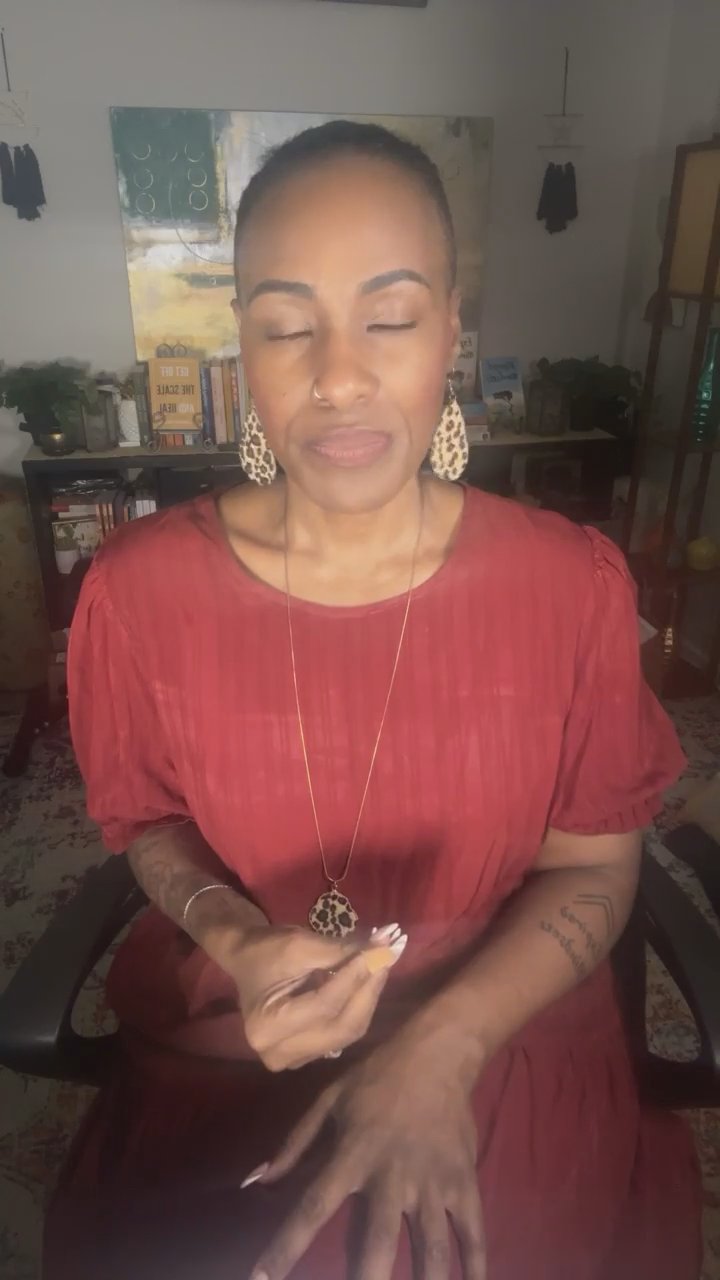
Dr. Charisse Johnson is a licensed clinical mental health therapist, mindfulness practitioner and author. Today is the anniversary of the death of her mother. Rate your week on a scale of 1 to 10. Speak Wonder from Eerie, pa. wants to talk about the difference between settling and accepting.
Dr. Charisse Johnson is a licensed clinical mental health therapist, mindfulness practitioner and author. Today is the anniversary of the death of her mother. We'll talk all things life, mental health, trauma, neuroscience, but through the lens of harmony, not balance.
Fuqua: Take a moment to somatically track soma, meaning body. Rate your week on a scale of 1 to 10. Where am I? How am I feeling? And what do I need for our focus of today.
Speak Wonder from Eerie, pa. wants to talk about the difference between settling and accepting. Do you view settling as a positive experience, or do you view it as a negative one? Where are you settling in an unhealthy or unhelpful way?
It's never too late for you to bring something up that really isn't resolved for you. Give yourself permission to go back and recommunicate what you need if you're willing to. You and work horizontally between you and other people. Be kind to yourself as much as you can.
Hello, Kaija Sphere. Good morning, good afternoon, or good evening, as I always say, because it depends on when you decide to show up and listen to this live. I would love for you to take a moment and let's start a little different. But first, if this is your first time here, welcome to Cadre. I'm Dr. Charisse Johnson, a licensed clinical mental health therapist, mindfulness practitioner and author. And I come into this space a few times a week so we can talk all things life, mental health, trauma, neuroscience, pretty much all things fit, but through the lens of harmony, not balance, if we're willing to do the work.
Come in. Let me know where you are in the world. It's so wonderful to see all of you as you desire, maybe give a little reaction just to send love into the atmosphere. Hello, New York. First one to chime in. What's up, upstate? Oh, I was wrong. South Carolina beat you to the punch. I'm gonna say good morning, North Carolina, because I always forget. But I've got to rep my state, of course. It feels good once again to be home. Hello from Philly. I love it. I love representing your geographic location and just having that constant reminder that we are all in life together.
So you may notice in me this morning or not, but you know, this is our space. Hello from Minnesota. My countenance is a little different. Today is the anniversary. It's the heavenly birthday, I should say, of my mother, who passed away when I was quite young. And no matter what I do. What's up, Jersey? Hello, Fuquay. Did I say that right? Fair. Quay. Give me, like a phonetic spelling. There's. It's always a little heavy and a little challenging, so I'm. I'm working to bring some pep. But also there's a little pep because I am excited to be here with you.
But there's also some sadness because I miss her so much. And it's just on me today, so I'm not going to talk about her too long so I don't start crying. Hello, Houston. But we come in, you tell me where you are. But what I'd also love is for you to rate your week on a scale of 1 to 10. How has your week been? And it's important that this is subjective to you, Fuqua. Thank you. And there is no judgment around where you are. It's just an opportunity for you to be honest. So two weeks ways that I actually want you to check in.
I want you to rate your week one to 10 so that you can see where am I and where do I Want to go? How do I want to land? How do I want to move forward? The other thing that I would encourage you to do is take a moment to somatically track soma, meaning body. Starting at the top of your head, just take a quick run through each vertebrae of your body, your forehead, your cheeks, your neck, shoulders, and just notice. Are there any messages that your body is trying to tell you about what it needs? Our mind can be in one place, our body can be in another.
That's not a bad thing. But it's important to listen to the messages that are coming through our emotions and also the messages that are coming through our body. And that's a really great analogy for what it means to be harmonious, is that we're listening to both. Now, if I rate my week, I would say it has been a three, but I'm good. You know, I know what's coming as I head into the rest of the week, and I am confident that it will end higher than it is right now. And my body is actually in a good place.
So that has given me life this morning. And those are just really quick ways for you to check in and go, where am I? How am I feeling? And what do I need for our focus of today. Hello, Speak Wonder from Eerie, pa. I want to talk about the difference between settling and accepting. I was having this conversation with a client, and I thought, this is a powerful conversation that can be confusing and challenging. When you're in a relationship, a situationship, a vocational dynamic, it's difficult to know, am I settling and is settling bad, or am I in a place of acceptance and how do you view them?
So first, I'm curious. When you think of settling, do you view that as something positive or negative? You tell me. I'm going to wait until we get a few responses because I'm not going to tell you what to think. This is all about you going like, hey, that's a good question. What do I believe about that? When you think of settling, just settling, do you view it as a positive experience, or do you view it as a negative one? All right, so far I'm seeing that most people say negative. Definitely negative.
If you've been around me for a while, you know that I love word etymology, defining things. So defining settling, Jules is saying, depends on the subject. Okay? So settling by definition means that you are reaching an agreement or resolution through negotiation and compromise. So by true definition, settling could be something helpful if. Right here's when you know that settling is a productive thing and therefore going to Be beneficial in your life and for your well being. When it includes a level of give and take.
When there is resolve versus escalation. So we're going to settle something so that we have resolve and it doesn't continue to escalate, then we're still in the place where settling is adaptive. If you're in a dynamic where everyone is not getting what they want, but both people are satisfied with what they are getting, then it's a good settlement. So essentially settling and whether or not it's adaptive or negative will depend on the context of the situation. But it's only going to be a positive experience for our well being.
When we feel like there's a give and take. It's not a matter of you've completely given up all the things that you desire for someone else. When it's not one sided question for reflection for you, this is personal reflection. You don't necessarily have to put this in the chat. Where are you settling in an unhealthy or unhelpful way? Where have you settled in an unhealthy, unhelpful way? And I want you to consider that that may not mean settling in a work situation or in a relationship. It could even mean within yourself.
Is there anywhere in your own personal life where you're like, I've settled and I'm not sure that it was the right thing to do for myself, or maybe you've given up and it hasn't proven to be as beneficial as you thought it would be. So then I want you to consider acceptance. I will go ahead and say here, acceptance is typically viewed as positive because of the world of radical acceptance. There can be moments where acceptance is helpful, but there can be moments where acceptance is harmful. For example, if you've accepted being treated a certain way that is damaging or degrading or toxic or harmful to you because you feel like, well, I can't change them and I can't do anything about it.
That is not a healthy level of acceptance. So by definition, acceptance, and this kind of blew me away because I've done work around acceptance, but not really looked into the word etymology. So by definition, acceptance acknowledges or agrees to something as it is without the need for negotiation. But it's characterized by passive agreement, which means sometimes, maybe many times, we accept things that we don't really want to accept. We passively agree to these things, but they still bother us.
Acceptance doesn't entail a level of compromise. So if we are accepting the wrong things, we lose in the process. So you have to know the difference between a good acceptance, something that you feel like, I'm okay if nothing ever changes here, and I still feel good about this choice, this decision, or this situation, or the kind of acceptance that is unhealthy because you've passively just stepped back and agreed to something that bothers you. Because maybe you feel like you don't have the energy, maybe you feel like that relationship or friendship is too difficult.
Whatever the case may be, here's one thing that you want to keep in mind. Whatever you choose to accept in yourself and in life as a protective factor of your mental well being, make sure that it actually brings you relief and resolution, that it does not create more negative emotions. Because true, healthy acceptance doesn't create negative emotions. It creates peace. When you accept something that you're like, every part of me is really okay with this, you have peace. But if you're accepting something in your life that bothers you and still eats at you, that's a problem.
And that's often one of those sneaky undertones that we don't realize that further creates unmet needs. Here's the other thing that I'll say when you've accepted something that may not be ideal for you is you may also be accepting it so that you can avoid deeper issues. I'm being a little tough today. I'm usually lighter in this space, but you're gonna be okay. Where have you accepted something that is unacceptable? Think about that for a moment, and that's personal. Where have you accepted something?
Or where are you even considering accepting something that if you really think about it, it's unacceptable? And yeah, I'm seeing some incredible shares in this chat where, you know, you might be recognizing that. Wait a minute. I actually kind of think some of the things that I have accepted are leaving me more with defeat. Yeah, Kelly, take a sip, girl. Take a sip. For those that don't know what that means, Sometimes when I say things that are like, ooh, I need a minute, we sip a tea or water, whatever.
Mine is over there right now off screen, but I will take a few sips. I think this is an important topic. Settling versus acceptance. We often automatically view settling as the bad guy, but sometimes settling is the greater compromise because it involves negotiation. If settling is done in the right way, if there's a give and take, we often convince ourselves that acceptance is incredible. But it's not. If you're accepting something at your own expense, if you are taking on the brunt, a decision of a choice of someone else's decision or a choice because you don't want to address a deeper issue that's going to impact your well being in really difficult ways.
All right, so I want to leave you with a few tools. Let's say that you're in a place where you're like, oh, I do recognize that I've settled for some things that are not helpful and harmful or you've recognized, yeah, I am accepting some things. I've considered accepting some things, past, present, potentially future that really aren't acceptable. I wouldn't encourage anyone else to accept this. Number one, the first thing that you want to do is identify and acknowledge the cost that you are experiencing to settling or accepting this unhealthy situation.
Identify the cost. That means I need to get you back into the reality of how it's impacting you versus the part of you that is just trying to be a good person and do the right thing at your own expense. So acknowledge that. Number two, I want you to identify, describe, be honest about what would be more ideal instead of passively, you know, accepting this, instead of settling for this the way it is without a give and take in a dream world, what would be a more ideal compromise or situation? Number three, where or how can you go back and recommunicate what you need if you're willing to?
Right. There are a lot of variables to this and some of this may be in a situation that you can, but if you can, I want to tell you today, it's never too late for you to go back and bring something up that really isn't resolved for you. We sometimes think, well, if you didn't catch it the first time, then I can't. That is not true. Anytime you get new insight around what you need for your own health and well being, give yourself permission to go back and go. You know, I know that we had a conversation on this and I've continued to give it some thought or I've noticed that it hasn't felt settled to me.
I'm not at peace with it. So here's what I want to say and communicate and let's bring this back to the table so that we can really both feel like there's some resolve. Because what I'm trying to make sure that you do or don't do is forego your own level of harmony to create it for someone else. That's not healthy and it will not make you feel well in the moment. You're like, I avoided this situation and I didn't want to deal with this or I Didn't want to say something that I really needed to say.
But if we talk about long term sustainable health and well being, give yourself permission to go back to the table now. Great question. Let's say, for example, you feel petty about readdressing it, do it anyway. Because what we don't want is we don't want you to invalidate something about this still bothers me. A healthy person will not only hear you, but understand you. Did you, did you pick that up? So if I genuinely care about you and you bring something up again, even if I'm like, but if I genuinely care about you, I will entertain the conversation, I will listen again and not just hear you, but I will work to understand you, you and you'll know that I understand you because I'm willing to change my actions.
If you share, communicate, take the risk to let someone know, I don't feel settled, I'm struggling to accept this. And they become defensive, they deflect, they project something onto you or make you feel bad. That's a level of unhealth in them. It does not mean that what you feel is wrong. So if for nothing else, communicate so that you don't invalidate your feelings and your needs. Because the last thing that we want to do is give other people permission to minimize our value, our worth, our needs and how we need to be treated.
But it starts with us. Today was a bit of a mouthful. This might be one that you want to kind of go back to. Just look at the settling part for a minute, then look at the acceptance part for a minute. Really take some time to identify, where am I settling? Where am I in a place of acceptance that is great and healthy and improving my well being? Where am I in a place of acceptance that's actually having a negative impact there? And don't just look horizontally between you and other people. You and work relationships also want you to look vertically, meaning take a look at yourself.
Because often we replicate what's happening within us in those horizontal relationships and then go back to those steps that I gave and see where you can take action. Where can you give yourself permission to take action in your life so that as you move forward, you feel heard, understood, and you are fully valuing and validating your own needs? All right. As you move forward from this time, know that you are an incredible individual. Be kind to yourself, rest as much as you need to. And as I look.
Thank you all for your comments for choosing to engage. And remember, what happens in this space stays in this space. Thank you. K19 oh, six. For that comment and for all those others. And I will see you very, very soon. Have a good one.