And why it’s costing you more than you think.
Hey, good to see you. I hope you are doing. Well, hello. CA MCNA. Haven't seen you in a while, but your presence is being felt. I'm definitely trying to do a better job at letting you all know. When I'm gonna be on and just popping on when it's authentic. And when it feels right, so good afternoon. To wherever you are. Good morning or good evening. If you're coming in at different times. This is your first time in this space. I'm Dr. Cherise Johnson. Sharice Johnson. I'm a licensed clinical mental health therapist, mindfulness practitioner, author.
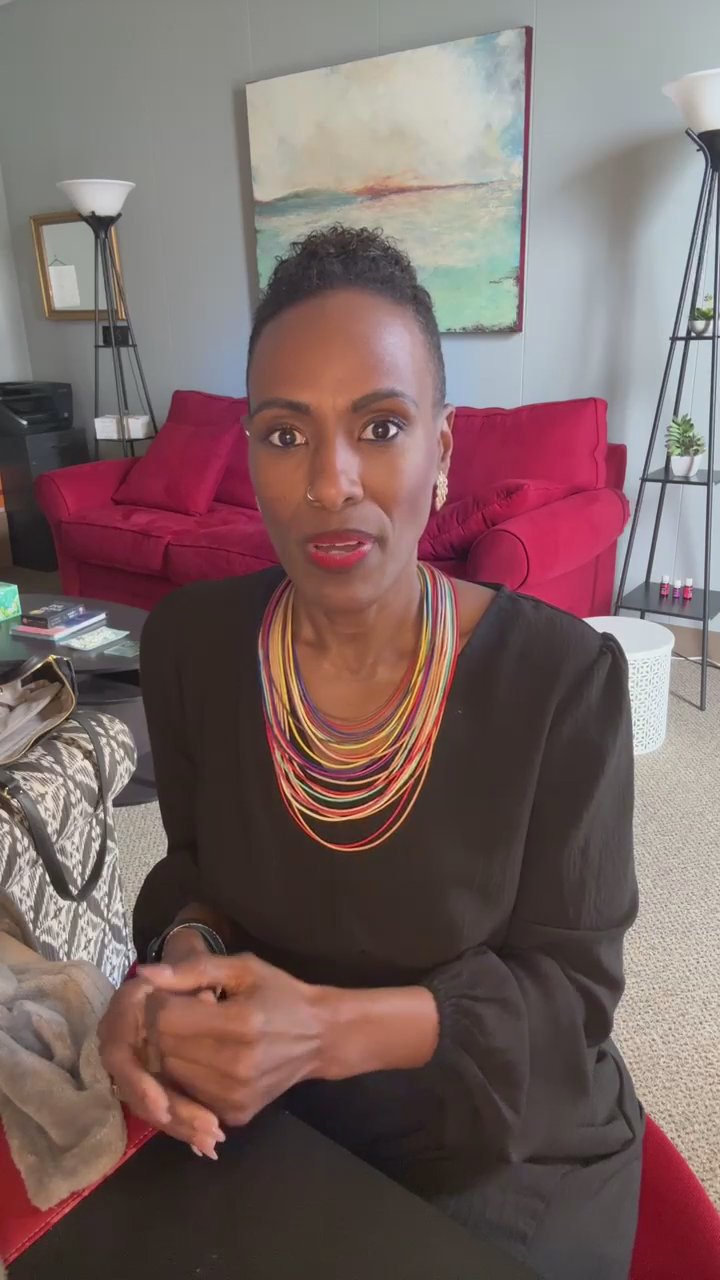
But. Most importantly, I'm a human, I'm a human, just like you who lives life. Goes through good days, bad days and everything in between. Usually when we come into the space. I encourage you to rate your weekend, even though it's only Tuesday. Please Rachel week on a scale of one to ten one, your week is working you you're not working your week. And 10 so far. You're doing the very best that you can given the context of your week. And then let me. Know where you are. I am here in Charlotte. In my office, one of my favorite places with my red couch and my red lips.
So let's get into the focus. Of today. I want us to spend a little time. We talked about boundaries the last time. I was on a few days ago, really thinking about. Being everything to everyone. So tell me, have you ever had. A moment. Maybe you've had multiple. Where you thought to yourself? I am so busy being everything to everyone. That I barely feel like I have time for myself. Oh, I love it. Nine Steph Irwin. Good to. See you I've said that to myself a million times, but then we kind of have to step.
Back and really go why do I continue to do that? What do I believe will happen if I don't do that? And how does being everything for everyone at the expense of myself. End up at some point, potentially being a challenge. So. Here's the opening quote. Every time you say yes to something that doesn't align. With your priorities you're saying no to something that does keyword in. That quote your priorities. If we are naturally those people that we place. Everything that we have to do. And everyone else before us, the challenges is that your priorities may not be on the.
List. So opening quote again, every time you say yes to something. That doesn't align with your. Priorities you're saying no to something that does. And here's why this. Matters and why it's so important. One of the greatest misconceptions about boundaries. Is that boundaries are about other people. So a lot of times we struggle because, oh, I don't wanna be mean or people. Say you're mean when you're trying to have a boundary, but. Boundaries are about stewardship. I want you to think about that.
They're about. Your energy, your emotions, your finances, your time. Et cetera, et cetera. Your energy can recover. Your emotions can actually regulate. Your finances. Finances can rebound, but the one. Resource that we never get back. Who knows what it is. I'm gonna wait. I'm gonna give it like 60, 30 to 60 seconds and see what is one. Resource that we all have. That we don't ever get back once it's gone. It's gone. I wanna see what you say. I'm playing internal jeopardy music. What's the one resource that we don't ever get back.
I'll tell you what it is. It's time. Every day. We, uh, of course Charlene, you got it. I love it. Unknowingly sometimes surrender hours of our lives through guilt. Obligation. Urgency people pleasing, poor planning. And the inability to disappoint others. And the result exhaustion. Resentment burnout. And for some of us a life that feels like. It belongs to everyone. Except you can I be honest in this moment. Sometimes I'll put things together and in the moment I'm like, oh yes, this is gonna be great.
And then in the moment I say I'm like, cool. I'm talking to myself, which is what I love about being in this space. So every day we. Unknowingly surrender hours of our lives. Through guilt obligation. Urgency making something more of a priority than it really. Has to be, or other people bringing it to us and making it feel like it's pressing. People pleasing, poor planning and the inability to disappoint others. So a time boundary. Is the decision. To treat yourself like something that you value.
Before. You give that away to someone else. All right. Quick neuroscience of time boundaries, cuz you know, I love my neural. Neuroscience when everything feels urgent your brain begins. Begins operating from a threat state. You'll feel that if you have a day, that's just too busy, you don't give. Yourself enough time. I will often talk to people. About meetings that they plan or just even giving themselves enough drive time. Um, I remember as I was. Raising kids and nieces and nephews, just them just.
Their pace. And I was like, you need to spread things out and give yourself more time because then you. Become hypervigilant. The amygdala. The fear center of the brain, the threat center of the brain. Becomes activated. And so instead of asking. Is this important, you end up asking how quickly. Can I make this discomfort go away? Or how quickly can I do this? You say yes. To a meeting? Yes. To the favor? Yes. To the. Call yes. To the project. Sure. I can pick them up. Sure. I can do all of these things.
And then every unnecessary. Yes. Becomes a future stressor. And so over time, your nervous system becomes. Becomes overloaded because you've committed. Your future self to more than your current self can realist. Realistically sustain. Now I'm gonna out myself here. If there are any other neuro divergence, listen. Listening. You're probably gonna resonate with this. I don't always do. Well, I know my yeses. I know how much time I have. And my heart can be so big that sometimes that pace is just.
A little too tight. There are moments where I look at a day and go. I took out some key breaks in order to fit something in because. This other person wasn't available. And I really needed to step back. Yep. Go ahead. Out yourself. Right. And say that time doesn't work for me, you know, but I'm trying to fit in all these things. That are valuable and I can become so focused in my brain as a neuro divergent. Is already going a million miles per hour. That as those requests are coming in, I'm not always filtering them well.
So one of the things. That I've learned to do. Is to not answer very quickly a yes. Or where I can to get other people to help. Manage parts of my schedule. I know we don't all have that. I haven't always had that. So. Don't get it twisted. But sometimes it's helpful to have even a friend or my sister. Go like, oh, this what I, you know, this is what I said, or I'm gonna fit this in here. And it's sometimes. So helpful for her to be like, girl. You cannot fit anything else into this day? Like you're done.
Shut it down, wrap it. And if you're a highly intelligent person, that may feel like it's a challenge as well, because you're like, oh, it won't take me that long. So here are seven signs that your time boundaries might need a little. Bit of work. Number one, you say yes before looking at your count loader. If you've. Done any of these, I need your honesty. Just, you know, raise your hand or give. Me your heart or be like me, it's me. Right. What happens in the car? Just fear stays in the car just sphere, but we gotta lean into the honesty.
So number one, you say yes before looking at your calendar. Number two recovery. Time is treated like free time. So you finally get an evening off. Then you fill it with calls. Aaron's favors texts. Obligations. Oh my goodness. I am reading my own mail today. Just the other day. I was like, oh, I have an off day. It wasn't wasn't calls text. Aaron's oh, let me go edit this. So rest gets gets sacrificed because it doesn't feel productive. And in reality, recovery is not optional maintenance. It's.
It's productive. You need actual rest days. And I will fully acknowledge. They're very difficult for me. On multiple layers, but I'm working on it. Number three, everyone else's emergency becomes yours. Yours now. I'm I'm I don't do that. If you do that, that's okay. But I'm, I'm pretty good about not making. Everyone else's emergencies, but there might be certain people in your life. That you will, kids. Nieces nephews, parents. There's people probably in your life somewhere that you're like, I don't do it with everybody, but with this.
Select group of people you'll drop everything. Yep. Okay. Number four, you feel guilty when you're unavailable? You know, you need rest, you know, you need space. But you feel selfish. Saying no. The witness, which one? Which one are you specifically bad with? I'm being, gimme the T. All right. So here's the reality. Guilt is not proof that you're doing something wrong. Sometimes it's. It's just evidence. You're doing something different. All right. Let me say those four again. Number. One was you say yes, bef before looking at your calendar, number two.
Recovery time is treated like free time. And you fill it up. Number three, all of 'em. Everyone else's emergency becomes yours. Number four, you feel guilty. When you're unavailable at number five. You answer messages, the moment they arrive. Your nervous system has been trained to react. Every notification feels like, okay, lemme respond to them real fast. Oh, lemme just do this real quick. Email notification comes through, you're working on something that. Would be helpful to focus on and you just pop it in.
All right. Accessibility is not the same thing as availability. You might be semi available, but that doesn't mean that everybody needs access to you. Immediately um, uh, your sister thinks it's because you were raised by a oh, well, it, it might be that is definitely possible. On a lot of ways. You know, depending upon the urgency for things. I'm gonna come back to that. Cause that is one that I Absolut. Absolutely wanna hit for a moment. Number six, you keep promising future time. You don't actually have.
Sure I can do that next week. Let's put something on the calendar. Um, absolutely. Meanwhile, next week is already overflowing and you know it. Yeah, no, that's real. When you have a. Presence in the house. Whether we diagnose them or not. That is very strong. And meeting their needs means safety. Validation or attention to name a few. That comes from those behaviors. Behaviors then it is really easy to be the person who you learn, how to be, what everyone needs and. You're kind of almost anxiously getting things done.
Because that might be the only way that you were praised. It might be the only way that you stayed safe. It might be the. Only time people said anything to you that was validating. And, and that sense of self-worth and yes, the guilt trips are awful. And, you know, here's the thing. If you've been in situations like that, depending upon how you've grown up. That guilt. Doesn't just come from what people say. It's internal. You are used to being the caretaker. You're used to being the one who kept everything.
Calm or maybe, you know, as a, a parentified child, the witness, as you're talking about. You learned, Hey, it's my responsibility to kind of keep everything safe. And so you. Fall into that habit, even though it might exhaust you. And then number seven, you have no white space on your calendar. Every hour has a purpose. Every day has a task. Every week is full. You leave no room for recovery, creativity. Reflection or unexpected life events. And so. Here's the hidden cost. Really not so hidden cost.
Of poor time boundaries. When we repeatedly violate our own time. Boundaries, which all of us have done. At some point three things happen. One resentment grows. Grows, you can begin feeling frustrated with people who simply. Accepted access to what you willingly used to give. You can resent being needed by people that at one point you actually. Wanted you're welcome the witness. Two relationships. Suffer you show up. But you're tired. You're distracted. You're impatient. You're emotionally depleted.
You're physically there, but you're presence. Isn't there. And three you lose yourself. So. Eventually you wake up. And you don't want anything to do with. Anyone anyone Ooh, Charlene C. Thank you for the list. I, I have my own little tick marks in here as I'm going through. And so part of what happens is it's not about time management. We all get the same 24 hours, seven days a week. Most of us don't necessarily need. Better time management. We need better. Permission management. We need permission to say, no, we need to give ourselves better permission.
To say, no, we need to give ourselves better permission to rest. We need to give ourselves better permission. To delay, we need to give ourselves permission to disappoint. People and not own that disappointment as a sign that we've necessarily. Done something wrong. All right. I wanna leave you with a little practical tool. That's called the gate. Framework. Yep. Time management versus permission management. We all have time. But it's what we're giving permission in that time. That is the challenge.
So we need to give ourselves. More permission to say no. To rest, to not be immediately available. To not take on the guilt. Of other individuals. Individuals and really work through, Hey, we're breaking. Into a, a different dynamic. And let me say this. It's hard. This sounds easy coming out of my mouth, but when you are the person that is used. To being everything. For everyone. And there's part of you that doesn't mind and part of you that fills valued. Valued and part of you that gets joy, but there's also part of you that is so.
Exhausted by that role. It is hard to break because then it's like, is this really allowed? Is this okay? You feel like you're doing something wrong. Other people are complaining. Because they're used to you being everything and. Yeah. Being a person is hard. You are not wrong. So gate framework. G before saying yes. Run every request that you're willing. To through gait, G a T E G goal. Does this align with my priorities? If I do this, if I say yes to this. Does it align with my priorities? A availability.
Do I genuinely have the time I'm gonna pause here. Yes, it can be painful. Yes, it can be heartbreaking. And it's it's often a necessary. Part of healing. Something within us. That has constantly over functioned. But it is. Absolutely painful. Like physically and emotionally painful even. Somewhat disorienting. Yes. And it is sometimes. A necessary part. Of us no longer. Showing up and you get to this other side. That feels like man, this feels great not to be carrying that anymore. This is way lighter who knew.
It could feel this way. So painful, heartbreaking. And there can be joy on the journey. As you get to the other side. So gate goal does this align with my priorities? A, Hey, this is an equal opportunity space. Say what you need to. Availability do I generally have the time. Tea. This is a big one. Is now the right season. So some opportunities. It's not that you don't wanna do them. It's just that this isn't the right season to do them. And then eat energy. Do I have the emotional. Physical and mental capacity.
Eight. And if the answer is no. Then the answer might need to be no. Or not right now. All right. I definitely encourage you to like rewind replay. That part and get it down and try it. Especially when you're faced with something that you would typically. Say yes to very quickly. All right. The strongest people are not the ones who carry everything and do everything and are everyth. Everything to everyone. They're the ones who know. Everything is not theirs to carry. I almost want you to know that.
If you don't remember anything else? In this moment. Everything is not yours to carry. Everything is not yours to fix. Even if you feel bad, even if it's uncomfortable. Even if you really wanna fix it all. You can't can't and just because someone wants. Access to your time. Doesn't mean that they're entitled to it. My encouragement to you is as you move from this live and you head into the rest of your day. And the rest of your week, where can you give yourself? Greater permission. To do what's best.
For you. Let me know how it goes. And as always, I'm glad that you came. Thanks for hopping in. And I'll be back Thursday morning. Have a good one.