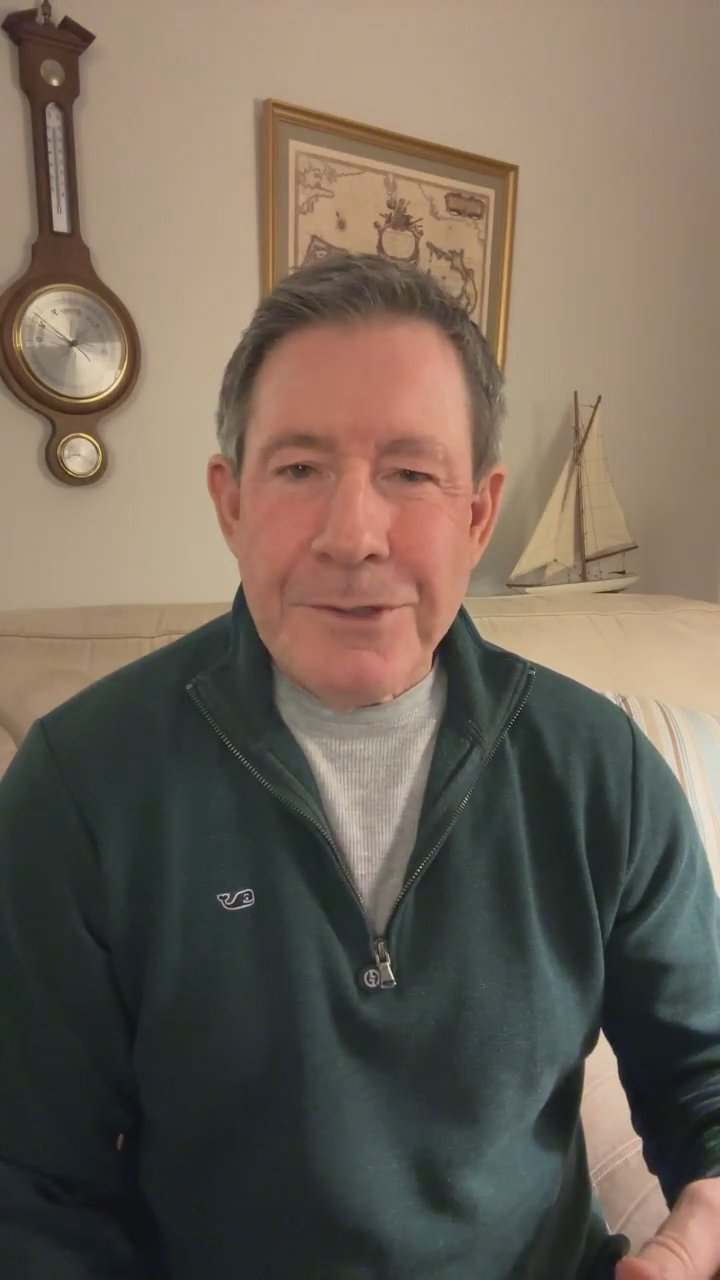
Today marks 50 years since the injury that changed my life. Please join me for this celebration of resilience: yours and mine. Live today (Nov. 8) at 5:15/4:15 to share stories, lessons, and encouragement for our journeys. "Pain may change your life — but resilience defines it."
Rick Cram here with a special edition of your Resilience Coaching Studio. This is the 50th anniversary of when I injured my knee. I'm marking this year by taking a positive, even making this a celebration of resilience. Would love for you to join me sometime.
This is the 50th anniversary of an injury which has changed my life. I'm going to go through a list of what resilience means as we take this anniversary. This evening on Zoom, we'll go live and have a discussion about what resilience looks like both today and moving forward.
The first one is resilience means strengthening your sense of self. Resilience means growing your agency, feeling that and being able to reinforce and even, let's call it sovereignty. Working on your resilience provides for each of us understanding your needs.
When we get a clear look at exactly our needs, that's another place to begin to say, all right, if that's what we need, how do we achieve that? Building your resilience does that.
The more we can understand someone, the more we've got to work with. When we're more resilient, we listen more carefully to ourselves and to others. The next is speaking of listening, listening deeper. These things go hand in hand.
This is the 50th anniversary of the injury to my left knee. It has meant 50 years of a lot of pain, seven surgeries and countless number of lessons. I'm celebrating today with this time to focus on celebrating your resilience and mine.
What does resilience mean to you? What one word or phrase comes out. Is there something in your life in the past or currently that you might be able to share? Let me know where you're from and I'll continue with this list.
Rick Cram: strengthening your resilience helps us make better decisions. One of the benefits of strengthening resilience is lowering the stress. Another is resilience means more purpose. Join Cram for a live broadcast on Zoom at 6 o' clock on Tuesday.
Resilience, more resilience and working on your resilience means more encouragement in three ways. It means that you have greater value to others because of the journey. Planning for future moments to plan for something that might happen down the road.
When we are resilient, we can strengthen natural, innate strengths and motivations. The further you are away from your source of hope, the less hope you have. On November 8th, the 50th anniversary of the injury that altered my life. I'll be going live on Live Zoom to talk about resilience.
Happy Saturday. Rick Cram here with a special edition of your Resilience Coaching Studio. I hope you're having a great Saturday as you join in and whether you're going to join for the live or watch this recording, what's kind of special about this edition is that this is the 50th anniversary of when I injured my knee with less than two minutes to go in the last game of my high school football career, the last game of the season, and took an injury to my left knee and then had three surgeries on that knee over the course of the next couple of years.
Three more surgeries later on in my mid late 30s in surgery number seven in 2019 which has left the knee in a state of trauma. And I'm marking this year, this anniversary, this 50th anniversary by taking a positive, even making this a celebration of resilience, yours and mine. It's good to be live on Cadre. As you may know, I've been going live on Zoom every the first and third Tuesday of each month doing your Resilience Coaching studio live on Zoom so that you can access it, of course, and join me as well as people from my community.
I've been emailing and going on social, inviting people and people are signing up and this, it's slowly growing and I'd love for you to join me sometime. I'll keep you posted on when they are, but it's good to be live on Cadre again. And what I'm going to do as part of this time together is go through a list of what resilience means as we take this 50th anniversary of an injury which has changed my life. Let me actually start by asking you a question. Is there something in particular that you've experienced or you're experiencing now that is really moving the needle on your resilience?
Is it impacting you in a profound way or is there something that you've experienced in the past which when the anniversary comes around, you might be approaching it and have this sense of trepidation such as I've had for some months leading up to this. I wasn't quite sure how to mark this, what I would actually feel up to since I'm living this trauma experience every day with blasts of instant agony dozens of times a day on my knee. What do I have the energy for but to turn this as a positive and let's think through what are what does resilience do for us?
And I've got a list and I'll ask you to reflect on each of these, I'll go through them all and then conclude this, but not before inviting you to as one more step to mark this day. This November 8th, I'll be live 6 Eastern, 5 Central. This evening on Zoom, we'll go live, we'll be face to face and we'll be able to have a discussion about what I'll be sharing with you now, as well as what resilience looks like both today and moving forward. It'll provide a source of sources, I'd say, of encouragement for you, as well as fuel for strengthening your own unique resilience.
Let's take a look at this list and I'll share with you. I'll go through each one, perhaps I'll comment just a little bit on each. But think through what resilience means to you. What do you get out of it? What does it do for you? Add any comments or contact me as you wish to let me know what what additional one word or phrases come to mind? The first one is resilience means, and this is how I started this Resilience means strengthening your sense of self. So many people, as a resilience coach and caregiver, caregiver now for 25, almost 25 years, often say, especially with the more significant changes in their lives or the more difficult and more painful things that they're experiencing, it's not uncommon to hear them say, I don't know really who I am anymore and I don't know what to do about it.
So when we work on strengthening our resilience, this is one of the places to really begin, is let's re anchor in who we are. What is good about you, what is true about you, what is unchangeable about you. That sets a foundation for also taking a look at our values and re establishing what's important to us because that becomes a guiding positive force and vision for strengthening your resilience. So strengthening your sense of self is one of the first things to do and one of the primary things that strengthening your resilience does for you means to you knowing your values.
As I just mentioned, that goes hand in hand with reinforcing your sense of self. Resilience means growing your agency, feeling that and being able to reinforce and even, let's call it sovereignty, being able to do what's best for yourself, even what's best for others, even with the pain that you might be experiencing, whether it's physical pain or mental stress or emotional distress, that increased sense of agency is one of the things that resilience and reinforcing and working on your resilience provides for each of us understanding your needs.
When was the last time someone asked you, what do you need? And even in this moment, what do you need? What is your answer? Or what are the variety of answers that you have for that? Certainly, for example, I need some kind of relief from now six years since the seventh surgery, I'm pursuing and turning over every possible stone that I can. The next thing I'll be trying is a spinal cord stimulator. Surgery is no longer an option. But what do you need? When we get a clear look at exactly our needs, that's another place to begin to say, all right, if that's what we need, how do we achieve that?
If I can't get. And certainly while I have this as a need in terms of a solution for my knee, I need other. A variety of other things to help me through the mental journey and the emotional journey, the spiritual journey, how this is affecting virtually every dimension of my life. So you can actually look at all of those dimensions, the social dimension, the environment, the work, the financial, and look at each one of those and ask yourself that question, what do you need? And then the thing to do is to bring that to someone who can help you, walk with you and find answers of saying, all right, if that's the need, where do we begin to fulfill that need?
Building your resilience does that. It helps do that. Understanding others. One of the key facets of understanding others is that the greater the understanding, the more you have to work with. If as someone in pain, the more I can understand others, the more I can understand how to navigate the relationships, how to communicate with them, how to understand what they're communicating to me. Have you ever noticed how people often will say the wrong thought, the wrong emotion out of goodness, out of trying to be helpful, out of trying to be encouraging?
But so often what they say doesn't land well. So the more I can understand when someone does say something that is everything from out of line to something that's just irrelevant or not their place to comment on knowing. Having to understand where they're coming from helps me react to whatever it is that they're saying. The more I can understand someone else in pain, the more I can understand the ways in which I can support them. There are different personality types, as you know, and I particularly focus on four different personality types.
There's a person that is process oriented, someone who is more socially inclined. There's the person who likes to be inspired and loves to inspire. There's the bottom line oriented person. And each one of those four comes with a variety of traits that when I understand which one of those someone might be leaning in, the better. I can actually understand how to best listen to them, how to best communicate with them, the way to connect with them and as much as possible be a caring, empathetic supporter.
And that understanding is actually something that never ends. The more we can actually seek to understand someone, the more we've got to work with, including how we listen to them and how we communicate. The next is speaking of listening, listening deeper. When we're more resilient, we listen more carefully to ourselves and to others. When we're more resilient, we are communicating better. Going to be repeating myself there, but these things go hand in hand. Being able to focus on what someone else is saying, knowing how to respond to them.
Welcome. I'm glad that you're here. I'm Rick Graham. Perhaps this is the first time that we're meeting and let me just recap where we're at this evening. This is the 50th anniversary, this November 8th, 50th anniversary of the injury to my left knee, which has meant 50 years of a lot of pain, seven surgeries and countless number of lessons, some of them very hard, all of them very important. But I'm celebrating today with this time to focus on celebrating your resilience and mine. This is a positive way for me to mark this very powerful, very emotional time.
And I'm going through a list of what resilience means. I'm the author of Plan to Be youe Best as yous Navigate Pain. And let me welcome you here. I'm coming to you from Metro Boston. I'm west of Boston by about half an hour. I believe this might be the first time we're meeting. Where are you located and what brings you here? One of the questions that I started off with is, is there something in your past? Just as I had this football injury 50 years ago and it's led to so much change in my life and it continues to drive more change.
And might there be something in your past or is there something you're experiencing now that is driving change and therefore challenging you, just as this has been challenging me day to day to drive positive change, which is basically one way of looking at resilience. Is there something in your life in the past or currently that you might be able to share, even as one word, or even just to say hello and let me know where you're from and I'll continue with this list of the top things that I as I was journaling about what resilience means means to me, and I'm curious to know what it might mean to you.
Perhaps that's one way to also begin is what does resilience mean to you? What one word or phrase comes comes out. For example I've gone through it means strengthening your sense of self. It means knowing your values, growing your agency, understanding needs of others, better understanding your own needs, listening deeper, communicating more clearly. This is one of the the next one I'll share with you is that strengthening your resilience helps us make better decisions. Part of One of the benefits of strengthening resilience is lowering the stress.
When we are stressed, it's harder to not only make decisions, but even before we get to decision making, thinking of options, of what we've got control over and can do that would be beneficial. One of the things that I share in my book that will be coming out next year is how pain has a potent and powerful way of hijacking our focus, sapping our energy and frustrating our hope. So part of the plan to be your best approach is to use the three steps of resilience to win back that focus, spark new positive energy by making some good choices and then being your best by taking action and helping to move forward.
These three steps, those three steps of resilience, are part of the process of making better decisions. We can make better ones when we are more calm and have control over our thoughts and the choices that we make. Another is resilience means more calm, less stress. Making decisions, thinking about options can can be stressful. But the more we can practice being in the moment we see the cortisol level, the stress hormone come down. That calm helps to create both a combination of a relaxed approach instead of that urgent frantic need that needs to be filled to be sure.
But if we can use our mindfulness techniques to be in the moment, we can actually plan to make better decisions for the now and for the future. More movement, less stuckness that that storm of thought and emotion that is so common when things are out of control. If I have sometimes it's a dozen to two dozen blasts of instant agony every day. That's my baseline. And I will experience this tempest, this storm of thought and emotion that can easily get me stuck. So I'll even use the three steps of resilience to win back that focus in that energy.
Even movement in terms of physical movement has been a very key part of my pain management approach. And being more resilient the more I move and I try to work out almost every day on the total gym machine that Chuck Norris inspired me to get after I had a chance to work out with him many years ago. I work out. And when I'm working out, when I'm moving, the greater the resistance, the more I'm breathing, the more I'm focusing on the reps. And that is creating a pattern of resilience that is very beneficial.
Another is resilience means more purpose. Purpose has become. And having identified a mission, my purpose in life and putting life and breath into it has been beyond words. How important that is to navigating the challenges that face, the more that I actually do, such as being with you here on Cadre, this is actually creating energy for me and for my resilience. If you know your purpose, then you know the energy that comes from just identifying that. And then as you chase it, as you put life and breath into it, you know the energy that comes from that.
I'm so glad you're here. If you wouldn't mind letting me know if you're still here with me. And I'm going to keep on going. And I'll again offer this invitation to join me in half an hour at 6 o' clock on a free Zoom. So we'll be face to face. com, you'll see it at the very top, how we're getting together face to face. Excuse me, live on Zoom. And it will be going live on YouTube at the same time to have a conversation about this very list, as well as taking a look at some of the techniques from plan to be your best to the point where you're able to say I got cut off and kicked out.
Was it something that I said? But I believe I'm back. This might be a continuation or a separate recording or a separate live stream. If you're joining me, I'll just do a really quick recap. Hi, I'm Rick Cram. This is a special edition of your Resilience coaching studio. I've been with Cadre since June, I believe, and just so glad to be a part of the community. I get such an opportunity to meet wonderful people such as you. And what I'm doing today is celebrating resilience because this is the 50th anniversary of the injury that I took to my left knee, which meant three surgeries in my teens, three more surgeries in my 30s, and then surgery number seven in 2019, which has left the knee in a state of trauma.
And I deal with that every day, looking still for more possibilities that can give me relief. Surgery for the first time in my life after that one, in 2019, surgery is no longer an option, but being resilient is. And that's what we're talking about. We're celebrating 50 years of resilience, yours and mine. Let me continue with the list of what resilience means. The next one that I'll go to is the last one I was talking about when the connection got lost was Resilience means more purpose. Resilience, more resilience and working on your resilience means more encouragement in three ways.
Going through the plan to be your best method, you'll find that there are numerous opportunities throughout it. In fact, it becomes a perpetual part of your your life and and the life and your living resilience. I do believe that your resilience and mind is alive. It needs energy like anything else that's alive. It needs to keep growing to survive and plan to be your best. As you navigate pain does that for your unique resilience in your own way. It helps you grow it, strengthen it. And the approach is designed as a whole person approach to grow with you.
So when it comes to encouragement, that is an integral part of the plan to be your best approach. Where you find new ways to encourage yourself. You find how others can encourage you and how to receive that encouragement in a way that you get more energy out of it. Also, as you encourage others, you begin to experience more and more of the goodness that flows right back to you. So resilience and strengthened resilience means more encouragement. It means that you have greater value to others because of the journey.
Whatever challenge, whatever adversity you've gone through, you've grown through or perhaps that you're going through now. Even though at times you might very well seem as if. And a lot of people shared with me how they sense that their value is lessened because of how much pain they're in, how much suffering they are. But the reality is that you have more value because of it. You'll become more and more uniquely qualified to be more encouraging to others and to be able to help others, especially as they understand what you've been through.
Your degree of empathy and compassion is greater, is greater, and therefore you have greater value. Just a few more Resilience means better planning. Planning I found in while I believe in and I've got a plan to be my best. My plan even though I deal with a tremendous amount of pain, enough so that I don't have words for it. I've got a plan. And that gives me the ability to say, even with the pain, that my best days are ahead of me. There are certain techniques that we use when we go through the plan to be your best approach, to be able to maximize our ability to actually enjoy making it a positive experience of planning.
You might plan in your own certain way, as each of us do, but when we find that we work with each other and how we go about doing that, understanding the way each of us go about planning, we find that there is new energy and resilience and confidence that comes from that. There's planning sometimes for the very next moment. How do I rebound and be resilient from being perhaps knocked down in some shape or form, being in the pit, being depressed, grieving, and so forth. But there's also planning for future moments to plan for something that might happen down the road.
Going to see different doctors, for example, has become a very difficult and emotional time. Going, going in and being honest with doctors and talking about things that I thought I'd never talk about with a doctor, telling them what I'm experiencing is extremely difficult. I'll be honest with you. I've been sharing with the doctors for the past couple of years, especially as I see a new doctor. Something that's very hard to admit, but I think it's important that I do, and that is that I'm desperate.
Being in so much pain that I am every day, there is this desperation for relief. What would it be like if you. Well, I won't go there. I was going to say, if you were dealing with dozens of shots of agony every day. It's a natural human response to get to a point where there is this desperation. There is such an urgency. And it's important to actually acknowledge that I believe and share it. It's not easy. It's not easy. The doctors, I share that with them so that they understand me more. They understand how I'm reacting to some of the things that they're saying, how I'm sharing with them a variety of aspects of my journey, hoping that they might both have be able to extend to me something that I need greatly, and that is the understanding of others and compassion and empathy that leads to working together to find solutions.
A few more. I think I'll share two more. Greater stability. When we are resilient, when we're strengthening our resilience with the understanding that there is no perfection in resilience, just like there is no perfection in pain management. There's no perfection in much of life is there? But when we are working on being able to strengthen natural, innate strengths and motivations, we find that there is a greater stability. Part of it comes from actually living out that sense of purpose that I was referring to in the previous recording.
That stability comes from identifying those things that we add to our resilience toolkit. Those things that we know we can count on, including such as we've talked about numerous times over the past several months. And that is the idea and the power of having an attitude of gratitude. Get a shot of pain and one of the most effective and consistently thoroughly helpful thing. Next thing to choose and do is to be thankful for something and to focus on it. Lastly, resilience means more hope. There is such a thing as that.
I've heard that the further you are away from your source of hope, the less hope you have. I know what that's like. And one of the reasons why this is a key part of A Plan to Be youe Best Approach is that we can realize how each of us are wonderful, powerful sources of hope. You are one of your greatest sources of hope. I am one of my greatest sources of hope. I have others, a few that I would even say are more powerful, including my faith. My faith provides a source of hope. But within you and within me are innate strengths and innate qualities to be able to take a look at what we're experiencing, understanding how our unique resilience works, how we can strengthen it.
And there's hope in that. There is an innate ability in you to be your best, which is certainly a key and foundational aspect to being able to be resilient. You've got strengths. Even though you might feel exhausted. You might wonder if you've got any strengths left. But it is that exhaustion that makes us feel that way when it's helpful to remember that. And I'll conclude with this, that your strengths are there. They may be tired, they may be exhausted, but they are there. They need to be fed.
And they are fed through conversation. They are fed through the steps that we take when we go through the plan to be your best approach and can keep going back to these steps, including what I call the eight Paths of Intentionality. To remember the that those strengths are there. Even to the point where we might say I need to find those strengths. But then remember and realize the strengths are there. We don't need to look very far. We can look so close and we get to the point where we see it there day to day.
Help each other walk through the challenges and the adversity together to the point where you can even say, my best is greater than the pain. I wish you well. Thank you for joining me on this. If you're watching the recording, please do comment. I'll answer all of your comments. Reach out to me. com and you'll learn more about the resilience coaching studio that I'm doing now on Live Zoom. I'll be going live in just about 15 minutes at the top of the hour, 6 o', clock, 5 central, on this November 8th, the 50th anniversary of the injury that altered my life.
But more than setting me on a path of pain these past 50 years, it's been a path of resilience that's brought me to you. And I think that's worth celebrating. Thank you so much, and take good care.