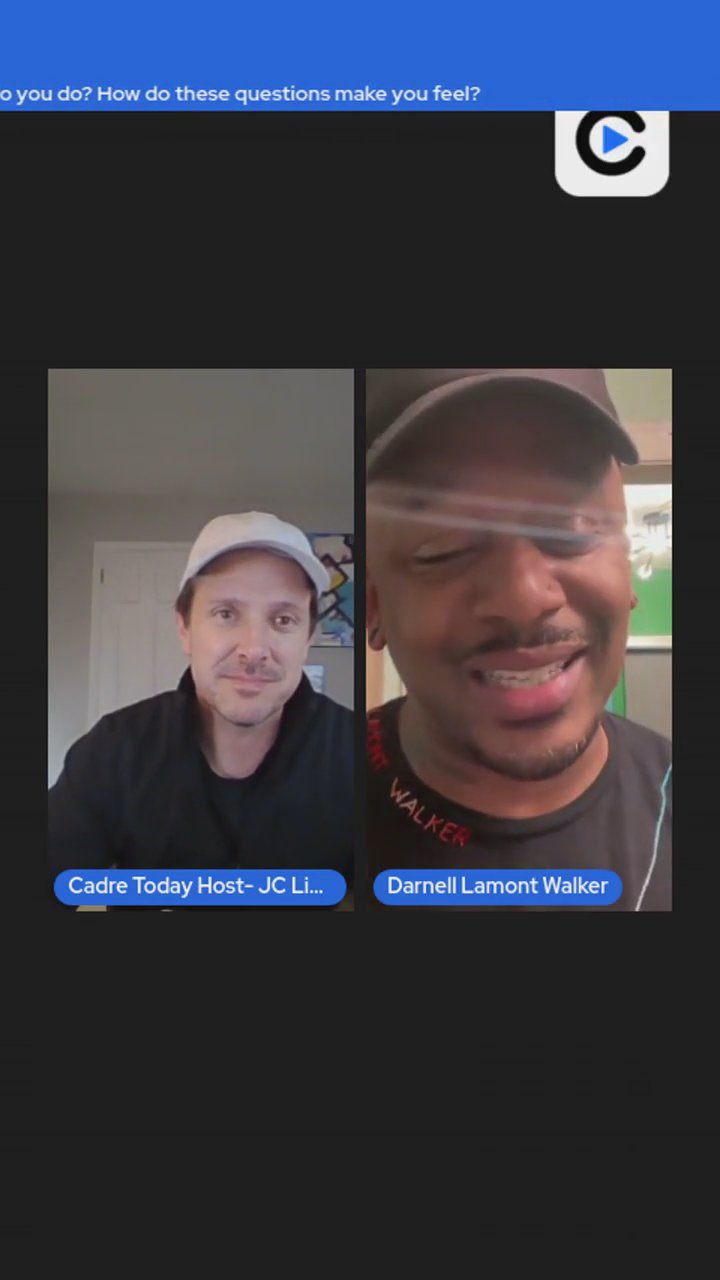
If you're not doing great, know that that is okay, too. Cadre is always the place where there's many ways to be. Conversation is a power vessel and vehicle for people to connect. If you're listening at home, feel free to steer the conversation where you wish.
Cadre: How are you doing on this Monday afternoon, Darnell? If you're not doing great, know that that is okay, too. Cadre is always the place where there's many ways to be.
Cadre Today interviews one of our newest contributors, Darnell. Conversation is a power vessel and vehicle for people to connect. If you're listening at home, feel free to steer the conversation where you wish.
Darnell: Who are you? What do you do, and how do these questions make you feel whenever you're asked them? Mike: Sometimes the technical dance happens, and we can chuckle our way through it. The Monday is happening, y'all, every once in a while.
Darnell Lamont Walker is a death doula and children's television writer. He says any conversation he can bring back to death is a good conversation for him. Walker also facilitates storytelling workshops to help people tell their story.
Darnell: I'd love to talk about creating life practices that reduce burnout. I'm a huge fan of journaling. I think the world runs on creativity. As a death doula and as a writer, I think it's very important to have something that helps that transition.
How would you encourage people to find the confidence to write their own story, to be their own protagonist? Darnell: One of the things I start with as a writer is that we have to start affirming ourselves. Then you have to let the audacity kick in and say, oh, I'm just going to do it anyway.
Darnell: One of the takeaways I want everyone to take away is. Just have the audacity to. If it takes collaboration, lean into that. As a death duel, I think it's important to kind of name what's dying in you.
Darnell: For Cadre, I don't have scheduled posts yet, but I'm planning on it in the next two weeks. I'm always writing, talking about death, dying, grief. That's what my Cadre is about and how to move forward. Next Monday morning, me and our one, one and only Speak Wonder from Lake Erie.
Cadre, how are you doing on this Monday afternoon, Darnell? And I hope you're doing great, but if you're not doing great, know that that is okay, too. We were just talking about before we signed on to the call that feels like spring is happening outside. But again, you. You may not be feeling that in the same way that. That. That the person next to you is. And that's why Cadre is always the place where there's many ways to be. Well, so if you're. If you're high, if you're low, if you're focused, if you're.
If you're scattered, this is the right place to be. I'd love to introduce you to one of our newest contributors here in the Cadre sphere, Darnell. Darnell, how are you doing today? I'm pretty good, man. You know, I'm really enjoying the day. I'm so grateful for the sunshine. So everything is everything, and I'm loving it. How are you? I'm doing great. You know, Mondays. Mondays, for me is one of those days that the liturgical week. Monday's always a long one, but by the time I get to the end of it, I'm like, okay, I'm in the week.
I see, Rick, that you've logged in on the call as well. So I hope you're doing well. Rick, let us know how you are doing and healing with. Dr. Green says, welcome, Darnell, with an excellent. I appreciate that, Dr. Green. Well, hey, you may be wondering at home. Okay, we do. We see live streams in the Cadre sphere. We see prerecorded content. There's a community feed. But also, every once in a while, we get to have a special conversation within these Cadre Today interviews. Conversation is a power vessel and vehicle for people to connect, to gain enlightenment and insight.
So today, we get to go ahead and have a conversation with Darnell. So there's always three questions we go and ask that kind of flow, the conversation. But if you're listening at home, feel free to steer the conversation where you wish. With Darnell's wisdom, with our collective insight, it'll be a nice, wonderful moment. So, Darnell, we always start by asking what seems to be a pretty standard question. But in the mental health space, we know these questions can create some response. So who are you?
What do you do, and how do these questions make you feel whenever you're asked them? Darnell, I think you may be muted for a second. I see your. I see your lips moving, but I think maybe, no, we lost. We lost your vocal, which maybe and again, this is. This is the reality. All right. Sometimes the technical dance happens, and we can chuckle our way through it. Darnell. Yeah, sometimes. I always say sometimes unplugging that the Bluetooth and just going with the. With. With the speaker sometimes works.
Not yet. Not yet. The Monday is happening, y'all, every once in a while. So let's go ahead and see if. Give it one more click on and off, and then if not, we'll go ahead and see if Darnell comes back here for a second. So, everybody, Darnell just popped off to go and pop back in. Rick, glad to hear that you are doing well and that the blue skies are shining where you are. Darnell's coming on back. I'll add him to the stage. Hello, hello, hello. There we go. And Mike is back, my friend. I have no idea what happened.
It happens, brother. It happens. It's a Monday, so it wouldn't make sense if it didn't happen on a Monday. Yeah. So I. Like I was saying, I'm Darnell Lamont Walker. I am a death doula, which brings me to Cadre. I am also a children's television writer. And it's sometimes those two things are kind of strange, like saying them side by side, because most of the time, it's like working on two ends of a spectrum, Right? But, yeah, I get to walk alongside people as they, you know, leave this place and whatever happens next.
And I get to help children make the transition from where they are to where they're headed. And I've been doing both for many years. I've been a writer most of my life. I've leaned into death being a deaf duel in the last 10 years, but I've been unofficially doing it since my childhood. And how these questions. And I'm also a filmmaker and one of the. One of those explorers of the world. Right. But how these questions make me feel. I love being asked these questions. I think it gets. Because I get to ask them back in most cases.
And I love connecting with people, and I love learning about people and finding out who they are, what they do, and why they and the reasons they do it, you know? And so I get to really get into those in the nitty gritty because it can really lead to some interesting conversations, especially when I say, oh, you know, I help people die, and I help kids become better kids in preschool, and they're like, oh, okay, how does that work? And then we get to really get into it, and any conversation I can bring back to death is a good conversation for me.
Oh, my gosh. I mean, and like, if you're listening at home, like, Darnell, what, what. What I hear you do is walk past the, you know, I hear you walk past the, the potential anxiety of what's the right answer? Or how do I say what people want me to hear? And walking to the place of the opportunity to answer a question of who are you and what do you do? Leads to a potential connection, right? Leads to a potential, like, I mean, kid, you not Darnell. My Mondays, like, I've spent the day working with 62 to 90 year olds singing rock music, but after this, I go to rehearsal with 10 to 18 year olds at Stages Theater Company, where I get to work with people telling stories on the other side of the age spectrum.
So again, it's like, like so often I say those things and people go, oh, huh? And they either have interest or they go, I have a different reality. So then they walk away. So, so for you to see it as a, an opportunity to be like, how do I pull someone else in to. Also answering that same question, to being in that space with one another is so, Is so powerful. And again, what a beautiful bookend because we're never that far away from that childlike wonder, and we're never that far away from, from leaving this, this part of our.
Of our energetic journey. However, you see, life exists. Oh, absolutely. And, you know, I, I write for kids, but I also hope that I can also tap into those folks who haven't quite, you know, lost those imaginations they had growing up. And, you know, when I'm writing, I have parents in mind, I have the grownups in mind to say. And also, as a storyteller, I teach a couple times a year. I facilitate storytelling workshops to help people tell their story. And a large part of that, that we've forgotten is play.
And so I get to show adults that, hey, you forgot how to play. So let's go, you know, climb this tree, row down this hill, whatever that is, to really get you back in touch with that, you know, like, you just said that childlike wonder. I mean, it's a beautiful thing to witness. And I'm just, I'm grateful that I'm able to hold on to mine, but also facilitate those things. So, yeah, it's, it's great. So I, I love what you're doing. You know, like, you, you, you know, you're doing rock and roll on this.
It's that spectrum, you know, it's like, oh, and then you get to go and create with, like, these minds that seemingly have a lifetime to really create, you know, and, and, and the folks at the end, and hopefully you. You're able to bring messages back from the people who are at the, the senior citizens who are a little closer to the end to, you know, get those messages and take it back to those who seem to have time, you know, and really build it into the work you're doing. And also with you, right.
Like, like, it's. I, I, I, I, I feel like people who live within their own grounding and call, we can see how things tie, and then it's within the storytelling that we invite people to consider with curiosity and courage how they tie into their reality as well. Andrew, Michelle, so many wonderful, Jamie, wonderful people joining on in. Let me know if you have any questions for Darnell, and I'll go ahead and throw them into the conversation. So, Darnell, as you shared, right, Your pathway, your call, your vocation is rich and wide.
If you're listening at home, I always ask people in these cognitive interviews, I'm like, hey, what do you want to talk about? And I leave it that way, wonderfully open. And Darnell said, I'd love to talk about creating life practices that reduce burnout. So, Darnell, why did this come to mind when I gave you that prompt? Well, you know, it's, it's so often, like I, like I said, I facilitate storytelling workshops often, and I work with folks so often that they, they come to these places because they, they're burnt out.
They don't know how to continue. They. Their creativity's been locked up, it's blocked. And I, for me, I think the world runs on creativity. I think art is what keeps the world spinning. And so any way I can help folks, you know, recharge is important, I think, is. I think it's great. And so that's, it's important to me to figure out ways that we can do that, especially as storytellers and especially as people who, you know, we, we face our mortality, and we know that we, by facing our mortality, we hope that we are living a better life.
And so in living a better life, it's also making sure that we're able to keep going and not be so burned out, not be so just, you know, depleted and. Yeah, so it's, so it's very important to me. I mean, you know, I often think, you know, if we think about the functions of speech, right, there's verbs, and they're nouns. I think people get to the age once they're. They sooner or later get to an old enough age where life becomes a noun, not a verb. And then sooner or later they get old enough that they then go, wait, no, life needs to be a verb.
And I always think it's like, how do we minimize this, the time that people live thinking that life is just something that you do rather than something that is. That is doing. So, so, so what are these life practices that. That, that. That you may offer people who, who come into your space who come to you because their. Their fire is flickering less? What can people do to. To. To keep life in that verb state? Yeah, I mean, you know, I think it's very important to think about who you are and what, what's worked for you in the past, if you've had anything that's worked.
But just some things that have worked for me. Like, I, I'm able to create what I call, like, sacred transitions between these roles. Right. So as a death doula and as. As a writer, when I switch between the two, I think it's. Or whatever it is you do, I think it's very important to have something that helps that. That, you know, signals that transition. Whether it's, okay, I'm gonna. I'm just gonna change my shoes. I met a nurse practitioner a few years ago who works as a nurse practitioner, but also as a.
She works with victims of sexual assault. And, but so she said, you know, between the two, I change my shoes, so I know what I'm going into. And it's like, yes. And I. And that's important. You know, it's. It could be, you know, changing clothes, it could be washing your hands, something as simple as that. But having something between the two another is like, as a writer, it's so many of us who are writers and storytellers, we feel like everything we create has to. It all has to be profound and it all has to be, you know, this big idea.
And that's not true at all. I'm a huge fan of journaling. I think journaling one is free therapy. Two, it's just an amazing way to. To unlock and unblock all the, all that stuff that's in there. Right. And so, and, and so just to acknowledge that some of your writing is going to be for you and, and that's fine. It can be just for you, or it could be simple and be for everyone. It doesn't have to be the next great. The next great novel, you know, also remembering that you. You're not a sponge, you know, you know, let yourself move through.
Let what needs to move through you move through you, you know, voice, note your feelings. If you need to, you know, draw a line and figure out, you know, journal your feelings, whatever that is, whatever it is that needs to move through, let that happen. Don't be a sponge. Don't hold it in, get it out, and don't aim to be untouched. You know, aim to just keep moving. Oh, wow, Darnell. Every. Every single morsel that. That you're dropping, I think, you know, can apply in so many ways to so many people, and yet we know so much, so many good things in this world.
I always love to say, get put on the high shelf, you know, just like, late, like Granny's china, where it's like, that's not for me, or, I can't touch that. We're not supposed to use that. But. But I just think everything that you're saying, it's like, what are your. What are your sacraments? What are those special things that you do that holds special power? You know, during COVID I was doing a lot of virtual mindfulness, virtual wellness stuff because everybody was at home, and, you know, chros were calling me up saying, my workforce is.
Is literally dying because they don't know how to start or stop or be within their workday. They don't know how to, you know, and one of the things that. That we started establishing is how do you allow your brain, your body, your spirit, all of these things know that something is changing. And all of a sudden, you had mommy and daddy who've been working at home. They walk out the front door at 5pm get in their car, drive around the block, and walk back in the door, and they go, okay, now I'm done with the work day.
And it sounds goofy, but at the same time, physiologically, it's the body saying, I am now going to be done with this chapter and move into the next. How would you encourage people to find the confidence to write their own story, to be their own protagonist, to. To really know that what makes sense to them is what they should be doing? No, absolutely. You know, one of the things I start with as a writer, for me personally, and that I brought into my workshops, is that we have to start affirming ourselves, right?
Like, the confidence is hard because we've had this inner critic in there that says, you know, hey, you're not a good writer. No one wants to hear what you have to say. Your story's not original, whatever that thing is. Like, we've all heard it. It plays for all of us. We have to start by fighting against that and saying, you know, even if you don't believe it, you just have to say it, you know, and you have to write it. I am a good writer. People do want to hear what I have to say. I always encourage people to write at least 10 things that they need to hear.
I have a. At my cabin, I have a cardboard box that I cut, that I ripped off and I just wrote these affirmations down, and I have it tacked up against the wall near where I write at my, at my station every day. And I have to look at it. I mean, I've been writing. I've been, you know, I think I'm a good writer. I've been nominated for awards and, and things. But even me, it's like people will say what you, but you, you're successful. Like, yeah, but this still happens. Like, that doesn't go away now.
It's. It really feels like I have imposter, like down. The imposter syndrome really kicks in when, when that happens, you know, and so, and then audacity, you know, you have to just say, even if I don't believe this, even if I don't believe that I'm a good writer, I'm going to do it anyway. And so getting the confidence is hard, but fighting against the, that, that monster, that inner critic is, is a little easier than getting the confidence because you might, you might not ever become confident enough to do it, but you had.
So then you have to let the audacity kick in and say, oh, I'm just going to do it anyway, because if you don't do it, it just won't exist ever. You know, and, and so it's, it's your story. You have to be the one to, to tell it. Yeah. That said, there's a. I, I don't have it in front of me, but there's an amazing letter written by Martha Graham to Agnes DeMille called Keep the Channel Open. So if anyone. Yeah, yeah, it's. If anyone, you should just go and read it. I mean, it's one of the most amazing things that I've ever read.
I mean, because it's about this exact thing. It's like, listen, if you don't do it, this thing will never exist in all of time. And so you have to be the one to do it. And it's not your job to determine if it's good. It's not your job to determine how it's received. Your only job is to get it out, because you, you have to. Yeah. And so, yeah, Well, I mean, like, I just think, you know, Dr. Green in the chat said, put those affirmations on the bathroom mirror. It's like, whether it's Dr. Green's bathroom mirror affirmations, whether it's Betsy Hodges who live streams on.
On Tuesday about her rules of engagement, or Darnell's cabin cardboard box writings, like we all. Like you're hearing. I mean, I'm speaking for my own truth now. Like, three. Three people I look up to who. Who are saying something very similar, but through their cultural, linguistic, through their understanding, through their language. I love that. Through their audacity of going, I'm going to do it. And, yes, we can see the fruit on the other side, but everybody at home, you still need to be the one who has your audacity to go.
This may seem weird to everybody else, but this is my clarity, my potency. Yeah, absolutely. Yeah. Oh, my gosh, Darnell, I feel like we've known each other for a lot longer than this conversation. I appreciate your energy in the. We always finish these moments because, I mean, we could talk forever, everybody. But we know that Cadre is one of those little pit stop moments, one of those rooms you come into and you go, huh? And then you go back out in your world with a little bit of change. We always leave these conversations with what I like to call a take home prize.
So, Darnell, we've been chatting for 19 minutes. If you're going to say, ah, here's something I can take from this conversation. Something. Something that you offered, something that came to mind from this moment. What would you offer? And then I'll throw this up in the community feed later so we can all share and not shot it together. You know, I think the first thing is what we just talked about. I think, you know, one of the takeaways I want everyone to take away is. Is to have the. Just have the audacity to, you know, whether in everything you do, you know, you don't have to believe in it.
You just have to do it. And if it takes collaboration, lean into that. My last year, every year, I have a theme for my life. And last. My last year's theme was collaboration and audacity. And it really. Because I wasn't great at. I wasn't great at either. So I was like, these two are going to be the. The thing. And it really pushed me, you know, further than I. I could have imagined another. Just as. As a death duel. I think it's important to kind of name what's dying in you, you know, we deal with death all the time, and sometimes the death is inside of us.
You know, if it's a dream, a version of ourselves, a project we once thought, you know, would save us, you know, we have to name that and think it and mourn it and not carry it into our next thing, into our next chapter, into our next scene, whatever that is. So, you know, if those things have died in there, name that morning and figure out a way to move forward. And that really helps with, again, going back to the unlocking and unblocking. You know, when. While you're writing those affirmations before you write, think about those things.
Like, oh, you know what? There was a dream I had that. That died and let me acknowledge that so that I can find a way to move forward. Darnell, for the unlocking and the unblocking that you've offered everybody through this conversation today, thank you so much. Darnell. When. When. When do you. So talk. Talk about the content that you're putting into Cadre so people know where they can engage with you more here in Cadre and outside of Cadre as well. No, absolutely. So for Cadre, I don't have scheduled posts yet, but I'm planning on it in the next two weeks.
And so I will have a scheduled weekly thing going on. I'm just trying to get my calendar locked down so I can know exactly what time. So now they're pretty sporadic. I'm on there as I think it's Darnell, you know, but I'm sure I'm somewhere on your thing, but And. And everywhere else. I'm. I'm on Instagram as hello Darnell. I'm on substack as hello, Darnell. And I. I'm always writing, talking about death, dying, grief. That's what my Cadre is about and how to move forward. But not just about death, dying, and grief.
It's about how we can live a better life while facing our mortality. So it's like, how can life be so much better? Because I love life. I love my life. I love the life that I'm creating, and I have no plans of dying anytime soon, but should it happen, here's. Here's, you know, the life that I've lived, and here's how I made it a good life, and I'm ready for it should it come. So, yeah, you can find me all over the place. Cool. Well, everybody, we'll be back for another Cadre Today interview next week.
Next Monday morning, me and our one, one and only Speak Wonder, coming to us from Lake Erie, who's always talking about the most beautiful, rich analogies and stories and poems. Me and Speak Wonder will start off next Monday, 7:30am Central Standard Time. So 8:30 Eastern on Lake Erie. But wherever you are, whatever's going on, keep tapping into the Cadre sphere, y'all. You are the part of this very special community with a special intention that's changing the world. So, Darnell, thank you for this conversation, everybody.
We'll see you soon. Bye.