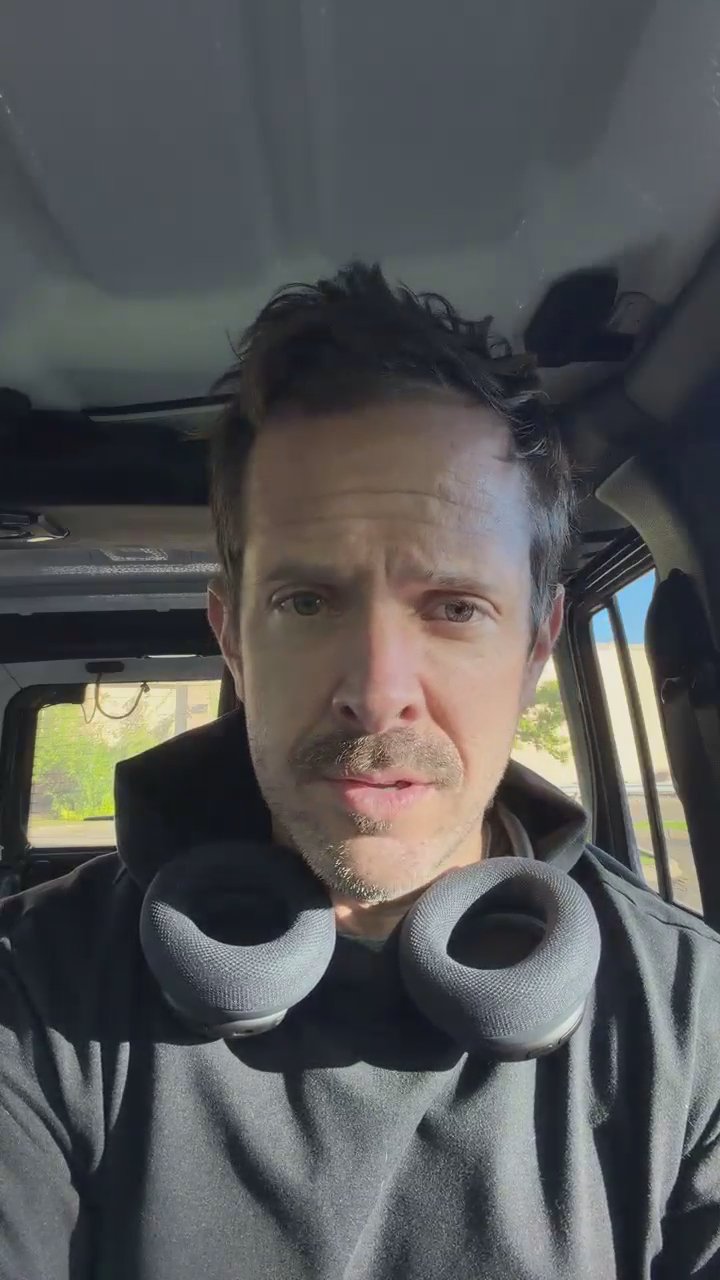
JC leads a short mindful-breathing practice, guiding listeners to notice nose vs. mouth breathing and to feel breath movement into ribs, sternum and belly; he explains diaphragm mechanics and models softening to access fuller, belly-directed breaths.
JC welcomes viewers, notices the sunlight, and thanks people for sharing time and space. He establishes a warm, communal tone to prepare for the brief practice.
Using a You've Got Mail example, JC explains that even brief online exchanges can carry real emotional weight. This frames the video's intention to foster connection and awareness.
JC asks viewers to notice whether they breathe through nose or mouth and where the breath goes in their torso. These simple observations start the mindful awareness of breathing patterns.
JC describes how lungs, ribs, and the diaphragm interact—how inhalation presses the diaphragm down and the belly rises in a 'C' shaped motion. This gives a concrete model for feeling belly-directed breaths.
JC vulnerably mentions his morning panic and how it shows up as shallow breathing. He guides listeners to soften muscles and breathe into the belly to create oxygen, stretch, and potential release.
JC notes that breathing won't instantly erase everything but helps him take the next steps of his day, like going to the gym. He encourages finding breaths that impact the belly and ends with a friendly farewell.
Hey, good morning, Cadre. I like how the sun is creeping through the trees from me right now. So often when we get Cadre today from the Jeep, it's like, there's the sun. Right now it feels like the sun is giving me a little bit of magic. It feels good. Hey everybody, my name is JC. If you've never shared time and space together before, thank you for the opportunity to spend some time with you right now. Me and my headphones, this is how I make sure I don't lose them when I'm going to go move my body a little bit at the gym.
But yeah, I'm glad I'm here. I'm glad you're here. I know the things I know and I care about you. We all do. All those things. We all know things, we all care about other people, we all at moments feel like we're in a good place, and it's often because we're with other people. And you may feel like you're not with other people in this way, but in reality, that's why we're doing what we're doing at Cadre, to remind you that sometimes social connection through tech can be not personal, but I'll remind you, my favorite movie, You've Got Mail, which is now an oldie, I guess.
But there's a moment where Meg Ryan says to Tom Hanks, hey, so often through this instant messaging on AOL, it feels like we're talking about like nothing. And she says, but I need you to know, Tom Hanks, that all of these nothings have meant so much more to me than so many somethings. And then that connection is the story. But I digress. Where are you, where's your breathing going right now? Like self-assess. Is your breath going in through your nose or is it going in through your mouth? Is it going out your nose, out your mouth?
That's a good place to start tracking where your breath is. But think about where your breath is on this part of the process, right? Breath goes like this and it goes this way, then that way, then this way, then that way. And I'm curious, where is breath getting into your torso? Is your breath getting to your sternum? Is it getting to your first rib, your second rib, your third rib? Is it getting down into your belly? And if you go, it's like, no, breath goes into your lungs. How can breath go to your belly?
Well, if we think, when your lungs fill up, you have your rib cage here, so your breath can't go out your breath actually has to press down on your diaphragm. So when your breath presses down on your diaphragm, then all of a sudden your belly goes out. So I always like to think of breath goes like this. It's like a giant C, right? Goes in, down, belly out, And then when it exhales, boom, back up. The thing I want you to think about today is a lot of times, and this was me this morning and it still is now, my breath is really shallow, right?
It's only getting down to like my ribs and then I'm going and I'm pushing it back out again. It took a lot for me to get out the door this morning because I live with irrational panic that doesn't necessarily have a reason and doesn't have a way to be like, oh, well, it's okay. And it's really hard to navigate that stuff. And even like right there, I just talk about, I just talk about it, I just talked about it as if it wasn't here. That stuff as if it's over there by that tree. Like that stuff is in me right now.
That panic. In a tactical and a practical way to go, well, how do we move with that? How do we move past that? finding the evidence of that panic is often in your breath. If I right now go, hey, consciously breathe into your belly, right? Soften these muscles, JC. All of a sudden, it's acknowledging that the panic's there, and it's inviting there to be some oxygen and some stretch and some potential release for a moment that then can move things around. And I'm not going to say, oh, now I feel better.
But I know that I'm on a pathway that's going to allow me to do the next step and the next step of my day, which is getting out of my Jeep and going in and putting on some music and, you know, walking and doing things that feel good at the gym. And then the whole day and all the things will happen. My invitation for you today is to figure out where your breath is getting to. Where is it going in? And how deep is it getting into your torso? Find some breaths that impact your belly. It's a good thing to do.
Have a good one, y'all. We'll see you tomorrow.