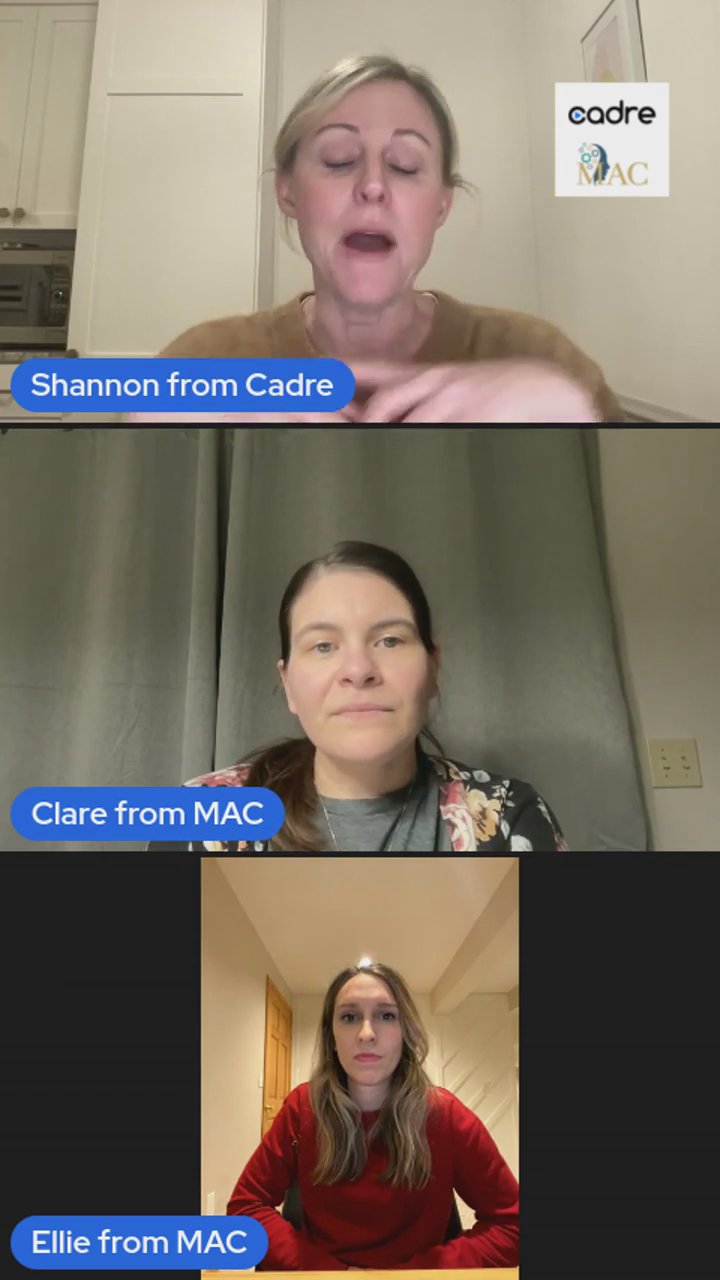
💡 What is Occupational Therapy, really? And how does it support those diagnosed with autism? MAC Midwest and Cadre are teaming up to break it down! OT can feel complicated, so we’re bringing in expert clinicians to make it clear for everyone. Featuring: 🔹 Ellie Lindberg, OT 🔹 Clare Koezly-Escobar, Lead OT
Cadre is a community of people who exist to share information, to support each other in our mental health journeys through community. We're bringing those professionals to you to talk about OT occupational therapy for people who are living with or caring for people with autism.
Shannon: I am an autism mom. I have a son who's 15 who has autism, ADHD and anxiety. Also live with anxiety and cptsd. And then we have our professionals here from Mac. Mac is Mac Midwest. They're empowering individuals to live their best lives.
Claire has been an occupational therapist at Mac for almost eight years. She says she fell in love with the community and all the people here. Occupational therapy is very broad and can do a lot of different things, she says.
Claire: What does occupational therapy mean for autism? Ellie: I've been an occupational therapist for almost 10 years now. One of the things they talked about doing at Mac specifically was celebrating wins with parents. Claire: It really is a really like builds us up as ots and it really just keeps us engaged.
This is a live Q and A, which means part of why we're here is so you can ask questions. Just pop a question in the chat. And my dog is barking, so I apologize if he keeps barking.
occupational therapy is not just, like, your job type of occupation. It's really any activity that you do that you want to do, and then really that meaningful aspect of it kind of makes it your own occupation. How it all fits together depends on the person and their family or community.
OT can modify the environment based on some of those behaviors to help them be successful. Can you explain what a sensory processing disorder is? So sensory processing is our ability to take in all of the stimuli in our environment. Some people need some additional supports.
Claire: Anything that's kind of just like interfering with the day. Like pulling back from toothbrushing, not tolerating taking a bath or a shower. We all have our own sensory needs and especially as adults we have more freedom to be able to do that.
Claire: Do you see that being a trend that schools will continue to evolve outside of special ed classes? Claire: We do introduce like those sensory activities or sensory diets like at the center. But those can also be used at home. Do you think classrooms would evolve or should evolve to. navigate those?
What would be some things? Like, are there any times you would not. want to do ot? Is there any Downside to ot or is that not a thing? If is a challenge and a parent is noticing some concerns, it's worth bringing it up to the doctor.
A lot of times it starts with an evaluation, like an initial assessment. The client might be seen one to two times a week. It could be anywhere from 30 minute sessions to one hour sessions. How do we know that we're making progress as parents?
Our daughter has some sensory needs around clothing. Is there anything we can start doing at home to make it more bearable? Try different types of fabric, different materials, print textures in addition to that. Have an extra change of clothes available for her too.
Ellie: There's so many families on wait lists who don't have access to help. What is something that people can do at home while they're waiting to be. What can they do as a parent? Ellie: What are some sensory strategies that might be specific?
One, one thing that I would just like sensory wise, like caution. Like the spinning and like upside down can be really intense. Give yourself a lot of grace, especially like, like, getting ready for bed. Thank you, Cadre, for being here and we will see you again soon.
Foreign. Hi, you guys. Happy Thursday. Welcome to Cadre. We are here tonight for our live Q A with our friends at Mac Midwest. And for those of you who have never been to Cadre before, we are a community of people who exist to share information, to support each other in our mental health journeys through community. And so we do it through peers and through professionals. And we do it in authentic, human centered ways. And so tonight we are here with our Mac friends. We're bringing those professionals to you to talk about OT occupational therapy for people who are living with or caring for people who live with autism.
Welcome to our live Q and A. I am Shannon. For those of you who don't know me, I am part of the Cadre team. I am an autism mom. I have a son who's 15 who has autism, ADHD and anxiety. Then I myself also live with anxiety and cptsd. So I have my own mental health stuff. So we've got the full acronyms. We have all acronyms at our house. And so my job on Cadre and in this Q and A tonight is both to speak from a parent's point of view and just speak from a peer point of view and then ask the questions that maybe parents want to ask or regular humans who don't have all the answers want to ask.
And then we have our professionals here from Mac. And Mac is Mac Midwest. So. So they are a fantastic provider here, based here in Minneapolis, where we are tonight. They actually serve though families all across the Midwest. They're continuing to expand and they exist to help individuals. They're empowering individuals to live their best lives. And so Tonight we have two OTs, we have Claire, who is a lead occupational therapist at Mac Midwest. And then we have Ellie from Mac Midwest. And so welcome you guys to.
To Cadre. Thank you for being here. Yeah, of course. And so would you guys just take a minute and just introduce yourself, tell us a little bit about who you are, your role at Mac, and then also why you, you know, why you chose this field and what it is about ot and frankly, just autism. And this, this care, you know, the care that you give, what drew you to it? So, yeah, Claire, please, just. Yeah, so my name is Claire. I'm an occupational therapist at Mac, as Shannon said. I have been an occupational therapist for almost eight years and I've been with Mac about five years.
Let's see. What drew me to OT was kind of I wanted to. I wanted to work with kids, but I wasn't sure. I felt like education was kind of a Common way to go. But I wasn't quite sure about that. And then actually my sister's friend was going into occupational therapy. Yep. So I was like, I think I can do that. So went and did that and just, you know, loved it. Occupational therapy is very broad and can do a lot of different things. So that's exciting. And then as far as coming to Mac was kind of like, location wise.
They had an opening and kind of came and then, you know, just kind of fell in love with, with the community and all the people here. And five years later, still here. Yeah. That's what we found about the Mac community over time. Is the team that the team at Mac is. Is pretty amazing. Truly. You know, you guys are a very dedicated group. And I think Claire, one of the things I did want to talk about tonight is OT is so broad and so. So how do you know? I think people in the world think about occupational therapy can apply to so many things.
And so what. What does it mean for autism is something would be, you know, obviously we'll cover tonight. Thank you for sharing that. Okay. Ellie, how about you? I'm Ellie and I've been an occupational therapist for almost 10 years now. And I've been with Mac for my entire occupational therapy career with Mac directly out of grad school school. And I fell in love with the client population, the families, the team, everyone working together collaboratively. So it really felt like my niche. Like I really found the right spot there.
And then getting into ot, I had worked in the past as a personal care assistant. I've worked with children and I've always really wanted to help people. So I'm like, how can I do more? How can I be a resource? How can I support people beyond like what even I do as a pca? So occupational therapy was kind of the, the next step. It's what I found a way I can, you know, provide resources, support, care, help. Not only I was working with, but families. And I feel like we're able to do that in our career path is really like clients, families, and be really a part of the bigger team.
So that kind of my drive. Thanks. And the why is because we see so much success. It really is a really like builds us up as ots and it really just keeps us engaged and involved in learning more. That's awesome. I know. We had a conversation with some speech therapists from Mac last time last month. And that's one of the things that they talked about doing at Mac specifically was celebrating wins with parents. And I'm guessing you Guys probably do the same thing, but, you know, like, really taking the time to notice and say, like, okay, this was a huge win, and celebrate it together as a group, which is really important in autism in general.
And I think parents and families don't always do that because so much of the time it feels so heavy. So celebrating it is awesome. That's awesome. Thank you, guys. So I think it'd be great. Real quick, before we start, actually, I do want to just set the stage and say, so this is a live Q and A, which means part of why we're here is so you can ask questions. So if you're watching tonight and you might not have access to a therapist, an occupational therapist, or any kind of clinician, maybe you live somewhere where you don't have people like that to ask questions.
Just pop a question in the chat. We see it, and we will ask the question to the team here. And so just wanted to make sure that you all know that's also why we're here. And my dog is barking, so I apologize if he keeps barking. He may do that. For those of you who have watched Cadre for a while, you've seen Gilbert in my videos, and he is. He is here tonight as well. Okay, so let's start. If you guys are okay with it, let's just start with defining what occupational therapy is in the autism space.
I think that's just a great place to start, is like, what does that mean fundamentally? And you guys, whoever wants to take it, you guys can. You guys can fight over it. Sounds good, I guess. I mean, just occupational therapy kind of in general. So the occupation of occupational therapy is not just, like, your job type of occupation. It's really any activity that you do that you want to do, that you need to do, and then really that meaningful aspect of it kind of makes it your own occupation. So then especially, like, when the autism space, as you were talking about, it just translates into that too, where, like, what's important for the learner or their family and school kind of out in the community.
So I guess that's kind of broad. But, Ellie, I don't know if you have more specifics for things since you've been here longer. A great description that makes so much sense. That's really what OT encompasses. And we have a variety of different, like, skills and areas we can focus on. We look at the client holistically. We look at the skills that are important to the client and the family. We work on everything from hygiene routines, dressing skills, development of fine motor skills, like Pre writing or typing, we also focus on self regulation and sensory processing.
So like that really broad occupational child there encompasses a lot and there's a lot we can do to support clients and their families. So as parents, when we think about, when we think about the word occupation, is it fair for us to sort of like reframe it in our head? As the child's occupation is to be a successful student, the child's occupation is to be able to successfully engage in the world. Like, is that a good way to think about it or is that not fair? Absolutely, I think a lot their primary occupation is play, like for some of our younger kids too.
So how do we help them explore their environment? What can we do to support them, to help them be more effective and build some social relationships and you know, they're in individually or groups, like help, so. Yeah, that's a good question. Yeah, I think too. How often. So for me, when my son got his autism diagnosis, he was two and then we started to layer in the therapies and I think, you know, often when you, when you're, when you're getting a diagnosis, you, you get a diagnosis and it's, and then you, of course, you Google it and you get a lot of information and you're finding all the things and then you get thrown a lot of words or concepts.
So you get speech and you get OT and you get maybe, you know, play therapy or you might get. There's just a lot of stuff. And so how do you know, like how do you know how that all fits together and how does OT fit into that? And that's kind of a big question. Yeah, I would say kind of how it all fits together kind of depends on the person and kind of their family or community as far as like what, what level of different services they need. Where occupational therapy can fit into that is, you know, like if there's difficulties with like daily routines or that self regulation piece that Ellie was talking about, challenges that just are kind of like, why so kind of like teasing those things apart.
And then occupational therapy too is kind of like like your act, your activity or your occupation, those things that you want to do are both like the, the goal of therapy and the how of therapy too. Yeah. So like a lot of like if your goal is to, you know, brush your teeth fully, like get that morning routine part down, part of what we do in therapy is brushing your teeth, breaking down the steps. Yeah. To, to be successful, to build up to that and like using the activity in therapy. So that could be part of it, too.
Like, if it's an actual activity that we want to do, then then OT can kind of step in there. Yeah, as well as. Yeah. Yeah. As well as, like, if having, you know, challenges with, like, certain environments, like, maybe the environment is too loud or too bright, or I need to move a lot or I need to, like, feel more secure, stuff like that can kind of go along with that as well. I know that's a lot of what we do at Mac, too. Yeah, that's awesome. That makes a ton of sense. We do have a question that it said.
So we had someone say, what are the behaviors that someone might display. Display that could indicate that OT would be beneficial for them? That is a really. I mean, that's. That's a good question. Some of the behaviors we might see secondary to a diagnosis kind of going off of, like, some of the sensory processing challenges. If someone is covering their ears and loud environments or environments where there are peers around, we might think, okay, that person might have some, like, auditory sensitivities, or if someone is pulling their hood up over their head and kind of looking down at the floor, maybe they have some light sensitivities.
So we can modify the environment based on some of those behaviors to help them be successful. Those are just some of the really common ones that we might see for someone who has, like, some sensory challenges in addition to, like, their diagnosis. Can you. Can you explain what a sensory processing disorder is? Yeah. So sensory processing is pretty much our ability to take in all of the stimuli in our environment, the noises, the lights, the smells, and really be able to process what is going on around us and, like, respond to that.
And for us, a lot of people, it comes naturally. We're able to filter things out, and we're able to adjust to our environment. If there's a dog barking in the background, we're able to filter it out and, you know, function in process. Some people have a harder time with that. Some people need some additional supports, or they might need something called a sensory diet, which is just a personalized combination of activities that really helps us feel organized and calm and things that we do for ourselves that really helps us process that information.
That's awesome. That's awesome. And I'm feeling really sleepy. I might need a cup of coffee. I might need to, like, lift the blinds up so I feel alert and aroused, and I can start my day. For some people, it's really more. It's more challenging to identify some of those things. So we're here to help with that. Help that might help people, you know, regulate their body and their emotions. Yeah. And I think that's so helpful because honestly, it's the same things that we all experience. It just sounds like it's more exaggerated or more impact.
Impacting their ability to, you know, have a more typical day to day experience. Is that, does that sound fair? Yes, that sounds exactly right. Yeah. Which is then easier to understand because then it's not this unknown thing. You're like, oh, it's when I hear this thing, you know, a sound that makes me crazy, but. But 100 times worse. And so that's why it's so stressful for them and that's why they have a behavior 100%. And maybe we can help by offering some like noise canceling headphones. Maybe we need to find an environment that's more suitable maybe.
Right. And we need to find some different lighting rather than some really intense bright lights that are found in a lot of schools and buildings. That makes total sense. Is there anything, Claire, you'd want to add about that behaviors that might indicate OT is needed? I mean, I think Ellie's. Yeah, Ellie said it really well. I mean kind of any. Yeah, anything that's kind of just like interfering with the day. Like pulling back from toothbrushing, not tolerating, you know, like taking a bath or a shower, kind of needing to be on the move or like always kind of like draping like over furniture, leaning on stuff that to the point where it like interferes with something because like you guys were just talking about.
We all have our own, you know, we all have our own sensory needs and especially as adults we have more freedom to be able to do that. Like you can take a break and walk for a minute if we need to get up or we can chew gum because now we're old enough and our teacher didn't tell us we can't stuff like that. So. Yeah, kind of figuring that out. That and for ourselves too. This is just an aside because I'm curious about your points of view. Do you think that classrooms would. Will evolve or should evolve to.
I mean I know probably some classrooms do evolve to navigate those. Do you see that being a trend that schools will continue to evolve outside of special ed classes, for example, or I just curious. My son is in full time autism classroom and so they do. They have evolved that. But I'm wondering for the mainstream if that's. If that's something that you're seeing. I can't speak from specific experience as far as like. Or like a ton of experience. But I do, I do think so. I think like it's. Yeah. Just kind of more.
More known that kids need, you know, more breaks or different. Different accommodations or different seating can be tried to. Yeah. Awesome. Generally think there's more awareness and there are occupational therapists that do work specifically in the schools support. So if they know, if they think there is like a modification needed for the environment or the classroom that will help all of the learners, I think kind of put their two cents in. Yeah, that's great. We have another question that says my son had an occupational therapist and it was like magic.
The therapist could see what my son needed and would work on those things with him. But when we got home, I was at a loss. How can I as a parent understand better what my son needs? Compression, large motor movement, et cetera. How would I know that as a parent? That is such a valid question too. We see this all the time, like kind of different environments, different responses. I think something that some of our families have found helpful is like more like family skills, like family centered sessions where the parent is like really involved in the occupational therapy session and even doing some of like the activities with their child while the occupational therapist is there and kind of supporting or facilitating.
So the client has that time practicing not only with parent, but then kind of making like a note to like practice that same skill at home and really set aside some time to practice that. Because our days get really busy. It is really hard to find time to work on every single skill. So just picking one skill and then practicing that home, whether it's toothbrushing or shoe tying or one of the skills that they're working on in OT and just kind of honing in on that and kind of expanding from there.
Yeah. Oh, go ahead, Claire. Oh, yeah, no, I was just gonna say too. Yeah. It's like ideal when, you know, like parents can come for at least part of the session too, which like at, you know, at the center, since they're there all day, is kind of, you know, more challenging. But yeah, just kind of having that like observing sessions even of like. And you know, just those conversations of like this is what the therapist is noticing. So that's what the therapist is like. That's what their cue is to do like that large motor movement or that compression and then also like noting like when it works and when it doesn't work.
And one thing specifically, maybe more for that, like sensory and regulation. We do introduce like those sensory activities or sensory diets like at the center. But those can also Definitely be used at home. And sometimes even, you know, like, when possible, like, noticing or like, writing down, like, oh, I tried. Like, we tried this at home and it was helpful. And we tried it again, like, two days later, and it was helpful again. Kind of like working together to notice those patterns, too, can be helpful.
And that's a lifelong. That's a lifelong thing. I'm doing that with myself for, like, you know, all those things. I mean, listen, we're all. We're all always doing it, right? Yeah. And then, you know, what works in April doesn't necessarily work in August because of whatever reason, too. So. Yeah, just kind of really trying to, like, hone in on those cues and, like, having that observation and then that conversation around it, too, is really helpful. Yeah, I definitely. I was going. I was going back in my head to the sensory diet piece, and I remember with my son, we did.
He had a lot of. He needed a lot of. I think they called it the input in his body. He just needed a lot of, like. So we had to, like, squish him, and we had to do a lot of proprioceptive input, which was a word I learned, which I. The way I. The way that I talk about it is we had to, like, make his joints feel things. And I don't know if that's the right. That's clearly the correct definition, but what's the right definition for that? I think that's perfect. Is it? Yeah, because it's. It's the input in the joints is how I describe it.
And, like a grounding in your body, right? Yep. Yeah. But I remember, like, we had a, like, homework, which was we were supposed to do his joint compressions. Like, I think it was like, five times a day. And I will tell you also to this parent that's asking this question that. That's also very difficult. And so I would just say, also, don't feel bad if you can't. You can't do everything. And so, like, just also one thing, like you said, Ellie, like, one skill at a time is. Is fantastic because it's a lot.
Like imagine, like you said to Claire, imagine if we try to work on ourselves with all the. All the ways in which we can improve ourselves at the same time. That would be a lot of things. Yeah, no, these are. These are really awesome questions. What. Hold on, I'm just gonna quick go to. I. What would be some things? Like, are there any times you would not. I know this is a weird question. You wouldn't want to do ot. Is there any Downside to ot or is that not a thing? Just, you know, like, yeah, guys, like clients who really need occupational therapy for.
Based on like our observation and assessment and evaluation. If a client is, has like age appropriate like skill levels, there, there isn't in there having like, you know, they're able to complete their routines and activities without having too many challenges. I don't know what the need for OT would be. But if is a challenge and a parent is noticing some concerns, it's worth bringing it up to the doctor, worth like making note of it, because we don't. It's hard to know specifically, you know, what falls into ot, what doesn't fall into ot.
So it makes sense just to ask. Yep, yep, that's a great, that's a great point. So what, what happens typically in a session? I know you talked about, I know you talked about, you know, it's very different depending on each human, because we're all different. But can you kind of walk through, like, what would a parent, let's say someone starts out to you for the first time, what would, what would one expect their child would go through? Like, how would the time be spent if you're willing to sort of break down sort of the moments and how long would it be and how often might someone go just to sort of have an understanding of what somebody might expect?
If. And again, I know it's, I know it's, it's hard to generalize, but I can just kind of give like an overview of what it might look like. Yeah, like I mentioned, a lot of times it starts with an evaluation, like an initial assessment. So the parent and their child will meet with us, meet with occupational therapy. And like a lot of the point of it is to establish goals, like what is important to the family, what is important to the child. And in addition to like really identifying goal areas, figuring out what are challenges, what do we want to see in the next three months, what do we want to see in the next year.
And in addition to establishing those goals, the OTs will usually perform a variety of like standard assessments to help us really understand that, you know, that baseline where we're starting at and then allows us to really kind of look into some skills in more detail. In addition to some of that standard test, standardized assessment, we also do some informal observation and really just like what we look at play skills, we look at toothbrushing, we look at all the person holistically. So we're looking at motor skills and working with the family to establish some goals.
And then beyond the evaluation, the client might be seen or the person might be seen one to two times a week. Really depends on what their needs are. And that also goes with the duration. It could be anywhere from 30 minute sessions to one hour sessions. That's really individualized. So it definitely varies thing to add to that. Yeah, I will say specifically at max, since most of our learners are here like five days a week, it is often convenient to have like two. Those two sessions obviously like in an outpatient, it really just depends on kind of like family scheduling.
When I worked at an outpatient mental health clinic for kids as well, it was typically like once a week for, for one hour and they had all sorts of, you know, different diagnoses. But here too, it kind of depends. I'll see some kids. Yeah, for 45 minutes if, if it's like, oh, we have these goals and we can't get through them in half hour type of thing. But a lot of them at Max specifically are half hour. And for instance, let's see yesterday and I was having, having sessions. So sometimes it goes like toothbrushing and then we take a little break to do something fun and then like we maybe do some exercises and then we take another little break and then we work on, you know, some handwriting or like some like household activities and stuff like that.
So depending on the kid too and what they like to do, kind of incorporating their interests and it can be. Yeah, it can be really fun that way too. Yeah, I definitely remember, I remember those breaks like we had to do a preferred activity every couple, every couple of rounds. It was like, now we're going to do a thing you like just to kind of keep. Maintain that interest. Which is, which is super smart. How do we know, And I know I alluded to this in the beginning. Like how do we know that we're making progress as parents?
Because I think too, it's so hard to measure progress with, with these types of therapies. Gilbert's asking my dog. So how do we, how would we start to know. Yeah, that we're doing the right thing and it's. And we're making progress. Definitely. Well the, the formal way of doing it for at least at Mac, for ot, every three months we have our progress report. So like I go through like all the data from all the sessions and kind of see like compare it to the previous three months. So that's. And then send that off to the doctor and everything like that.
So that's kind of the like formal way of doing it. Otherwise it's you know, kind of once you've been with that person long enough and you kind of know what they've. Like where you kind of started at with an activity and just seeing it grow, like, you can kind of just tell in an instant sometimes that is the best time you have ever written your name that I can ever remember. Like, that is like, that is today something. Something clicked. So certain things like that, where it's like, oh, or they've never.
They've never done that before or they did it while I was, you know, like I was doing something else over here, like for a parent, for instance, like something here. Then I turned around and their. Their shoe was tied and they did it. You know, small little things like that too. That's awesome. Yeah. Ellie, do you want to add anything or. No, I mean, that. That's. That makes so much sense. It's like the little wins too. Just like the little things that make a big difference in the day, like putting on your jacket.
Well, to brush your hair and that they're able to get their socks on after, like, practicing it with, like, arm weakness. We worked on over a bit of time. And then when it came down to it and they were able to use their arm to zipper and zip it up for the first time, we all just, like, cheered. I was just like, those little things that we take for granted are just. Can be so monumental. So, like, taking every win you can get. I totally remember those things where you are just like, oh, my gosh, you did it.
Yeah. It's such a win. It is. It's such a big one. Okay, we have another question. It is. Our daughter has some sensory needs around clothing. Is there anything we can start doing at home to make it more bearable while we wait for her OT intake? That's a great one. Yeah. Because it's like a really common issue. Totally. A lot of times clothing textures can be really aversive. I would say that there's a couple things you could try. One is like trying different types of fabric, different materials, print textures in addition to that, which could.
Maybe you've already tried that proprioceptive input that we talked about earlier. The squeezes, like the deep pressure that generally calming for a lot of people. Those hugs, the deep hugs, the squeezes. Just that input to your body can kind of organize your sensory system before you put a shirt on. Some of that. And then we try dressing. Sometimes we have more success. Not always. Yeah, absolutely. Something you can try something that kind of organizes our sensory system and something like those senses sensitivities to the clothing might feel a little bit more manageable.
Yeah, definitely. My first. Yeah, my first thought, too, was trying, you know, those different textures, different clothing, which. Yeah, you may. May have already tried because that's kind of my. My first go to. And I love that proprioceptive input, too, if there's different. Because. Yeah, generally calming, kind of like massage to. In that. In that same vein. And then kind of along with having, like, the different. Different textures. If changing clothing goes okay and is not too disruptive, you could just, like, have an extra change of clothes available for her too.
Like, okay, today, this sweater isn't working out very well. So, like, if you want to change, we can certainly change into something else too, maybe just as an option. Yeah. And I think. I think also, like, I'll just again, speak for myself, but I think as parents, too, we. We. We start with our kids with, like, they need to be perfect. They need to look this way, they need to do this. And then over time, you're like, it's okay that he's wearing sweats every day. Like, that's okay because he can function in sweats.
And that's the point, you know, like, then he can have a successful day. And so that's the win. Instead of, like. Yeah. The aesthetics of, you know. Yeah. So it's just. It's also, I think, just it's learning for everyone, like, this is what success is for our family. And, like, another thing is kind of getting of, like, what's. What's bothering you about your clothes? Is it there's a tag that's bugging you? Because you can cut a tag off. Is there. Is it the texture? Like, trying to see if they can give us any feedback and really kind of explain what's uncomfortable?
Are they too warm and are they having a hard time telling us that they're too warm and they get a T shirt on? So there's a lot of different things you can look at as far as, like, the clothing goes. That's awesome. Well, we've just got a couple minutes left. I just wanted to ask a final question. What. What if someone. So some of why we do this also is we know that there's so many families on wait lists who don't have access to help. And so if someone's on a wait list right now or someone's watching this and they're just unsure if their child needs OT or, you know, maybe they're thinking there's a diagnosis that they don't have.
What is something that people can do at home while they're waiting to be. To not, not to get ahead of it, but just to start to, like, better understand what's happening. What can they do as a parent, if they're wondering, what can they pay attention to? What can they. Like, what are the things someone who's worrying or thinking or wondering can do while they're waiting or, you know, when they don't have answers so that they feel like they have a little bit of power, control. Like, what advice would you give to parents who, who need that right now?
Yeah, I mean, kind of depending on where you are in the process, you know, like, if you're. If there are other diagnoses that you think might be undiagnosed, I'm talking to your doctor and getting those, like, referrals going to. Because they might have, you know, kind of the different therapies that you were talking about at the beginning. Physical, occupational, speech, play therapy, all those different things. And then as far as, like, if you don't have, like, a clinic picked out or if there's a clinic, like, on a wait list, honestly, I've just gone to like, a Google Maps and just search like, occupational therapy and just like, like zoom into your area or zoom out.
Because sometimes there are those smaller clinics that just aren't as well known, even if, you know, maybe they're a little farther or sometimes, yeah, they can be a little closer to. And their wait list might look different from the one that, you know, the one that your doctor recommended to or the one that's like, in the same system. So that can be a way as well to kind of expand and then not to go too far down like the, The Internet rabbit hole. Good. Yeah, I was like, since. Somewhat unavoidable.
Yeah. When I mean, there's the. org and that's kind of some of that educational. Okay, so that can be helpful. Another one OT Toolbox, I think, is helpful as well too. They have a lot of different. A lot of different, like, sections and like, different, like, skills and stuff that you might be looking into on that website too. I think they have a. I think they have a parent section as well. Or maybe the whole. The whole thing is just useful for me too. That's great advice. Thank you. That's awesome.
Ellie. Yeah, absolutely. And then if your child is in school, they might have full OT too, that could consult and maybe share some recommendations of what we can do. In the meantime, what are some sensory strategies that might be specific that might actually Might be helpful. Might be able to share some of those tips or tricks based on some of, like, their observations or what they've. What their experiences. Yeah, definitely. That reminds me too, like, as well, like, you know, if your kiddo isn't in school yet, looking into, like, your early intervention team nearby too.
Yep. I feel like it's helped me grow or helped me connect. I think it helped me grow. I think that's what it was. Or ucfe. Yeah. Don't quote us anyone, but I think it has helped me grow. There's definitely. There's early childhood resources, for sure. And I think, like, to both of your points, I think it's just sort of like. I think what I remember most or learned the most is that especially the sensory piece. And correct me if I'm wrong, but is OT most of all of the therapies that exist, like, comparing to speech or play, is OC the most.
OC is OT the most focused on sensory. It's definitely a huge focus area. Yeah. Yeah. You integrate it into their practice, but, yeah, it's a huge focus. Yeah. Because I think one thing that, as a parent is difficult is that sensory stuff is also what can cause maybe the most disruption in daily life. Like, you can't get out the door because you can't get someone dressed, or there's a meltdown in the store because of. Yeah. Maybe the environment. And so I do think that that idea of Claire that you shared of, like, just finding some skills and trying them, like, if you're noticing to your point, if there's a visual sensory issue, if there's an auditory sensory issue, if there's, like, energy everywhere, like, just try, like, for.
Again, like, for us, I know we squished with a ball. We just. Or a pillow. Now we just get a pillow. And then we would just say, like, squish and just squish him. And I remember being like, how is this therapy? Like, I mean, truthfully, I was like, I don't understand how this is therapy. And then I was like, oh. And he actually loved it. And you could see him start to. You know, we turned it into a game and so I could do it at home, but so those are things too, that, to your point, Like. Yeah, I think just being able and they're.
That's easy. That just seems like play. So it's. I think that's great advice just to even, like, try to find one skill to try. Because what if it works? Yeah, yeah, definitely. And give. Yeah, yeah. And a lot of those things too. Like, if you, you know, if you try it and it. And it doesn't work, it's okay. Yeah. One, one thing that I would just like sensory wise, like caution, like, like, like the spinning and like upside down can be really intense. So. Okay. Not like going wild on that, but that proprioceptive stuff is that.
Yeah. Is like that generally calming you? Yeah, you almost can't go wrong type of thing. Which is, which is nice in that sense that you can have a little more freedom there and even like those auditory and visual, like a lot of things you can, you know, you can try and if it doesn't work, you just don't try it again tomorrow type of thing. And yeah, giving yourself like, you know, a lot of grace, like, especially like, like you said, like, getting ready in the morning is, is. It's just a challenge and getting ready for bed and, you know, different things.
And like, it's okay if it, if it, you know, if it's. It's hard together. Yeah. And it's like, it's. Yeah. And it's. If you have, you have this much together, that's, that's good. And then if you have this much tomorrow, that's great. Goes down, goes up all those things. So just like remembering that, that too, like it all. It always goes up and down. And that's just part of being human beings too. So this is why we love Mac, because you guys always close with this kind of like now you can just mic drop it.
But it's true. Thank you guys so much for being here. This is why, honestly, truly why we love you as partners is that you. You get it. You actually, I mean, you sincerely care about our, you know, the families that you serve and people. And so we just appreciate you so deeply and I appreciate you guys both tonight for being here and for sharing your wisdom and just, we're grateful for you and thank you for giving the gift of your knowledge to the parents tonight that needed your support. So thank you, Cadre, for being here and we will see you again soon in the Cadre sphere.
And thank you guys. So have a great night. Thank you.