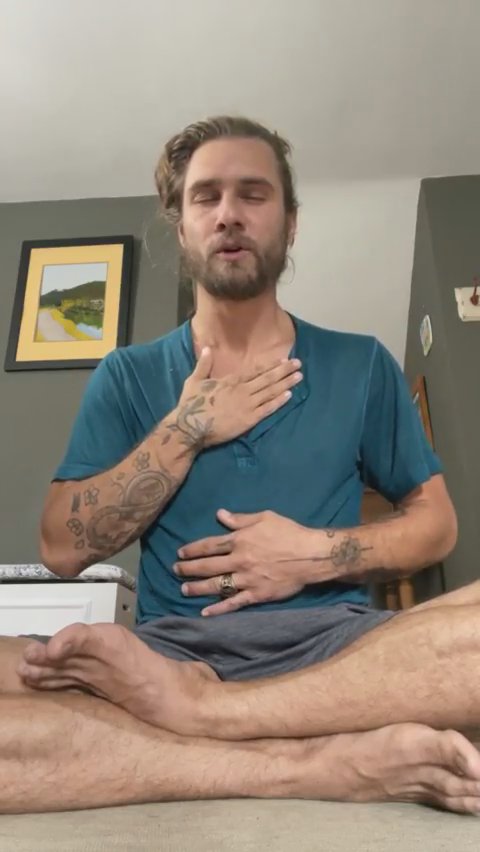
“Dragons Breath” or “Tigers Breath” is a way to utilize the tensions in the facial muscles tho help us release negativity from our bodies.
Saturday's exercise focuses on your facial muscles and tensing up that area on our exhale. Starting from the belly to the chest to the head, do three rounds of this. Find your own rhythm.
All the way in, all the way out. Just allow your breath to come back to a normal rhythm. If it's too long of a hold, just go back into your normal breathing repetitions. Let me know how it's been benefiting you and your practice.
Hey, everybody, and happy Saturday. Hopefully you're doing well. We're going to be working on another breath exercise for this one. It's going to be what's called a dragon's breath. So this is going to be kind of mainly focused on your facial muscles and kind of tensing up that area on our exhale. So it'll kind of look funny, you know, like with your facial thing going on. But, you know, it's kind of okay. So what it's going to look like at the end is we're going to do our normal breath exercises from our belly to our chest, up to our head, as we've done in the past, but a slight variation on the exhale.
So it's going to look something like this. So when we come in and it's going to, on the exhale, look like, and we're going to actually push the air out and kind of like release our face. Just like, I mean, like really like blast it. Blast it out. Imagine blasting it fully out of your face and your eyes, everything. Release your tongue. It's a really good sensation when you come out. And then you let that kind of all come in afterwards. So with that, let's go ahead and just try a couple. You can kind of just loosen up the face.
Just go ahead and open up your jaw a little bit. You can feel that kind of even down to your neck here, and then move down to your, like, feel it in your eyes. Your cheeks do kind of circles. You can do circles around your face. Maybe you can make faces, make noises. Doesn't really matter. It might look silly, but, but it's kind of fun. You just kind of can have fun with this part. And it really kind of loosens everything up. To start, you can even bring your tongue out, move that around, see what that feels like.
Get all those muscles just loosened up before we get started. So go ahead and do your own kind of facial stretching and practice. Just kind of feel it all. You can do a big smile over eccentric smile. Really open everything up. Okay, so we'll finalize just that little facial stretch. Anything left that you want to do. Then we'll begin our breathing. Okay, so finalize your own face stretch. And with that, then we're going to go ahead and begin our first couple breaths. So we're going to start our breath exercise going in about 30.
I'm going to roughly count in my head, but it'll be about 30. We'll do our hold at the bottom. So at the end of our 30, we'll do our dragon's breath out. And then we'll hold at the bottom. We'll begin again. We'll do three rounds of this. Okay, so let's go ahead and get started. So let's breathe in. Belly, chest to the head. This is one. Begin your own rhythm. Just find that even in and out. Belly, chest, head. We're at about ten here. We'll call that about 2010. More at your own rhythm. About five more.
Okay, last one big inhale, and you'll do your dragon's breath out. And hold it here. Okay, breathe all of it in. And let's hold at the top. Let's do another dragon's breath out. Shake it all out. Notice how you feel. Take a big breath and let's go ahead and begin the next round. Okay, ready? Again. Starting from the, from the belly to the chest to the head. Find that rhythm. I usually kind of like, imagine a rhythm in my head. Like almost like music, something like this. You can imagine that at your own pace.
So let's go ahead and about ten there, about 20. Let's call it five more. Let's go at a rapid more pace. And the last one, dragon's breath. And hold. And hold. Release. Sorry, I got a bit light headed for that one. That can happen. It's also a good sensation. It gives you a bit of a tingly feeling. You can kind of breathe it out. If you feel that, that kind of sense of dizziness. A bit light headed. Just go ahead and breathe that one out. Deep inhale. Deep exhale. You'll notice probably by now that the capacity has kind of increased a little bit.
Also the calmness has increased. Coming in. Going out deeply in and deeply out. We'll take this last one slower. We'll just do ten for the last one. Okay. Really recognizing the capacity here. All the way in, all the way out. Just really taking your time. And one last one. All the way in. And one final dragon's breath out. And we hold here. Just feel it all. Feel the sensation. For this one, I'll let you go because I might go a little bit longer than you. Hold at the top. And release. Take that full inhale.
Hold fully at the top. A couple sips. And our final exhale with a dragon's breath can really shake that one out again. You might feel a little bit dizzy, a little bit lightheaded as I am. It was even hard to kind of keep directing the practice. Just allow your breath to come back to a normal rhythm. Really get in tune with how you feel afterwards. Notice how you felt before. Notice how you feel after come back to a normal breathing pattern. Maybe you'll notice a sense of calmness afterwards, especially in your face after doing those kind of tense exercises up here with the breathing exercises, calming down the whole body.
So if you noticed anything, feel free to let me know. Let me know how it's been benefiting you and your practice and if there's anything that you would like to see differently or like that you would like to improve on or practice more of. All of those comments are very beneficial. So I haven't really had time to look at any of the comments going on here. It looks like. Yeah, sorry, Nick. I know it's pretty long holds. Just do as long as you can and then, you know, you know, for the future, if it's too long of a hold, just go back into your normal breathing repetitions until we get back into that next repetition of breath holds.
So it's okay for you to break that hold. I don't expect you to hold these breaths as long as I can just go at your own pace because we all have a different lung capacity, especially at different times, you know, you don't want to, like, overdo it with yourself and be holding your breath to the point of you passing out. Just hold your breath to the point where it feels normal and then take that breath in. You know, we just want to be expanding and growing upon that so we can take a timer and really get to get to know our breath holds if we want to do expansion and be able to hold our breath longer.
For instance, you know, you can start to do a timer and get, you know, from 60 seconds to 90 seconds all the way up to, you know, a four minute hold if you really want to go that route. You know, I mean, the longest hold I've gotten without any oxygen in the lungs is about four minutes total. But that takes a lot of exercise and, you know, a lot of kind of mental prep also, because you have to be in the right state of mind in order to hold your breath for that long. So hopefully you guys enjoyed that practice and I will see you next week.
Enjoy.