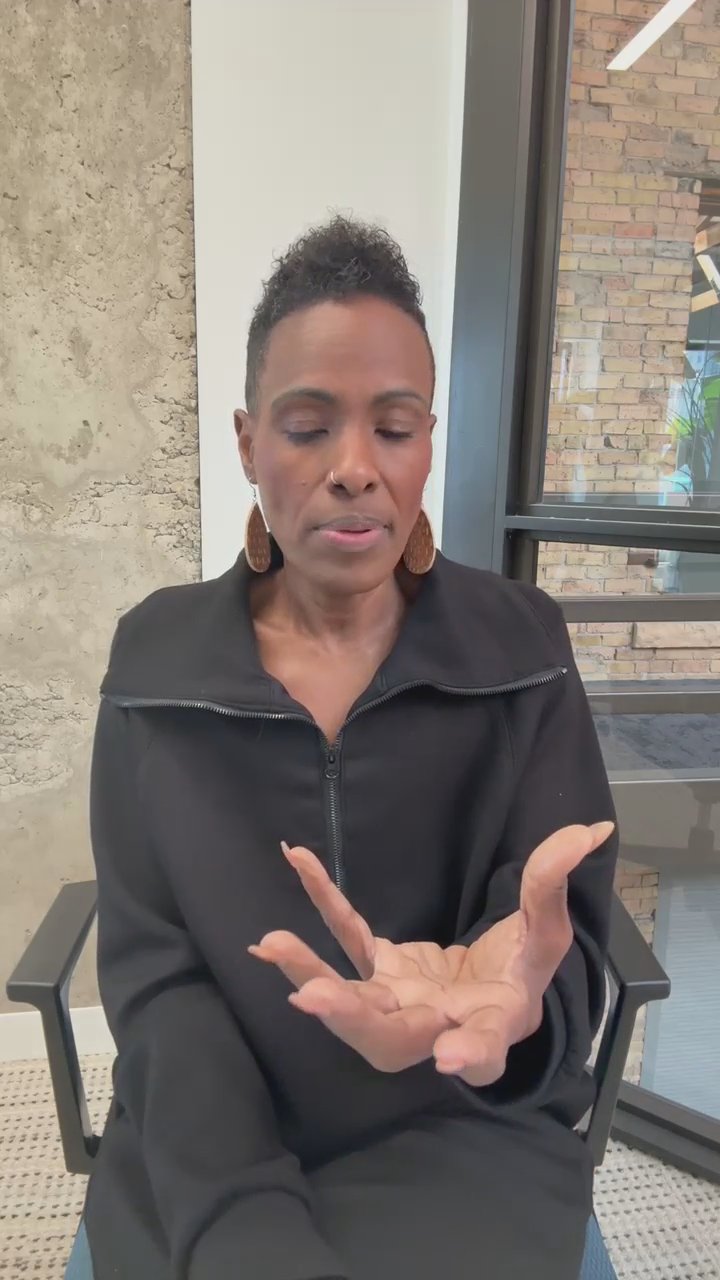
Dr. Cheryse opens the live, welcomes the community, asks viewers to share their location, and guides everyone to rate their week as a grounding regulation tool. She also models vulnerability by sharing her own rating to normalize the check-in.
Dr. Cheryse opens the live, welcomes the community, asks viewers to share their location, and guides everyone to rate their week as a grounding regulation tool. She also models vulnerability by sharing her own rating to normalize the check-in.
Dr. Cheryse briefly introduces her credentials and the purpose of the space, then announces the session's focus: seven lies that anxiety may tell you. This orients viewers to what to expect.
She explains that anxiety is a useful nervous system signal, asks viewers where they feel it, describes common physical and behavioral signs, and outlines a brief neuroscience perspective (predictive thinking). This prepares listeners to contextualize the seven lies.
Dr. Cheryse covers lies one through three: that fear means something is wrong, that you must figure everything out immediately, and that thinking enough will prevent outcomes. She normalizes rumination and offers perspective on urgency and control.
She addresses the belief that avoiding anxiety keeps you safe and the idea that safety only comes once everything is resolved, noting how avoidance and unrealistic safety expectations can maintain anxiety and offering a more flexible view.
Dr. Cheryse challenges the thought that others handle life better and the fear of not managing what comes next, reminding viewers we rarely know others' full stories and that they've handled challenges before. She encourages self-trust.
She asks listeners to consider their needs, possible boundaries, and small shifts (rest, food, community) to reduce anxiety, invites them back to the space for community, and closes the session with encouragement for the week ahead.
Controsphere, what is up? So good to see you. I hope that you are taking care of yourself. And if not, that's part of why you're here, right? For us to be together and really anchor in. Come in and let me know two things that I always ask. One, where are you in the world? Just a really powerful way for us to be reminded that We are not alone. And you never know when you might meet somebody else in the college sphere who lives near you. We've definitely seen that happen. And let's rate your week.
I do recognize if we're kind of on the other half of the week, it is Thursday if you're listening to this in the moment. However, rating your week is a wonderful regulation tool, right? On a scale of 1 to 10, hello Erie, PA, where are you? One being low, 10 being high, given the context of your week, and this is subjective. You decide what your one looks like, you decide what your 10 looks like, but it's just a really good way to say like, okay, what's the truth? I would say if I had to rate myself, I'm somewhere between A7 and eight, I'm pretty tired, but you know, there's room to move up from there.
If this is your first time here, I'm Dr. Cherise Johnson. I'm A licensed clinical mental health therapist, mindfulness practitioner, and author. But more importantly, I am a part of this community and I come into this space as much as I possibly can to talk about all things life. This is not alive in any way, shape, or form that is here to diagnose you or make you feel bad about anything, but it's great to have some perspective. And I often talk about what does it really mean to be well and chill up.
Today I want to focus on 7 lies that anxiety may be trying to tell you. I want to give this caveat that although anxiety is an emotion that we don't typically like, it's not something that we enjoy, it is valuable to our nervous system because it is signaling and letting us know something is not right. And some of us know what that anxiety feels like in our body. If you're someone who has felt or experienced or lives with anxiety, take a moment and let me know in the chat when you're anxious, where does that show up for you?
For me, it can be one of two places as a primary place. I can feel it in my chest where it's like this really irritable feeling that's kind of fluttery. or I can feel it in my gut. Sometimes both, but it kind of goes back and forth between there. Others of you may be operating and acting in ways that demonstrates that anxiety is present, but you're not connected enough to your body to really know where it's showing up. So just because you can't feel it doesn't mean that it's not anxiety. It can also be something that shows up mentally in how we talk and how we speak and how we think.
And it can even show up in what we reach for, right? So we may be reaching for substances or food or shopping or scrolling as a way to manage that anxiety and we're not always putting that together. From A neuroscience perspective, because I always love little neuroscience, when we're in that threat state, when the nervous system is like, I'm afraid, this doesn't feel good to me, the brain starts asking the question, what could happen and how do I prevent it? And that's a really helpful way of recognizing, oh, that predictive error that our brain is engaging in that moment can kind of keep us in a state where we're trying to figure everything out.
Okay? So 7 lies that your, that anxiety may be trying to tell you. Number one is because I feel afraid, something may be wrong. Fear and unfamiliarity can feel the exact same way. I was actually having this conversation with my daughter this morning. When we are doing something that we are anticipating or we're afraid of because it's unfamiliar, the feeling of anxiety can be there, but it's not necessarily a sign that something is wrong. It is a sign that we want to pay attention, but anxiety does not always mean that something is wrong.
Number 2, I have to figure everything out right now. We believe that there's an answer There's a concrete answer. And if we think hard enough, we're going to figure it out right in this moment. And then we're putting unrealistic pressure on ourselves because life just doesn't work that way. And that urgency, the right now also adds to any anxiety that you're feeling. Number 3, if I think about it enough, this is a big one, I can prevent something from happening. All right, this is your time to be honest.
If you are a #3, you ruminate, you overthink, you calculate, you look to figure out, okay, there's got to be a way to get ahead of this, just go ahead and say it's me in the chat. Just be honest, right? If I think about it enough, I can prevent something from happening. Not necessarily. There's nothing wrong in essence with trying to think ahead. That's a natural dynamic. that can be helpful, but it's also important for us to recognize I can think through things and that does not mean that this situation or the outcome is going to perfectly align.
Speak wonder, thank you for your honesty. I can even say that it's me at times, we all can. Number 4, avoiding it will keep me safe. So did you know that can be a sign of anxiety? I'm just not going to think about it. I'm going to sit in a little bit denial or I'm going to be so busy that I'm not going to sit with unanswered questions or unmet needs or anything that's coming that makes me uncomfortable. Number 5, I can't feel safe until everything is resolved. I hear this one A lot. Dream scenario, we would absolutely love for things to resolve and stay resolved.
right? that would be great. But there are often going to be moments where life is still overwhelming, chaotic, scary, uncertain, which isn't safe or which doesn't create safety. And you can still experience less anxiety while all of those things are kind of floating around you. Number 6, Everyone else is handling life better than I am. Well, today's hard truth. We actually don't know how everyone else is handling things. I want you to keep in mind, this is something that plays through our mind when we're not able to show up the way that we'd like to, but it's also rooted in comparison or viewing other people through their highlight reel.
we don't actually know how people are handling things. Even when people get on social media and say that they're handling something a particular way, there's always layers and complexities to that. So what we want to do instead is really remind ourselves, it actually doesn't matter how anyone else is handling this. is what I know about what I'm experiencing right now. What do I need? How am I responding? And where can I support myself? And then #7, I want to be able to handle what happens next. Oh, sorry.
I won't be able to handle what happens next. I actually love when people say this because I love reminding you that you've actually handled everything that's come your way so far. Now, maybe you haven't handled it the way you wanted to, or you're looking back and thinking, I wish I would have handled it differently. Sure. But still, at the end of the day, if you're here and you're standing, you've handled it one way or the other. So I want you to trust yourself that as things come, you will figure them out.
Okay? If you're someone right now who is navigating anxiety, I want you to consider what do you need? What are you telling yourself that's adding to anxiety? And what would it look like to put a boundary in place or communicate in whatever manner that you need to help just get that anxiety to start kind of pulling back. We're not looking for this immediate, it'd be ideal, that's not possible, but really considering what can I do? What can I shift? Do I need to communicate something? Do I need to use a boundary?
Do I need less stimulation? Do I need more time with others in community? Do I need more rest? Do I need more food? Not eating enough can even create feelings of anxiety. What do I need and what am I willing to give myself? And then notice, did that help? Do I need multiple different things? But I want you to be mindful that sometimes anxiety takes us to a place mentally that isn't ideal to stay and that's okay. but you absolutely have the ability to move through it and you won't always feel that way.
I hope you have an amazing rest of the week. As always, come back to this space whenever you need to and continue to come here, find community, share about who you are, and I will see you again next week.