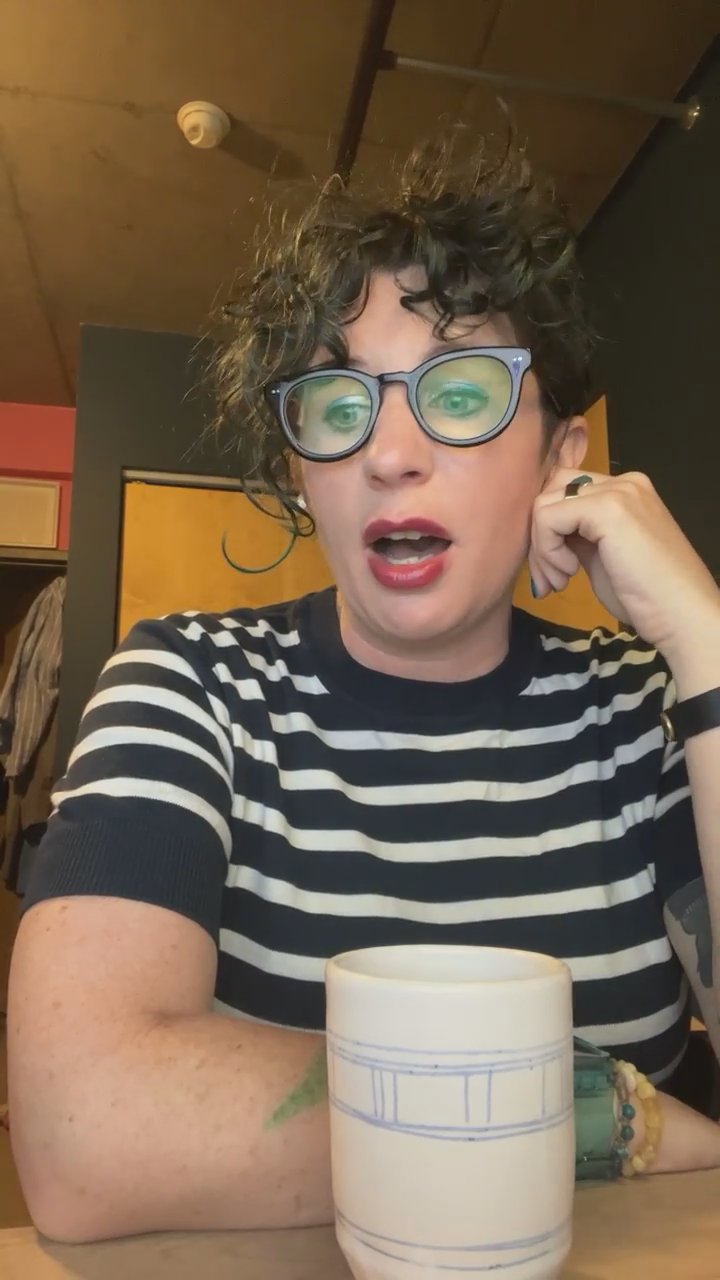
I’ll be chatting LIVE about what indicators we can start looking for in ourselves to help us take breaks before we reach our absolute limit. And spoiler alert: we have to give ourselves permission to actually TAKE breaks. See you soon!
Hi, folks. So excited to be here on this live stream with you. These live streams are something that I want to start doing at least once a week. We're going to dive into kind of the breaks, what it means to take a break.
Nikki Warby Parker has been working in the tech space for about 14 years. She says she noticed a lot of toxicity within leadership and not a willingness to hear employees. How people can take better care of themselves by looking for signs before it gets really bad.
Right now, it's essentially up to us about why we need to take a break. The hard part about this is, nobody's going to give you permission to do it except you. So you can keep pushing.
When there are indicators that you need to take a break, pay attention to what your body feels. Other indicators of stress are feeling extremely impatient about everything. If you just stop for a moment and take a few deep breaths, you can come back to reality.
When we feel burnout, or pre burnout even, is sleeping. Box breathing helps regulate your nervous system when you are in fight or flight mode. Even stepping outside for 10 minutes can completely shift your energy. Here are some real life examples of how to take a break.
This weekend when you are in a relaxed state, take some time to pay attention to what it feels like to feel relaxed. We have to give ourselves a break, even though we feel like we can't. You're not going to be able to push forward with your best self when you're burnt out.
So I do this a lot if I'm frustrated. Write down what relaxes you when you start to feel that stress heading towards burnout. Just call it out, give it a name, go to your list. Have a great weekend, everyone.
Hi, folks. Thank you for joining me today. So excited to be here on this live stream with you. Sorry if I sound a little strange. I'm at the very tail end of a cold, so you get that. But I have my iced coffee here my partner makes that I'm obsessed with, and I'm excited to talk to you all today. These live streams are something that I want to start doing at least once a week, and I'm going to talk a little bit about who I am and what I do, and then we're going to dive into kind of the breaks, what it means to take a break.
Hi, Nikki. Hi. So I have been working in the tech space for about 14 years, and prior to that, I worked in the mental health care space for about. Well, I worked in mental health and then worked in nonprofit space for about 14 years. And during that time, I was a people manager for the first time ever. I was a little baby when this happened. It was in mental health. I was 27. I didn't know what I was doing, but I started really paying attention to how people behaved. My employees, I had about 14 employees.
I was an administrative manager at an outpatient mental health clinic. And oftentimes my employees seemed more stressed than the patients coming in. And I thought, this is really interesting. I wonder what's going on here? And what I soon discovered was a lot of toxicity within leadership and not a willingness to hear employees. And there was just a lot of breakdowns happening while this is happening. While I'm working at this mental health clinic, my dad retires early from work and has a psychotic break.
And if you're unfamiliar with what a psychotic break is, it is essentially you enter a realm of kind of non reality because he just had been so stressed his entire career, he worked in sales, that he let it crush him. And after years of dealing with, you know, getting him in and out of treatment, and I think a total of 6 attempts to die by suicide, he finally found some support. And once he did that, I had stepped away from the mental health space because I'm like, I can't take care of my dad and do this right.
And ended up in technology, but ended up on the people side in technology, which kind of leads me to where I am today. So the reason I'm talking so much, of course, about my dad and burnout and all that stuff is because he and I still have conversations about how that could have been avoided and what he could have looked for as signs to make things better and to take care of himself. But this was the 80s, right? And 90s. Like he was told, you don't sell, you don't eat. You've got that traditional, you know, wife, kid.
You don't talk to them about your problems. You don't talk to your boss. There's some, you know, friendly competition in sales. But this was, according to him, beyond friendly competition. This is intense, right? But as I've continued on in my career, I have really seen people go through it. I mean, from working remotely during the pandemic to trying to do the return to office stuff. Like none of us know what we're doing and we're exhausted. Right. I think we're all tired. And as a matter of fact, right before this, I was getting ready and I couldn't find my glasses and I started to go into frantic mode.
And my partner had is wonderful. And she helped me find them. They were on my desk, on this chair in my office. And it's because it's been a week and I know that I'm starting to have something, have some of these signs of burnout. So there couldn't be a more fitting time for me to talk about this. I'm a solo business owner. I spend a lot of time coaching executives doing trainings around psychological safety, organizational behavior practices, and how we can measure those things in real time. But also I help a lot of leaders take care of themselves.
Thank you. Nikki Warby Parker. How people can take better care of themselves by looking for signs before it gets really bad. And so a lot of the things that I have started to see, even in myself this week are things where I know I need a break. So when I talk about breaks, when you talk about this with clients or in classes, I often ask people what they think of when it's taking a break. Some people say taking 15 minutes. Some people say, you know, taking a vacation. And the point of that is you get to determine what that looks like for you.
The hard part about this is, and I mentioned this when I posted about doing this live, nobody's going to give you permission to do it except you. So you can keep pushing and have people say, wow, it seems like you should take a break. Nobody's going to say you have to do this. Right now, it's essentially up to us about why we need to take a break. So I want to talk a little bit about what it looks like when there are indicators that you need to take a break. Right. So for everyone, this is different.
But I always have folks start with paying attention to what your body feels. So our Nervous systems are telling us things all the time. Unfortunately, in 2025, a lot of times we don't pay attention to what those things are, or we just ignore them and keep pushing. Right. I'll give you an example. So if I'm in a meeting with a client and it's really intense, I'm going to be internally more reactive than I usually am because I'm super stressed out. This looks like what you probably know or maybe you've heard of for fight or flight.
So it's what I often refer to and what you can read about all over the Internet as the amygdala hijack. Right. So our lizard brain, the oldest part of our brain, is what's kept us alive as humans. It helped us outrun saber tooth tigers and all those things. Unfortunately, when it goes into overdrive for us in intense situations like that, when we are stressed, we cannot logically compute on a neurological level. We cannot come to things in a calm space. So for me, this is a huge sign that I'm maxed out.
I know that that is happening and I need to take a break. So this is just an invitation for you. If you are starting to find yourself really reactive in meetings, if you're maybe crying more often than usual and you can't figure out why, give yourself a minute to just pause and listen to your body. So when I say listen to your body, yes, you're obviously having this neurological response, but in your body and your nervous system, you might feel clammy hands. I get a flushed throat, my heart starts racing.
I know that something's up. But it has taken me my entire career and I'm still continuing to grow and learn, of course, along with everyone else when those things happen and what to do about them. So other indicators of stress are feeling extremely impatient about everything. Right. You know those weeks where we're like, ugh, I'm just having a week and I just. I can't get my. Get my stuff together and we start talking really fast and blah, blah, blah, things start feeling really frenetic. So if you start feeling that really frenetic stuff, I'm wondering what happens for you in your body.
Obviously, you're speaking fast, but what happens when you're frenetic? It's often, like, running around. For me, at least it looks like running around. My mom exhibits a lot of this and she knows it. And I always call it squirrel energy because she just, she's running from one thing to another and she can't slow down, blah, blah, blah, and just I'm so, so busy. If you just stop for a moment and take a few deep breaths, you can come back to reality and then discover that, yeah, I'm probably feeling a little bit crispy.
Maybe it's time for me to take a break. Another thing that I want to mention that I think is often ignored, or we don't really think about it as being a part of the burnout cycle, or pre burnout even, is sleeping. So I see this. Look, I've heard clients talk about this in two different ways. It either looks like wanting to sleep all day, right? You're just exhausted. You don't have any energy left. The things that you usually love to do don't feel so great anymore, and. Or you can't sleep, or you wake up in the middle of the night.
And for those of us women who are either perimenopausal or menopausal, that's going to play a factor too, right? So all of these things together, we, especially as Americans, have a tendency to just push as hard as we can, right? We're just expecting the most out of ourselves, but we would never expect that of someone else, right? Hopefully not. So the question is, what do we do about these things? So when I've talked to my dad about this and I've said, you know, what do you think you could have done differently?
What could have felt good for you in that moment? He said, asking for help, number one, with a bullet, just asking for help. Sometimes we're so overwhelmed, we might just blurt, I need help and start crying. And that is okay. So for me, number one, when I start feeling these things, I start to think about, who are those helpers? Who are people that I can maybe lean on right now if I'm feeling really stressed? Maybe it's your partner, maybe it's a wonderful set of friends. Maybe it's family. Maybe it's a forum you belong to online.
It really doesn't matter. What matters is being able to outwardly process it and put a name to what's happening. Because we know what happens if we don't pay attention to starting to feel burnout. These are things like, exactly what my dad experienced. This is severe depression. This is crippling anxiety. This is all sorts of things. And above and beyond that, you know, suicide, which is obviously the thing we want to most avoid. But I want to go way reverse engineer all this stuff to have us start thinking about before we even get to a point where we're like, whoa, I'm beyond crispy.
I Gotta take a break is how to start paying attention to that stuff. So this is just an invitation. Maybe over the next, let's say on Monday, I want you to just take note of how your body feels as you move through the day. Do you feel overloaded? Do you feel stressed out? Are you sleeping well? Are you not sleeping at all? Are you having more cocktails than you'd care to? And that's not going to help, right? Are you just kind of shutting down? Like, this has happened to me before and it actually happened recently.
I was working on a presentation and I was in the midst of a cold. Like, why am I working while I have a cold? I'm like, well, I have to do it, but I don't. Not all at once. So I just found myself staring at a blank screen and I thought, I need a break. And actually that's kind of what prompted me wanting to do this live. So I wanna give some real life examples of what these breaks might look like, you know, before we have a breakdown. Let's take a break. If you are super strapped for time and you're overworked and really just feeling it, even stepping outside for 10 minutes and just taking a walk around the block can completely shift your energy.
It's going to move things around. You're not just staring at a computer screen. You're going to be able to just take some time for yourself to just chill out. Another thing that I'm a huge fan of is something called boxed breathing. It will regulate your nervous system when you are in that fight or flight mode. So when you are feeling the most stress, when you're feeling like you just can't get it together, you're on the verge of tears, you're having a panic attack. Whatever's happening, for those of us who have had panic attacks, we know the absolute joy of having them.
Not they're terrible, but box breathing really helps us kind of realign. And what box breathing is, it's just simple breath. You breathe in for four, you hold for four, you breathe out for four, you hold for four. So doing that for as many times it can, right? Maybe set a limit for yourself. But even me doing this motion, right, it just kind of brings us to a place where we can kind of settle a little bit, right? Like, I already feel more calm just from even walking through that exercise. What we really love to do as human beings, and we do ourselves such a disservice, and myself included, is we think we don't need the breaks.
We think it's not Going to make that much of a difference, right? Or when we say we need a break, we're like, yeah, I need a break. I need like a month. Well, that might not be realistic for us. We've got kiddos, we've got pets, mortgages, things that we have to do, right? So if taking a month off or a week off isn't an option, what can we do with the time that we have now? Okay. If there isn't some hard pressed deadline where you have 90 seconds to get it out, which usually is not the case. Right.
How can you time box for yourself? A little bit of space to take care. Right. So what I have found to be really helpful is even setting half an hour on my schedule that if somebody, if a client tries to book me on calendly, they see that I'm busy. I know that I'm busy. But I have to make a note on there that says break, take a break, whatever that looks like. Yesterday I didn't have time for my morning walk with my dog and I was feeling really stressed and I thought I'm gonna just go for a jog around the neighborhood.
And a client texted me when I was jogging and it was, I mean, my phone is on so they texted me. It was nothing they needed in that moment. But even that is like jarring, right? Because you're trying to take a break, but technology is everywhere. And I thought, you know what? I think next time I run, I'm not gonna take my phone, I'm just gonna go. Because if it can't wait 30 minutes, it can wait 30 minutes. Like more than likely it's not going to be an emergency. Right? But it's about really creating time for ourselves to just take a break.
So this weekend when you are in a relaxed state, I just wanna invite you to take some time to pay attention to what it feels like to feel relaxed. Okay? Like maybe you're sitting on your porch and you're just relaxing outside, maybe you're playing with your kids, maybe you're having dinner with friends, whatever that thing is, pay attention, Just check in for a minute about what your nervous system feels like. It might feel just more like relaxed in the shoulders, less jaw tension. All of these things are happening all the time, but we're all moving so quickly we don't really pay attention to it.
Right? So I want you to do that and then I want you to give yourself a little bit of time to think about what could a break look like for me if I'm feeling really stressed right now? And whether you have a job or not, if maybe you're on the job hunt and it's exhausting you. I just had time with a friend yesterday who's been looking for months for something. They had to pull money out of their 401k. They are beyond stressed out. And so then it's the. And. And have just been looking so hard and just nothing is coming.
And I think in those moments, it's like we're beating our heads against a wall. We have to give ourselves a break, even though we feel like we can't. You can and you need to, because you're not going to be able to push forward with your highest and best self in front of you when you're burnt out. End of story. I have actually a story that I was really, really stressed out. I was working at an organization where I was just overloaded. I had to give him presentation. And on my way to give said presentation, I pulled something in my back because my body was screaming at me and I didn't even do anything.
I just, like, moved my shoulder wrong. And I'm an active human. I, you know, take walks every single day, like to go indoor climbing, that sort of thing. Doesn't matter. My body is like, hey, you are not listening to me. I am serious. I need you to find a way to take a break. And we know these things, right? And when I pulled that muscle, I just. I was not surprised. I thought maybe, yeah, well, this was coming. I was on my way to a presentation. Still had to do it. Did the presentation. But after that presentation, because actually I was traveling.
I was out of town. I went back to my hotel room. I was supposed to have dinner with a former client. And I texted her and I was like, you know what? I'm gonna need to stay in tonight. I need to take time for myself. Because even though that would be leisurely time and I would love it and I love to see Jen and she's fantastic. Enough was enough. I needed to do something that was relaxing for me. So what this looks like for me sometimes is. And it's really potent medicine, especially if I'm traveling for work, get back to my hotel room, I get a takeout order, I crawl into bed, I put on some sort of old movie.
I love old movies. I feel like they're so just relaxing for me. There's just very cathartic. I grew up with parents who really loved black and white films. So I'll put on, you know, a Marilyn Monroe movie or something with Lauren Bacall or Whatever it is. And I will let myself just not work and just rest, just let yourself be still. I think right now being still is kind of the hardest thing for us. And it was just an evening, but that next morning I woke up, had to teach, you know, a workshop again.
I felt better, I felt less exhausted. So I experimented with that. This week I had plans two days in a row. I've been really busy at work and it's great busy. Like I'm. I love the work that I do and I think this is an important point. You can love the work you do and still get crispy as h***. That is absolutely possible and will happen. So I was two days in from, you know, had birthday parties over the weekend and it was fun. But then like Monday night I had something and Tuesday night I had something and last night I had an event.
So on that in between night on Wednesday, I told my partner, I said, all I want to do is just sit on the couch, relax, make some food and just chill. And so she made food, I took a bath. It was amazing because it wasn't super hot anymore. But even that the next day when I woke up, I don't think I could have done the event last night had I not done that. So I'm really trying to do this for myself as well. It's very important for me with the work that I do, teaching organizational behavior practices, but also wellness practices, that I'm taking my own medicine because it's not going to do me a lick of good if I have no idea how to do those things myself.
If I'm teaching, I better be doing. I don't want to teach with something I'm completely removed from. Right. So just a few takeaways and if you want to share anything that's coming up for you that you're taking away, please go ahead and do so. But just pay attention this weekend or even today, if you have moments of relaxation, what it feels like in your body, jot it down in a journal. I'm a huge fan of post its. My desk is usually covered in them. Just pay attention to how you feel and take note of that.
Take note of the things that help you relax. Is it an old movie? Is it going for a walk around the block? Is it giving yourself a 20 minute power nap? Which I'm a huge fan of because if I go outside that 20 minutes, I'll wake up on another planet three hours later. It's not great. So I want you to pay attention to those things. And then on Monday when You have that list of stuff, and you start to feel that stress coming up. I want you to think about how you can take a break. Before you break what is something you can do.
Maybe It's a silly YouTube video. Doesn't matter. You don't need to be prescriptive about it. Just see what comes up for you in those moments when you're feeling overwhelmed. I want you to also just do this and give it a name. So I do this a lot if I'm frustrated. Actually, my own coach taught me this is when I'm feeling overwhelmed or I'm feeling anxiety or feeling really stressed. I put my hand in my chest and I say, oh, hey, anxiety. And I give it a name. So I'm like, okay, that's the catalyst for me to do something else.
So I invite you to do that with yourself. Write down what relaxes you when you start to feel that stress heading towards burnout on that upper slope of a roller coaster. Just call it out, give it a name, go to your list, see what you can do. Go hug your dog, go pick up your cat if they like being picked up. Just give yourself some time. Thank you so much for joining me today. This was great. I really, really appreciate you all, and I hope you have a fabulous weekend. Thank you. Have a great weekend, everyone.