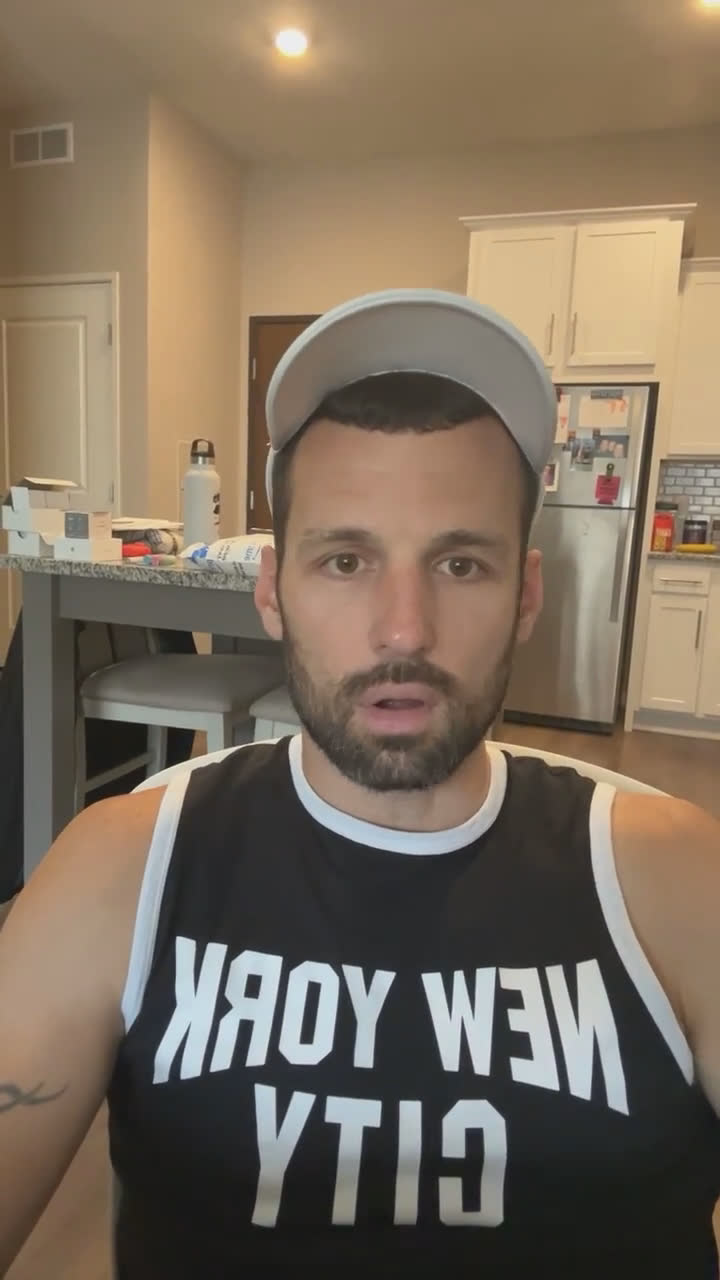
Jason Lennox is your resident recovery champion. He talks about mental health, recovery from substances, alcohol. There's so much that comes with serenity and peace. It's been hot and humid here this week. So good to see people getting out and about now.
Jason Lennox is your resident recovery champion. He talks about mental health, recovery from substances, alcohol. There's so much that comes with serenity and peace. It's been hot and humid here this week. So good to see people getting out and about now.
Jules: I am pretty vocal about my recovery. In fact, I speak about it very openly. I want to share three reasons why. I think it's very important that all of us share now. Me sharing allows and creates space for other people to do the same.
The author says he wants to educate society about addiction and recovery. He says when he shared his story with the general public, it made sense to them. Because of social media, he has up to seven active messages going on every night.
I hope you have wonderful vacation wherever you're going. I will try to get to you here Sunday night from the Outer Banks. I'll be in North Carolina leaving Tuesday, so make sure I have some service. Until then, I hope you all have wonderful weeks and that you stay cool.
Hey, good evening, Cadre sphere. Sunday here. I hope you've all had wonderful weekends here in my neck of the woods, which is in the metro of Minnesota. Hopefully you've been able to stay cool. It's been hot and humid here this week, so this weekend, very hot and humid. I am Jason Lennox, and I'm coming to you with Sunday serenity and who I am as a. As I like to say, your resident recovery champion. So I talk about all things recovery. I'm a champion of this work, in this work, about this work, just everything recovery, which for me includes mental health, recovery from substances, alcohol, all the things.
And, you know, I just think there's so much that comes with serenity and peace. Just lack of that is what drove me to substances, to alcohol, to all the things that kept me very unhealthy. So that's a little bit about me and Sunday serenity. Hey, good evening, Sherry. It's always good to see you. By the way, where were you? I saw you look like maybe you're out on some water or something this weekend. It is that time of year. Minnesota people. So good to see people getting out and about now. But one thing I want to talk about here tonight, something I thought about.
I am pretty vocal about my recovery. In fact, I speak about it very openly. I share about it on social media very openly. I've got a memoir that I publish, so it is literally out there for the world to see my story and all the good, all the bad. Hey, good evening. Speak Wonder. Good to see you. So I, you know, I learned from early on that what actually kept me in the rooms of recovery was the fact that there were people who shared their stories and shared with me. And so because I've heard that and because I could connect to people, it kept me around long enough.
And so I always knew that it was my job to share with others. And I grew up in recovery in a really good circle of people who said, this is how you're going to actually do this. Yeah, thanks. Thank you. Thank you very much. It was a journey publishing that thing. I knew from early on that it was about sharing. And I want to share three reasons why. I think it's very important that all of us share now. I used to go to these meetings in early recovery where people would say, if you don't have a year, six months, whatever the case might be of recovery, then this isn't really the meeting for you to talk.
And that used to drive me absolutely nuts. I just thought, why would we not let people who Are early on in this program. Talk about recovery. It just didn't make sense to me. And you know, the concept behind it is, oh, you haven't learned enough. But what I remember early on, my first AA meeting that I went to, they did a bunch of pins, they handed out medallions. I really only remember two. One was somebody who got a new medallion, a 24 hour chip, which is a somebody coming into the program, the rooms of recovery for the first time.
And the second was a 30 day medallion. So I remember thinking, 30 days, wow. I think I'd been in treatment for like a week. So if I could get three more weeks, I could get that 30 days. Those are the two I heard. Now I'm certain they gave away a bunch more. But it was important for me to hear that. So I never really agreed with don't let people share. I think the person who's got one day has something to offer the person who doesn't have any days and who's just trying to figure out how to get to one day.
So I think it's very, very important that we share. We all have a story. And this is, you know, obviously we talk here, recovery, addiction, substances. So we share from that lens. But I think in general it's good. I'm going to tell you three reasons. One, me sharing allows and creates space for other people to do the same. Like I said, the people who shared early on with me gave me the opportunity, gave me the courage, gave me the motivation to actually share myself my own story. So when we do that and people witness that, people see that we're willing to open up and talk about things.
It just creates room for them to do the same. And we all have, let me tell you, we all have things we need to talk about. I wrote that book. I had people that I knew that it would touch people who are going through it, people who connected on the recovery side, great. I had a second audience that I knew I really wanted to understand and to target and they would get it. And that was the family and that was the loved ones and the people that you know around people in recovery who would start to make a little more sense of what it is.
Because it's a. It's a journey. That book is a journey through the mind of somebody who struggles. Good evening, Jules. Good to see you. Thank you, Sherry. Oh, some boating, getting ready for vacay. I'm going on vacay to North Carolina outer bank. So hope you're going somewhere fun. But I didn't realize there would be A third audience that would catch on to that book. And I had people in my family, like a cousin, for example, wrote and said, look, I don't know if I've had these kinds of problems with drinking, with alcohol, not from that lens, but man, growing up like that, and the mental health and the struggles and all the things that not being good enough, that landed.
And that is exactly how it felt. So anyway, it creates a space for other people to share, which is absolutely amazing and necessary. The second reason, and I was trying to understand, like, how to order these, because these are all very important and critical pieces, but I'll talk about this. The second reason, the reason why I started to speak more and to write more was because when I spoke in front of groups that were not in recovery. So I did a lot of speaking early on in the rooms of recovery and treatment centers, things like that.
But when I started getting into the audiences, like fundraisers, people, just general public, I shared my story so vulnerably and authentically that people would come up and I would connect with people after. And I realized very quickly that people started to understand this thing when they heard from the lens of somebody who had actually gone through it. And I also realized that it wasn't what I always thought it was, which was that people just chose to look at me a certain kind of way. No, they.
They looked at me because it was logical to look at me and go, if you don't want trouble, if you don't want X, Y and Z, don't do A, B and C. You don't want to go to jail. Don't pick up the drink, don't pick up the drug. That's logic. That's a logical, normal way of thinking. So I realized when I shared with the general public and with our society at large, it made sense to them. And they started to change their minds a little bit because they actually got in the. In the. Into the. Into the story.
Like, when we get into other people's worlds, we start to see things and feel things a little differently. So that's very important. And by the way, I think that if. If I were to put that as the most important reason that I like to share, and then I think we all have share, it's because our world has such a problem with the stigma with this misperception, with the judgments, with all the things that come with addiction, substances. And that would be fine and dandy if it was just that people's perspectives were off.
But what ends up really happening is what happened in my Life, which is I. I'm not going to share because there's so much guilt and shame and remorse and just all the bad feelings that come from this stigmatized disease that I can't possibly open up and share with you that I have a problem because otherwise that means something very bad about me. Because again, we've got this misperception in our society. So for me, it was always about. That's why I wrote the book. It was always about educating our society as much as possible to understand what addiction, what substances, what alcohol, what recovery, what mental health, what all those things actually look like.
Because when we can do that again, people start to change and they start to relate a little bit. Oh, I'm not so different from this Jason guy. I just didn't happen to go down the paths of drugs and alcohol. So I think that's the second thing, the third thing that I find more and more every single year that goes by and every day, even that goes by. Again, I share very openly here on social media out in the world. And because of that, I have, at any given time, three to five to seven active messages going on, whether it's through Facebook, it's through text, but so much is through social media.
Just from the sharing from people that I've never met before, from people who get connected and just referred over just because they know that somebody's struggling with something. I say, well, I mean, I've seen this guy. I know he talks a lot about this. And so I don't always have all the answers. I'm not pretending like I'm the greatest recovery person in the world. No, none of that. But because I'm willing to share, I regularly have these conversations and again, I don't always know how those conversations are going to go.
I don't always have the right answers, but usually I can connect to people who do have the right answers or I can just talk people through. So I've got a few messages going just today about people, about loved ones. And you've been, Thursday night, I think, had gotten a message and got someone connected to an assessment within minutes. I mean, 9:30 at night. And those are the kinds of things that come as a result of sharing. Now, I will say this life gets pretty busy and it can be challenging. So we need to be ready for all those things, right?
We. That comes with something. There's some responsibility that comes with me wanting to share and educate our society and being called to actually, you know, show up and stand up and be there consistently. There's. There's something to be said about when I'm going to put myself out there and then I'm going to get the four or five messages in. That sometimes takes a little time. It, you know, it's resource, it's energy. So I. I have to be ready for those things. And so that's the only thing I say with some of this is we got to be careful how far we go.
But for me, this is my life. I'm always going to share as much as I can, and if I can't help every person, I'm just going to connect dots as much as I can. But I think it's very, very critical that we all get in the habit and the nature of really feeling comfortable sharing because again, it's the stigma, it's the fear, it's the guilt, it's the shame. All the things that keep us from actually sharing with others, we have to work through those because there are so many people out there who could benefit if we truly could really share deeply, personally and get our stories out there.
And I think at some point, when we get the life that we get out of this, we get to the other side, we have some relief, some reprieve, some serenity on Sunday. It's our jobs to then go out and do this and support and serve the rest of the people who are less fortunate. Because, you know, I was one of them for so long. I was just out there on the other end going, I don't know where this is going to go. I'm going to die. I know that's what's going to happen. I can't share these things. I didn't feel comfortable doing any of that.
Just let that guilt, shame just kind of build up, build up, build up, build up until I was ready to explode, which for me meant, you know, very suicidal thoughts, overdoses, more drugs, more alcohol, and, you know, wasn't going to be a good ending. And I'm thankful that I got out of that. But again, now it's up to me and all of us who've had an experience to share with other people, even if it's in passing. Maybe you're not comfortable on the social media, but I'm telling you the stories, the connections, the things that have happened, and we tend to cut ourselves short and not really think that we're capable of adding a lot of value.
I can tell you that this is all relative. And so my little connection where I text a buddy and say, hey, I got someone who needs help. Can your department. Can you get Them out to this program. Phone number exchanged, Boom. I make the connection that took me, you know, I don't know, I'll call it 20 to 25 minutes of my night. To the person on the other end, it's the rest of their life. It's, it's, it is life saving. So it, again, like making one little connection for us is a very small thing for someone on the receiving end who doesn't know what to do.
They don't know how to handle this. This is life changing. This is life saving. So I think again, it's very important that we look at it that understand that we all have something to offer. If we've gotten through the h*** that we've gotten through, I promise there's something we can take to the rest of the world. And it's very important that we do that or we will still continue to see people die at record numbers because, you know, they're not comfortable sharing. So sharing is, you know, a huge deal for me.
And again, one, it creates space for other people to share, which is just huge and creates for some amazing conversation. Two, it educates our society, educates the people who are just ignorant. Ignorance isn't a bad thing. It just means they don't know. It's not. What I've almost always found is that people want to believe something bad about us. They just don't know any difference. So two, educating. And then three, it creates opportunities for us to give back and to make connections and just open doors that save lives in very simple ways.
So those are three reasons I think it's very, very important to be sharing with the rest of the world. So I will keep doing that. I hope you do too, and you pick up on some things. Sherry, I hope you have wonderful vacation wherever you're going. I will try to get to you here Sunday night from the Outer Banks. I'll be in North Carolina leaving Tuesday, so make sure I have some service and I'm in a good place out there. Maybe we'll do a little walk on the beat or something. Until then, I hope you all have wonderful weeks and that you stay cool and we'll talk to you again soon.
Bye. Bye.