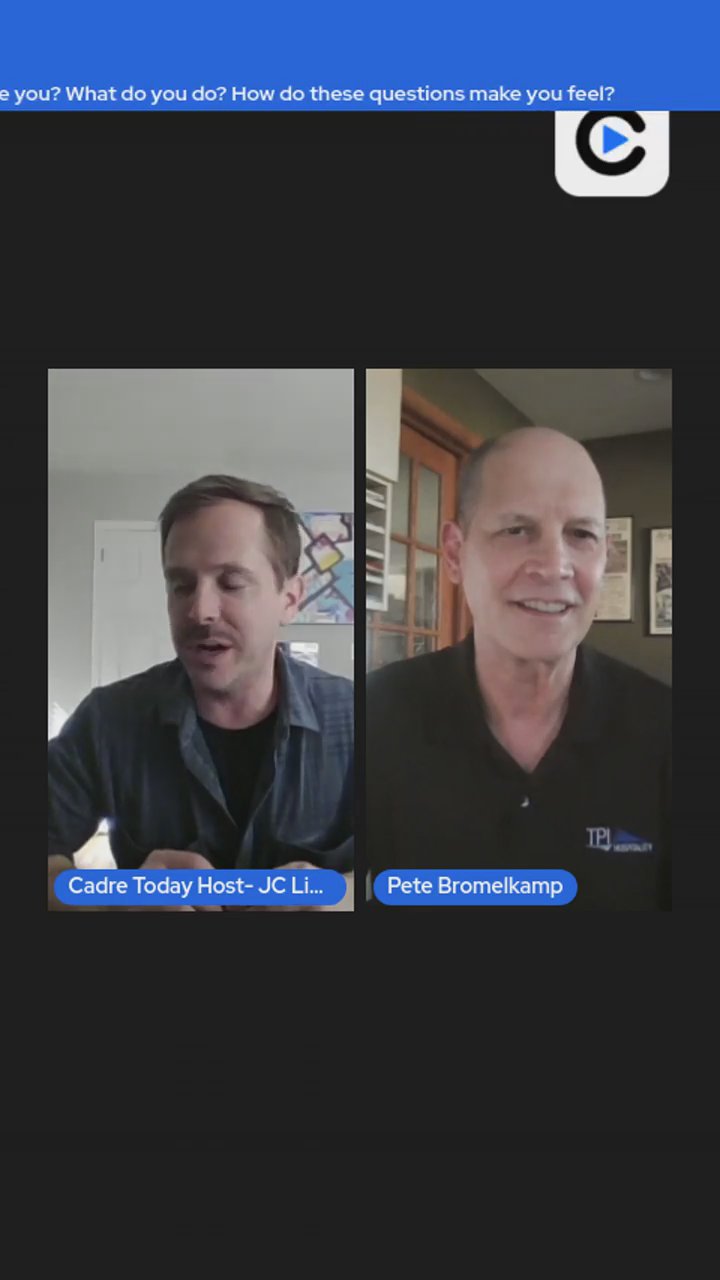
As we kick off a new week, join TPI Hospitality's CHRO, Pete Bromelkamp, SPHR on the Cadre App as we discuss building a healthy workplace culture. Consistently named as one of the best places to work, we'll tap into Pete's vision in practice.
Cadre Sphere welcomes back Pete Brommelkamp, chief human resources officer for TPI Hospitality. It's a sunny Monday before we have another blizzard up here in Minnesota. I'll be going down to Margaritaville later this week, so I love it.
Today's topic of conversation is how do we build a healthy workplace culture. For a company that is year after year named one of the best places to work, there's no better person we could have in conversation today. If you have questions at home, everybody feel free to share.
Pete Brummelkamp is chief Human Resources officer with TPI Hospitality. Says his goal is to make sure that at tpi, we're always doing the Right thing for the right reason. Says it can feel uncomfortable at times, but if we do the right thing, we can empower our people.
We asked Pete if he would share some about how one builds a healthy workplace culture. TPI Hospitality wins the awards for being a really great place to work. Our focus is always to create just an amazing environment for our people to work in.
Pete: How do you build a healthy workplace culture? JC: We have a recruitment team that works hard day in and day out to make sure that we're Hiring the right people to join our family. What they're looking for is someone who's kind. And that's how you create a environment where people support each other.
Ray Ray: How do leaders start changing a culture that's has a lot of opportunity for improvement? J.C. i: TPI's greatest opportunity to continue to grow is to empower our people. You're always going to be more successful when you allow people to create their own success.
Pete Bramble: Who is this mentor that you're referencing and where do they cross in your life path? He says we can't worry about taking care of the guests. We got to take care of our team. And that's what creates the win win outcome.
Pete: What would you take away from this conversation? Jc: Seek to understand, respect the fact that the person working next to you is different. Our purpose is to serve others to create win win outcomes. Next Cadre TODAY interview will be on Saturday with Alex Muir.
It. Well, good afternoon, Cadre Sphere. It is always a treat when I get to see it twice in a day. So we kicked off the week this morning, and now I'm back with one of my near and dear friends, Pete Brommelkamp, chief human resources officer for TPI Hospitality. How are you doing, Pete? I'm doing great. How are you? I am great. It's a sunny Monday before, as we were talking before we went live, before we have another blizzard up here in Minnesota. So I think it's time to head to Margaritaville sometime soon.
Yep, yep. I'll be going down there later this week, so I love it. Not in time to get out of this snow, but that's okay. Yeah. Well, hey, everybody, if you're at home going, hey. So. So why did I just get a notification to jump into my Cadre app? Well, we as we bring together professionals and peers to share resources, to knit together this community, to show there's many ways to being well. We use this interview, this conversation technique every once in a while to invite you into the conversation of professionals and peers, of people who are out in the field living life, and for someone like Pete, supporting other people's journey in this world as well.
So today's topic of conversation is how do we build a healthy workplace culture, which when you're living the C suite life. For a company that is year after year named one of the best places to work, there's no better person we could have in conversation today. So, Pete, just so you know, I'll be letting you know who's tuning in. I have the Cadre app open right here so you don't have to Colleen and Shannon and BC 62, say, hi, Pete. Go, Pete. With lots of exclamation points. You bring the exclamation points, my friend.
All right. Love it. So if you have questions at home, everybody feel free to share. To share them in the chat, and I will let Pete know when they come on up. So. So, Pete, we always start these conversations by asking, who are you? What do you do? And whenever you're asked those questions, how do they make you feel? So give an introduction and then whenever you have to talk about yourself, how does it make you feel? Yeah, I'm Pete Brummelkamp, chief Human Resources officer with TPI Hospitality. I've been doing this for many, many years.
You know, when people ask me about what I do, the easiest way jc for me to communicate this is that my goal is to make sure that at tpi, we're always doing the Right thing for the right reason. It's really as simple as that. Now, there's a lot of things tied to that, but that's, that's how I judge my own success, is whether or not we're doing the right thing for the right reason. And it can feel uncomfortable at times. But, you know, I believe that if we do the right thing for the right reason, we're going to be in a place where we can empower our people.
And I think that's incredibly important. Those tpiers that are watching or that see this at some point, they know that our vision statement is, whatever it takes, you have the power. And that means we need to empower each other. And, and I need to understand that I'm empowered as well. So it can feel kind of awkward at times. But again, if we continue to do the right, right thing for the right reason, we always land in a good place. Yeah, well, and Pete, you just said it, you know, in my head, I'm going, how long is it going to take Pete to get to when he starts talking about his people?
Right. And it took you about six seconds because that's, that's, that's the name of the game. Like, you're in the hospitality business, which by definition is about people who have different needs and preferences, and they walk in with different moods and attitudes and emotions. So for you to say, hey, right thing, right reason, right time, requires us to empower the people who have the opportunity to provide that for one another to look up the organizational structure or down the structure or for all the people that you're serving.
So I appreciate that you bring that to the place of. And there's going to be anxiety associated with that. So that's the heart of the conversation today. Right. We asked Pete if he would share some about how one builds a healthy workplace culture. So, Pete, I'm wondering if, first of all, you can talk about TPI Hospitality as an organization. What's your business? Where is your business? And then how has your business been received? Because as I mentioned in our opening, TPI Hospitality wins the awards for being a really great place to work.
So talk a little bit about tpi. Well, first of all, let me just say, jc that TPI really doesn't win the awards. It's our associates that are winning the awards. Because I'm telling you, we are so humbled and so blessed to have almost 1500, probably over 1500 people right now that work at TPI. You know, we say all the time that we're not perfect. We're downright dysfunctional at times, but that's okay. It's okay to be that way. It keeps us grounded. It helps us continue to focus on getting better every day.
And, you know, when we get these awards, best places to work for the last two years, yeah, we feel very blessed to be able to, to even say that. But it's, it's. It's the room attendants, it's the cooks, it's the front desk agents, you know, it's the, the maintenance personnel. It's all those people that are making things happen day in and day out that make us who we are. And yeah, we, we try hard to, to help provide a great environment for them to work, work in. And sometimes we do really well at it, and sometimes we fail at it, but that's our focus.
Our focus is always to just create just an amazing environment for our people to work in. I. I don't know if I have a magic potion or not. It really, really comes down just to, just to creating that culture and treating the people the way we want to be treated. Well. And like you say so often in, you know, so again, for, for those of you at home who don't know TPI Hospitality in the Cadre world, TPI Hospitality was one of the first entities to really see what Cadre was, was, was, was putting into the world and the value of it.
And Pete, like you said, there isn't a magic formula. You know, I wrote down we are downright dysfunctional. But then you put two words after it at times. That's what humanity looks like. You know, every single day, Cadre starts with this phrase, we hope you're doing great, but if you're not, that's okay too. Right? Life is always in this evolution that if people walk into work going, you can't make a mistake, you always need to do it. Quote, quote, right. That creates a certain unachievable bar for people to jump over.
So maybe as you talk about, you know, some of the ways that you build a healthy workplace culture, how. How does that look in the day to day? Like, like what are things that if, if I'm a TPI hospitality employee, team member, what are things that I know that make me, that empower me in the TPI world? Well, let me. JC Let me just step back a little bit and talk a little bit about how you become a TPI associate. Oh, cool. And I think that's really important because, you know, we have a recruitment team that works hard day in and day out to make sure that we're Hiring the right people to join our family.
And it's definitely a family. I don't, I don't. I can't stress that strongly enough. And so our recruitment team is out there and, you know, we'll post a job. The recruitment team will post a job online and they'll start getting applications coming in. And sometimes within minutes of that person applying, our recruitment team picks up the phone and calls and makes a personal phone call to them. And then they spend 10 or 15 minutes just getting to know that person. And they really focus in on getting to know who that person is and whether or not they might be a good fit for the TPI family and the TPI organization.
And again, it's not a perfect science, but ultimately our recruitment team kind of has a tagline, is that we hire people, we don't hire resumes. And they're so good at doing that. I can't speak highly enough to the members of the recruitment team because they go out there and they do make a personal connection with that person. And, you know, we try to make sure that it's a good fit not only for tpi, but for that person too, that candidate. And if, you know, if they believe that they might be a good candidate, then they pass that person along to the management team on property.
And then the management team on property kind of has the same attitude, is that we are looking for people that are going to be a good fit with our current associates. And ultimately, and I wish our recruiters were on here too, to talk about it, but ultimately what they're looking for, they're looking for someone who's kind. If they can just find a person that's kind, someone that you know is going to care about the person working next to them, that's incredibly powerful. And that's how you create a environment where, you know, people support each other and, you know, support is just, is critically important because I'm telling you, we all have the crappy days, right?
It just happens. And in hospitality, it can happen a lot more. Hospitality is hard work. And how gratifying it is when you can come to work to know that the person working next to you cares about you. And is that always the case? No, it's not. But if you can come to work more often than not, and, and you know, that person cares about you and in turn you care about them, that creates, what we talk about all the time is our win win outcome, which is our company purpose. We serve others to create win win outcomes.
So that is our ultimate focus. Those are the type of people we want to hire. And those are the people that are going to not only make TPI successful, but create a great experience. Like Pete, Like, I'm, I'm often a systems thinker, right? So, so as I, as I play out what you've said a couple of times, a lot of the work that TPI does, you know, it's hospitality focus. So we could, someone listening at home could right now go, okay, so, so Pete's focus is all about the person walking into the property, the person who is, who is going on vacation, the person who is laying their head down on the bed.
But Pete, everything you've spoken about is the recruiter creating a human connection with the potential employee and the employees creating potential life changing, positive connections with one another. And through that, that's what creates the TPI experience for the customer walking in. And I think that's a big thing, right? Ray Ray says, how do leaders start. This is a question for you, Pete. How do leaders start changing a culture that's has a lot of opportunity for improvement? And I think, you know, one of the things I'm already hearing you say is it's the internal work first, right?
It's like, how do we see one another? How do we take care of one another? Because that's what customers are going to buy from us. But what do you have to say about that question? What are those first steps for leaders who have influence and the power to impact in their organizations? What are things that they could do first to improve their workplace culture? C. i learned very early in my career. I had a wonderful mentor that taught me that. He always said, the moment that we start taking better care of our guests than we do our employees, we're in big trouble.
And I truly believe that because it starts from within. We have to take care of our people, we have to take care of our associates and allow them to be fulfilled every day when they come to work. You know, when we go home at the end of the day. And jc, you're no different when you go home at the end of the day, you want to feel a sense of accomplishment about what you accomplished during the day, not about what somebody told you to do all day long. That's why that empowerment is so important. So if I'm speaking to leaders of any kind of business, it's empower your people, let them create their own success.
You're never going to create ongoing success by trying to just stick to the rules and tell people what to do and tell them when they're out of line. You're always going to be more successful when you allow people to create their own success. And that's why I go back to that vision statement again. Whatever it takes, you have the power. And probably I will say TPI's greatest opportunity to continue to grow is to continue to empower our people. It's that simple. And if you think about any great organization, you know, you think about Apple or all these great companies that are out there, they empower their people.
And that's just so critically important to a good organization. Well, Pete, I mean, I'll go ahead and share because you brought up your mentor 16 years ago. I was just starting with a company, Core Power Yoga, and my mentor there, Vincent Amendola, he messaged me two days ago, and he's like, jc, we don't get to talk all the time, but I think about you often. And Vinny's one of those people that I quote all the time. Core Power went from being six states, 20 studios, to being many states, hundreds of studios.
And I was lucky enough to be the person who was going around the United states. I opened 33 studios in three years. And what Vinnie told me, he's like, take care of your people and empower your people to take care of the people walking in the doors. And Vinny's one of those people I look up to, and I go again and again, how do you grow a company fast? You said it. If you take care of your people and you empower your people to take care of the people walking in the doors, that's the name of the game.
Pete, for a moment, talk about your mentor. Who is this mentor that you're referencing and where do they cross in your life path? Well, this goes way back to my early days. I started my career, and I'm going to really date myself here. 78 an hour. 88, and I was on top of the world, man. I thought. I thought I was ready to take over the world. And as I grew with with tpi, Mike was one of my mentors. And that's one of the things he mentioned is, you know, we can't worry about taking care of the guests.
We got to take care of our team. And if we take care of our team, they'll take care of the guest. And then, you know, I know. I don't mean to Say this again, but that's what creates the win win outcome. You know, it's so important, you know, when we talk about whatever are creating win win outcomes, you know, we're talking about creating a great experience for our guests. Of course, we're in hospitality. We're going to create a great experience for them. We also want to create a great experience for our communities.
We want to be an important part of our communities. But most importantly and with an asterisk, we need to create a great experience for that person working next to us. And that's part of the win win outcome. And I'm just so fortunate. And I've had a couple other mentors too that I've worked with over the years that just have really kind of guided me and helped me, I think, just see the world a little bit differently than I used to. Yeah, yeah. You know, and, and, and the reason why, and thanks for sharing, Pete.
You know, the reason I asked that is so often we, we look inside, we go, it's okay, what's my answer? Where, where, where do I need to go? What, like what do I need to do? And it's so often listening to those voices around us like a Pete Bramble camp, who are, who are very much clearly showing, hey, what do you need? And how can I, how can I walk alongside you and provide that for you? A couple comments. Speakwender says we hire people, we don't hire resumes. Great. You know, just to amplify that again.
So wonderful. So, you know, as we come into the Cadre sphere and TPI hospitality, I know you're out there listening right now because you have, you know, Cadre as one of those benefits to help take care of you as you take care of, of each other and create a space for people to walk into. But we try to do things very efficiently, you know, in the Cadre sphere. You know, Pete and I could talk for forever, right? But these little moments in your day provide you the opportunity to go, all right, now I'm gonna get back to work.
So all you tuning in, you probably have takeaways, right? That for me and Pete, sharing back and forth a little bit or things that have been brought up in your mind. But at the end of these little 20 minute interviews, little meaning short, not little meaning inconsequential. We always ask each of you at home, but also our guests to share what a take home prize would be. You know, and what's a take home prize? You know, you just experience something. What's going to be that little Thing that, that you carry with you, that you put in your pocket, that that stays in your mind, head or heart today.
So, Pete, We've talked for 19 minutes today. What would you take away from this conversation and maybe encourage others to take away from this conversation so when they sign out, this stays with them and changes the way that they live, the way they take care of their mental health, the way they show up to work and impact those people around them. What would you take from this conversation today? Well, jc, I would say I want to just repeat a phrase that we use at TPI all the time and those people that are, that are on, have probably heard before, but it's seek to understand.
And we always talk about seeking to understand. You know, at at TPI we have, I think now it's over 1500 associates. So, you know, that means we have 1500 different opinions, 1500 different lifestyles, 1500 different perspectives. We're all different. Every one of us is different. But that's what makes us strong, that's what makes us great, is the fact that we are all different. But the important piece here is that we have to seek to understand. We have to understand that the person working next to us may not see the world the same way we do.
They might have different beliefs, different viewpoints, and that's okay, it's okay to be different, but we have to respect the fact that we're different. And so I use that phrase all the time is seek to understand, respect the fact that the person working next to you is different. And now when you do that, now you get back to our purpose is we serve others to create win win outcomes. Because one side can't win and the other doesn't. Both sides gotta win. So if we seek to understand and respect the fact that we, we have different beliefs or different viewpoints, we can create that win, win outcome.
So that's my, that's my, my golden, golden rule at the end is just seek to understand. I love that. Well, I mean, and, and again, you know, what are we doing at Cadre? We're showing the world that there's many ways to being well. And today you got this wonderful perspective from someone from within their, their business mindset. But again, we can hear within Pete. This is not only Pete when Pete goes to work, but this is, this is this, this is Pete through and through. Everybody, all you who are listening at home, consider what you need.
It may be different than that person sitting next to you or that or the name that you see pop up on a Cadre. Screen. So let us continue to provide for you what you need. If you have questions, comments, if you need content on certain, certain topics, please reach out to us and know that we are always right here for you. As we wrap up today, our next Cadre TODAY interview is going to be on on Saturday with Alex Muir who's going to be talking with us about breathwork and how do we create resilience within our lives through the things that make us all very, very human.
But in the meantime, prerecorded content, live streams throughout the day and you always have that community feed that you can bop into. So everybody at home, everybody, no matter where you are, thank you for spending some time with Pete and I and and we will see you soon. Pete, thank you so much. And let's hope that the blizzard on Wednesday is not too blizzardy. We'll talk to you later, Pete. Have a good. Thank you.