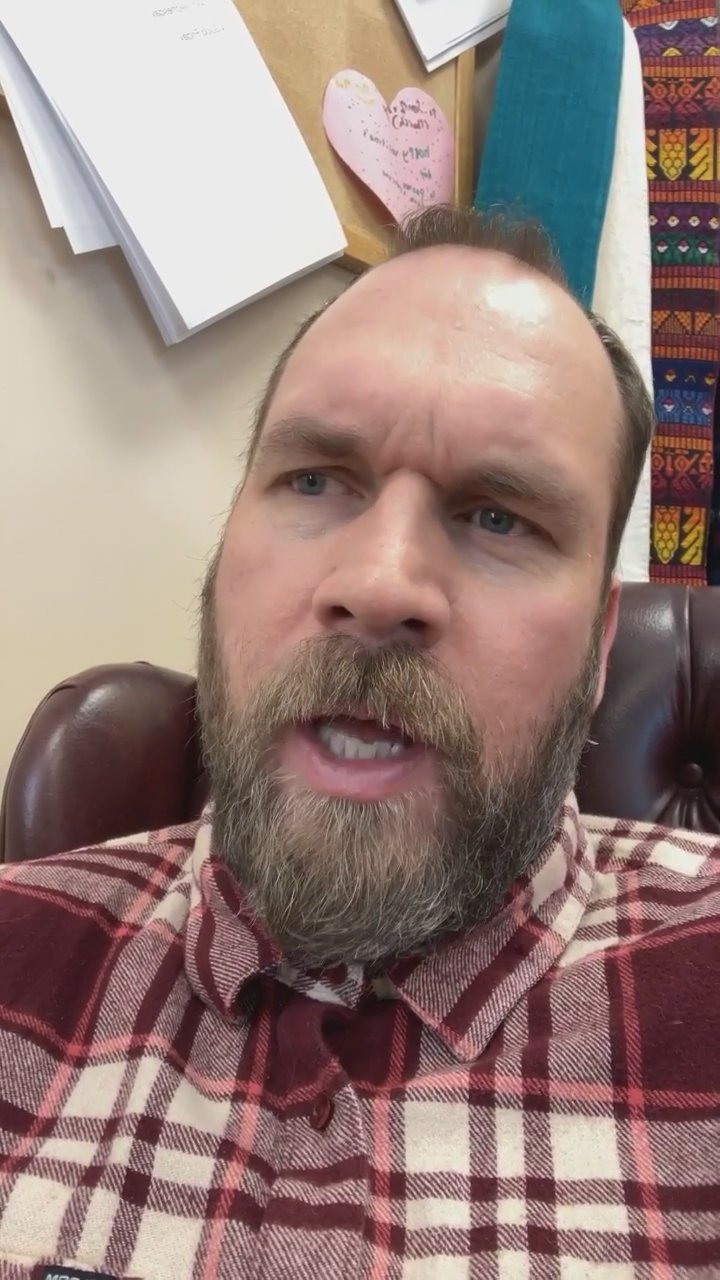
Pastor Seth Perry talks about putting someone else to the test. Sometimes that's harmful to other people to see, to test if their spirituality is strong enough in the Christian world. Faith communities need to work on being inclusive and not exclusive.
Pastor Seth Perry talks about putting someone else to the test. Sometimes that's harmful to other people to see, to test if their spirituality is strong enough in the Christian world. Faith communities need to work on being inclusive and not exclusive.
Hello everyone, and welcome to Talk Stigma. My name is Pastor Seth Perry and here I am in my office. It's a Sunday afternoon and I am going to talk about something that I was speaking about earlier today in church. And I'm going to be talking about finding out if someone else is worthy, testing them. So I've talked about this theme a little bit recently, but today I want to talk about it in this way. I want to talk about putting someone else to the test. Why? Because sometimes that's harmful to other people to see, to test if their spirituality is strong enough in the Christian world.
It's to see if you are, you know, are truly a Christian. Sometimes that kind of language is used and I don't think it's very healthy. So that's the focus today. So why? Well, I just entered the season of Lent and it's not a time, I've told everyone this today. It's not a time to test your faith. It's not a time to prove to anyone that you are worthy of the label Christian. So in all areas of my life, I kind of see this. So as a recovering addict, sometimes in recovery circles, people can be legalistic in the way that they, they see things.
You know, oh, that's, that's not a, you're not a true recovering alcoholic or you're not truly a part of this 12 step fellowship you have, you've not passed the test. Right. And, and, and even like in recovery circles, in mental health recovery circles, just in what specific way you approach mental health recovery? There's, there's, you know, different approaches, different, different ways to, to live well with a mental health condition. And I've seen people kind of test other people's recovery in that way as well.
Not effective. So here's my story. So my story is, you know, I was out here at the cafe near my church a little while ago and I was eating lunch. There are a few guys there in the cafe. And we all entered into a conversation, all three of us just random people eating at the cafe. Three random people entered separately. We are not. None of us came together. None of us knew each other. We were just three people sort of yapping across the cafe at each other about news about local, local geography. It was, it was just kind of old guy stuff that we were talking about.
Anyway, one of the guys then turns to me and, and Hello, Adel. Well, 23, glad you're here. And, and so one of the guys turns to me and he tests me to see if I'm from around these Parts. His question was, so, do you know about John Dillinger? And I was like, what. What are you even talking about? And apparently, as I looked up, there's some lore about this area of Minnesota and John Dillinger, that John Dillinger actually had a cabin out at one of the lakes that's real close to the church where I'm a pastor and all that.
And. And I failed the test, right? I failed the test to see if I was from around there. So that got me thinking today about if we ever do these types of tests with other people to. To test if they are authentic or not. And. And yes, yes, we do in. In faith communities especially. So why is it harmful? Well, faith communities need to work on being inclusive and not exclusive. Spiritual practices need to be in. In their essence, inclusive, not exclusive. And. And in a world where many people are excluded, in a world where, you know, politics is.
Is just seemed. Seems to be stripping away the. The rights of. Of so many people. You know, we need to create places that are inclusive, that are affirming, and that are welcoming. And that is why I say a spiritual path is not a place to test yourself. A spiritual path is not to learn things that then you can test other people on. There's a lot of knowledge, understanding, and experience that you get through spiritual practice, but it is not something that should be made inaccessible to other people.
That is my perspective on this as a pastor in recovery living well with bipolar disorder. So it's my encouragement to you to open up those doors, roll out the welcome mat, whatever that is. Yeah, you know, absolutely. And also do a little bit of outreach to places that you may be uncomfortable doing. Outreach. And that's my message for today. Faith, spirituality, religion, or just whatever sense that you may be fostering inside of you, whatever that is. If you're not comfortable even using the word spirituality, just know you never have to be tested.
You don't have to test anyone. You're enough. You are enough. So had a wonderful Sunday afternoon with you, and I'll see you again next week.