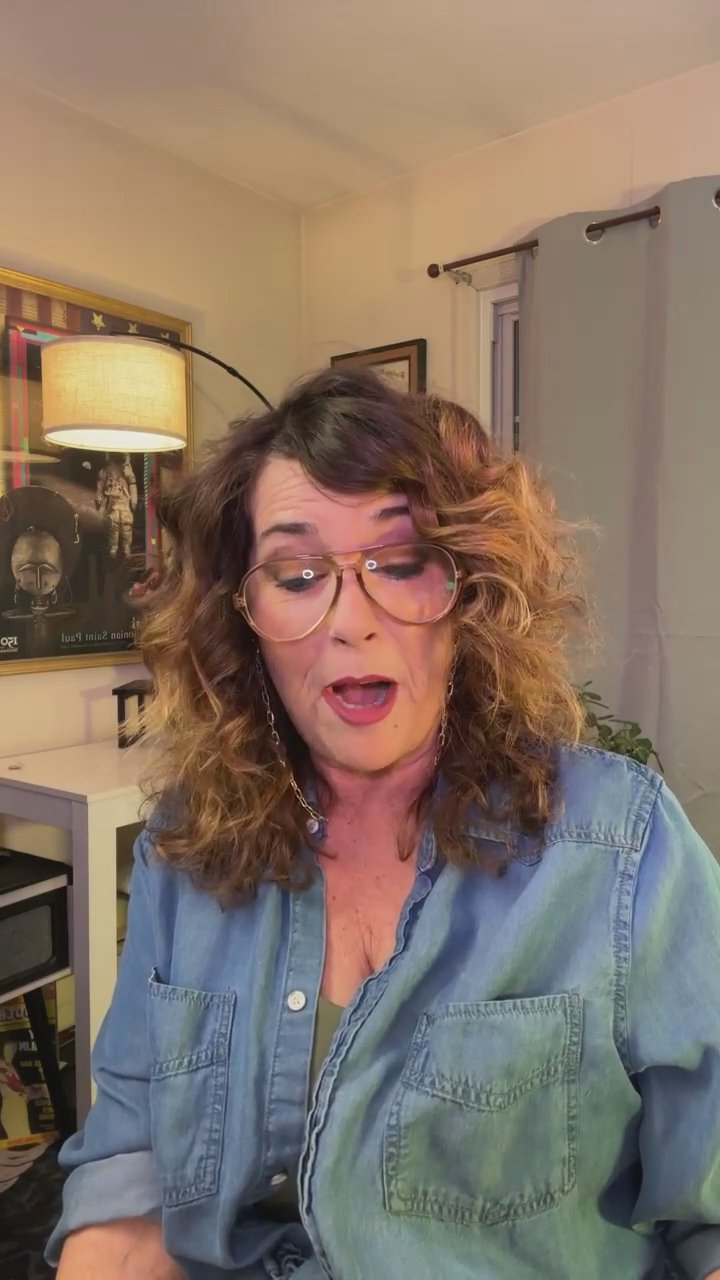
Tiffany Orton is a stand up comedian. She is a late diagnosis attention deficit person, neurodivergent and cptsd. It's called the wizard of Oz and other Narcissists. Narcissist personality disorder is an actual diagnosis and it's a certain set of behaviors.
Tiffany Orton is a stand up comedian. She is a late diagnosis attention deficit person, neurodivergent and cptsd. She tries to make sense of whatever doesn't make sense today in our world. Welcome new people to comedy centered.
I've got a new book for us this week that I'm gonna highlight. It's called the wizard of Oz and other Narcissists. Part of the reason why I spend a lot of time in this space talking about narcissistic personality disorder. Chime in, in the chat, if it is hitting anything or sounds familiar.
Narcissist personality disorder is an actual diagnosis and it's a certain set of behaviors. You experience your experience with an NPD person will be determined in large part by how he or she sees you supporting or not supporting their unconscious agenda.
The narcissist essentially experiences and understands others as if they were an extension of themselves. He therefore feels entitled to what you have without concern for true reciprocity or exchange. The most insidious and subtle dynamic underlying all interactions with the NPD individual is his unconscious capacity to turn his lack of boundaries into an asset.
The MPD person will not be threatened enough in the beginning of a relationship to immediately craft warfare. Far more common is the approach of absorbing you or your abilities. Unrealistic expectations will be greatly influenced by your ability to keep track of your own boundaries in the relationship.
Intimidation dynamic can also draw you into conciliate. This style of interaction is more often the pattern of a covert narcissist who draws you into a perception of how exceptional he is through an aloof and indifferent manner.
Another personality dynamic of power is the martyr role generally seen in a female narcissist. You are now in the unenviable position of being her irreplaceable support person. Allow your support role to develop slowly until you know how much energy and time you can afford.
The distraction dynamic is a continuous ingenuity for creating a sense of distraction. Distraction dynamics are often a defense reaction on the part of the NPD person. If you are not prepared and ready to stay calm and firmly stand your ground, you will quickly be pulled into the escalation of action reaction.
The distraction behaviors of the NPD person often involve subtle devaluing messages. Sometimes you may experience a devaluing dynamic immediately. When in doubt or on the spot, give yourself permission to to take time or space.
There's a lot of good nuggets in this one and it's a fairly easy read, pretty decent size print. First chapter basically analyzing how the wizard of Oz was. Was a narcissist. I think it's quite good.
A double message consists of two messages delivered simultaneously that are in direct opposition to one another. The narcissist experiences herself as inherently flawed and shameful. No matter what message you respond to, you receive the devaluing message from the opposite side.
All right, my guys and girls and all the pronouns in between, I love you all. For the love of God, try to stay centered this week. Just remember, we live on the earth. The earth doesn't live on us. And we've got to figure out a way to all get along and have space for each other.
Welcome, everyone. Hello. Hello. Happy Sunday. It is comedy Centered. Oh, that light is bright. Turn that down a little bit. Ah, getting shot in the eyes. How are you guys? Happy Sunday. I think we are just in between some football games. Sad news for the. The Washington commanders didn't. Definitely didn't go their way. Kind of a trouncing by the Eagles. Sorry, sorry. Spoiler, spoiler alert. Anyway, greetings. I hope Everybody had. Hello, Ms. Jules. Welcome, welcome. Hi. I hope everybody had a good weekend.
I. I always had some challenges, but you know what? We're gonna push through. You know, we're gonna. We're gonna keep. God, this light is driving. I think I'm just gonna turn it off. Driving me nuts. Hey, Luke. Hey. Becky's. I'm sorry, I'm screwing with my light. It's driving me. My. Okay, all right. There. That color. That color's better. I don't know what was happening. It was freaking me out. I'm like. Anyway. Hi, welcome to comedy centered. Welcome new people that have not joined before. My name is Tiffany Orton.
I am a stand up comedian and I am a late diagnosis attention deficit person, neurodivergent and cptsd. And trying to stay away from the old alcohol. So if any of those things relate. Also just trying to make sense of whatever doesn't make sense today in our world. But. So I try to inject some humor into all my stuff, right? I. I think there's some funny vignettes. I've got a new book for us this week that I'm gonna highlight, one that I recommend and this is another one that I bought several copies given away.
Hi, Becky. That I've given away to people. And then I had to go back and rebuy, but it's called the wizard of Oz and other Narcissists. Now, obviously I can't get through a book with the time that we have, but we've been spending a lot of time, or at least I have been spending a lot of time having conversations with people that it feels like we don't know how to have conversations anymore. We just, we're just having hot takes, like. And I'm as guilty of it as the next person, right? We're all coming to our discussions with family members and friends with a certain energy and a certain charge, right?
And everybody's really frantic right now. The energy to me is very, very frantic. I think everybody's patience is at an end. I think on one half of the country was thinking that once this election was over, we were going to have some Calm and some respite, and that hasn't happened. So. Part of the reason why I spend a lot of time in this space talking about narcissistic personality disorder. I am not a licensed therapist. I will say I've spent a great deal of time studying psychology. I have a minor in it from school, not a major, so no accreditations, but I was raised by a very, very, very malignant, destructive narcissist who was an attorney and a very, very vengeful man.
Right. And so these are books and these are things I've been studying for a really long time because I've just really been trying to make sense of what the heck is going on in my family half the time. Right. So. Oh, God, you can see my stomach. Anyway, Hi. Hi. So I'm. I'm jumping ahead to chapter three. So I'm going to hit some stuff. Chime in, in the chat, like a thumbs up if it is hitting anything or sounds familiar, and take a little, little sip of my emotional support Diet Coke. Okay. Chapter three.
Following the Yellow Brick Road. The boundaries of self. Okay. Consider that the narcissistic personality person or NPD person is on a constant mission to achieve a sense of self driven by his obsessive desire for a particular set of ideal standards. These standards are in turn defined by his self image, and he seeks them with the fervor of his whole being. Therefore, you experience your experience with an NPD person will be determined in large part by how he or she sees you supporting or not supporting their unconscious agenda.
Okay, so what does that mean? Let's go in a little more. Initially, the NPD individual will assess whether or not you are deserving of simple recognition because you either promote or threaten his or her sense and experience of self. If he perceives that you neither enhance nor threaten this pursuit. So you. You don't move their ball forward and they don't lose ground with you, you will likely be dismissed or perhaps not acknowledged at all because you're not, you're not a threat and you're not a potential, like, friend or, or, you know, you're not going to give them anything.
Okay. For instance, and see, this is what I love about this author. eleanor d pay son p a y S O M. Okay. For instance, in a grocery line at the store, the mother of your child's schoolmate may appear utterly indifferent that her child is chatting away with yours, despite the fact that you have seen each other many times at school and the school they both attend. In this scenario, you're merely inconsequential to the NPD person. Therefore you don't exist to her. While it may be insulting and annoying to receive this kind of treatment, you can see how the narcissist creates a narrow and impoverished worldview for herself as she attempts to censor and eliminate all experience.
All experiences irrelevant to her standards. I'm not doing a good job of reading today, but okay. You may remember that the narcissist essentially experiences and understands others as if this is very important, as if they were an extension of. Of his own self. When you have. In my experience. In my experience alone. When you have a narcissistic personality disordered parent. Now, we use the term narcissist a lot, right? Narcissist is an old reference to a story and a fable, and it goes back to like, whatever, Greek mythology.
But narcissistic personality disorder is an actual diagnosis and it's a certain set of. Of behaviors. It does not mean. Because these are very general statements, I don't want anybody walking away thinking that absolutely everybody they know is now a narcissist because they fall into this category. Because. But anyway, I digress. All right, moving on. I'll read that last part one more time though, because it's important. You may remember. The narcissist essentially experiences and understands others as if they were an extension of themselves.
Okay. He therefore feels entitled to what you have without concern for true reciprocity or exchange on his part. The inability to recognize the boundary of you as a free agent with your own ideas, your own feelings and desires, along with his intensely felt sense of entitlement are the powerful forces at work behind the scenes in virtually every interaction. The most insidious and subtle dynamic underlying all interactions with the NPD individual is his unconscious capacity to turn his lack of boundaries into an asset by causing you to lose the boundaries that define you.
I came across a quote recently and it rings true to this. You know, it's easier to fool someone than to convince them they are being fooled. Narcissists know that and they lean in hard on that. Okay, so here are some of the traits and some of the techniques. Now, these are not exclusive. People might use a variety. Some, one all, whatever. These are some that the author has identified. Okay. Dynamic wise. Okay. The admiration and idealization dynamic. Generally, the MPD person will not be threatened enough in the beginning of a relationship to immediately craft warfare.
Far more common is the approach of absorbing you or your abilities. And this could potentially occur Through a combination of strategies, a more overt NPD person will shower you with their charms and their charismatic display of humor and wit and drama. With such a captivating performance, you may feel disoriented, off balance, and unsure of what's going on. You may also feel completely enamored with her personality and apparently confident and her apparent confidence in these situations. You invariably feel a sense of intoxication that you are being courted in this way.
Okay. The power of the MPD person to bring you into an unconscious agreement with her belief that she is someone truly extraordinary is possibly the most remarkable feature of this narcissist. Right. Okay, here's the next part. This is the next part. Same topic. Behind the scenes of this heady experience is the insidious conditional expectation of the narcissist. As he lavishes you with his attention, opportunities for special status or financial enhance enhancement. He also induces you into a sense of obligation and disproportionate loyalty.
His expectations for the return on his investment will eventually be clear. Setting limits on his unrealistic. Unrealistic expectations will be greatly influenced by your ability to keep track of your own boundaries in the relationship, because they're going to constantly challenge them. At the beginning of a romantic relationship, the MPD individual is often the pursuer with an ardent intent to capture you. Right? The idealized perfect partner. Whether the pursuit is subtle or direct, the NPD individual will not rest until he secures his goals for the relationship.
You may be literally swept off your feet by the adoration and the intensity. The initial phase of the relationship, which is characterized by the MPD's person's idealization of you will be followed by subtle or not so subtle turning of the tables once the relationship is secured. Isn't it funny that after you get everybody, they. You. I've had this happen so many times in my romantic relationships. They love everything about me for about a year and then everything that was, like, the things they liked about me, now they suddenly can't stand.
And I get that. I mean, we get, you know, like at first it's cute when they burp or they fart in front of you or whatever, right? But you know, when. When someone all of a sudden starts trying to manipulate your values or try to remind or, you know, try to question when you say no to something. You know, when they keep pushing or trying to. Anyway, I've had that experience a lot, I guess, is what I'm trying to say. All right, next one, the intimidation dynamic. Let's jump in the Intimidation dynamic can also draw you into conciliate.
Oh God, I don't know that. Conciliary. Conciliary. Conciliate. Conciliatory. Conciliatory and deferring behaviors. The ND's individual's capacity to intimidate is something he has generally developed into an art. Intimidation is not only an overt power play. You may also feel a subtle air of authority and a loose sense of scrutiny and an indifference, an indifferent attitude towards you. Depending on the need to have this relationship go well. You may or may not feel bothered by this aloof demeanor.
But when your own desires are at stake, you might find yourself drawn to make an impression and find out where you stand with the npd. So when you do that, you're essentially giving them power to say whether or not they find you worthy or not. That's just my own take. She didn't write that. Okay. Perhaps you are consciously drawn to the challenge of establishing some sort of rapport. Now that's me. I see someone. I could tell they got a lot of snakes. I'm like, I see your snakes. I'll still play.
And it doesn't necessarily work out for tiff, but trying to stop that habit. But anyway, Meanwhile, the MPD individual may respond only to your admiration and support, causing you to invest more energy in these behaviors. On other occasions, you have no idea where you stand and you become uneasy as you receive no real feedback or response from from the NPD person. Ever heard of ghosting? This style of interaction is more often the pattern of a covert narcissist who draws you into a perception of how exceptional he is through an aloof and indifferent manner.
Fun. Let's go to the next one. The martyr guilt dela. Ah, we have a lot of these in my family. There was a. There's a do. Dr. Laura Schlesinger. She used to have a radio show and she had a pretty funny line one time that I liked about martyr. She said, get off the cross, we need the wood. I don't know if that's her joke, but I thought it was kind of funny. Martyr and guilt dilemma. Another personality dynamic of power is the martyr role generally seen in a female narcissist. No, not us. We would never be manipulative.
Come on. Often subtle at first, you will be drawn into the MPD's individual, the NPD individual's world through her display of unique or special suffering. Her flattering, self effacing invitation for you to help her accomplish a task or engage in an activity can be the lead in for you to listen endlessly to her dramatic and seemingly catastrophic problems. Meanwhile, she may simultaneously communicate how special you are with your exceptional abilities to listen and provide hope and give assistance.
Only after considerable repeat contact do you realize that her circumstances are forever dramatically urgent. You are now in the unenviable position of being her irreplaceable support person. As you attempt to backpedal out of your support role, the martyr behaviors intensify with sullen and hurt feelings of recrimination from the NPD individual. Your own sensitivity or unwillingness to hurt her feelings will certainly play a role in keeping you hostage into these. In these manipulations, if you are already in the position of primary caregiver, the entanglement can be formidable and difficult to extract yourself from.
You may need to enlist outside support and develop self care abilities that help you value your time and energy with effective boundary setting. Consequently, you're better off allowing your support role to develop slowly until you know how much energy and time you can afford. Proceeding slowly will also surface the expectations on the part of the NPD person, giving you a chance to make a course correction before you commit yourself. So essentially I, I think at our core most people are good people and we want to help.
And if there's someone in our family, friends, someone we know, someone, our church, someone in our work that needs help and we hear, you know, they're sympathetic and they, they, they have a terrible story and they need help, it's a good thing to want to help. I'm not, not everybody's doing that to be manipulative, but there are certain people that when you encounter them, it's, it's always suffering with them, They've always gotten screwed or the short end of the stick, or, you know, somebody did something to them and you know, that might be true, but it might be an exaggeration.
And sometimes in my experience, when you're having a reaction with a, or an interaction with a narcissist and it's not going the way the narcissist wants it to, they will take the, the fact that you got upset as proof that you know they're right. I don't know, I'm not saying it well. Anyway, let's keep going. The distraction dynamic. Another manipulative behavior on the part of the narcissist is a continuous ingenuity for creating a sense of distraction. While distraction can be positive or negative, you may notice an ongoing ability for the MPD person to defocus you or those around you from the intended agenda, for instance, and I've had this one happen many times, just when a board of directors might be ready to discuss the implementation of an agreed plan, the NPD person raises a new issue and the subject at hand stalls out.
This power to distract may be facilitated through humor, shifting the topic, making catastrophic predictions, subtly pitting individuals against each other, creating an atmosphere of distrust, or simply asserting a last minute change of mind. Etc. Meanwhile, the NPD person is jockeying for position for the moment when he can take over the program and gain control. The more chaos and confusion that exists in a given situation, the more possibility the narcissist has to wrestle power and assert his goals.
Distraction dynamics are often a defense reaction on the part of the NPD person to avoid an issue that he or she would rather not address. I will say this to me what I just read. An example of that was during the presidential debate between Kamala Harris and Donald Trump, when Kamala Harris asked a very pointed question and Donald Trump's response was they're eating the cats, they're eating the dogs. That's a distraction dynamic. I'm not diagnosing anybody, but that's a perfect example of one. Okay, just try.
Okay. Defocusing the subject by bringing up a counter complaint is probably the most common for the form of distraction. If you are not prepared and ready to stay calm and firmly stand your ground, you will quickly be pulled into the escalation of action reaction. For the NPD person, the most common distraction is to immediately bring the subject back to herself and change the focus to a different issue. The broken record technique is particularly effective when encountering the distraction dynamic.
This skill requires your ability to remain calm and keep a fairly neutral tone as you simply restate the same message, altering the phrasing but not the message. Each time the NPD defocuses the issue onto herself. You can respond. I am aware that you may have an issue of your own, but we are not discussing that right now. You are not listening to what I am saying, then repeat your message. Or perhaps at a meeting, you state that you recognize that the MPD's person's issue. You recognize the issue, but wish to return to the subject on the table and finish that first.
The primary skill you will learn is to calmly but firmly reclaim the focus and restate your message. At other times when you are simply sharing your thoughts about a subject of interest, the MPD individual may begin sharing something so unrelated that you wonder if you fell down a rabbit hole in Alice in Alice's Wonderland. Now that particular Part I don't. A hundred percent, no. Yes, that probably is true. I will also say that as someone who is neurodivergent, I have been told by others who are neurotypical that my connections, my mental connections do not fire necessarily the way others do.
I see correlation between things that other people don't necessarily see. And I'm not saying that I'm right. I'm not trying to say I'm special or anything like that. I mean, I can make a whole host of very weird associations very quickly. And it brings up a very important point. You can see people behaving a certain way. You can hear what I said from this book. It does not mean that that's what this person in your life that does this is. There's no substitute for a diagnosis. That does not mean they're an npd because they change the subject a lot.
It could be a lot of things. Yes. Gaslighting. Thank you, Becky. Exactly right. But for the most part, this is when you're getting the combination of a lot of things. And these are all strategies. Most narcissists, if they're really malignant NPDs, they will use a variety of strategies they will try. They'll go up, down, left, right, back forth. Up, down, left, right, back, forth. They'll drag you all over to all over town verbally until they just worry out anyway. Okay, okay. Oh, we're getting close on time.
Let me keep. Let me hustle up. Okay. The devaluing dynamic. As you can already see, many of the dynamics overlap and the distinction, or the distraction. But. Oh, my God, I'm going too fast now. I got worried about time. As you can already see, many of the dynamics overlap. And the distraction behaviors of the NPD person often involve subtle devaluing messages. However, sometimes you may experience a devaluing dynamic immediately. For example, perhaps you are introduced to a group of mothers at school.
As your friend introduces you to another mother, she suddenly stops the conversation to question you. So your last name is Wilson and your husband's name is Strahm. Doesn't your son find that confusing? Thanks, hon. Perhaps she even continues to lecture you in front of everyone about how confusing and hurtful she thinks this is for your child. Situations like these are also termed passive aggressive because although this mother is devaluing you in front of a group of women, you are not in a situation where you can truly confront her.
In addition, the power of being stung in public in a public situation generally renders most of us unable to think efficiently and effectively. Not to mention, manage our emotional reactions. Consequently, when in doubt or on the spot, give yourself permission to to take time or space. And I emphasize space. When someone says something that I absolutely disagree with, I will physically move back from them. I will take a step back from them physically because it helps me. Consequently, yeah, when we're in doubt or on the spot, give yourself permission and or time and space.
Keep several neutral phase phrases in your hip pocket for these occasions, such as you have an interesting perspective, I have to think about that, or I'm not sure this is the place to discuss personal choices. Then take space. Both of these interventions allow you to reclaim your personal boundaries and regroup when the NPD individual repeatedly violates your boundary, perhaps by calling you honey or sweetie. When you have asked to be called by your name, you can use an intervention called Therapeutic Bewilderment.
Therapeutic Bewilderment. In this case, you throw the responsibility back to the NPD individual by asking in a calm tone, I'm confused about why you are still calling me honey when I have asked you several times to call me Jennifer. Can you please help me understand this? See, there is the bewilderment. Reframing, taking what they're saying and saying it back. What I heard you say was this. Did I hear you correctly? Is that how you feel? Put them on their back foot. Okay, we're going to close out with this last one.
And like I said, I mean, it's a whole book. I mean, I can't get to all the. There's a lot of good nuggets in this one and it's a fairly easy read, pretty decent size print. It's only about 160, 170 pages and I. I think it's quite good. But once again, it is the the wizard of Oz Other Narcissists and that's the first chapter, basically analyzing how the wizard of Oz was. Was a narcissist. Basically, that's the analogy. Okay, the double message, double blind dynamic. It's our last one. A double message consists of two messages delivered simultaneously that are in direct opposition to one another.
The narcissist Conscious and unconscious experience of self. The embodiment of the double message. For example, unconsciously, she experiences herself as inherently flawed and shameful. However, consciously, she experiences herself as superior and upholding standards of perfection that few others can achieve. Therefore, her projection of this contradictory reality would be communicated in the themes of you must be perfect contrasted with the message of you are so incompetent you can never do it.
Right. I'm awful. I'M the best. I'm a winner. I'm a loser. Okay. An example of this communication is illustrated in the following vignette. An NPD mother who has always valued education and admired individuals who have achieved high levels of academic success. Okay. When our daughter, who has achieved advanced degrees, finally confronts her mother about her lack of acknowledgment for this, her mother replies, well, I never understood why you wanted to work so hard. Her mother's response not only fails to validate her daughter's desire for acknowledgment, but also reveals her mother's opposite message that education is not a worthy enough pursuit and is perhaps a waste of time.
This is an apt example of the contradictory messages you can receive from the narcissist. No matter what message you respond to, you receive the devaluing message from the opposite side. Perhaps the message is something like an NPD parent telling his son, you can do anything you want if you try, while simultaneously finding fault or other reasons why one goal or another is not realistic or not a good idea. Another example would be for the MPD partner to admonish his partner for not expressing how he really feels.
When he does express his own thoughts, she finds endless fault with them and becomes outraged that he would have such thoughts. So what do we do with this? You know, a lot of these behaviors, too, fall in line with my recovery work and AA and what it's like when you're overcoming addiction and stuff. And, you know, we've got to take ownership. Ownership of our own stuff, too. Okay, let me go into the chat here. Becky's got something for us. I hope it's okay if I do a. If I voice or share. I went for a drink with a new friend, listened to her complaints for an hour and a half, and finally admitted that I needed to go home.
I had a neck brace on and spinal surgery pending. I repeated several times, I'm in pain. I have to go home. I left. She was livid and sent me several texts. She told me when I wanted a beer, I needed to ask someone else. There you go. Wow. You are in pain. You need spinal surgery. And she's mad that you. You went out in public and met her for an hour and a half, and that wasn't enough. That wasn't long enough. You didn't make a good enough effort. You weren't a good enough friend. You know, complainers always need an audience.
Don't be their audience. When people say things like, I don't have any friends, there might be a reason why? You know, because at the end of the day, we have to. Our own. Our own stuff, and we have to. We have to take accountability for our own behavior and our own actions, I guess is my point. And when. And. And oftentimes when you. When the veil comes off and you start seeing these relationships maybe a little more authentically and a little more clearly, you might realize that they're not really that valuable.
I noticed that when I stopped drinking, everybody stopped calling me. I thought it was because I didn't drink anymore, but it was also too that, like, anytime I hung around with people when I wasn't drinking, I wanted to leave almost right away because all. All people did was complain. I didn't get this. I didn't get this show. This person didn't book me. This person doesn't like me. This person won't call me. Well, why? You know, I can't do anything about that. I'm just trying to. I'm just trying to keep.
As we say in recovery, I'm just trying to keep my own side of the street clean, you know? Oh, Becky. Yeah, he said, not a friend after that. Yeah. You know, like, I mean, a friendship should go both ways. When you. When someone's really your friend, you both leave empowered. You both leave feeling good. That's a real relationship. That's a real friend. When you both feel good afterwards, you know, we're like, man, we got to do this more often. I laughed my a** off. We had so much fun. We had a great time.
You know, if it's less than that, first of all, food's too expensive and going out's too expensive. So if it's any less than a really good time and someone is really going to support you and meet you where you are and not make you agree with everything and not make you try to do things exactly like them, you know, that's just. That's just being controlling. That's not being a friend. So. All right, my guys and girls and all the pronouns in between, I love you all. For the love of God, try to stay centered this week.
I am trying my hardest. But just remember, you know, we're, you know, we live on the earth. The earth doesn't live on us. None of us are alone in this deal. And we've got to figure out a way to all get along and have space for each other, you know? Oh, Anna, thank you. Love myself, I love me some Anna. Thanks, guys. Appreciate you chiming in. All right, have a good one.