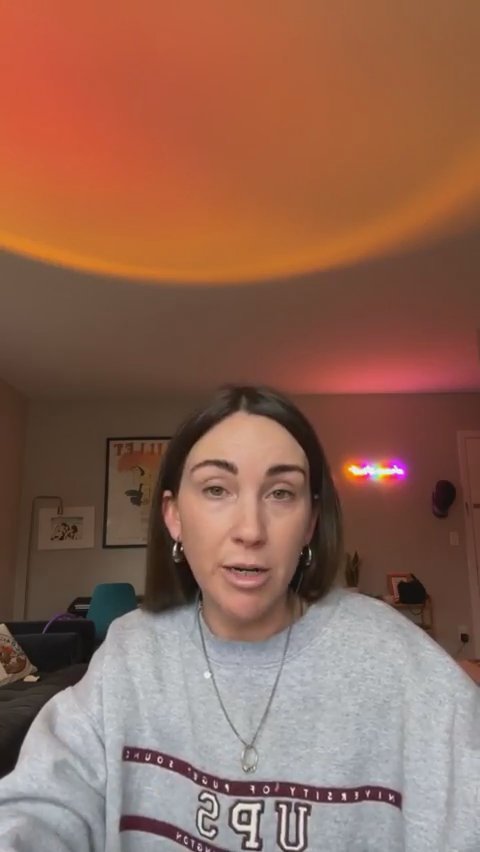
Come reset your nervous system with me after the holiday! If you’re feeling stressed, overwhelmed, overstimulated, or burned out after the holiday this will be a great chance to regulate and reset your nervous system. I’ll share some of my favorite ways to get us back into parasympathetic and wind down so that we can return to our daily life without additional stress.
Rachel Havocost is a writer and mental health advocate. She shares some tips she uses to calm her nervous system after stressful times. None of us have a perfect nervous system, so just. have some compassion.
It's confusing. Let me know what's feeling confusing. I feel like these are things that I would have liked to learn about in school. Sometimes if we've experienced trauma or chronic stress, both of them can experience fatigue in a way. There are a ton of things they need to focus on in schools.
Hi, Cadre fam. Happy Wednesday. I hope everyone is having a day. I hope you're having a day. I am a little under the weather, so please forgive me if I have a little bit of brain fog. And. And I'm very excited to talk to you today about nervous system health. If you're new here, my name is Rachel Havocost. I'm a writer and mental health advocate, and I have been in therapy for 19 years for my own mental health. And I am on a mission to help people feel less alone and share my experiences, both through therapy and also from my time in school.
I just got my master's in mental health counseling. So today I want to share a few things that I really like to do for my nervous system. And before I do, I'm just going to briefly kind of explain the nervous system and then talk about why it feels relevant to share some of these tools right now. So the autonomic nervous system, or the ANS, is comprised of two different parts, and it's a system that runs through our body, and it helps regulate things like digestion. It helps us stay awake when we're supposed to stay awake.
It lets us know when it's time to rest, and it's also responsible for. It's responsible for getting us prepared for activity by getting us amped up, and it's responsible for helping us calm down and slow down. And those are kind of two parts of the autonomic nervous system, is the sympathetic nervous system, which is in charge of getting us amped up. So it's kind of what activates when we're preparing to maybe go for a run or start a sports game or maybe give a presentation. It's kind of what gets us alert and ready to go.
It's also responsible for our survival response or to a threat like fight, flight, freeze. And then the parasympathetic does the opposite. So that's what is responsible for calming us down, for letting the body know I'm in a safe space right now. It's okay for me to digest. It's okay for me to relax. So there's these kind of two pedals. And when our nervous system is healthy, those two pedals are both functioning at an even rate. And as they should, we want both of them to be effective, and we want both of them to be online.
Sometimes, though, when we experience chronic stress or long periods of stress or traumatic events, those systems can start to get out of whack. We can either become parasympathetic, dominant or sympathetic dominant, meaning we either are always kind of on alert, as if there's always a threat or always something that we have to fight against, or we can kind of be always dulled down, as if nothing really impacts us. So after the holidays, we might experience a little bit of imbalance. There might be some recalibration that needs to happen.
For some folks, the holidays can be really stressful for a variety of reasons, whether it's your mental health, whether it's your planning to host for a lot of people. And so there's a lot of stress with that, whether it's burnout from lots of travel or social time, you know, the holidays and big events can kind of increase our stress levels. And so I always really like to, after anything stressful or long periods of perhaps stress or buildup or anticipation, I like to try and do some recalibration so that my system can kind of come back to that even keeled baseline.
I particularly am someone who, when I experience stress, I get more into that sympathetic, meaning I'm more activated. So I like to do things to try and calm my nervous system and activate the parasympathetic so that I can get back to a baseline. So a few ways I like to do that, which you can do at any point if you're feeling like you need to calm down. Hi, Rachel. Mine must be messed up in both ways. I'll be. None of us have a perfect nervous system, so just. I just also want to remind you to have some compassion.
No one's living at, like, a perfect 50 50. It's just about, you know, being mindful of where we're at and then trying to recalibrate. So to get my parasympathetic back online so that my body can start to rest, digest, and feel a little bit more even keeled, one of them is singing and humming. So singing and humming activates the vagus nerve, which is responsible for kind of getting that parasympathetic online. So things like singing, humming, chanting. So I really like to listen to mantras and chant that will get the vagus nerve activated, which helps get the parasympathetic activated.
Another one, which I'm sure folks have heard about and seen all over social media, is cold exposure. And exposure to cold also activates the vagus nerve and increases vagal tone, which helps our parasympathetic be stronger. So doing things like taking a two minute cold shower or if you have access to a cold plunge or going in the ocean for a couple minutes, I also, if I experience anxiety, I like to hold an ice package or hold an ice pack against my chest, because that cold can help activate the parasympathetic.
So if I'm experiencing some panic in the moment, cold exposure is also really a great way to kind of relieve panic. And then the final one is breath work. So when we inhale, we're activating our sympathetic. So if you think about, like, a runner before they go for a long sprint or someone before they or an athlete before they get out onto the court or the field, I'm clearly not an athlete, because court or field is not even right. You'll see them take a lot of short inhales, and that's because that gets the system ready to go.
And then if you've ever been to yoga, you've heard them talk about focusing on your exhale and having a long exhale, and that's because the exhale activates the parasympathetic. So if you've ever heard of breath work practices that talk about having a longer exhale than an inhale, those are great breath work practices to activate the parasympathetic. And you can do this at any time? I do this often. Hi, Luke. Where I just count my inhales, and I count my exhales, and I try for my exhales to be longer than my inhales, and I might do that for a couple rounds.
And excited, too, Luke. I'll do that for a couple rounds, knowing that by having a longer exhale, I'm activating my parasympathetic. Rachel says I'm extremely hyper vigilant, but at the same time, have a hard time getting motivated. Yes, I relate to that heavily, and it's really quite common and doesn't make it enjoyable at all. So I think that that is definitely an indication or an invitation to both. Focus on ways to get your parasympathetic back online. So focusing on things like your breathing and having longer exhales and just getting that strengthened so that that hypervigilance can start to go down.
And then when it comes to motivation, I'll look. I'll look into. Because I'm always looking at ways to activate my parasympathetic because my sympathetic is the one that's always on overdrive. But I can look and see if there are suggestions for activating a sympathetic. I know that having a shorter inhale does help with that, and, yeah, I'm curious, though, to see if there's specific things. I'll look into that, and then if I find anything, I'll just I'll leave a comment on this live. m. PST in Rachel's room.
As always, if you have suggestions or ideas about what you would like to hear me talk about, I am happy to take suggestions. Just leave them in the comments. Rachel. It's confusing. Let me know what's feeling confusing. And hopefully it is confusing. I mean, it's wild to me, too, because, and I could rant about this forever. I feel like these are things that I would have liked to learn about in school, and I'm just learning about them now. Like learning about how my nervous system works as an adult feels like, oh, I have loved to know this when I was a kid because these are really great ways for us to regulate.
You know, being in the mix is confusing. Yeah, totally. I think that makes a lot of sense. And I think, you know, you can also think about it like this. Like, you know, we want both of them to be functioning and doing their job so that we can regulate ourselves and stay alive. And sometimes if we've experienced trauma or chronic stress, both of them can experience fatigue in a way. So it's almost like if you think about, you have two arms, right? And let's say this arm has been throwing a baseball over and over and over and over again and just keeps throwing a baseball, your shoulder might hurt, the arm might feel tired.
And let's say, like, with this arm, you've just been holding it up like this for days and days and days and days. So then it's going to feel like a little bit of pain back here, and it's going to want to come down. So it's kind of like a reminder that both systems can get overused and get tired. And so they need to be strengthened and mobilized in ways that are gentle and still can get them to a place where they're not constantly doing these activities. There are a ton of things they need to focus on in schools.
More important. Yeah. Than standardized testing. I agree. I think. I think learning about our mental health, learning about our physical bodies, learning about relationships and communication, that would have been really nice to learn about in school. So, yeah, I totally agree, Rachel. All right, my love, I will see you all next week, and I hope that you have a lovely rest of your Wednesday and we'll connect soon.