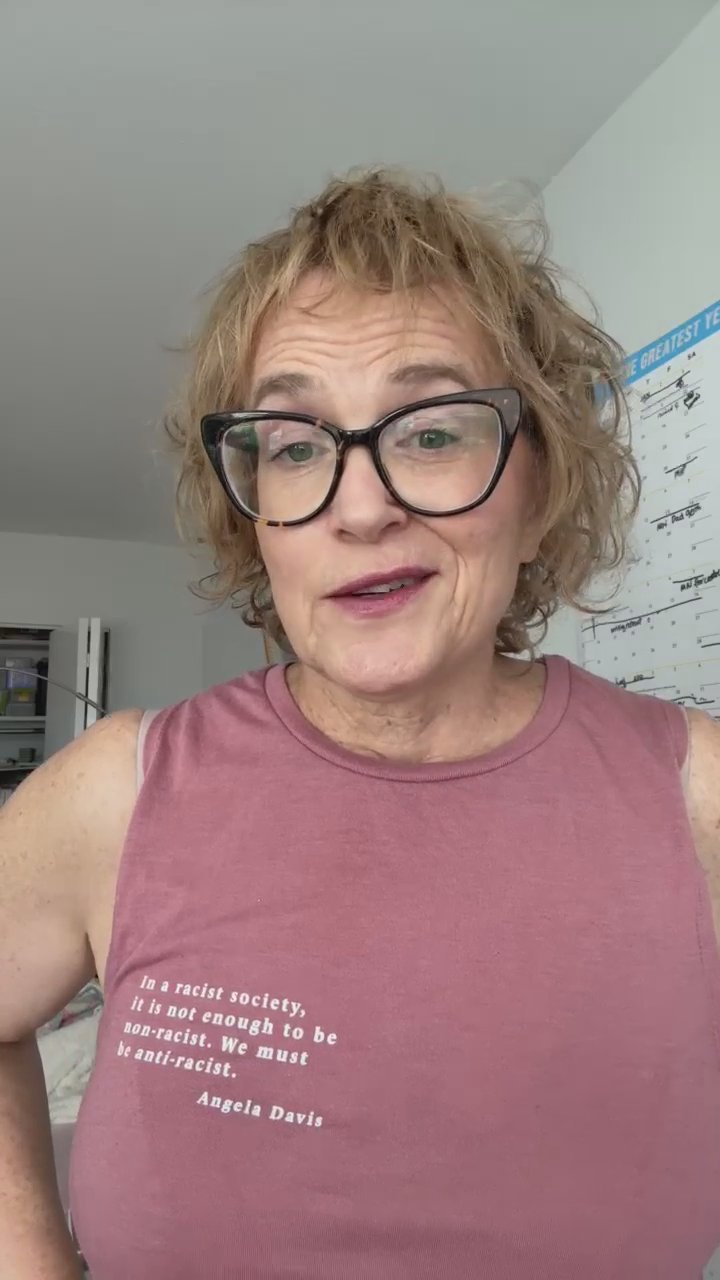
Thoughts about creating a life you want to live in, from someone who has had to do it herself. Today: the news is heavy sometimes. What tools work to keep us centered in our own lives?
The speaker greets the audience, names the topic as a toolkit for heavy times, and briefly struggles with live connection problems before deciding to continue. This orients viewers to the theme and sets an informal, conversational tone.
Betsy describes current upsetting news and how repeated triggers have worn on her, explaining why she needed to turn to her personal toolkit. This short section validates feeling overwhelmed and motivates the tips to follow.
The longest practical section covers sticking to routines (workouts, prayer/meditation, food), a visible reset list, movement and 'keep moving' as an antidote to freeze, playlists, singing for the vagus nerve, and somatic breathing/exercises. Viewers will get concrete behaviors to stabilize mood and interrupt anxiety.
The speaker advises carefully curating social media, news, TV, and music to avoid downward spirals—using examples like reducing true-crime exposure. This helps viewers understand how incoming content affects emotional trajectory.
Betsy shares experiments with identifying personal fun (sequins, animals, music, comedy, poetry) and keeping a written reset list on the wall to lower activation barriers. This section shows how intentional joy and easy-to-access reminders support resilience.
She explains keeping an inventory of how anxiety shows up so it can be detected earlier and addressed more quickly. Viewers learn the value of awareness and a pre-made plan for earlier intervention.
The speaker summarizes that these are her toolkit ideas, offers them as support, and invites viewers to reach out on the app. This closing invites connection and reinforces that the tools are available to use.
Hello, Cadre team. Hello, Good morning. How are you? Betsy Hodges here. Rules of engagement. Today we're talking about tools for heavy times. A toolkit for heavy times. It's been, well, here's a new and good. I like to think about new and good things when things are a little heavy. That's one tip. put my attention on something good. And today was my 1150th Orange Theory fitness class. For those who are interested, 1150 Orange Theory fitness classes. But I guess I'll... Let's see. This says I have a connection problem.
So let's see if it can go through or not. It says it's live, but it also says it's unstable. I don't know what to do for you. I'm going to keep going, crossing my fingers. Maybe it'll tell me something different. Nope, I'm going to turn it off and see what happens. Never mind. I'm going to keep going because it's giving me that option, which means I think it's still going. These times have been kind of heavy. There's news out of Cornell that is not particularly positive, and if you have life experiences like mine, they are particularly, not the first time somebody says something about it or the second time somebody says something about it, but the 4th or 5th or 6th time I start getting a little weary.
So I realized I needed to dig into my toolkit because I was starting to get a little overwhelmed and a little low down. And so the first tool that I'm going to talk about are routines and resets. Routines and resets. If I stick to my routine, I do much better. I can weather so much more than if I am not in my routine. But I also like to travel and I also need to travel a fair amount for work. So I have been way out of my routine. I had a trip to the Catskills and then I was home for a couple days and then I had a trip to LA and then I was home.
Now I'm home for a few days and then I'm going to Boston and then I'm going to, you know, here, there and the other way. So when I am at home, I'm doing my best to stick to my routine. All the things I know support me, my workout routine, my prayer and meditation routine, my food habits, the basic physics and physiology of life, the physical needs. But when things get really bad, I have on my wall over here a list of resets, things I can do when if I notice I'm in a bad place, I can reset myself right away.
Prayer is one of those things. Your mileage may vary with that, but for me, prayer is one of those things. Keep moving. One of my rules of engagement, I am not choosing between the first most important thing and the second most important thing on my list. I am choosing between doing something and doing nothing. And so keep moving, just keep going. That is a big one on my list. I have a list, I have a playlist on my phone called the zesty list. To me, zest is the opposite of anxiety. And my stuff usually comes up in the form of anxiety and if my anxiety gets bad enough, I go into a a dorsal freeze or a freeze, my whole system shuts down, which is why Keep Moving is a good one for that.
But I also have a playlist of songs that get me moving no matter what. I also have a playlist of theme songs that help me remember that life is good. Those upbeat, positive songs that are about life. I'm very focused on lyrics, so that's useful for me. one or the other of those, but usually the zesty one because I need to just pop myself out and put myself in a new mindset. I sing. Now, even if you can't hold a tune, you can hum. Singing and humming are very good for your vagus nerve. They're very good for your whole physical system.
And I do sing. I sing every day. I take voice lessons, not to sing in public, just to sing for myself. And so I sing. I remember to sing. If I'm out of my routine, I don't sing because I don't like it when other people can overhear me. So I don't sing in hotels that often. So if I'm traveling, I get out of practice. And somatic exercises are so great. You can just look up all the ones you want online. Somatic exercises, breathing exercises. The ones where you twist your fascia and look behind you.
are very good if I'm feeling, if old feelings of danger have been surfacing. But there's all sorts of them out there. Putting your legs up against the wall, letting the blood flow out to let your body know that you don't need to run. Those are all good, useful, you know, there's a whole bunch of them online. I suggest them. And then one of my guidelines for life is that laughter and poetry will save the world. So reading some poetry, watching some comedy, watching something that will help me laugh.
Laughter helps, it helps raise the vibe if that's the way you like to talk about it. helps release fear and light embarrassments if that's the way you like to talk about it. just feels good if that's the way you like to talk about it. It's really great. So routine and resets. So those are one and two, I guess, that go together. Number 3, I would remember one of my guidelines for life is what comes in is what goes out. What comes in is what goes out. So I really curate, I start curating even more carefully my social media timeline, my social media time, let alone my social media timeline.
My news, how much news I take in, what kind of television or movies I watch, what kind of music I'm listening to. Are they contributing to an upward trend in my life or are they continuing to a downward spiral in my life? I really do my best to curate what's coming into my brain because what's coming in will go out. I love a good mystery and I love a good murder show, but years ago I had to stop compulsively watching so many different Law and Orders and so many different CSIs because all that murder, murder, murder, not good for my brain.
Occasionally I like a British mystery story, that's fine. That doesn't seem to lower my vibe, sort of be a negative thing to come in. The final thing I'll say about toolkits for heavy time is fun and joy. I already mentioned it a little bit with laughter, but I figured out a few years ago what I think is fun, which is different than what other people might think is fun. And I have little fun things to do and big fun things to do. I had a whole list. Fun was my word of the year in 2022 and I created a whole 22 fun things to do in 2022 list and I learned a lot about myself and what I think is fun from doing that.
And one of the things I like to wear sequins every day. So a little later I have a meeting and I might wear something with sequins on it just for fun. Sequins every day, like every day wear. I just, for some reason that just really gets me. That's a small thing that I can do. Animals every day, another one of my guidelines, making sure I'm hanging out with my cats, fun and joy. Again, with the humor and the laughter. I really love the music of Bruce Frederick Joseph Springsteen, who just turned 77 on the 23rd.
So I will listen to some Bruce music. Many of these things are on my reset list, my list of resets I can do if things get bad. And I have it written down and on my wall because it lowers the barrier to accessing them. All I have to do is look at it. Probably I should have it on my desk in A-frame, you know, so I could see it whenever I'm there and have it go in even more. But it is, it's on the wall. I go and look at it. It's like, oh, right. right. And I also have the list of signs that things are getting heavy for me.
Because when I did that assessment, when I started writing down all the ways that my anxiety shows up, it starts showing up way further than, way further back, more upstream in the process than when I'm likely to notice it. But because I did that inventory, it means I can back it up more quickly. I can catch it more quickly. and headed off. So cadre, if you're still here, if you're here, those are my ideas for a toolkit for hard times. And I hope that if things are getting to you a little bit, like the way they're getting to me, that this can be helpful for you.
Let me know. Let me know. I'll see you on the app.