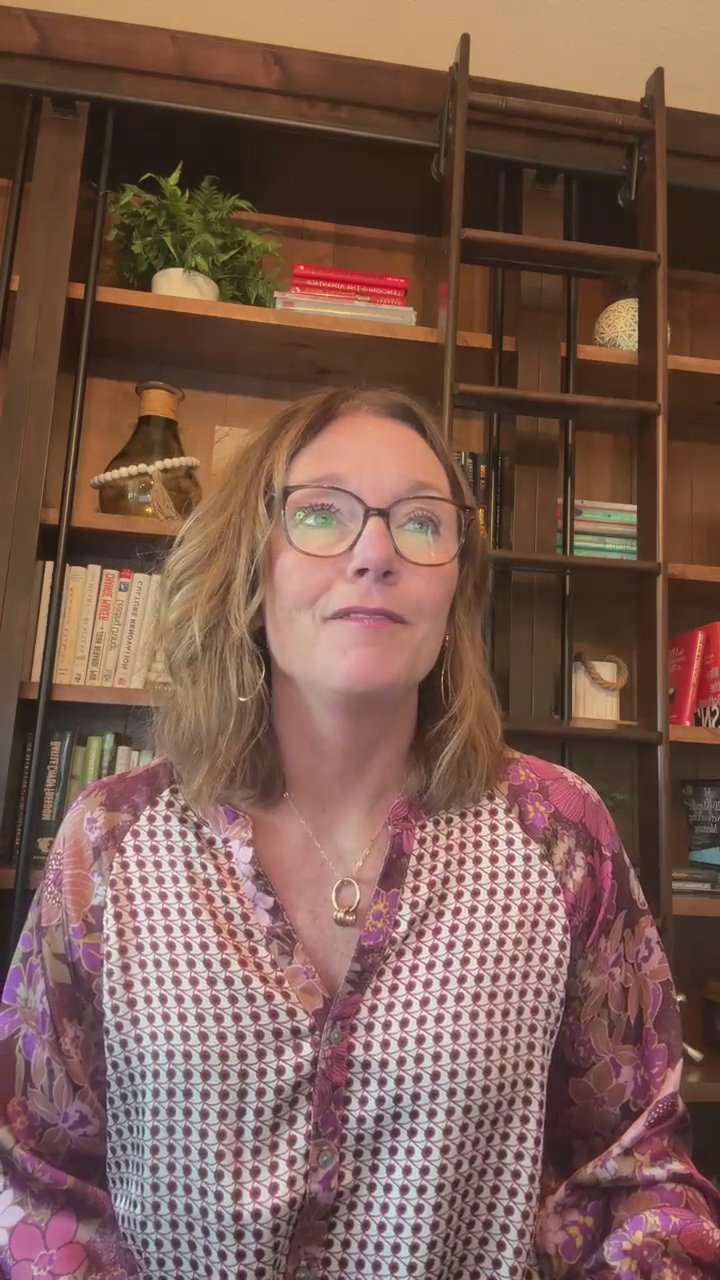
Do you sometimes feel like you’re not allowed to have a bad day? To feel a little off? Today we’ll talk about the cost of emotional suppression and some tips to try this week.
Carrie opens the live, apologizes for technical hiccups, and introduces herself and her co-host. She sets a friendly tone and welcomes viewers to the HR/leader community.
Carrie recaps the series structure and phases, reminding viewers that this month is about inner work. She names the first topic as the pressure to be the calm one and explains the aim of understanding hidden patterns.
She frames HR leaders as the organization's emotional thermostat and asks whether viewers hide their own struggles. Carrie introduces a mason-jar analogy from a podcast to visualize suppressed thoughts and emotions.
Using the mason-jar metaphor, Carrie narrates a detailed morning—a bad night, family worries, commute stress—showing how many small thoughts and emotions accumulate before the workday even begins. The illustration demonstrates how full our internal 'jar' can be when we put on a calm exterior.
Carrie explains themes from the podcast about under-sharing versus revealing wisely, and cites research on emotional rigidity and the toll of suppression. She describes how suppressed emotions drain energy, reduce access to positive emotions, and often emerge in harmful ways.
She recounts leading HR through the pandemic and a massive cyberattack, describing being expected to be the composed, steady presence. The story illustrates how performing calm can hide deep strain and why that becomes unsustainable.
Carrie gives three concrete tips—name your feelings, notice when you prioritize others' comfort over your honesty, and separate regulation from suppression—and invites viewers to notice moments they suppress emotion. She also poses a deeper reflection question about what you'd feel if you weren't expected to be the steady one.
The session closes with a reminder to be kind to yourself, an invitation to share reactions in the chat, and a preview that the next live will address the fixer trap. Carrie thanks viewers and signs off.
Hi everyone. I had a super cute opening to my live. I had my dog Bailey all queued up to say hello to you and then I got notice that my internet was unstable even though I tested it. So I apologize for that. I hope that it stays stable throughout this. Super excited to be here with you today. My name is Carrie Heimer. And I have spent the last. Oh, hey, Adria. Oh my gosh. Well, now I do. I want to bring Bailey back. So hopefully she can make an appearance here. I was just saying that my internet connection was unstable and so I had to start over.
So anyways, I'm Carrie Heimer. I have spent the last 30 plus years in human resources and I also am here because I'm super passionate about this work. Hello. I have my own share of lived mental health experience and I just, my passion is to hopefully find ways to be there for others and make the journey feel, make them feel less alone on the journey. Adria Gerber is joining us here live. She is my partner in crime on this. We're super excited to start this HR community together, HR slash leader community together.
I wanted to take a couple minutes just to reset where we're at on our journey. Adria and I chunked this work into a few different phases. The first month was really about kind of recognizing what's actually happening underneath the human underneath HR leadership. It's about naming it. if you can't name something, it's hard to change it. And so we spent the first few weeks on topics like the emotional load of HR. We talked about the loneliness that we often experience. We covered the boundary problems that we often have.
And by the way, I'm putting a huge plug in for Adria. If you haven't listened to her last boundary live, you really should do so. She just does such a fantastic job making the content so relatable. So check it out. And also if you've missed any of the other episodes, go back and take a listen. This month we're going to be talking more about the inner work. So again, we started with recognition, so naming what we're feeling. This series is called the inner work and it can be kind of harder, quieter work that we do together.
So it's more about not just naming it, but understanding the patterns that are wearing us down quietly behind the scenes. And oh gosh, I just had to hold on with me one second. I had my computer went out. So this is real life, right? We talk about this, that this is happening in real life, real time. But so the harder work of understanding the patterns that are wearing us down. And so this first topic is the pressure to be the calm one, which really means suppressing our own emotions. In a couple of weeks, we'll talk about the fixer trap, how we can fall into the tendency of trying to fix everything.
We'll cover topics like burnout and then we'll conclude this series with a discussion on enoughness and the oftentimes the feeling that we might have of not being enough. So, but let's start with the first one. So I'm gonna just pose a few questions to all of you to get us started. And we know that as HR leaders, we are often the emotional thermostat for the organization, right? When things heat up, we regulate. When people are anxious, we're calm. When tension rises, we absorb it all. I mean, let me ask you this.
Have you ever walked into work feeling anxious, feeling kind of overwhelmed, feeling stuck in your thoughts, but the whole day you worked your hardest to make sure that no one else noticed? It's kind of like you're not allowed to have a bad day, right? Everyone else can have a bad day, but you show up to work, game face on, ready to tackle whatever the organization throws your way. I think we can all relate to that. I want to take you on. I haven't done this before, but I'm going to give it a try and see if it resonates.
There was a visual. that was used in a recent podcast that I was listening to. Thank you, Andrea, for commenting on that analogy. Oftentimes when I'm thinking about a topic, it seems like whatever I turn on, it's like on that topic or somehow connected to the topic. And that was the case with a recent Mel Robbins podcast episode. She interviewed someone by the name of Dr. Leslie John. She's a Harvard Business School professor. And the topic just in case you want to look it up later was the hidden power of let's see what was it called revealing wisely.
So she used a mason jar to illustrate the sheer volume of thoughts and emotions that we suppress daily. So I'm just going to take you on a journey about maybe a typical day for some of us. So bear with me. So we have a bad night's sleep. So here's my mason jar. I hope you all can see that. And my dog is kind of bitter with me because she used ping pong balls in her story. I didn't have any ping pong balls. So I dug out all the little dog toys and cat toys that I could find to make this illustration and my dog thought it was playtime and I said, nope, it's not.
It's mommy's work time. So here we go. Here's a typical day. You get up at 6 o'clock or so and you have just had a horrible night's sleep. You were thinking in the middle of the night about the presentation you had to give and you couldn't turn your thoughts off. And so you're exhausted and you're already telling yourself it's going to be a hard day. It's going to be hard to focus. I don't know how my presentation is going to go. So there's a thought. Put it into the jar. Imagine this is your mind.
Then you head to breakfast. Your kids are sitting at the table already. Maybe your husband's sitting there too or your partner. And one of your kids shares with you that he is being picked on at school, and your mom heart is just crying out, right? You want to solve it immediately, and yet you know you can't. You have to be at work at 8 or 8:30. And so you've promised that you'll address it when you get home. And so that's another thing that's swirling around in your mind. Then you're thinking about the big presentation, right?
You gotta find something to wear. You gotta look great. You gotta feel great. And you look in the mirror and you're like, I feel horrible. I feel horrible about myself, how I feel in my body. I have nothing to wear. I'm gonna bomb at this presentation. And so here are some more thoughts that are swelling around in your head. Then you hop into your car and you're like, okay, I'm out of the house. I'm gonna get to work on time. And what happens, but you realize you forgot to get gas last night? You told yourself you should, but you didn't wanna take the time.
You said, I'll do it in the morning and now you're running late and you need to get gas. Another frustration and angry thought at yourself. You get your gas, you get back on the road. You think, well, while I'm on the road on my commute to work, I might as well call my parents. You talk to your mom. Your mom tells you that your dad's not feeling very well. He's forgetting things, he doesn't seem to have the energy that he once had. and she really wants to talk more about it. And you do what you can in the time of the commute that you have, but then you have to cut the call short and get into work.
And so you carry that thought with you into work. Now we're getting into the cat toys in case you haven't noticed. Then you seem to hit every red light possible And it seems like people are driving at a turtle's pace on the day that you need to get to work on time and perform at your best. And so again, the frustration is mounting. It's hard to even fit that in there. It is now only 8 or 8:30 and this is what you are carrying into your day. You walk into your office, your co-worker or one of your employees comes in and asks how your day is and what do you say?
I'm great. I'm good. How are you? And they proceed to tell you that they're not having a great day. In fact, they're in an argument with one of their coworkers and they need you to step in and help solve it. 30. Big presentation still coming. You have a giant day ahead of you. So, Adria, thank you. You said so relatable, many a day like that, right? And it's 8:30. So how are you going to tackle the rest of the day? So in the podcast with the author, Dr. John, she shared really two themes. One was the concept of under sharing versus revealing wisely.
So under sharing, right? We're suppressing our emotions, the feelings that we're bringing into the day. And why do we do that? Because that's what we're taught. We're taught to be calm. We're taught to hide our feelings. We're often taught to put on the perfect front game face on. When in reality, we know, we know that holding back those emotions creates more stress, it drains our ability to focus, and it's detrimental to both physical and mental health. And yet we do it time and time again. The second theme she talks about is the physical and psychological toll that it takes for under sharing or not.
sharing what you are experiencing and feeling. Again, we hide our feelings under the guise of strength, but the reality is suppressing our emotions like that is like an open loop running in our brain all throughout the day, quietly draining us of the energy that we need for everything else we do in our day. I think Adria in one of her last talks mentioned the author Susan David, or maybe I did, maybe we both did, but she wrote a book called Emotional Agility. And what she calls this term is emotional rigidity, the belief that certain feelings aren't okay to have in certain contexts.
And that's what we tell ourselves when we're in the work context, that we somehow have to hide what we are feeling and experience for the benefit of other people. And what we know and what her research and other research shows is that not only costs us energy, but it actually reduces our ability to access positive emotions too, because there's only so much space in there. There's only so much capacity to process. And so what happens then is those suppressed emotions don't disappear. They accumulate and then usually they come out sideways.
They come out ways that we did not intend, whether that's taking it out on our partner, taking it out on our kids, being unkind to ourselves. And so that's the whole point of why we want to find ways to express those emotions in a way that allows us to free up ourselves to be able to give give to others. So I always like to share a personal story and I'm going to take you back to 2020. In 2020, COVID happened, right? We were hit with a global pandemic and this memory is etched. It's forever etched in my memory.
I was a part of the team that was tasked with leading the organization through the global pandemic. We were making decisions in real time, you know, about people's safety, about people's livelihoods, about how we were going to protect their families. There wasn't any playbook. We were, what did they say, building the plane while we were flying it. And in HR, I was looked to be the calm one. I was looked to be the steady one, the person who people hoped would have the answers. This was unchartered territory for all of us.
Also in 2020, one of the things that Red Wings Shoe Company experienced was a massive cyber attack. I will never, ever, ever look at Halloween the same again. On October 31st of 2020, I got a call from our CEO that said I needed to hop on a call within the next 15, 20 minutes because we had just been hit and hit hard. It turned out to be the biggest nightmare. We were just starting to get our feet underneath us with a global pandemic. And then this happened. And honestly, we almost lost the entire company.
There were days when we didn't know if we were going to recover. At the time, it was a 115 year old company that had stood the test of time through wars, through depression, through all the things. And we didn't know if we were going to make it. The infrastructure we ran on was gone. The good news is the story has a mostly happy ending. We were able to recover 90% of what was lost. It took a long, long time, but the 10% I was part of the 10%. HR had what we called the W drive. All of our stuff was backed up to the cloud, but for whatever reason that part of the cloud was not able to be recovered.
So decades of work and assets that were created were gone. And I remember trying to look my team in the eye and face them and say all of the work product, the things you've put your heart and soul into for so many years, it is gone. And we are back to table stakes. We are back to basic blocking and tackling. It was so hard. And I know, you know, through all of it, I was performing, right? I was performing a version of myself that everyone needed. I was professional, I was composed, I was present.
I got really good at it, and I'm sure many of you did too during those times, but I've come to understand that that was part of the problem. We get good. We get really good at performing okay. We've talked about this in many of the other lives that we've had, and so no one really sees the cracks in our armor and recognizes that we need help too, that we need a place to go. So what I want to say to all of you and just remind you is it's okay to not be okay. Your feelings are information. The anxiety, the frustration, the heaviness you feel, whether it was things you brought in from home or things that are happening at work, they are not signs of weakness.
They are signals and they deserve to be heard. The reframe that I would offer you today is there's a difference and there's a big difference between choosing how and when to express something and pretending that it doesn't exist at all. And that's what we normally do. We pretend it doesn't exist at all. You don't need to be perfect. I don't need to be perfect. Adria, I think you would totally agree with this. We don't need to be perfect. We want to be perfect, but we don't need to be perfect. And when we show our imperfections, it makes others feel safe to do so as well.
We need to be authentic and we need to be regulated. Those are two very different things. And so I'm going to offer you a few reflections for this week. And I jotted these down in my notes. So if you see me looking away, that's why. But notice one moment this week when you suppress or set aside what you're actually feeling in order to perform. You don't have to change it. You don't have to share it. Just notice it and name it yourself. Then noticing as we've talked about all along or the naming is the start.
Some tips for this week. So there's three, three that I would offer you. One is give your feelings a name, even if it's privately. You know, sometimes it would be so helpful for me when I would go into the office and let's say I had a team meeting right at the start of the day. to feel safe and comfortable to say to my team, you know what, I've had a rough morning. I'm feeling a little off today. I might not be performing at my best. Hang with me, give me some grace because I need it today. Now that might not feel comfortable right away to say that.
But if you can find it within you, I mean, usually that draws people in and they want to support and they want to be there for you. The other thing I'd ask you to think about is notice when you're managing others comfort at the cost of your own honesty. This is easy to do. You know sometimes the calm performance isn't so much about regulation it's about trying to protect others from your real experience because we're supposed to be the one that protects everybody. And so notice when you're starting to manage others comfort at the cost of your own honesty.
And then the last thing, separate regulation from suppression. So regulation means you feel the emotion and you choose how to respond. Suppression means you don't even let yourself feel it at all. You don't name it, you can't feel it. So think about that. And then the last thing, deeper reflection for this week. If you weren't in an HR or leader role, and if no one was counting on you to be the steady one, whether that's as a parent or as an employer, whatever it might be, what would you have allowed yourself to feel this week that you didn't let yourself feel?
I thought it looks like Adria had a comment here and for some reason it's let me see if I can She totally had a moment this week where her jar was full and didn't get it out in time or at all, and it led to her crying at work in front of her students. Not a great moment. So I love this advice about not hiding it or holding it in. Thank you so much, Adria. I think, you know, the analogy was powerful because just think about that. You are full and you haven't even started your day. So where does the rest of it go?
I just would ask you to think about those things for this week. And if anything resonated with you, if you listen to this on the replay or whenever you do, please drop a line in the chat. And until then, be good to yourself. And we'll be back online. Adria will be back next week to cover a little bit more of this topic. And then I think next up, we focus on the fixer trap, which is our tendency to step in, solve, and smooth things over before anyone even asks us to do so. So thanks a lot for taking time.
I appreciate all of you, and I hope you have a great day. Bye-bye.