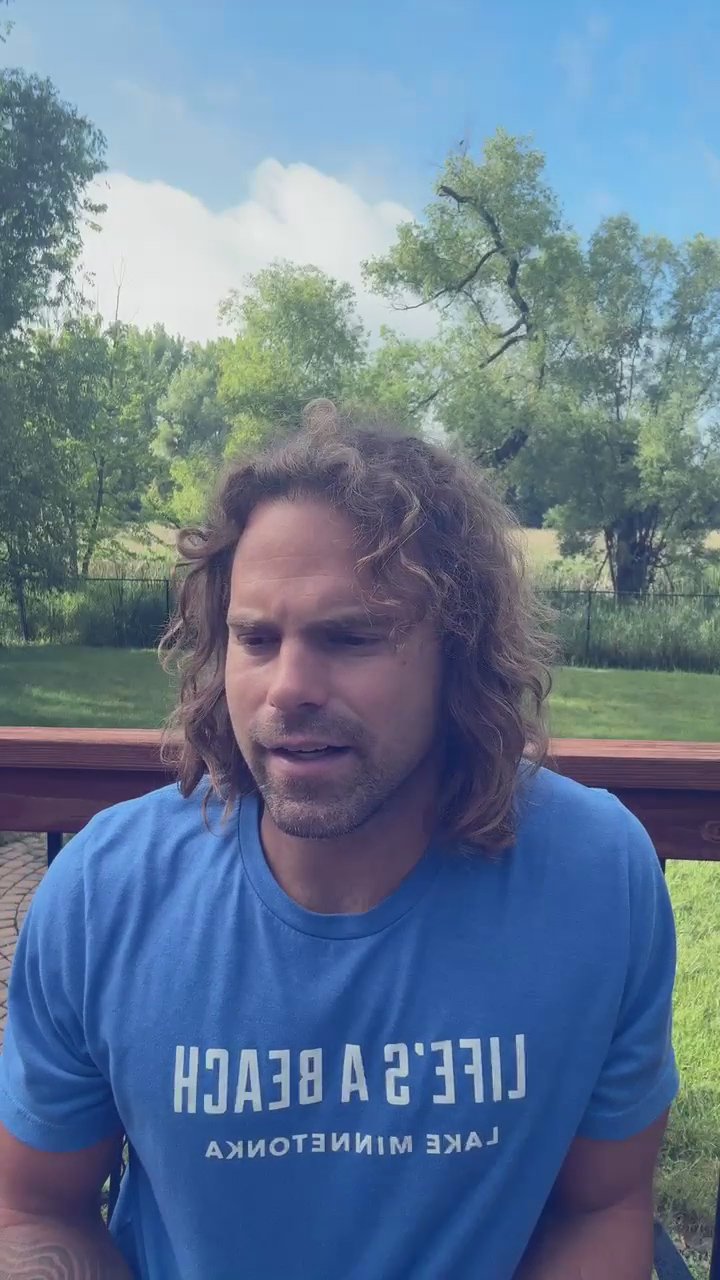
Tales from a life of battling pain—physical, mental, emotional, spiritual. I’ve faced it all. Now, my purpose is to turn my experience into a roadmap to healing for others.
The speaker opens with a friendly morning greeting and states that he will talk about vulnerability, linking the topic to Men's Mental Health Awareness Month. This orients viewers to the subject and tone of the talk.
The speaker details a timeline of traumatic sports injuries, misdiagnoses, surgeries, and long-term physical consequences that began in childhood. These events set the stage for the mental health struggles he later faces.
After leaving home, he finds solace in two cats and documents his journey through tattoos that symbolize perception, family, and home. These personal rituals help him process pain and reinforce identity during a difficult period.
He restarts a lake-weed removal business with a friend, emphasizes the healing effects of teamwork, being outdoors, and physical activity, and begins sharing his story. These experiences gradually help him emerge from depression and inspire him to communicate his journey.
He introduces his book, Pain Management, My Pain, Your Gain, and explains the iceberg cover metaphor showing hidden suffering beneath small visible pain. He also candidly shares struggles such as binge eating during his depressive period and how writing aided recovery.
He urges people not to hold their stories in, recommending writing, talking to friends or professionals, and highlights how emotional trauma can manifest as dense fascia and chronic pain. The emphasis is on treating origins rather than just symptoms.
He invites listeners to reach out for conversation or help, plugs the book available on Amazon, and closes with encouraging remarks and gratitude. The final moments reinforce vulnerability as a path to growth and recovery.
Good morning, cadre. Hope everybody has had a wonderful Monday and Tuesday so far and that you're set up for a fantastic hump day and rest of the week. I am here to chat about vulnerability today. As part of Men's Mental Health Awareness Month and yeah, I I now I get to talk about my book a little bit here, which is just kind of the, I guess, epitome of vulnerability. And it I basically just kind of had to undress myself when it came to the mental difficulties that I dealt with as a result of physical injuries.
So I'll give you like a quick little rundown of me if you haven't paid attention. When I was 11, I was checked from behind the boards head first, taken off in a stretcher, ambulance, whole nine yards. They misdiagnosed me and told me I was fine. Then a couple years later, I randomly tore my ACL and then a few years after that, or no, a year after that, I collapsed running to first base, found out that my spine slid forward, fused itself together, stunted my growth and created injuries throughout my whole body from compensation patterns with a resulting condition of spondylolisthesis.
Then I tore my left ACL a few years after that and then I tore my left ACL again and then I found out I had torn labrum in my hip and partially torn hip abductor muscles and then hip dysplasia, herniated discs and all of that eventually led to a significant depression and mental struggle where I was searching for answers and I didn't know what to do. I didn't have the resources. This is like 2005, 2006 that I was dealing with this stuff. So 20 years ago, right? And when you think about where mental health was at 20 years ago, I don't even think mental health was a word.
It was just, you know, it just wasn't a topic. So I didn't know what to do. And I started to be vulnerable with myself in the form of journal writing and asking, just asking questions like, why is this happening to me? What is going on? Trying to figure out why I was putting in this position, why things were taken away from me and why I was dealing with this struggle. And being vulnerable and trying to help myself led to a situation where my My best friend's mom, who I was living with at the time, was worried about me and then she went through my journal and got scared to the point where she called my parents' house, left a voicemail saying that she does not want her son or her other son to interact with me anymore because I'm troubled or they're scared of me or whatever.
And that was a pretty low blow. And that came at a time when my dad tried to sell his business and kind of got screwed over. Well, not kind of legit, got screwed over. And he was in a depressive state. My mom was in a depressive state. I was depressed and we all just had a big cry together in the basement. That was a tough moment of reality where, you know, the two people that have been rocks in my life for my whole life are now dealing with the same pain that I'm dealing with. We don't know how to get out.
So that, you know, that set me on a path where I needed to figure things out on my own. So I moved out on my own, found a little apartment in uptown and I Got a couple little companions in the form of two cats, two brother black cats that I named Garfield Lindale. I lived right off of Garfield Lindale. Also love Garfield the cat, so it was kind of a no-brainer to name them that. And they were my little compadres, my helpers. They helped me, they helped provide just comfort with having somebody around that wasn't judging me, or at least I didn't think that they were judging me.
And I was totally in my head about what my friend's perspective was of what my friend's perspective towards me was. And that actually led to me getting this tattoo right here. Oh, can't see it. Oh, it's a really tough angle. You can kind of see this thing right here. Yeah, that one. That's a symbol for perception. And I put that on my wrist so that I could see it and tell myself that the things that had happened to me need to be processed through my lens and I know the type of person I am and I'm not a failure.
So I took the, you know, I took this little trick, this little tattoo trick and started adding to it and eventually it became a symbol for my, here we go again, right? Became a symbol for my grandmother right there. I put the lake that I grew up on there. I put the state of Minnesota. I need to figure out a better way to show you. But the state of Minnesota, I put a map in case I were ever to lose my way again. I can find my way back to the things that are important to me. But it was still a long road ahead.
And when you're depressed, it's not a snap of the finger when you can get out of that. So I was lucky that a friend of mine growing up playing hockey with wanted to restart a business with me. That's Life's a Beach. It's a lake weed removal business that I had started after I tore my ACL for the second time and wanted to bring it back and this Being able to work with my friend, having a sense of teamwork, having someone rely on me, it was huge. It just brought me back. And also with being outside, being in nature, being barefoot in the grass, in the water, moving my body, feeling the sun, that was integral in helping me move through this depressive state.
And it took some time, but I made it, right? All along I knew that I needed to share my story in some capacity. I didn't know what it was. I was inspired while I was in college going to EU of M, University of Minnesota as part of the sport management program. I had a philosophy of sport professor that encouraged me to develop my story of sport. And that story basically entailed all the pain that I endured, the injuries that I suffered, yet still achieve my goal. of going to play for Boston University only to have it taken away with another with my third ACL surgery and then subsequently got an infection during my recovery which stunted the recovery and led to chronic patellar tendonitis that I eventually got rid of as well but I mean it's just it's just a string of one after another and it was hard to deal with so You know, over the years, I've really worked hard to not be depressed.
And Life's Beach was huge for that. Playing sports, being with my friends was huge for that. Finding my eventual wife, Melissa, was huge. And then starting the brewery, Back Channel, was fantastic. as I started to operate back channeling, I would talk to people and I'd share my story a little bit. And I could tell people were really uneasy when I was honest about the troubles that I had faced. Some people lean into it, others did not want to hear it. They didn't want to hear about my problems. They didn't want to hear about me being vulnerable.
You know, I'm this, I'm a business owner, how could I have problems? I'm I look like I'm in shape. How could I have problems? And that really drove me to tell my story and to be vulnerable and to show that mental health is real and wellness is not easy. It's hard work. And so I wrote this book, Pain Management, My Pain, Your Gain. I got this that's kind of like the tip pain is like the tip of the iceberg right here, you know, so it's a little prick so it could hurt. But, you know, people when they see pain, they might not might not look like much, but underneath the surface, they could just be drowning.
So that's kind of what this this book cover is supposed to represent. And, you know, I talk about the struggles that I went through. I had a binge eating problem during my peak depressive state that lingered for years after that where it was tough for me to fend off the werewolf at night from feeding. That's the analogy that I used in my book. So, you know, dealing with mental pain, dealing with this struggle of eating and nutrition and feeling like a failure. Yeah, those are hard times. And writing that book, kind of releasing that was really paramount towards the continued separation from this depressive state that I endured for such a long time.
I held it onto my head. I kept telling the story to myself because I knew I wanted to share it with others. And if you find yourself in that position, don't keep telling the story to yourself. Tell it to somebody. Write it down on paper. Talk to a friend. Talk to a professional about it. Move past that stuckness because that type of emotional trauma can get built up in your body in the form of dense fascia, which then creates a traffic jam of communication from your brain to your nerves to your muscles and then leads to pain that is hard to determine where it came from.
And when it's hard to determine where it came from, it's hard to treat when you're only treating the end result of pain. You're never getting to the origin and the origin is the most important. And a lot of times it can start with right here. If you're hurting in your mind, it's likely related to some form of pain in the body and being present and understanding that is, is really important. So I just, I just want to, I don't want to challenge anybody, right? Because mental health is tough. But if you are having problems, if you're stuck in your day, if you can't find the motivation to do what you think you need to do, reach out to somebody, reach out to me.
Happy to talk, happy to share stories, happy to give examples of struggles I had and wins that I had. So yeah, I guess I'll just kind of leave it at that today. If you're interested in reading more about my story, you can find this little bad boy on Amazon. Pain Management, My Pain, Your Gain. It's a good read, it's a quick read. I wrote it efficiently because if someone's struggling and in pain, I didn't want to have them sift through 300 pages like, All right, where is this information here that's going to help me?
And then on page 278, no, it's a quick read meant to just get to the point. No fluff, just coming at myself pretty hard and honest. for you. So yeah, so I hope this information, this story helps you today, helps maybe helps you like lean into the vulnerability that helps all of us grow. So all right, until next time. Appreciate all of you. Love you all. Kaijre is the best and it's only getting better. So we'll talk to you very soon. Cheers.