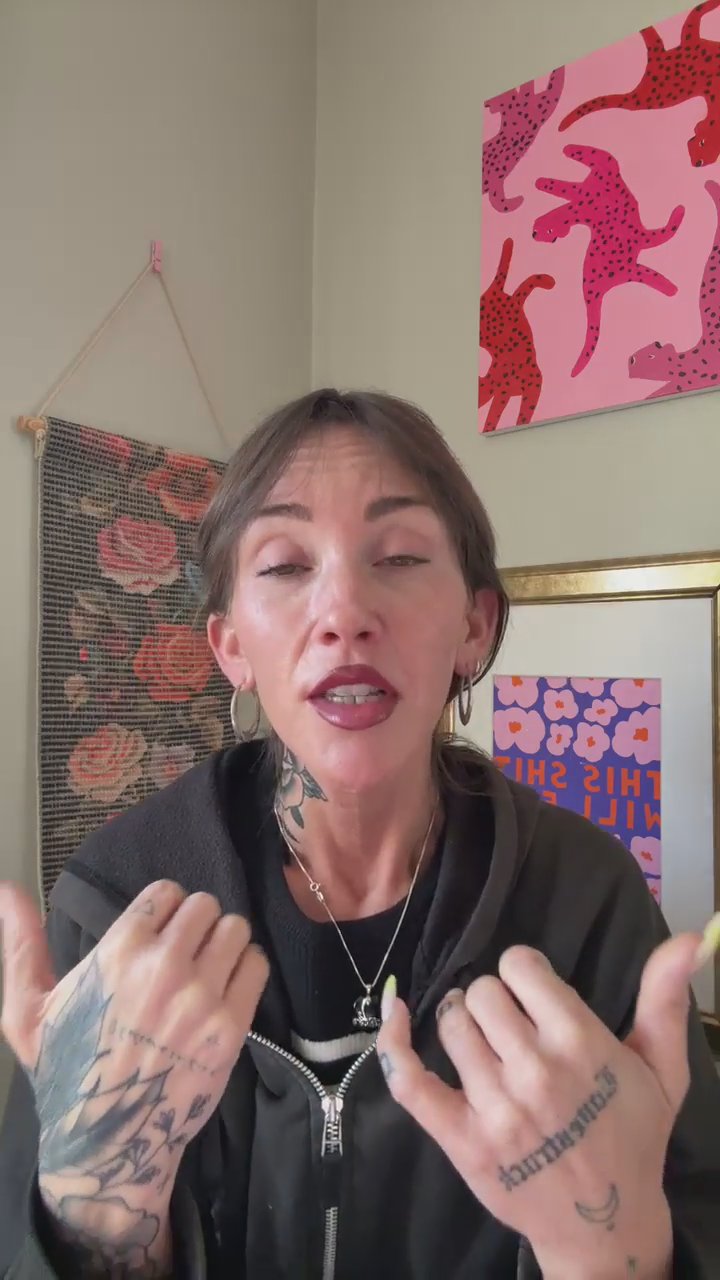
Hello, happy Thursday cadre crew. How are you? Oh man. It's February. How'd that happen? How did that happen? Well, I usually feel like this month, and by this month I mean January even though I know we're not in anymore, but I usually feel like it does not go as quickly as it did and I feel like January just flew by. Maybe it's just me, but Hi Rach. So this week on the beautiful cadre agenda schedule menu. Hi Carrie. We are talking about being honest with yourself with your girl is not good at.
This is such a funny topic. Not funny, but it's topical for me because I am someone who is the queen of being honest with myself, but then not changing. I am really, really, really, really good at being super self-aware of whatever it is that I'm struggling with or what my behaviors are that are maybe contributing to things not going well. I'm very, very good at being aware of those things. which can feel like being honest, right? It can feel like, oh, I know that the reason I'm feeling X, Y, and Z is because I'm doing X, Y, and Z.
I'm being honest with myself, right? But being honest with ourselves is not the same as taking responsibility. And this is like a key difference that has been a very hard, hi, Luke. a very hard lesson for me to learn and it is one that I am still learning. So the way that, just to give you an example, the way that can show up for me is definitely when it comes to my eating disorder is I am the queen of being honest with myself about the ways that I am the symptoms and behaviors that I am exhibiting or participating in, right?
Like I am the first one to say, whether it's to you on this app or to my therapist or to my mom or to my friends, like I am active in my eating disorder. I am very aware of that. I can be honest about that. But being honest about it, being honest with myself is not the same as taking responsibility. And the difference is that when we're honest with ourselves about what's happening, about what we're feeling, about how we're behaving, that's step one, right? That is acknowledgement, that is awareness, that might even be acceptance.
But if we are being honest with ourselves, and nothing is changing, it's probably because we're not taking responsibility. And the reason it is so hard to move from acknowledgement to responsibility is because responsibility can oftentimes feel like blame. And there's a difference. So taking responsibility for my actions, for my feelings, for my behaviors, for my symptoms does not mean it's my fault. It does not mean it is my fault that I experience these symptoms. It does not mean that it's my fault that it's incredibly hard to let go of them.
It does not mean it's my fault that I have these beliefs or these frameworks that I'm operating with. That is not my fault. So the idea is that I'm not blaming myself, okay? If anything, I'm having a lot of compassion for myself for experiencing these things in the 1st place and for it not being my fault. But the accountability and responsibility part is that even if it is not my fault, I am the only person who can change things. So as soon as I'm willing and able, because sometimes we're willing, but we don't have energy, resources, time, or support, right?
So as soon as I'm willing and able to take responsibility, then I can start to change. So this is why being honest with ourselves can sometimes get mixed up into this world of perpetual self-knowledge that doesn't go anywhere, which is a trap that I think a lot of people get stuck in, myself included, where we feel like, well, but I know all these things, right? Like I've worked so hard in therapy to become self-aware. I'm super, super aware of when, you know, when I'm depressed or when I'm anxious or when I'm exhibiting behaviors of something or when I'm acting out or when I'm self-sabotaging, whatever it is.
We can know these things like it's written in stone, but knowing does not create change. What creates change is taking responsibility. And it's really, really hard to do that. So if you struggle with that, you're not alone. And it doesn't mean that change can't happen. So making that bridge from self-awareness to, also I am now, I just have to tell you guys, I'm A Post-it queen. I've been loving my Post-its lately. I don't know about you, but I'm sorry, this is such a tangent, but I'm such a visual learner.
So when I have therapy, I had therapy this morning, whenever we talk about something that kind of like sparks an idea, I write a note, but I also notice that I start like, I draw, I make like graphs, like I make visuals of the things we talk about. Anyways, the bridge from self-awareness to responsibility has to start with reducing self-blame, right? It is not about blaming ourselves at all. So acknowledging that this is not my fault, and my favorite word, and it's on me to make a change. Then comes the really fun part, which is choosing to make change.
And after that, taking action. So see, right now I want to draw like a four step, like a model, you know, like a bridge and like steps. Anyways, I shoot a whiteboard. Wow, Rachie's brain today. Yeah, so taking responsibility, choosing to take action, and then actually taking it. So what does that look like in practice? I will use myself as an example. And then I need you to hold me accountable and make sure I actually do this because I'm the queen of not taking my own advice. But for example, let's talk about eating disorder, right?
So I can be incredibly honest with myself and say, yes, I know that I am active in my eating disorder. Okay, I can also be really kind with myself and say, it is not my fault that I'm stuck in this cycle. It is not my fault that I am here again. It is not my fault that it is hard to get out. It is not my fault that it started in the 1st place. We reduce shame, okay? We gotta get rid of all that shame because we cannot cross that bridge to taking action with a big bag of heavy shame on our backs.
Okay, we want to have a light load. So we let go of the shame, right? Let go of the shame and then walk over to, okay, well, if I want to change, if I actually want to be rid of this, if I want to let go of these beliefs, if I want to reduce these symptoms and behaviors, I am the only person that can make that happen. Yes, I can get support. Yes, I can ask for help from my therapist. I can have somebody hold my hand I can use external tools and resources, but putting 1 foot in front of the other, that is my responsibility.
So then I have to choose to change. And what that might mean is I have to choose to let go, right? Oftentimes in order for us to move forward, we have to let go of what's behind us. Again, we gotta lighten the load. We gotta empty some stuff from that bag. And so that might look like letting go. It might look like letting go of beliefs I have about my appearance, about beauty, about beauty standards, about what is required for me to be loved or lovable. and letting and starting to try and actively let go of those things and not only let go of those things but try and rewrite some of those beliefs and make new ones.
And then taking and then taking steps towards that right and also knowing that like that is not going to look like an overnight change it is a long road and it's like putting one brick down at a time like we are building a road to something different and to get there we have to put one brick down at a time we cannot We cannot build a road overnight and it's going to take time. So please be so kind to yourself, right? Like if you are so, if you're like me and you're like, I am so goddamn aware of what is going on and what the problem is, like I know what the problem be.
But I'm not changing. It might be because you're not taking responsibility. And I'm not saying that in a harsh way. I'm not saying that in a blame way, right? I'm saying that in a, that's a really common thing. And the reason you might not be taking responsibility is because it can feel like taking the blame. So let that go. It's not your fault. You're not taking the blame. You're just taking responsibility for what happens next. I hope that makes sense. My brain is running on metaphors today. I went through like a crazy amount of metaphors with my therapist this morning and I It's just sometimes it's just like how my brain works.
But okay, I had to read these comments from a moment. A therapist I had in treatment told me I was the first person she saw who told on her, who told on herself so much, then asked why if I could be so honest after the fact I never brought it up before something happened. Wait, that's really interesting. Yeah, I like, so you're good at like owning up to something you've done, but not so much at like being honest with yourself before doing the thing that you're fessing up to. Is that what you mean?
I have tons of post-its when I lived in my car and they were everywhere. I love it. Yeah. I used to make post-it affirmations and like put them on my mirror and stuff. Maybe I'll start doing that again. I need to get like some cuter pens that have like pretty calligraphy style, you know? Yeah, okay, that is what you mean. Yeah, that's interesting. Yeah, I feel like I'm pretty similar in that. I think it depends on the behavior or the thing, But I also think that that's just like, that's exactly like that moment, right, of like, I know that what I'm about to do is problematic for me somehow, right?
Having that self-awareness, but then the action being, I'm going to fess up to it afterwards, like that moment of self-awareness before taking, before the problematic behavior, Like that's the moment of interruption. That's the moment where you have an opportunity to go, okay, right here, right now, I have an opportunity to acknowledge that what I want to do, what I have the urge to do, what I'm being pulled to do is not my fault, does not make me bad, but right now I have a choice to do something different.
Like that is a moment where interruption has opportunity. Not easy. I'm not great at it, still practicing, still learning. But again, that's like you're rewiring pathways in that moment right there when you're able to try and interrupt. And even if you try and interrupt and then you don't, like even that first initial like, I'm going to try and interrupt this or this is a moment when I can interrupt, even that is one step forward, which I think is really important to acknowledge too, because like interrupting those cycles that are so ingrained and patterned in us and literally feel like being on autopilot, to be honest.
It's not like a single moment of interruption. It's oftentimes like I have to do the first thing, which is notice that this is a moment I could interrupt. That's like 1 little change, right? And so we built one tiny little new synapse. And then the next time we are in that space, it's okay, I notice, I'm noticing this is a moment I can interrupt. So I'm going to try and then we don't do it successfully. That's still a little step forward. And then the next time, same thing, but we add in a little at a time.
And then we might, we might regress and fall and you know, go back. But like that is completely part of the process. So I think also giving yourself permission there to lay one brick at a time is really, really valuable. One brick at a time. I hope y'all are doing okay. I know that there is a lot going on right now in the world, in our country. It is a shit storm. It is terrifying and which is not new, but it's like, it is, it's really one thing after the other, which is really hard. So please, take care of yourself and each other.
Take some time off of social media if you can. And let me know how being honest plus responsibility goes because I'm curious. All right, my babes. I love you. I will see you same time, same place next week.