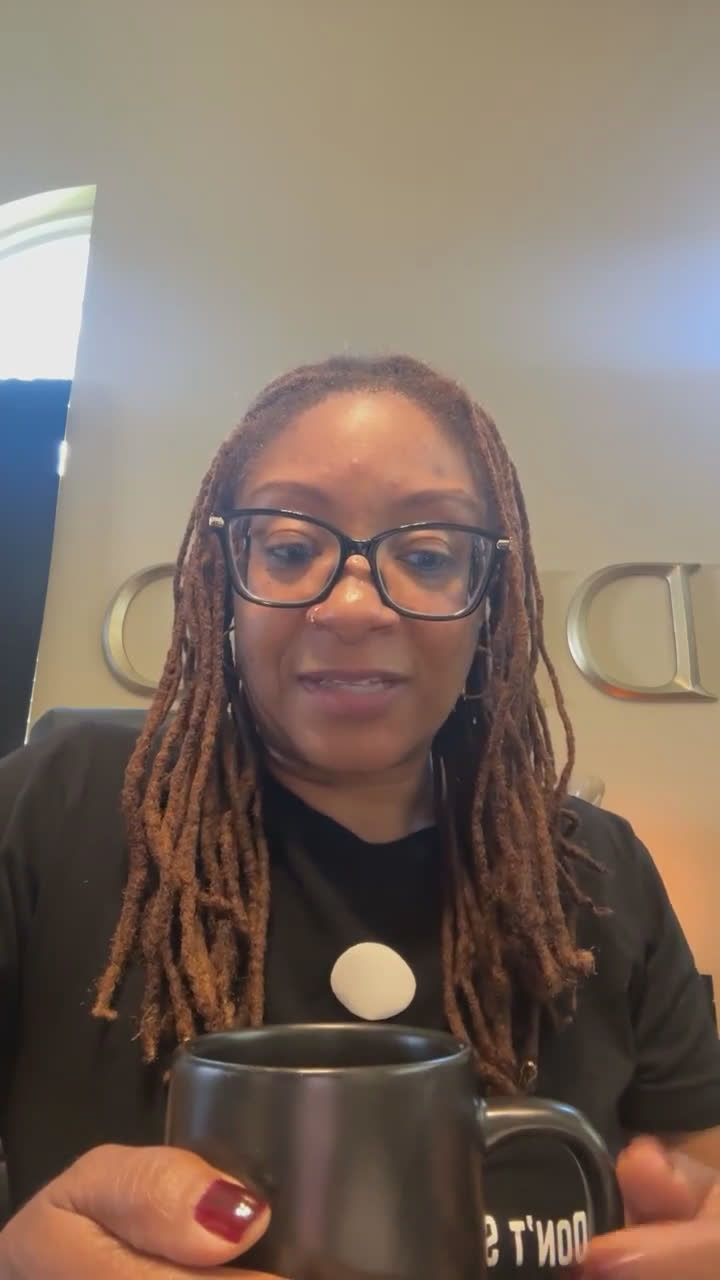
was trying to get some sun a few minutes ago. Midwest has been having these irritating bugs. Tomorrow starts Domestic violence awareness month. One out of three women and one out of four men experience domestic violence at some point in their life. Financial issues is one reason why some.
Dr. D. was trying to get some sun a few minutes ago. Midwest has been having these irritating bugs. Illinois has been my home state for a long time. Let me know where you're coming in from.
I tried goat milk in my coffee. The goat milk actually, for my latte was a lot creamier than I expected, and I really like it. If you find a good goat milk brand, let me know about that. I'll try it.
Tomorrow starts Domestic violence awareness month. One out of three women and one out of four men experience domestic violence at some point in their life. We're going to talk about what are some of the signs as someone on the outside that you could recognize that someone might be dealing with domestic violence.
All of the women on my father's side experienced domestic violence, including my grandmother. Financial issues is one reason why some. Someone might stay. Another issue is that sometimes it's just not safe to leave.
Sometimes we stay because there's a fear of freedom. Are you being a safe space for that person? Domestic violence in relationships starts as young as the age of 12. We have to talk to our kids about this, too.
Hello, Cadre. It's me, Dr. D. I am getting myself set up because I was trying to decide if I wanted to put my mic on today, and I decided not to. So y' all gonna. Hopefully you can hear me. Okay. I was trying to get some sun a few minutes ago, and I don't know where you guys are all at, but I'm in the Midwest, and we've been having these, like, little irritating bugs that you can't really see them, but then you feel them, like, pricking your skin, and you're just always, like, smacking your arm and smacking your leg.
And so I was out there trying to get some sun a few minutes ago, and it was just annoying out there. Hello? Is it Andrea? Andrea. I'm not sure how to say that. Welcome. Let me know where you're coming in from. So I am in Illinois, but I'm right outside of St. Louis, Missouri, so I'm right across the. The river is what we say around here. I'm right across the river in Illinois, and I've been here all my life. You know, Illinois has been my home state for a long time. Long, long time. Hi. Speak wonder.
So today we are going to talk about domestic violence. So coffee is on. Look, let me tell you about my coffee today, y'. All. So I am trying to, I guess, try different milks. Okay? I do not like oat milk in my coffee. I like oat milk on its own, but not in my coffee. I do not like soy milk ever. But I tried goat milk in my coffee. So let me know if you've tried that before. The goat milk actually, for my latte was a lot creamier than I expected, and I really like it. And that might be my new go to is goat milk.
Okay. So if you find a good goat milk brand, let me know about that. I'll try it. But getting back to domestic violence. So next month. So tomorrow starts Domestic violence awareness month, and it is definitely a very special month. It is a month that I think can be triggering for people in different ways, either because they've been a victim at some point, or we now like to call them survivors of domestic violence. Or maybe you were a child that grew up in domestic violence at home. But it is. It's something that needs to be talked about, because part of why we talk about domestic violence is because we want to create safe spaces for people to get safety or to even prevent the things that could happen in toxic relationships.
So awareness is key. Yes. Goat milk is good for hormone B. Oh, thank you. I need that, I need to know that. So I'm going keep trying it. But if you are not aware. So here just one basic statistic that I think is so powerful when you sit and think with it. So one of the three women and one out of four men experience domestic violence at some point in their life. So one out of three women and one out of four men. And I love to highlight the impact that it has on men because their stories are often not told or highlighted because of so many things society doesn't want to acknowledge that it can happen to them, but it does.
So think about the women in your life and if you've ever heard their story of domestic violence or if you've seen some of the signs and sometimes we're not aware of what the signs are. And I will get into that next month. We're going to talk about what are some of the signs as someone on the outside that you could recognize that someone might be dealing with domestic violence. But one, overall, I just want to emphasize that experiences with intimate partner violence and domestic violence are often under reported.
And a lot of times people that later hear stories of they were going through something, maybe it's your friend, loved one, or you just see something in the news. I think the first question most people ask is why, why, why did they stay? Why were they in that relationship in the in the first place? Why would they let someone do that to them? That big question, why, why? And it sometimes is not explainable. And so I want to just bring awareness to the why, why of domestic violence. So why do people stay?
And if you have any idea, let me know. Put that in the chat for me. Why do you think people stay in not just toxic relationships, but specifically intimate partner violence? Why do they stay in these relationships that are physically abusive, mentally abusive, emotionally abusive, financially abusive? Why do we stay? And I will share, and I'm not afraid to share this. I am a survivor of domestic violence. And my story, I feel, is very different because I didn't grow up in a household with violence.
I didn't grow up witnessing violent behavior with my mother. I didn't grow up with these things. So my experience does not fit the statistics of how this could have happened to me. But I later found out. So I did a genogram, if you guys know what that is. So it's kind of like a family tree, but you're looking at specific patterns in your family, like education, background, medical history, things like that. And so when I was in my PhD studies, I had to do a Genogram. And through conversations with my parents, I later found out that on my father's side, I believe all of the women on my father's side experienced domestic violence, including my grandmother.
And I had no idea. I never knew that. And I'm not close to that side of my family. But even from the connections I do have with some of the women on that side, I never would have guessed it. Never. And so that might be the. The why of. They're underreported. They're not telling their stories. But to me, it made sense. Once I saw that, I was like, oh, that's kind of how that generational trauma entered my life. It's not something that I chose. It's not something that was modeled for me, but it was in my bloodline.
Okay? So I want you to consider that if that is your story as well, if you're asking yourself, why did this happen to me? Okay. But I want to highlight just three. Three key things of why someone would stay. And the first one is, you know, sometimes there's a big burden of financial issues. So if they're being financially abused. So, for example, if one partner that's we'll say is the abuser is controlling the finances or preventing the victim from having access to money in ways of having a job, maybe they sabotage their job placement.
Maybe they show up at their job and, you know, get them in trouble with their boss because they've got all this drama, or maybe they have to call off work so many times because they have bruises and they can't show up like that, or they just don't have the energy because they've been beaten so bad. And so they end up, over time, losing their job. That's the first step, right? And then they become reliant on the person that they're in relationship with for financial support. And so if they're trapped in that.
That state of, I have to rely on you for support, if I leave, what am I going to do? I have no money, I don't have a job. How can I support myself? So it's better. You know, we might think it's better to just stay. And that's not true. Sometimes it might be better to stay for a short time. But what most people don't realize is that there are resources for victims of domestic violence that can help them get financial support that they need to get their lives started. Okay? So financial issues is one reason why some.
Someone might stay. Another issue is that sometimes it's just not safe to leave. So there are Many stories. And you may have seen movies about this, you may have seen documentaries about this, and it does happen, okay? These are not made up stories where a victim finally tries to escape and get to a place where they're. They committed to safety for themselves. They left the relationship, they left that home. And what happens next sometimes is that that person gets tracked down and the abuser finds them and hurts them even worse because they tried to leave.
So that that lack of control that the abuser had puts the victim in a situation where now they're at a higher risk of being abused and sometimes killed because they decided to leave. And here's another interesting fact for you. On average, it takes a woman seven times to leave her abuser before she stays gone. Seven times. Just think of how long that might take. Over a year sometimes. Because it's. Seven times is never like seven days in a row, right? It's over a period of time, maybe months, it could be years that she tries to leave before she's actually gone for good.
Seven times. And sometimes this is part of the. Why they go back for different reasons. They go back because they sh. They were shown that it wasn't safe for them to leave, so they had to go back because it was safer to be in a trapped situation. There are times when people are trapped by their abuser, right? And so they know everywhere they're going and they're being not just physically abused, but the mental abuse that comes with that. I know what you're doing, I know who you're with. And you may have seen that in some documentaries too, where the abuser finds a way to sabotage the next relationship that that person might be in.
They might bring up some things from their past because they just want to have control over that person, over the victim, and the victim doesn't know what to do. And so they just decide, it's just better for me to stay. It's better for me to stay in this toxic environment so I can keep myself safe. Not just physically safe, but mentally safe. Even though it's still abusive, you're still enduring the pain through all of that trauma and all of the trickery, right? All the gaslighting, you know, the love bombing that comes with that cycle of abuse.
Sometimes it's just safer to stay. And that's unfortunate. And so I want you to think of these people in your lives. Remember, one out of three women, one out of four men, there's someone, I can guarantee there's someone in your life that is experiencing this or has experienced this. So Think about that. What. What was their. Their journey like? How has their journey been to find safety? And this leads me to the last point I want to share with you. Sometimes we stay because there's a fear of freedom.
When we finally get free, we don't know what to do with that. When we finally get free, we don't know how to be because all we know of how he should be is a victim. That becomes our personality, that becomes our identity, is we're victim. So when we get freedom, we don't know how to operate in that space. So a person might stay because you know what? I know how to navigate this life. I know how to navigate this trauma. I know how to deal with my abuser, but I don't know how to deal with myself. That's scary.
That's scarier. So I'm just going to stay or I'm going to go back. If there's anyone that comes in mind, please let them know that it's okay to leave and it's okay for them to speak up for themselves. It's okay for them to talk about what's happening with them. And I encourage you to really take an inventory of yourself. Are you being a safe space for that person? Are you being a safe space for that person to share their story with you, to rely on you when they are ready to leave, that they can call on you and say, hey, it's time for me to go right now.
I need help that they know they can call you? And we, we all have different capacities, right? We all have a level of our cups to fill. But even if the help you give is just giving them resources, giving them connections to resources, giving them information, encouraging them that it's gonna be okay if that's all you can do to keep someone safe, you've done your job, okay? If you're capable of more, maybe you have connections to people that can financially support them for a little bit, or you have a room in your house that you're willing to let them stay there until they get on their feet, or you're able to give someone a job, or you're able to, you know, help them store things for a little bit until they can get to a safe space.
You know, it's. It's little things that we can do to create safety for each other. And the thing that I think is important with victims of domestic violence is they need community. So often that tactic of isolation is used because the abuser knows, if I can get you by yourself, you don't have any Help. You're not going to go anywhere, and I can do whatever I want to you. And so if all we can do is create a brief moment of safety, a smile to let them know, hey, I see you. Okay, texting them. How's it going today?
Think about your co workers. Think about some of your friends that may not be telling you the whole story about their relationships. And this is not age specific. Another statistic that just came to mind is that domestic violence in relationships starts as young as the age of 12. So middle school, seventh, eighth grade relationships are experiencing domestic violence or intimate partner violence. So we got to talk to our kids about this, too. We have to talk to our kids, boys and girls, okay? Both.
All of them, because they need to know the signs. They need to know what a healthy relationship is so they can stay safe. They. They need to know these things so if they see a friend who's going through it, that they can encourage them to get to safety. All right? That's all I got. I know this is a heavy topic, y', all, but I do hope you're able to join me next month, because I'm going to dig a little deeper into domestic violence. You know, how it impacts us, not just the person going through it, but how it impacts us in community, how it impacts children, the teen specifically, and what we can do about it, because it doesn't have to be this way.
All right? So I hope you all have a wonderful day. Thank you, Andrea. I'm saying Speak Wonder. Thank you for joining me today, and I will catch you all next Tuesday. Oh, and don't forget, if y' all could say a prayer for me. I'm doing a ted talk or TedX talk this weekend, so say a prayer for me that I don't forget my. My script. But I'll give you guys an update next week and how that went. Okay? All right. See you later. Bye.