PLAN TO BE YOUR BEST …As You Navigate Pain. Your best is greater than the pain.
Rick Cram: This evening we're going to use the three steps of resilience in an entirely different way. We will use them to savor the ordinary and find that by taking time there's a few benefits.
Use the three steps of resilience to practice doing something now that builds muscle memory for when we really need to hit the pause button. Once or twice during the course of this week to pause and savor the ordinary. Practice that resilience, even in a moment of calm, is what helps us further down the road.
Kathy: On a scale of 1 to 10, how stressful are you? Amar: Three. I hope you'll replay this as you need to as a guide to tune in, plan and be your best. To savor something that's ordinary, to turn your extraordinary resilience into something even stronger.
Rick Steves shares his tips for building a career in your 20s. Take a long term perspective and get to know as many people as possible. Always lead with your best foot. Remove the urgency, allow things to unfold.
Any any final thoughts about the three steps of resilience to use in this way or something that you might take with you? I'm going to look at this 1912 piece of musical technology as it was back in the day. I hope you have a great week.
May I invite you to take it in a deep breath? Have you ever found yourself going through a busy day and you all of a sudden realize. I don't remember the last time I was even aware of my breathing. So much going on. Your mind might be racing. You feel like perhaps a ping pong ball bouncing back and forth between different tasks, different thoughts, different pressures. Good evening, I'm Rick Cram and welcome to your Resilience coaching studio. This evening we're going to use the three steps of resilience in an entirely different way.
Hi. I'm so glad that you're with me. I'm at that point where I'm needing my glasses off and on to say hi, Valerie, so glad that you're here. Just as I was describing a few. And we all know what it's like, don't we, when we're racing through the day and our minds are racing our thoughts, we're forgetting to even breathe, it seems. On a scale of 1 to 10, what has your day been like in terms of the stress? Perhaps it's in this very moment. What would you say your stress level is on a scale of 1 to 10?
1 being too low and 10 being too high. No, I should rephrase that. Actually, a low one would be nice. Very little stress. But 10 is too high. What number comes to mind? This day has been very stressful for me. But I must admit what I'm about to walk you through is what I've been practicing myself for the past half hour or so. Preparing for our time together this evening, where we will use the three steps of resilience to tune in, plan and be our best and find that by taking time there's a few benefits, such as we'll experience together this evening where we will savor the ordinary and find that we gain a real sense of calm.
I've gone from a very stressful, even painful day today, but yet practicing this myself has calmed me down wonderfully. And I would like to ask you to first. Hello. Speak, wonder. Hello, Kathy. I'm so glad you're. You're here, my friend. And so you're five plus. Okay, so like a lot of days, it's been busy. Perhaps it's been so stressful that like I mentioned before, you forgot to perhaps look around you, take in a view out the window, the green trees or blue sky, perhaps, or even forgotten that breath.
But join me if you will, as we use the three steps of resilience right now to savor the ordinary and find how this is going to Be an example of how to practice using the three steps of Resilience to gain a sense of calm for now as well as for a future time. Again, this is an entirely different way to use the three steps of resilience. When we tune in, we take that first step. It's all about awareness. Take a look around you. What is there that's ordinary around you? What is it? Perhaps that's the chair that you're sitting in, the drink in your hand, or that view out the window, or perhaps even the rhythm of your breath.
What is it that comes to mind for me? I'm going to share with you something that I look at often and think of. In some ways it's very ordinary, but it's gone through some changes and it reminds me of a time to take a deep breath to savor something that was ordinary. What is it that. So, chasing grandkids all day, I get it right. A lot of energy, huh? So I was talking to a friend of mine this morning who was. Who had grandkids in a summer home for a couple of weeks and they got finished. They were up in Maine for a while and they got finished.
The grandkids left and they said now we need a vacation. So the ticking of the wall clock. Ah, there's a nice rhythm to that, isn't there? That ticking is steady. It's predictable. Have you ever found yourself counting as if you're trying to count at the pace of a second? 1, 2, 3, 4. Just as you and I like words, I like numbers and I like the pace of counting at the pace of a second for each number. So we just tuned in and we're thinking about something that is ordinary around us. And now let's go into the plan step.
Let's plan for a future moment where we will think about. And maybe it's every day, 30 seconds, 60 seconds or 90 seconds, where you'll plan to pick a time each day and notice something that's ordinary. What might that be? It could be something that you do at the start of every day. Maybe it's something that you do when you're first getting up in the morning. Or perhaps it's midday when you could use a midday pause. In effect, when we do this, we are creating muscle memory. If you do this each day for the rest of the week, for example, perhaps it's a mid afternoon deep breath and just looking around at what is ordinary and taking some appreciation into knowing that that is something that is present.
It is steady, if you will, that muscle memory that we Build up over. Doing this every day or multiple times every day is adding strength to our resilience. It's practicing, if you will. Doing what we can do when there's no major stressor going on, there's no pain point. But the more we practice it, when we don't have something overwhelming going on actually creates muscle memory for when there is something painful, overwhelming or stressful. What might you do? Might it be when it comes to numbers?
Here I go again. I've got a few numbers that are my favorites. 31, which was my jersey number I was wearing when I injured my knee. Or 21 was another jersey number. Or 57, the year I was born. Sometimes I'll think in terms of when I pause or do something or lift weights, for example, I'll do 57 reps of a certain exercise. Or it might be 31. What might it be? How much time Will you spend? 31 seconds? 60 seconds each day for the rest of the week, pausing in the middle of the day to take a deep breath and notice what is ordinary around you.
What might you look at? This is in the course of this plan step, we are creating a menu of options for us to think in terms of what are we going to do for the days ahead. And practice again being intentional, creating that muscle memory for when we need it the most. And now let's go into the be your best. The third step. Which one of those options are you going to pick? Which will you follow through on what comes to mind? I'll share with you what I'm going to do. Here's something that was once very ordinary.
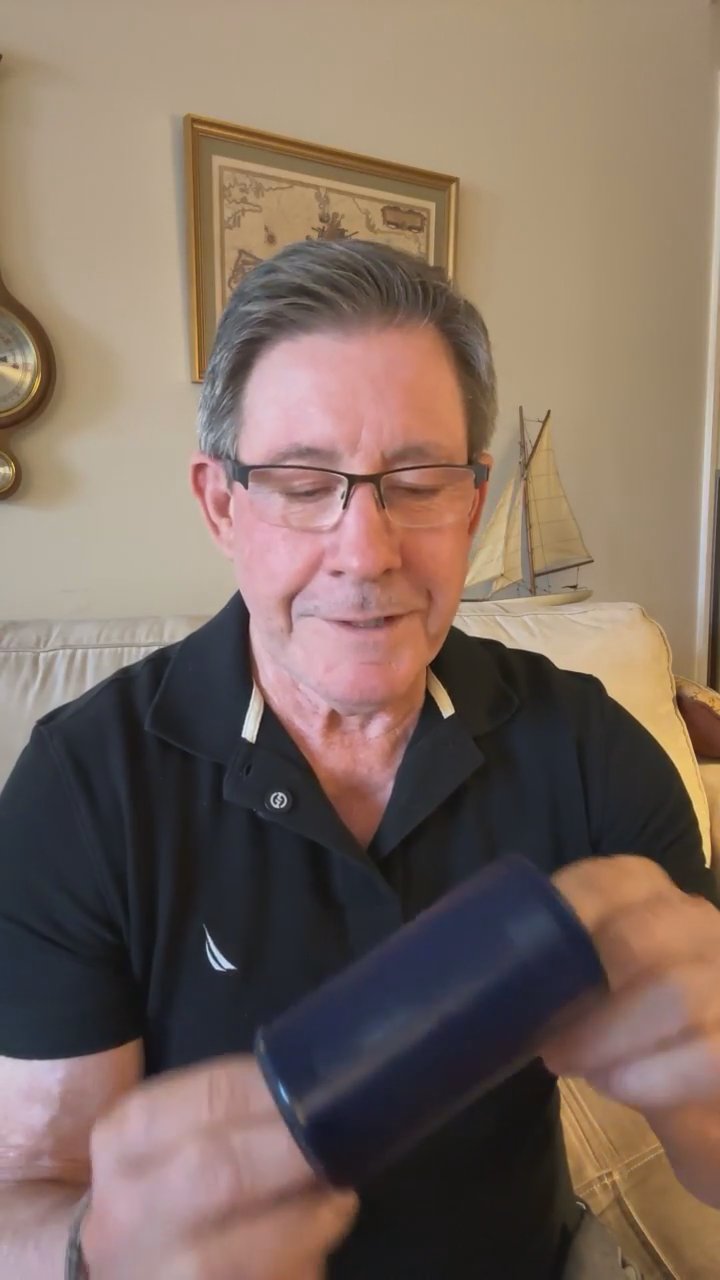
The writing might be reversed, but this is called the Edison Blue Amber Roll record. It was made in 1912 by Thomas Edison. This cylinder is hollow. Is actually something in its day was ordinary. It has a song on here, a very old piece of music from a band that played a sort of a jazz song. I've got the name of it and I can actually find it online. But this was actually before cassettes, before at LPs. This was a cylinder recording device. Thousands were made by Thomas Edison, myself. And I look at it and think of how this was once ordinary.
And I pause. I appreciate it. And now I consider how extraordinary it is. What might you pick to look at each day? Once or twice during the course of this week to pause and savor the ordinary. Perhaps it's something very ordinary, like the chair that we're sitting in or the scene out the window and maybe think about how ordinary it may be. But perhaps it's going to become extraordinary like you. So that's how to use the three steps of resilience to practice doing something now that builds muscle memory for when we really need to hit the pause button, to slow down, to win back our focus, win back some energy, even win back our hope and to be able to move forward.
That's being resilient. And practicing that resilience, even in a moment of calm, is what helps us further down the road. It is in a way, both having an act of resilience for now that's going to help us in a resilient moment down the road. And now may I ask you, on a scale of 1 to 10, how stressful are you? How much are you closer to enjoying that, savoring something extraordinary? Might it be less than five now, Kathy? I hope it is. So any one of you that might watch this as a recording, consider using this as a, as a stepping stone, if you will, or a guide to take the steps in these several minutes of this video.
You can watch it over again whenever you need to follow these prompts to tune in, plan, and then be your best. That's how you plan to be your best as you navigate whatever it is you're navigating. Three is a nice, nice number. That's good. Yes, I like that. And just walking through this, these moments with you, it's further relaxing for me as well. What questions might you have? I'll stay on for a little while longer. If there's anything else that I might want to suggest. There might be some different prompts that I'll add as a comment or two, different things that you can do in this way, different versions of it.
And so I see that Kathy, you're talking to Amar. Amar, I haven't seen your name, but I'm glad you're here. I hope that you have experienced what Kathy and I have during this time together. I hope you'll replay this as you need to as a guide to tune in, plan and be your best to savor something that's ordinary, to turn your extraordinary resilience into something even stronger. And let me just check the what advice in building a career in young 20s? That's an excellent question. And as I think of exactly how I'm going to give you my answer, I'm going to share with you a couple of facets of my early career story.
I wanted to be an executive in an advertising agency and I interviewed in different advertising agencies and wasn't getting anywhere. I was going in and out of New York City and hoping to have an advertising career there on Madison Avenue, so to speak, both literally and figuratively. But what I ended up finding was that where I was being received well was in the magazine publishing industry. So I ended up knowing, taking a chance, knowing I needed to start somewhere. I was getting rejections after rejections after rejections.
But the more I started meeting with different magazine publishers, I found that we connected in multiple ways, both personality wise. They saw my communication skills, thought I'd start out well, and sales, and it's a related field to advertising. So I ended up starting with Time Inc. And moved eventually to Home Magazine, which was then published by the company that publishes Architectural Digest and Bon Appetit back in the day. And it wasn't advertising, but I was selling advertising space. And I did that for 10 years.
And then lo and behold, not too much later, I was an executive with an advertising agency. Things don't always go as planned, at least when we wanted to. And I think one of the things to do when we're in our 20s, even our 30s, is take a long term perspective. We've talked about this before and it's another way to take the urgency out of. And I know that urgency, I know that desire that you have and I know you want to go into law enforcement and there are a number of both interests and skills that you've got.
But what if you in a way, cast a wide net, see what works, see where the door is open for you and get started where and when it makes sense. I know you've got some schooling to do. And perhaps in the course of the schooling it might not be exactly the match that you're hoping it to be, but it's going to give you education. One way that I look back on my education was two great things that really came from it. One, an appreciation for how to elevate the ability for me to be a student and be a student for the rest of my life, as well as finding that an education is an education and it's not so much what you've learned, not exactly the degree, but what, what you do with it.
For example, I got a liberal arts communications degree. And it wasn't so much that I was merely being trained and had an education for the direct area I wanted to go in, but it was enough for me to be able to get started after school. Let me take a look at your notes. This is difficult for young people. Yes, it is. Yes. Remove the urgency, allow things to unfold. I like that word, my friend, being a fellow word. Nerd life does unfold and we should and be intentional and try but realize that in that trying we are living into how life does unfold for us.
I think the key is, and I think what Kathy is acknowledging that it's not easy. Nothing really is. But as you go through your days and weeks and the years ahead, you'll find that there will be hurdles and sometimes roadblocks. But look for those the path that's a little less resistant. See where it takes you. Be your best through it. Always lead with your best foot. And I know that you do that. But take the urgency out of it and talk to here's what I'll actually one last suggestion. Get to know as many people as possible.
Your network is going to be your net worth. And if I would do one thing differently is that every person that I connected with early in my career that I would never lose contact with them. And there's something that happens very naturally, even for adults well into their careers, when they go through a time of transition, when they've lost a job, for example. For 10 years I led a transition group of people who are in and out of work. Many of them were senior executives with financial services companies like Fidelity Investments, State street and and so forth.
And when they would lose their job, then they started networking. Some of them came back years later and they said, you know what, Rick? After I got my new job, I stopped networking. And all of a sudden I find that I need to respark, reignite my networking. Stay in touch with everyone that you connect. Meet as many people as you can. Ask a lot of questions. One of the best questions to ask is, can you tell me about your career? How did you get started and let them tell their stories? You know, a lot of people love talking about themselves, but we can learn an awful lot from asking a question like that and seeing what paths people take.
A beauty about asking a question like that is that someone then knows that they're being invited to share their story with you. And the better of a listener that you are, the stronger that relationship is going to become. Thank you for your comments. And let me just read this. I don't think I knew this about you, Kathy. I'm sorry. Your late husband was a peace officer his entire career. He loved serving the public in this way. To serve and protect, as he always says. It truly is amazing. Thank you so much for that.
And I'm again sorry for your loss. I'm very, very sorry. What a good man he was and what a good heart you have. So Amar, I hope that was some wisdom. Of course you and I can connect elsewhere as we are on LinkedIn, on Instagram, and we can continue our conversation here in Gundre. Any any final thoughts about the three steps of resilience to use in this way or something that you might take with you? I'm going to look at this 1912 piece of musical technology as it was back in the day and think about how it was once ordinary, but now it's extraordinary.
Like you. I wish you well and I'll look forward to seeing you again next week and on Cadre with our posts and comments in the days ahead. I hope you have a great week.