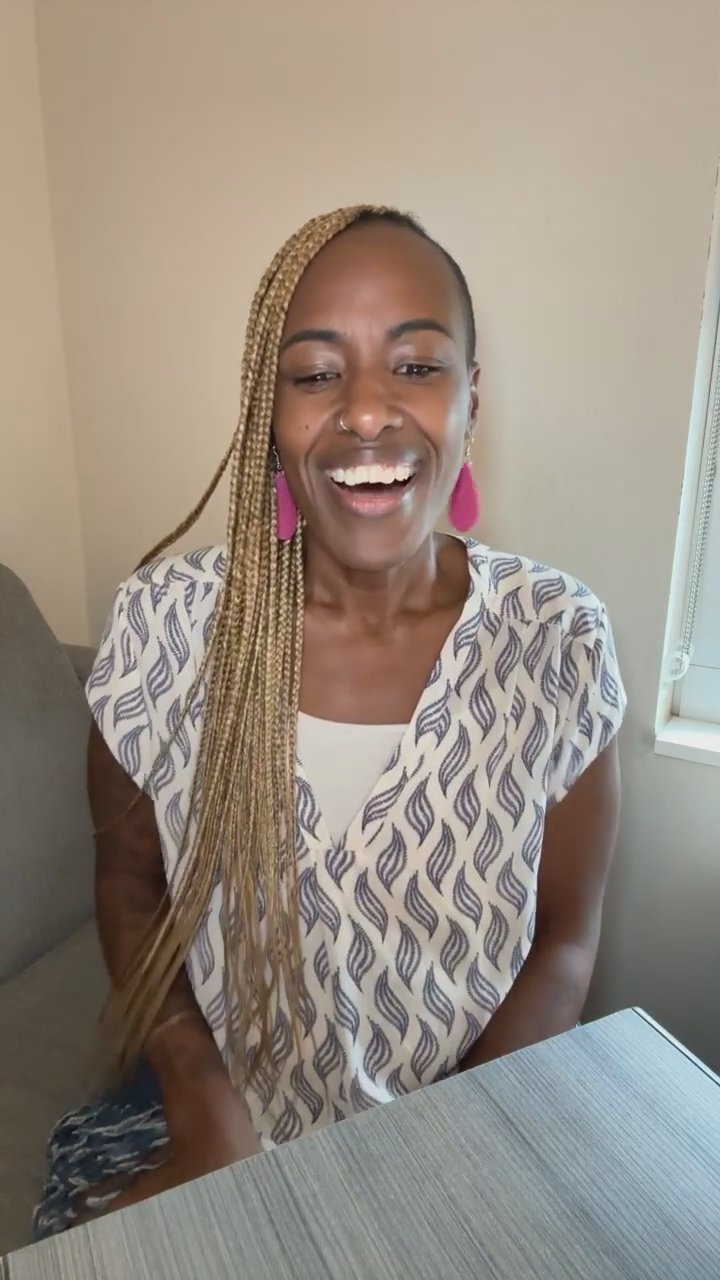
Dr. Charisse Johnson is a licensed clinical mental health therapist, mindfulness practitioner and author. 1 to 10, 1 meaning awful, 10 meaning amazing. This week has been a roller coaster. True freedom begins when you stop mistaking over responsibility for strength.
Dr. Charisse Johnson is a licensed clinical mental health therapist, mindfulness practitioner and author. This month we've been talking about freedom and just different elements of freedom. Today I want us to focus on emotional freedom from over responsibility.
Tell me where you are. 1 to 10, 1 meaning awful, 10 meaning amazing. This week has been a roller coaster. But I think that a moment to just check in and to regulate is extremely important.
True freedom begins when you stop mistaking over responsibility for strength. Over responsibility defined as the internalized pressure to do more, to be more and fix everything around us, even when it comes at the cost of our own health. Healing is always there when you learn to give yourself back to yourself.
You tell me, how have you been treating yourself lately? What have you noticed about how you're treating yourself in terms of the level of responsibility and the standards that you're placing on yourself? Here are some tips to help you balance your expectations and then releasing that level of over responsibility.
Third tangible tool plate. This is connecting how you're eating with what you're thinking. Let your plate act as a mirror, not of shame, but of truth. There is power in letting go of what depletes you. May your healing be louder than your habits.
Hello, cardiosphere. I hope you are doing as well as possible. And if you're not doing well, then the goal is for you to be doing a little bit better by the time that we finish our time together. If this is your first time here, I'm Dr. Charisse Johnson, a licensed clinical mental health therapist, mindfulness practitioner and author. And I come into this space a couple times a week to encourage you to talk about all things life, trauma, health and well being, but most importantly, to make sure that you are centering yourself and making sure that you are present in your own life.
This month we've been talking about freedom and just different elements of freedom. And today I want us to focus on emotional freedom from over responsibility. But before we get to that point, I want you to do two things. Tell me where you are. I am off in Hendersonville, not too far from Charlotte, North Carolina, having an incredible, incredible weekend and a time just to engage and enjoy. And if I had to read my week, as we do each time that we're together, 1 to 10, 1 meaning it's awful. 10 meaning it's amazing.
Hello, Snow Hill, North Carolina. What is that near? I don't feel like I've heard of Snow Hill. Then I would give my week. Let me think about it. This week has been a roller coaster. However. Hello from Canada. Hello, Alex. It's so amazing to see you. Hello, Statesboro. Hello, Dallas. 5, which is great. Hello Minnesota. It definitely started low and I've definitely had to work to get to this point. But I think that a moment to just check in and to regulate is extremely important. And I love when you all tell me where you are.
And the reason why that's important is it gives us an opportunity to. Oh, you're in Charlotte and I'm not. Hello, Dayton, Ohio. An opportunity to remind ourselves that we are not alone. All right, so let's get into focus of today. Opening quote. When you carry what was never yours to hold, your soul becomes tired, not just your body. True freedom begins when you stop mistaking over responsibility for strength. Can we just acknowledge that? Give me some hearts if that touches you. I want to say it again.
When you carry what was never yours to hold, your soul becomes tired, not just your body. True freedom begins when you stop mistaking over responsibility for strength. I absolutely know that that can be a tug of war for many of us because we're taught that being productive is something that we should aspire to. But in this space, we want to really unpack emotional conversations that we have within ourselves and make sure that we're looking at them through the lens specifically of food trauma and well being.
I'm always going to tie those in together when you're speaking with me or when we're connecting together, because what's on our plate a lot about what's happening in our life. So over responsibility defined, hello New Jersey is the internalized pressure to do more, to be more and fix everything around us, even when it comes at the cost of our own health. Now, you know, if you've been with me a couple times that you know, every now and then I ask you to kind of out yourself, I won't say if it's happened to you all the time, but if you've ever had a moment where you have internalized pressure to do more, be more, and fix everything around us, around you, even when it comes at the cost of your own health, I just want you to put in the chat, maybe.
So you're not really telling me if you have, if you haven't, you're just saying, maybe. I'll say for myself, maybe. Right. There are ways to normalize that, but it is important because sometimes we can get in our head and think, well, am I the only person that ever does this? And the answer to that is no. So whether you're navigating grief, chronic stress, or the invisible weight of a dysregulated eating patterns or just life patterns, I want you to know that healing is always there when you learn to give yourself back to yourself.
I love it. Dr. Teresa, she's like, maybe that is. That is an iconic answer. You can use that whenever anybody asks you something that you're like, I don't know if I fully want to make that. You could just be like, maybe. So let's ground this in a bit of neuroscience. So your brain is wired for connection safety. We've talked about that many times. If that's new information to you, then enjoy that little piece of neurobiology. So when you grow up in an environment where love is conditional or roles are imbalanced, maybe you were praised for being the strong one or shamed for needing help.
Then your nervous system adapts by prioritizing others needs over your own. This can also be true if you're the oldest. We see a lot of birth order that happens there. If you are not the oldest, but the most responsible out of your siblings. Sometimes you might be the youngest, and yet you ended up being the most responsible, the most leaned on. Then you can fall into that overproductivity. If that was something that was modeled for you. If you are the child of parents that had any type of issues with violence, with alcohol or with addiction, they weren't fully able to play their part.
And so you were a parentified child. And as a result of that, then you may also be one of those individuals that find that you felt like you had to be the strong one, or that's what you needed to do in order to be recognized or to be seen as different or to get love. And then that survival strategy becomes your new normal. And so your brain starts to associate over functioning with safety. Can I be honest? This is me. And it is a constant work in progress. Because over functioning became too much of a survival skill.
Wasn't so much that I. I didn't have a parent there who was giving to me, but surviving and getting myself beyond my circumstances meant over functioning. So even to this day I have to work on staying focused around that, making sure that I'm not leaning into that, reminding myself that that is not safety. Instead, it actually creates burnout. So when you have this process of over functioning as a sense of safety or success, then over time it leads to chronic sympathetic arousal and your body gets stuck in fight, flight or freeze, even when there's no immediate danger.
And so this can also show up as food fixation, guilt while resting, who's ever been there, or relentless self criticism when you don't meet the impossible standards that you're setting for yourself. You tell me, how have you been treating yourself lately? This is an opportunity for you to reflect either on your own or to pop in the chat and just give me a little bit of insight around what are you noticing about how you've been treating yourself lately? In particular, when it comes to the level of responsibility and the standards that you are placing on yourself.
Again, I always want to normalize and not come before you as like, I'm here and you're there. But we all navigate these things regardless of how much knowledge that you have. When I think about how I've treated myself, so it's been a bit of a roller coaster and I am working on being responsible for the things that I'm responsible for, but starting to pay attention when that appetite for over responsibility is starting to grow and making sure that I'm really managing that and going, hey, what do I need instead?
So what have you noticed about how you're treating yourself in terms of the level of responsibility and the standards that you're placing on yourself? And while you're putting that in the chat, I want to give you a few tangible tools that you can use as practices to kind of help you balance your expectations and then releasing that level of over responsibility. The first one is name the narrative. Ask yourself, whose story am I living? Right. And then write down three expectations that you carry that don't actually belong to you.
Did they come from childhood? Did they come from your culture? Did they come from past trauma? Are they coming from a future vision that you have for yourself? And you're over striving, but when you name these, it creates separation and what's named can be refrained. So naming the narrative. You've heard me use this tool, but I kind of break it down to you differently depending upon what I focus on. So I want to say that again. Name the narrative. Ask yourself, whose story am I living? And then write down three expectations that you carry that don't actually belong to you and where do they come from?
Childhood, culture, parents, past trauma, your family role, a future vision that you have for yourself. 2. Practice the power of pause. So the for saying yes, taking over, blaming yourself pause. Take three deep breaths, place your hand over your heart and ask yourself, is this truly mine to carry? This is one of the most powerful pauses that you can take. It's wonderful to take during the day. It's wonderful to take when you are working through something. It's even phenomenal to use vocationally when you feel like there's a strong level of responsibility being placed on you when you do this, specifically placing your hand over your heart and asking that question, it engages your parasympathetic system and then shifts the brain out of urgency and back into clarity.
All right, let's do this one together. Hand over heart. If you're comfortable, you can have that skin to skin top contact. It's going to create that oxytocin, that love hormone. It's going to just create a calming sensation to the nervous system. Take three deep breaths, don't rush those breaths. And then I want you to think about something that you know is on your mind and your heart and ask yourself, is this mine to carry? And maybe there's a portion of it that is yours, but is it all yours to carry?
And if not, what part of it would it be helpful for you to release? Third tangible tool plate. Check in. This is really connecting how you're eating with what you're thinking and what you're experiencing. So each day as you go through and you're navigating how you nourish yourself. I want you to reflect on what would my plate say to me right now? Right? That's what we talk about. If your plate could talk, what would it tell you? Would it say, you're rushing again? Would it say, why are you feeding everyone but yourself?
Or maybe this bite is the first thing you've done for you all day. Let your plate act as a mirror, not of shame, but of truth. If you're new. One thing that we do each week is we create two circles. One gives us a very tangible idea of, here are the things that I've been eating this week. It's not meant to be shame. It's meant to be awareness. And the other circle is what's on your plate, metaphorically. What are you holding? What are the responsibilities? What are the thoughts, the worries and the concerns?
And then how are those two plates interacting and paralleling each other? How are they at odds with each other? And then it's an opportunity, especially now, before you start a new week, to ask yourself, what can I take off of my plate? All right. Because when you're constantly in over responsibility, your identity becomes entangled in what you do, not who you are. But you're not a fixer. You're not a solution. You are a person worthy of rest, of nourishment and ease. So let today be the day that you create a small rebellion against burnout.
Let today be the moment you remember that you don't have to carry it all to be enough. You don't have to shrink to meet the needs of others. Well, peace begins or permission begins. Closing thought. There is power in letting go of what depletes you. May your healing be louder than your habits. My hope for you as you go throughout this week and start a fresh new week is that you start right now and you decide. What do I not want to carry with me this week? What's something that you're holding yourself responsible for that isn't really yours or doesn't really need to be taken care of by you right now?
And you can just put it on pause or maybe just get rid of it altogether. And I want you to give yourself permission to do that. Margie, thank you for sharing. Yes, treating yourself better by making smarter choices at night. Love the pause. Really come back to these if you have a chance. I try to make sure these are only 10 to 15 minutes so that you can come back to them and really replay. You can choose one tool. You don't have to do all three, but choose one that you want to practice on because we can't stop doing those autonomic habits if we don't replace them with new habits that are more adaptive in our lives.
As always, I'm so glad that you chose to come and to spend this time together. Remember, the Cadre Sphere is your space. This is where you're welcome. You are always welcome. Come back to this space as much as you need. I appreciate the time you spend with me and continue to explore the other contributors that are here because there is so much rich goodness being shared. I hope you have an amazing week and if you connect with me on a regular basis, then I will see you on Wednesday morning. Have a good one.