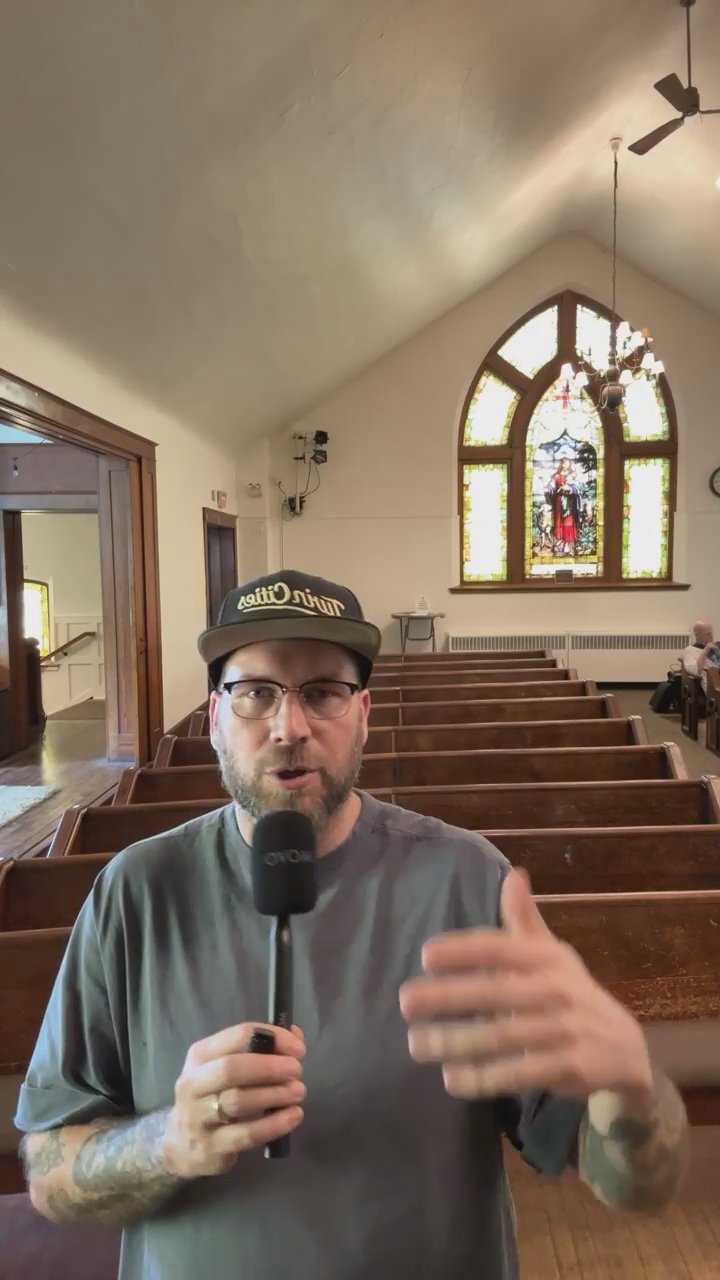
Join us live from Art House North in St. Paul as Pastor Seth and Nate Crary discuss balancing faith leadership with personal life and recovery. Don’t miss it!
Pastor Seth Perry is doing a service for Humble Walk Lutheran Church. Nate is doing the music. How do you balance all that? I live with bipolar disorder and I'm in recovery from addiction. Nate and his wife are navigating a co parenting situation.
I primarily lead song with guitar and singing, but I love working with other musicians. Tonight we'll have a upright bass player and a fantastic cellist with us as well. So it's going to be good music here and I'm mindful of time.
How do you balance everything in your life with recovery? The one day at a time mantra is it works. And I see a lot of parallels being a pastor and have to course correct. Now I'm looking forward to the summer to kind of make that balance happen.
Seth: In many ways also I'm a pastor and I don't get to go to church. And the balance as well too. This summer until September, it's just A time to plan, to take time off and to enjoy time with my dogs. That's why doing what we do here on Cadre is so vital.
Okay. Yeah. We're live now, so say hi to everybody. Nate. Hi, I'm Pastor Seth Perry and we're at Art House north, and I'm doing a service here for Humble Walk Lutheran Church. And Nate is doing the music tonight. And we have some surprises for them that we're not going to tell people who worship here yet. I guess we talked via text about what we're going to do, but I want to talk about balance. And then we've got Chrissy Moe ask us any questions about what we're doing here, here. And it's a beautiful worship space.
Before the end of the interview, I'll do a pan of everything and hello, Nikki. How are you? It's good to see you. And ask us any questions about the space we're in and what we do and where. This is Art House North. What's the location of Art House North? Do you know the address or neighborhood we're in? We're in the West 7th neighborhood of St. Paul, so not too far away from where I live, but I guess. So first of all, you're a church musician. You have a position at a church. Then how do you balance.
You have kids? Yeah. How do you balance all that then? Oh, boy. Yes. Well, they have a great mom who our schedules work out. You know, logistically, that I have a lot of freedom to do things like this. Yeah, that's good. That's kind of a practical thing. That's. I think practical things are good because my wife organizes a lot of stuff that isn't cooking. I do the cooking at home, but she does, like the heavy lifting. And I'm not joking. Like, she puts the other furniture and all that. And so I'm very open with everybody on here that I live with bipolar disorder.
I'm in recovery from addiction and I need balance. So I need a spouse who's going to be able to help me along with that. And then big cheer to the kid's mom. Oh, so someone. So your wife's name. Are you able to disclose that or. No. Okay, good. Then kid's mom is good. Yeah. Okay. Yep. Yeah, awesome. Good. And just for the record, recently divorced, so we are navigating a co parenting situation and. Well, thanks for being open. Open about that too, because. So then, yeah, then it's. It's co parenting.
And that was not a word when my parents got divorced. And I'm glad that it's a concept, too. So. Yeah. Tell me about your education that brought you to the point where you're able to be such a Good music, reputable musician in the Twin Cities Lutheran world. Yeah. What's the education behind that? Well, yeah, I think a lot of my education came from experience and so I did study music formally in college and got my undergrad in music and art. But it wasn't until really I started working at an outdoor ministry setting where it was kind of like I knew how to play guitar and they took full.
I mean, they'll use your gifts, whatever gifts they may be. So I found a good place in the church just to explore my gifts and grow and be challenged in different ways. So yeah, it's been a, it's been a long. I mean, yeah, it's been a good journey. Yeah. And, and Nikki says big cheer to co parenting as well. That's cool. So that's cool to see you did your summers were, were full of music if you're doing outdoor ministry. But tonight you're going to kind of bring a lot of in here you love. So what, what, what instruments are you playing tonight?
Yeah, so I primarily lead song with guitar and singing, but I love working with other musicians and so tonight we'll be. We'll have a upright bass player and a fantastic cellist with us as well. So it's going to be good music here and I'm, I'm mindful of time. So I guess my last part is. Do you want to talk about recovery briefly or is it something. Yeah. Okay, then how do you balance everything in your life with recovery? So go ahead. I think for me, my journey in recovery, which is like pretty, pretty new and fresh, but I found that sort of initial freedom of not obsessing over chemical all the time has actually really freed me up to just be more present and be.
Yeah, just, just have a better sense of what I need to do every day. The one day at a time mantra is it works. Right. And I found it really to free me up and focus on what I need to do today, what I need to do, the next best thing. All of that has actually like helped the balance of co parenting, working musician, that, that sort of thing. Yep. And I see a lot of parallels being a pastor. I go out of balance as a pastor and have to course correct. And then there's stigma around that because I'm leading a group of people and I recently did that going through a like January to May cycle of incredibly busy times.
And in the church world that normally is. And then so now I'm looking forward to the summer to kind of, you know, make that balance happen. So we got a Comment. Thanks for sharing the raw reality. That really works. Awesome. So I guess that's a good way for you to say, hey, go. You can go start your, your rehearsal and everything. Get going on that. Thank you for coming on. I'll, I'll say goodbye to everybody here and you can just give them a wave or whatever. Yeah. Awesome. So I just want to show the space a little bit because this is a place that people do church, but it's only rented.
Basically it's rented once a week for this congregation and it is an old church, but it was retrofitted into a multi purpose space. So they use a table up here for the altar on the stage. Right. So there can be concerts and things like this. And there's a living room over here, right here, which is really welcoming and I really like that. And then you got all these old pews here and a great, wonderful stained glass. So if you think about this kind of space here, which I'll just kind of pop up right here for a second.
So, you know, a space like this is something that I'm really interested in. When we think about church stuff and being a church. I get to preach here and. Hi Jules, good afternoon to you. I get to preach here once a year just in support of them because they don't, they don't have a traditional model. So they come to this church to check out what their model is like. And it's called Humble Walk Lutheran Church. And it is a very casual environment and community focused environment, cycling through musicians and how they actually have sustainable pastoral leadership is a completely innovative model too, which I come from a very traditional church where I'm employed.
But every time I come here, and I came here twice last summer and once the year before, it's a relaxing evening for myself because in many ways also I'm a pastor and I don't get to go to church. And that's part of the challenge. So. And the balance as well too. When do I get to worship? And I'll just say, another thing is I talked to my bishop not too long ago and she asked, you know, like, what, what are you missing really in your life and ministry? And I said, I don't get to go to church. So that's another thing to think about.
Pastors don't always get to go to church or worship. And you know, I get a certain number of weeks off per year for vacation and stuff. But yeah, so that's what I'm focusing on. So in terms of balance, this summer until September, it's just A time to plan, to take time off and to enjoy time with my dogs. And, you know, I had a incredibly Busy January through May 1, rushing to get a docu series podcast recorded and off the ground. And now I don't even want to hear the word podcast until the season two begins.
Really? That's. It's okay to feel that way because I think that sometimes people think that content has to be. You pump it out every day. So, yeah, I'm not subscribing to that model. That's why doing what we do here on Cadre, in the Cadre sphere is so vital. We don't have to feel like we have to produce content. I feel like more that we're doing what we're doing here. You might be listening to a recording or you're someone who tunes in every week. We don't have to feel the pressure to follow what someone like Gary Vee would say and say content is king.
What is more important is having a discussion that was not planned out in advance. Nate and I met for the very first time we knew of each other, but it was good to just talk. And I just sent him a text message. He said, yep, I'm game for a quick chat. But for all of you in what you do here in the Cadre sphere, maybe it's a post or maybe it is something like a live stream video or a piece of vertical or horizontal content. You're creating something that's different than stuff on other apps because A, we're curated and B, there's intentionality in what we're supposed to do.
And that's a mixed group of people. And that's what I like about this. And so Nikki says, humans are what this is all about. Thanks, Seth. That's a good place to end. I'm going to have some water, warm up my voice because I'm going to be preaching. But again, thank you so much for tuning in. I've had a wonderful time, and we'll see what happens next week. And peace out from Art House North.