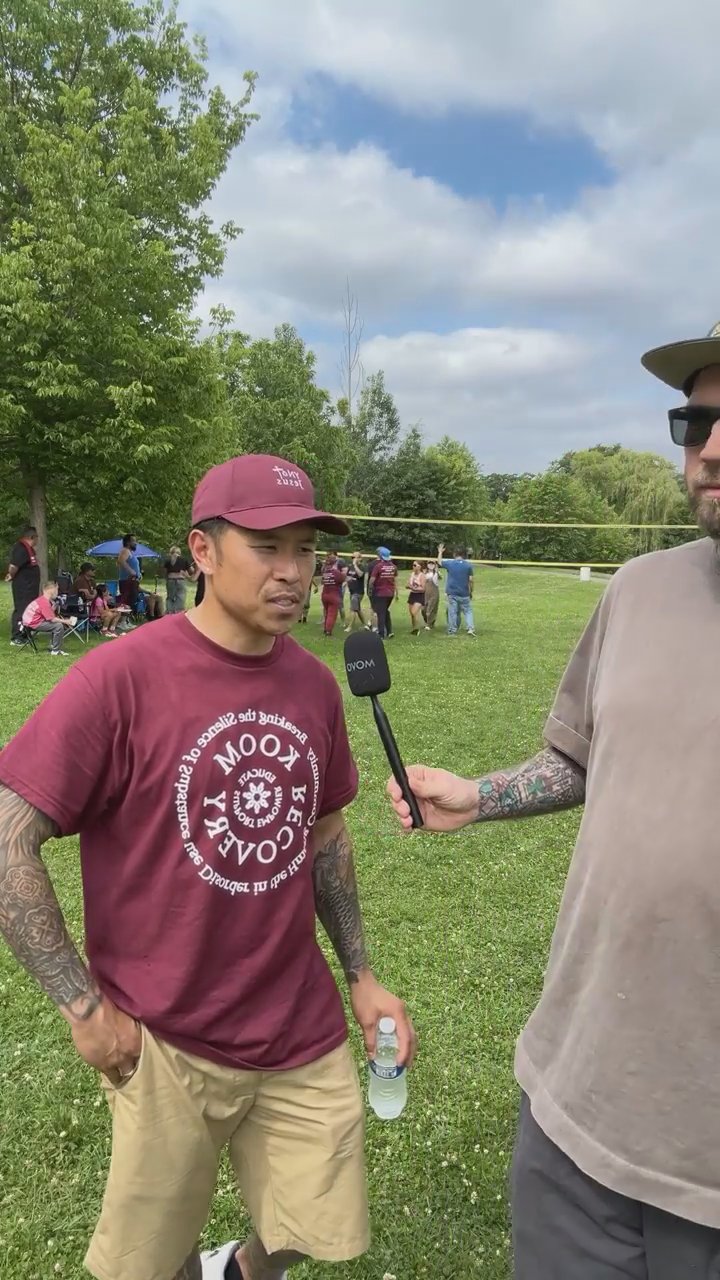
Seth Perry is live from Phelan Lake in Erie, Pennsylvania. The event is called Kuma Recovery family picnics. Feel free to ask any question. We're open to answer it.
Coombercovery is an RCO that is a recovery community organization that's for the Hmong community here. So basically, how about you come right in? Right in here. Excellent.
Yang: What inspired me to start Kuma recovery was that when I went to treatment, all the stuff I learned from treatment, it really helped me with my life. I just didn't know why Hmong people don't use these resources. So when Ying started working at Minnesota Recovery Connection, I was like, hey, we need this in our community.
Amaharid: What challenges specifically does the Hmong community face? He says in our culture, we just don't use treatment. But I broke that barrier because I went to treatment and it worked. It worked for me.
In her community, for the 18 clans, there are leaders. A lot of our clan leaders still actively drink alcohol. They don't see that alcoholism is just the same as substance use disorder, like using hard drugs. One day I'm gonna be able to break the silence by sharing my story.
Is there a particular age group in your culture that struggles with alcohol abuse? It starts in like the middle school age. I don't want people to end up going to jail first before they seek resource. So to everyone in the chat right now, let's focus a little bit on some questions.
Gong Recovery is the first of its kind for the Hmong community. The organization focuses on substance use disorder recovery. Founder says the biggest challenge has been getting people to attend events. Gong Recovery is making voices heard.
Is language a barrier in the Hmong community? Yes. It is. Especially when you're going to treatment and you don't speak English. A lot of the terms that American English like, it's. That's in the English language. We can't translate that into our language.
Kuma Kavari is the director of programs for Coomber Covery. The nonprofit is working to bring peer recovery support to the Hmong community. Do you feel stigma in your community? A little. Not a little. What do you want in the next six months?
Hey, what's up? It's pastor Seth Perry and we're live here at Phelan Lake. What part of the park is this? This is the island pavilions. Yeah, island pavilion here. All right, I'll let a few people come into the live stream. I'm glad that we're all here. And we're at the Coom Recovery. What's this event officially called? This event's actually called Kuma Recovery family picnics because we want it to be family oriented because family recoveries together is stronger. And. And we're just trying to break that cycles and trying to bring in families together so that they know how to recover together.
Yeah. And that's something that wasn't always the case in. In your community. And I've got amhered. You're back from last week too. So say hi. Ask us any questions. Jules, I want you to ask about the organization Kuma Recovery, and I'll ask anyone here. So if you want to just go ahead and do that. Yeah. Feel free to ask any question. We're open to answer it. Yeah. We're celebrating Father's Day. We're celebrating recovery. And yes, good afternoon to you, Jules, and hello from Erie, Pennsylvania.
Speak. Speak. Wonder. Hello. Hello. Hello. Hello, Hello. All right. Yeah, get Sienna over here. So we got a big crew here. Ask what we're doing here. The volleyball game just ended. And coombercovery is an RCO that is a recovery community organization that's for the Hmong community here. And I'm wondering maybe if you would want to ask any of our people here. So this is Siana, and. Yeah, and Siana, some people are saying, happy Father's day, but I guess, why. So basically, how about you come right in?
Right in here. Good. Excellent. So why don't you tell me what inspired you to start Kumo Recovery? So what inspired me to start Kuma recovery was that when I went to treatment, you know, when I. When I was in my 10 year sobriety and I was seeking for a recovery support, support group, I didn't find any. And then after like 10 years of sobriety, I had to reuse. And that's because I was out of the recovery community. I didn't have any. There was no Hmong community that I can go to, although AA and NA and all those other recovery group, they were welcoming.
Whenever I go there, I just always feel like left out. And it's nothing because of them, but it's just. Sorry. It's just the fact that I just felt like no one could relate to me, because of my cultural background and, you know, in light of my reuse, I realized that there's so much resource. And when I went to treatment, all the stuff I learned from treatment, it really helped me with my life. I just didn't know why Hmong people don't use these resources. So when Ying started working at Minnesota Recovery Connection, and he comes home and tells me all the good things that's going on, I was like, hey, Yang, we need this in our community.
Like, we don't have a resource hub like, of recovery. No one knows how to seek recovery. I was 23. I didn't even know how to seek recovery. I got locked up. And then I know how to find recovery because I was court ordered to do so. And so I got a specific question here. Someone asked a question. So that's. Amaharid says, what challenges does your community face? And when challenged, working for or working with recovery? So I guess what challenges specifically does the Hmong community face? Go ahead.
So the challenge is that, you know, no one really knows. Well, they know that there's recovery, but they don't think that it works. Because we growing up, none of us ever utilizes. We don't really use any of these treatment. We think by, you know, it's because probably the way our family, like my mom and dad or any other Hmong individuals, you know, our parents don't utilize. No, they don't utilize treatment systems. They don't utilize hospitals. They always go to shaman doctors. So growing up, that's all we know, is that when something is wrong, our spirits are not aligned with our family.
So they always seek for shaman rituals and doing these ritual callings for ancestors to come and bless the family. And so the challenges is just in our culture, we just don't use treatment. You know, our parents talk about it. They don't think it works. But I broke that barrier because I went to treatment and it worked. It worked for me. And I just find that it's hard to believe that no other individuals find this useful. So I have a quick question then. So you have seen that there are some challenges with the clans here.
And we're going to get to that in a second. I just want to ask anyone who's watching right now, if you don't know anything about the Hmong community, now's the chance to ask if you have any questions about the little bit that you know, now's the chance to ask because it all relates to recovery. So everyone who's here right now, just go ahead and throw another Question in the chat, but specifically, I learned about the clan system only, like in January, and I'd known about Hmong people for a while, and I knew I moved from out of country and out of state, and there's so many Hmong people here.
But. But what challenges do the clan system pose to your recovery and the recovery of all folks here in Minnesota and elsewhere in the Hmong community? Go ahead. So I'm going to be straight, blunt, and honest, because in my community, for the 18 clans, there are leaders. So they represent 18 different last names. So I'm a Yang, Yang is a Moa. And we have our own clan leaders. And they get come together, they set these set of rules, but they don't come and talk about recovery. And so the challenge is that, you know, a lot of our clan leaders, they still actively drink alcohol.
They do all these events. They utilize alcohol because alcohol is traditionally something that's embedded in, like, our culture. I really think that it was, like, it is used for spiritual offerings and spiritual stuff. But here in America, they abuse it. And they don't realize that. They don't see that alcoholism is just the same as substance use disorder, like using hard drugs. They don't see that it's the same. If you use hard drugs, you're like, shunned away from the community. But if you use alcohol, more power to you because you're a man when you drink.
But I got a question. Then. When a woman like you says that they're blunt or they're gonna, you know, put anyone on blast like this, how is that culturally different than traditional roles? So I would look like I'm a disgrace to my own community. So they're like, who is this girl who's so outspoken? You know, like, they will be like, I don't want my son to ever marry her. So that's the type of person that they will see me as. But I'm pretty blunt because I know that by trying to break the barrier and talking about substance use disorder, coming to the community, even sharing my own lived experience, I'm being looked down upon by a lot of elders.
But for me, I have to fight that. I have to be able to combat that, because how many people are going to stay silent if I'm just going to keep letting these leaders, you know, a lot, like, keep me silent. So I can guarantee you right now, I've seen a lot of bad comments about me when I was, you know, saying, being, you know, real about my story, talking about my recovery. But, you know, I feel like One day I'm gonna be able to break the silence by sharing my story. So I'm not, I have that hope for, that's my hope for the future, to be able to help other women.
Yeah, I gotta, I got an interesting question too because you and your husband, so both of you are justice impacted individuals, but you have created a non profit organization, right. And you're very active. You were at an event yesterday and you're here today. And if you follow kum recovery all over, then you're, you're always, you're always very active. Now I want to say. Go ahead, keep asking questions, especially about this topic. I got a question just on the fly. Is there a particular age group in your culture that struggles with alcohol abuse?
Go ahead. Yes. I mean it started, it started in our. Honestly, it starts in like the middle school age. It starts at the middle school age because every, everyone grows up. Every event, we have every spiritual family get together, everyone drinks. And so seeing the parents drink, you know, the younger generation, they follow the trend. Even, even as of now, you know, kids middle school age, they're still drinking. And that's where it starts with alcoholism. And as they go on to high school, they start drinking heavily.
I'm working with a few individuals who are in high school and going to college, but have they have, what is that? Liver cirrhosis or. Oh, liver cirrhosis. So I've been referred from the hospital, they referred me a few individuals that were going to college, they already have that. And I believe that's because of the drinking from a young age, not realizing that it's going to cause all that. And so that was one of my motivation to just get this out there, to be able to be the voice and to bring awareness.
And I don't want people to end up going to jail first before they seek resource. I don't want them to have like liver cirrhosis, you know, at the, at college level, you know, education. Yeah. It seems like when you're Hmong and you start drinking, you drink hard, right? Like that's what I've heard from many people. So. Yeah. Yeah. And if you don't drink hard, then you're weak. You know, you can then, you know, they, they will always, especially for the men, if you can't take, you know, all these drinks, then you're weak.
My youngest brother, he like when he was getting married, his wedding, they gave him drinks after drinks, liquor after liquor, and he passed out. I don't even think he remembered his wedding. So. And he was young he wasn't. He was. He just turned 21 and when he got married, he was. Everyone was making him drink. So. So to everyone in the chat right now, I'd say let's focus a little bit on some questions. I know you can come up with questions related to post incarceration or, or any who may be in the system right now in prison.
Thinking of them, who's. It's Father's Day. There's a lot of dads in jail right now. So just think about questions related to them, especially if you're using in jail, because people do use in jail, obviously. So a little. A few comments. Someone's named Jules says your courage is very honorable. Thank you. And it's so hard to break generational patterns coming from Speak Wonder. You're doing good work. And so what I want to say is why has it been like what has been difficult about starting a nonprofit?
Right. Knowing that you have a small nonprofit and there's bigger nonprofits in Minnesota doing the same kind of work. But you're specific and you're the first of your kind for the Hmong community. So what have been the challenges? And you can throw balls around. That's all. It's okay. Yeah. Yeah. So the biggest challenge starting. So the biggest challenge to start Gong Recovery, a non profit, I'm learning from scratch. But I was told that, you know, there's no point of starting a substance use disorder nonprofit in the Hmong community because we don't believe in recovery.
We don't believe in. There's no such thing as recovery in our community. I seeked out someone who used to run a nonprofit who was close to me and family related. I asked her, how did you start your nonprofit? Because I want to start one for recovery. She told me straight bluntly that that's not going to work in our community because we all drink. And that was a challenge to me because how do you know it's not possible to start a non profit about sud and not be able to get people to attend? Because Hmong people, whenever you come to a non profit that focus on sudden, that's not in.
That's not something that we talk about in our community. So I don't think you're gonna get anyone. So you're just starting a non profit for nothing. And look at us now. We are making voices heard. We are having people speaking up. And that's what I'm, you know, that's what keeps me going. We have people that come in that don't have a voice. And now they have a voice. And so with that challenge, when they told me that it's not possible, I wanted. I take on that challenge. I'm pretty, let me say.
I like to take on challenges. Oh, we know. Yes. Because I always told myself that it's only possible, it's only impossible if you don't make a move, if you don't try. So here's a question, and I think it relates to the news around Bruce Vento that was big last summer. Is language a barrier in the Hmong community? Go ahead. Yes. Language barrier is a huge. Is language barrier. Is it a big. Okay, okay. There we go. Perfect. Excellent. Yeah. So it is. So it is. It is a barrier, especially when you're going to treatment and you don't speak English.
And then it is also a barrier because a lot of the terms that American English like, it's. That's in the English language. We can't translate that into our language. So we can't find the Right. Like the. We can't keep the essence of the meaning of what it's saying in English when we translate to Hmong, because there's certain words that we have to describe, like substance use disorder. We have to say it. I will say it. So to say substance use disorder, it's ying chuo tao tian bia. Okay. Which is alcohol, drugs and liquor.
That's all we have to say about substance use disorder. But when we translate it in Hmong, it's alcohol. It's drugs, alcohol and beer. But when you say the word recovery in Hmong, you got to find a whole paragraph. It's recovery is so, you know, it's. We gotta find. So that it's hard for someone who doesn't speak the language to go to treatment and to try to understand all these English terms when we don't really even have the right Hmong words to keep the essence of what the English language means of the treatment system.
Yeah. So one thing I think that is important that you do is you do outreach. But you'd think that, okay, Kuma Kavari is doing a specific outreach only in one community. But why is it important that you're doing something multicultural and multi faith, you're working with other organizations, and when I see pictures of you doing outreach, it's with folks of all different cultures. And we got a cultural diverse group here. There's folks from different cultures here. I'm welcome here. There's a sign over there that said that this is a public event.
So talk about why that's important. So growing up in the Hmong community, we always grew up in a tight knit community where we all look the same, we go to school, we stay in Hmong clicks together because we're so used to that. And what I found out when I was in recovery was when I was in recovery, I was mixed with a diverse group and I tend to say, remain sober. It helped me more, I learned more, I was able to expand my knowledge. And so going back into my community after my recovery, my graduation, being a graduate from Wayside women housing in St.
Louis park, when I went back to my community, my knowledge, everything just kind of stopped. Everything was focused on alcohol. Going back into that tight knit community where I couldn't expand my knowledge anymore. I didn't recognize all of this until I had my reuse. But I told Yang we have to win for my success is to be in a diverse community. We need to be able to kind of break that barrier of Hmong people just growing up so tight knit and not going out and getting to know other community by sticking together with our community where everyone thinks drinking is normal, where everyone does the same thing.
And, and how do I say this? I'm kind of going off, but I get it, I get it. Yeah. So for us, our community didn't support us in this, you know, in building Kong recovery, we have a lot of people kind of turn us down. And even now with our nonprofit being out there, I still feel like, you know, I want to reach out to other Hmong community organization or. And it seems like not a lot of them really are supportive and I get more support from other communities when it comes down to recovery. And do you feel, do you feel stigma in your, in your own community?
A little. Yeah, a lot. Not a little. A lot. I'm wondering. Here's a, here's a lighthearted question too. This is pretty cool. Probably just seen four or five Hmong brothers and sisters with fishing rods today. So why is fishing so important to the Hmong people? Well, you're asking the wrong person. I don't fish, but I know it's self care for them. I love it, I love it, I love it. And plus it's Minnesota, right? Yeah. What do you want in the next six months? And this is the last question today, the next six months for Coomber Covery.
What do you see happening? So I mean, I hope to, you know, get a space, but I want to be able to just, you know, continue to do what we're doing. I want to be able to get peer support and get our NonProfit approved as RCO and be able to implement that into my community, where right now, a lot of them don't understand what peer recovery support is. Even a lot of these individuals here, they don't know the importance of peer recovery support. But what we're doing right now is peer recovery support.
And so in about six months, I hope that we'll become certified RCO and we can start bringing this more. And Yang can start doing some trainings when he's done with, you know, what he's. Whatever he's developing. So, yeah, I'm just the director of programs. I like to create things and all of these events. So, yeah, so Koom Recovery. Kum Recovery. And you can find them anywhere online, various places. So check out their website and other spots. And also they're very active in the Twin Cities area, so pretty much any large recovery event.
Look for their. Look for this logo here. And you'll see them. You'll see Sienna and Waimo, and they are both just awesome people, and I'm grateful to collaborate with them. Say goodbye to everybody. All right, well, see you later or some. Sometimes. Okay, awesome. Thanks so much. I don't really like to say goodbye. Oh, yeah, yeah, yeah. Goodbye is like, bye, See you next time. See you next time. Perfect. I don't know. I like, my brain is all over, so I'm kind of just. Just rambling off. Well, no, that's really good engagement that people were asking you questions.