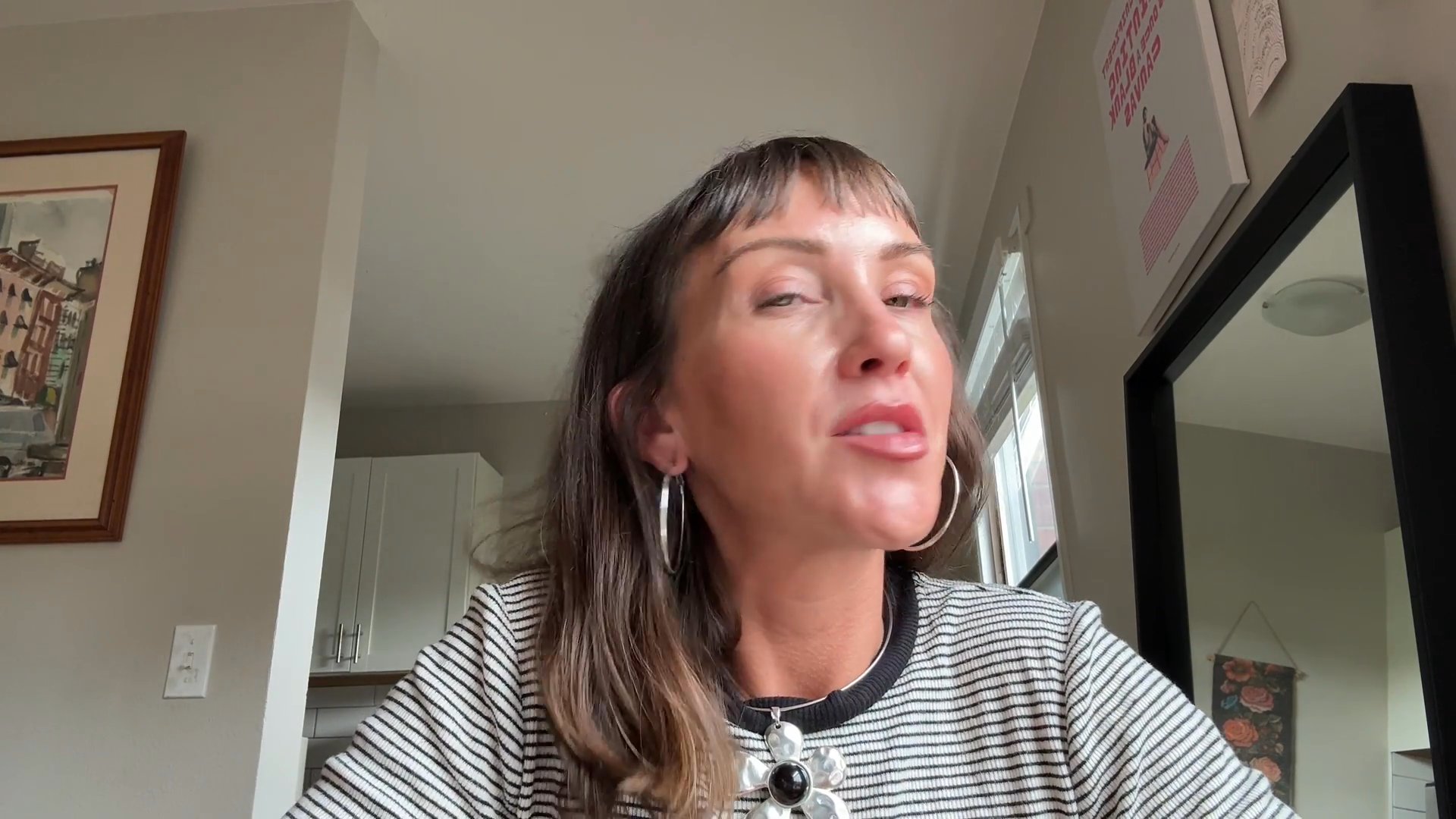
Asking for help can be really hard if we have a history of being shut down, minimized, or rejected for having hard days. Here is how showing up and telling people that I’m not okay has radically improved my mental health.
Rachel: This past week I have been really, really struggling with my depression and my eating, eating disorder. She says a lot of those thoughts have to do with being a burden. It's taken her a long time to find people to talk to, but she says it's possible to find them.
I want to talk about the power of talking to friends. Hi, my name is Rachel. I'm a mental health advocate and writer and I have been in therapy for about 20 years for my mental health. And one of the things that I struggle with, not more than anything, but like a lot, a lot, talking about what I'm going through with people I love. It is very difficult for me to call a friend, text a friend and say, hey, this is what I'm struggling with. These are the thoughts I'm having. It is something that I'm just Now as a 36 year old adult learning to do and be comfortable with.
And it's still, still really hard. And I want to talk about how incredibly powerful it is. This past week I have been really, really struggling with my depression and my eating, eating disorder. I have started to have thoughts again that I have not had in a long time that are very mean and have been concerning to me because when I have those thoughts, I know that's a sign that I'm not doing well and that I need to reach out for support. Especially because a lot of those thoughts have to do with being a burden.
And that gets really gets in the way of me actually asking for support or telling a friend what's going on. So I have been very, very fortunate in this last year to develop a couple very close female friendships that are unlike a friendship I've had in my entire life. And so if you are also like Rachel, I don't have friends to talk to. I did not have people to talk to for a long time. And it's taken me a long time to find those people. And so please, please know that it's possible to find them. They are out there.
It might just take some time. And these, these women that I have in my life are incredible because they're teaching me A, to talk about my feelings because they're good at it, so they're modeling it for me and B, they're teaching me that when I show up from a place of being mentally unstable, sad, anxious, paranoid, that they're not going anywhere. That's a really big fear of mine, is that if I'm, if I'm not doing well and I express that I'm not doing well to a friend, that they're going to think it's too much or they're going think that I'm being a bummer or being a downer and don't want to be around me because I've had people like that in my life when I'm not doing well, they're.
They just don't want to be around me because I'm. I'm not good energy. And that has reinforced that feeling of being too much or being a burden. And so it's really scary. I understand. It's really scary to let people know where we're at sometimes, because that fear of rejection or being too much is. Is totally valid and sometimes reinforced. And I'm glad that I've kept trying because I'm getting the chance to rewire a lot of my preconceived ideas about what it means to tell people how I'm doing when I'm not doing well.
And so this week, when I have been in that head space I have shared with my friends, look, this is really hard for me to do. First of all, my brain is telling me, do not talk to your friends. My brain is telling me that I'm being annoying or being too much. But I know that it's better for me to actually tell you what's going on than to try and cope with it myself. Here's what's going on in my brain. Here's what my thoughts are. Here's where my head's at, and I'm worried. And my friends did not shy away.
They leaned in. They showed up, and they didn't have answers. It wasn't like my friends were like, I know what's going to help. I know what's going to solve it. They just stayed. They just held space. They just showed up and checked in. And what that does, truly what that does is it keeps me afloat. Right? So the idea when we check in with friends is not like, you're going to solve my problem or you're going to fix me. If we have that expectation, then we're asking too much. We can't ask our friends to be our doctors or our therapists.
What we're asking from our friends is, can you hold my hand while I walk through this dark part? Can you sit with me until I'm able to get up? Can we go side by side? Can I know that if it's hard for me to move forward, you're going to be right there gently helping me move along? And that's what having those friends did. That's what reaching out and letting them know where I was at did is. It gave me a touch point. Okay? There's people in my life who care about me. Number one, that gave me a reason to stay.
Number two, I know that if it's really, really hard for me today, I have someone I can talk to, I have someone who can come over. I have someone who knows that I'm here and that wants me to be here. And just that alone kept me going through the week. I'm the reason that I got out of my depressive episode. And you're always going to be the reason that you do too. No one else is going to do that for you. And that's always because you have the strength within you. So I just want to make sure that you know that.
And it is beautifully, wonderfully supportive to have someone walk that path with us. I just saw a video once, it said, like, the point of therapy is not for the therapist to help you solve all your problems or build self awareness or do all this discovery. While that is something that happens. The point of therapy is to be witnessed and to feel old emotions in new spaces. So when we get to feel old emotions in new spaces with someone who is regulated, with someone who can sit witness us, we get to experience those old emotions in a new way and we get to learn that it's safe for us to feel those things.
And I thought that that was so valuable because it reminded me so much of what I've been experiencing with my friends and how much that is rewiring for me, that it's okay for me to be sad, that it's okay for me to get anxious and it's okay for me to spiral, that it's okay for me to be afraid about getting old or being single. I. All of these thoughts and feelings are okay because I'm human. And I get to experience those feelings in a new way in new spaces with people who are regulated, with people who can show up, who can witness and hold space for me and who love me.
And having that happen is incredibly powerful. Again, I understand that this is contingent on having those people to reach out to. And even if it's just someone that you can send a text to that says, hey, I'm not in a great headspace right now and you don't need to do anything. I just need to tell someone. That is practice. Part of it is practice. Part of it is learning and teaching ourselves that it's okay and safe for us to reach out when we're struggling. It's about rewiring that part of our brain that says I'm a burden, that says I'm too much and that says I don't deserve to say anything.
That's part of the practice. And if you don't have someone to talk to, you can talk to me. You can leave me a comment here. You can send me a message just to have somebody to tell. Even if I can't do anything or solve anything, because, again, you're the only person that can do that. I can still be a witness because you deserve it. I love you so much, and I'm so happy you're here. And I'll see you next time.