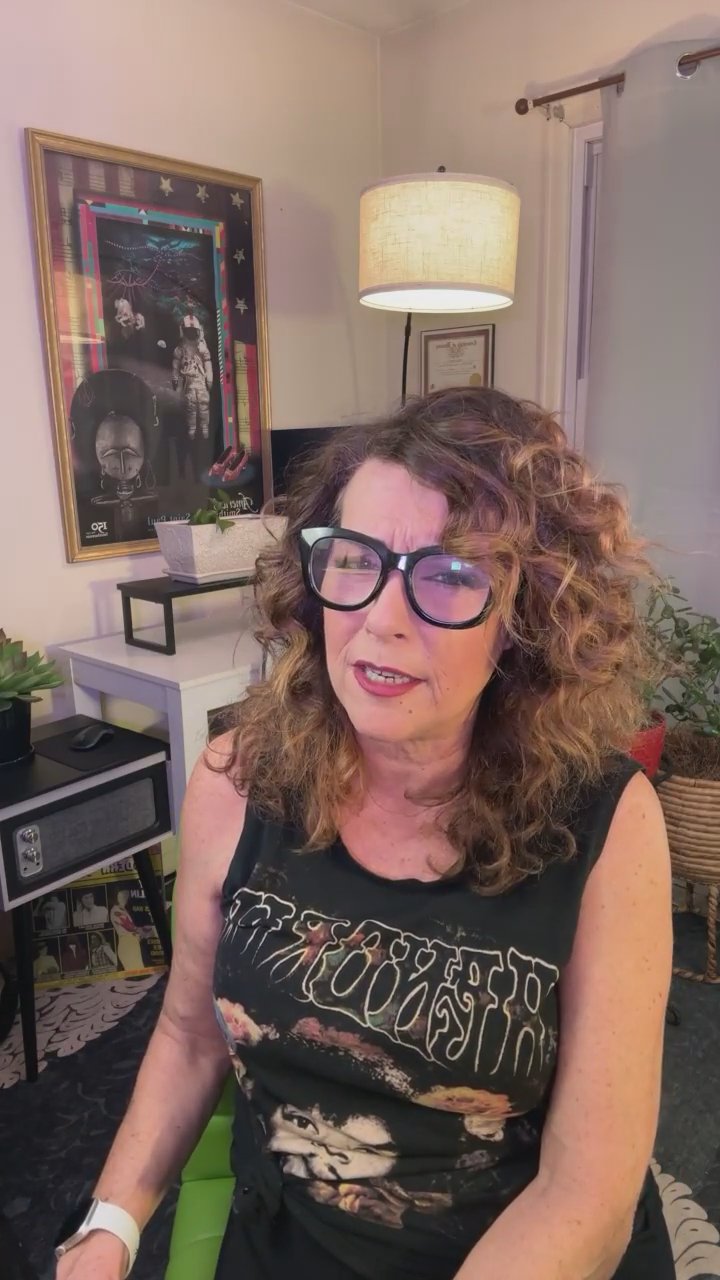
Comedy Centered is hosted by Tiffany Norton. Tonight's show includes stand up comedian, late diagnosis, CPTSD and lots of other letters. If you hear what sounds like drag racing, that is more than likely what it is. Comedian Wonder wants to talk about anger with women and as a woman.
Comedy Centered is hosted by Tiffany Norton. Tonight's show includes stand up comedian, late diagnosis, CPTSD and lots of other letters. If you hear what sounds like drag racing, that is more than likely what it is.
Comedian Wonder wants to talk about anger with women and as a woman. She says she is tired of keeping her opinions to herself because it's making others uncomfortable. Wonder: Donald Trump is a malignant narcissist. This is dangerous for us as people.
I'm here to tell you like the work begins once you stop drinking. Then you start peeling away and you realize all of the insecurities and all the reasons underneath why you gravitated towards the drinking. If you've been raised around some of these self absorbed types, you don't come out of that unscathed.
This book is again called Children the Self Absorbed written by Nina Brown. It's about reducing our own self absorption. Peeling away is painful, but it is rewarding because at least you know where stuff is coming from.
Common behaviors and attitudes. Taking on numerous tasks or responsibilities and feeling swamped. Exaggerating discomfort and aches and pains or having multiple complaints. Feeling that you are being treated unfairly and losing out while others don't. Envy.
STR strategy is just strengthening yourself. Your awareness of your own self absorbed behavior, behaviors and attitudes is probably scant or non existent. You fail to understand all of the negative impact of these behaviors. That was the whole part of the whole chapter.
The first step to reduce or eliminate self absorbed behaviors and attitudes is to accept a hypothesis. The second step is to say to yourself that you want to become more aware of these. Patience with yourself can be helpful as you develop and grow.
The specific categories reflecting self absorption presented in this chapter include the following. Entitlement. An attitude that conveys arrogance, contempt and superiority. Codependency. The excessive desire to be considered as incomparable and matchless. Envy. The belief that others are less deserving and less worthy than you.
So in this incredibly challenging time, we really have to take some time to ground ourselves. The biggest block to healing yourself with a narcissistic parent or a spouse is when you learn to accept the fact that you can still love them. And try to firmly set your boundaries accordingly.
All right, guys. Have a good week. Stay centered. And remember, when you start showing up for yourself as yourself. Not everybody always likes it, but you will. Eventually.
Hello. Hello. Cadre people. Cadre app. It is Tiffany Norton. It is Comedy Centered. It is Sunday. We are here. We are definitely here. I'm here. Definitely, definitely here. It sounds like the, the weather is actually pretty nice. We've had a little respite from the below zero. So a lot of, a lot of kids, it sounds like, have been driving around past my window. So if you hear what sounds like drag racing, that is more than likely what it is. Welcome to Comedy Centered. I am Tiffany Norton, your host tonight.
I am a stand up comedian and oh, Ms. Jules, welcome and happy Sunday. Just getting started. Stand up comedian, late diagnosis, late to the party on attention deficit disorder, CPTSD and lots of other letters and fun stuff. Hey. Oh, good evening. Good evening to you as well. So, so I've been back and forth on my topic this week, just several times, in fact, I've been kind of writing. Oh, God, I'm gonna anyway. And I, I, I don't know if this is the right form or not, but I, one of the things that I kind of pride myself on as a comedian and, and as a, a contributor, I hope to discuss.
I want to talk about something this week that is a bit taboo. I want to talk about anger and specifically why is that taboo? That doesn't seem like a taboo thing. Everybody gets angry. Angry is there. I specifically want to talk about anger with women and as a woman, how that, how that isn't easy to necessarily manage all the time. It should not come to any surprise. Sorry, there's something in the corner that's driving me nuts. It should come to no surprise, no surprise to anybody. I don't think male or female or however you align gender wise, that there are some constructs in our society that really reinforce the idea that women are supposed to be more, go with the flow, let others decide, you know, don't make waves.
Don't, you know, don't, don't, don't be too, you know, bitchy, to use a very specific word. But we've spent a lot of time in the last year almost together on Comedy center talking about family dynamics and relationships that are difficult with very difficult people. We love them, they're our family, but man, are they infuriating. And I am fairly angry, and that is the word at some of my family members at the moment. And I am sure that they are angry with me and I can tell you why on both sides, both of us are operating from a sense that the other person should be acting or operating in a different way than they are.
I Know, I am, I'm expecting. I, I, I've. Oops. And it brings me. See, I'm kicking things. I'm already. I'm just gonna try to spit this out. And I'm trying to do it in a nice way because it's Cadre, but maybe I should just be a comic and just cut to the bite of it. I am tired of keeping my opinions to myself because I'm sensing that it's making other people uncomfortable. I'm wildly uncomfortable with what's happening in our country at the moment. And I say that. And if that is upsetting for people to hear from me, I respect that.
That is absolutely okay to say. Hey, speak, Wonder. Welcome in. Sorry, I'm on a rant. But I, I am, I am finding a lot of social pressure in my family, in my social groups, to be quiet about the things that are happening right now in our country that affect me directly as a woman. This is not an area, you know, that Cadre is not a space where we discuss political things. But I will say this. There's nothing. Womanhood, gender orientation, skin, race, all of these things are on the table right now.
The norms are gone on these discussions. What progress I thought we had, what understandings I thought we had. It, it is broken or fractured or it's being morphed into something weird and crazy that I do not. And I have not known what to do with that anger. And as I've shared with people before, right, I have cptsd, which means that I get stuck in loops where I think the world is ending. You know, I get into my cocoons where I don't trust anybody and I'm super scared all the time, and I think everybody's watching me and all this stuff, right?
Like, you can loop out really fast. And so I'm talking about this today because I want to let anybody who knows watching, watching this live or in the replay. You are not alone if this feels insane. Donald Trump is a malignant narcissist. Donald Trump falls into every category of the NPD personality disorder type. I am not a clinician, but having been raised by a man exactly like our current president, and I'm sorry, and I'm probably going to get in trouble for this, but to ignore the behavior and to say it's okay and to permit these behaviors, these are dangerous.
This is dangerous for us as people, because these relationships, he'll go away. He's a president. He'll. Whatever will happen with him will happen. But he triggers in me my unhealed Family dynamics. And that's what I'm trying to bring this back to. My overreaction with my family about him, about what's happening in the country and in the government, has direct things to do with him. But if I'm being honest with myself, this goes back to my family dynamics. This goes back to me still being mad at my father.
Me still hoping one day that he'll embrace me and say everything's going to be okay. And then I'm sorry. I'm sorry for what I did. I know what I did wrong, and I'm sorry. And the thing that recovery has taught me is the sooner you let go of the idea that the really difficult person in your life is going to come to some epiphany, like it's the end of a movie. It can happen. It's rare. And it usually only happens when the person who's very self absorbed is willing to do work on themselves and have some ownership towards it.
So if, if you, if, if you feel like you can get very, like, here's okay, here's the note I wanted to find. But like, I get myself stuck. I get myself stuck in the idea that it can't change. And the idea should really be not that it can change. Do I need it to. And if I can remember to detach from the outcome, if I can remember to detach from my wish for, you know, my fantasy for my parents to both go, you know what? You're right. This whole time, God dang it, you're smart. We should have been listening to you.
So smart. It's not gonna happen. And it's not that they're bad people necessarily, or, well, whatever. Right? I'm not here to label. Everybody's journey is everybody's journey. No one's higher, no one's lower in my world as far as hierarchy. But these lessons, these are lessons that we need to learn. And I need to look at this mirror very clearly because I'm projecting anyway. But what I have to remember is to detaching myself from the idea that they're going to say that they're wrong, that they're going to say that they're sorry.
What if they don't? Then what? Right? Then what? You know, it's on us to let go of our unrealistic expectations as well. And as we touched on a couple of times, but again last week, it's easier to fool someone than convince them that they're being fooled. Right? And that's what waking up emotionally, spiritually, and through therapy is really about you start peeling away these layers. I thought like most people, that as soon as I quit drinking, problem solved, that was it, you know, smooth sailing.
No, Then you start peeling away and you realize all of the insecurities and all the mechanisms and all the reasons underneath why you gravitated towards the drinking, why you grabbed for the escape, for the running away from the decompressing. You know, it's escapism, right? It's because the full circle, especially for me and I'm, I'm speaking about, because it's, it's something that comes up a lot in my women recovery groups from alcohol is that we are socialized to just keep our mouths shut and to, and, and, and depression is anger to turned inwards and it makes sense to want to escape from these overwhelming feelings.
Right? But I'm here to tell you like the work begins once you stop drinking. Sorry. Not a very uplifting one, right? But so as a good reminder to me, I said last week I was gonna bring back the, the wizard of Oz and other narcissists, but I'm, I'm going back to this Children of the self absorbed this week because I had to go back and read some of my own stuff. And this is a reminder, I'm reading this out loud, but I, I, because I have to ask these questions of myself too. When we're re positioning our awareness, it is very tempting and easy to say, I know why I'm a mess.
It's you, you did it. You were terrible. You didn't encourage me. You never let me try out for ballet, whatever it is. Right? But if we grew up in these dynamics, if we grew up in combative households or households that were very repressive where things were not discussed at all. You know, if you, if you, if you've been raised around some of these self absorbed types, you do not come out of that unscathed and you do not come out of it with the best perspective on things too. So this book is again called Children the Self Absorbed written by Nina Brown.
And this is for us doing the work as the person who has been raised in these environments because it rubs up, rubs off on us. That's why this stuff goes on for generations and generations and generations. Right? Okay, let me skip ahead. Here we go. Perpetual shift. Reducing self absorption. Us reducing our own self absorption. It's relatively easy to see others self absorb behaviors, right. Like I just said and attitudes don't like that. But it's not as easy to see our own. While it is reasonable to accept that you'll probably have some of these.
It's also reasonable to try and work to reduce the self absorbed behaviors and attitudes you may know you exhibit as well as those that still remain hidden to you. Okay, so I'm going to start going through this checklist. Oh, let me check up on this. Yes, yes. Speak wonder. Thank you for the encouragement. Yeah. Peeling away is painful, but it is rewarding because at least you know where stuff is coming from. It's very disorienting. I think at the beginning you feel like you're on a top, you know, and it's a circle spinning.
But like if you remember like on those merry go round things like when you're out on the outer edges, it's the, it's worse. Right. But the more you get in the middle, it, it evens out a bit. So hopefully. Okay, so common behaviors and attitudes. And we're going to talk about what the common behavior and attitude is and then also what that, what that could look like, what that could feel like to you. Okay. Common behaviors and attitudes. Number one. Taking on numerous tasks or responsibilities and feeling swamped.
Okay. The possible self absorption on your part would be a sense of grandiosity. No one could do it without me. I, I do all the things no one. This place would. This place would just go to h*** if it wasn't for me. Right. That's grandiosity. Okay. Exaggerating discomfort and aches and pains or having multiple complaints. The possible self absorption on our end, that could be attention seeking. We all know somebody that it's. How are you today? Oh, well, you know, if it wasn't for the knee and then you get medical talk for 10 minutes.
Okay. Dismissing or minimizing someone else's problem or concern is being trivial. This could be. This could be you displaying a lack of empathy, having considerable self doubt. I think we all have that to a certain extent. That's the sign of an impoverished ego. Your ego is not feeling great. It's not feeling supported. It's not feeling like the, the lion. It should, you know, it's not roaring and proud, you know. Okay. Feeling like you have a lack of meaning or purpose in your life. Emptiness.
I guess emptiness is the answer. I don't know. It feels. Anyway, that's what she wrote. Emptiness. I don't know. I feel like you could, could be a couple more words there. Anyway, okay, this phone. Feeling that you're being treated unfairly and losing out while others don't have this happen to them. Envy. Now that one. A lot of people Right now have that. There's a lot of people running around in our country at this moment. Let me read this again. Feeling that. And I. This does not matter about party.
This doesn't matter about any of that stuff. I'm talking about the American experience, okay? Feeling that you are being treated unfairly and losing out while others don't have this happen to them. As we talked about many times, social media absolutely exploits the h*** out of this. They know this about us. You could be going along, your hair looks good, your pants fit so much better than the last time you put them on and you don't know why and you're not asking any more questions as to why you feel good.
And you get a ding on your phone. And then someone got a promotion though. Someone posted a picture, they look even better. Someone got the thing that you were hoping you would get. Someone got the stuff, the stuff you're not getting. We all have to work on it. I'm envious. I'm not guilt free on that. Please. I'm a comedian. People get a. A late night special. I'm like, yeah, they're okay. They're actually brilliant. But I'm like, yeah, they're all right. I've seen them do okay. Not the best, right?
I mean like, we're, it's like. But we're, but we're holding ourselves up to a standard that's not real. You can't, you can't be another person. And we make ourselves nuts thinking that our experience should be. We should get some of her experience and his experience and that experience and that one too. And we should go here. I want to, you know, I want to live in the woods, but I also want to live in a yacht. But I also want to go skydiving. But I also want to, you know, like, you know, we gotta pick Lane.
I know I do. Okay, so we're talking about strengthening. Okay, let's skip to this part. How am I doing on time? Pretty good. Okay, so I'm. I'm scanning, scanning, scanning. So she's. So this next paragraph or this next chapter. STR strategy is just strengthening yourself. Okay? Your awareness of your own self absorbed behavior, behaviors and attitudes is probably scant or non existent at this point. That is, you do not see what you are saying, doing, believing or thinking that conveys self absorption.
That's okay. You fail to understand all of the negative impact of these behaviors and attitudes. Just as your parents fail to see or understand the impact of their self absorbed behavior and attitudes. That was the whole part the whole chapter I had to read again and I keep having to read this to myself. I have to detach from the outcome because they're, you know, again, in recovery. We always talk about keep your own side of the street clean, worry about your side of the street. So I'm trying to remember to worry about my side of the street anyway, which sucks because I like being judgmental.
So much more fun. Anyway, let's go. All right, keep going. The first step to reduce or eliminate self absorbed behaviors and attitudes is to accept a hypothesis that you do have and exhibit some self absorbed behaviors and attitudes. The second step is to say to yourself that you want to become more aware of these so that you can reduce or eliminate them. Throughout all this, you may firmly keep in mind that this, under this understanding, takes a lot of work. Yeah, it's not pleasant work either, but rewarding work.
This is what she calls an unfolding process and the behavior changes over time. Patience with yourself can be helpful as you develop and grow. After completing or at least starting steps one and two, it's time to move forward. Identify okay previous chapters. Although 11 behaviors and attitudes are described, that does not mean that you have all of them. Okay. However, you would want to consider if you have mild version of each of them, the outcome will be that you will develop your personal action plan, one that fits you and your circumstances.
The specific categories reflecting self absorption presented in this chapter include the following. Okay, so here's a list of examples. Entitlement. That's an example. This is just going to be a list of different. Okay. Entitlement. An attitude that conveys arrogance, contempt and superiority. Attention seeking Actions that ensure that you are constantly the center of attention. Admiration seeking. Searching for external recognition, esteem and approval. Social media grandiosity and its flip side, the impoverished self, the grand and inflated self and the other side, the deflated self.
Just as you can have I'm the best you can have, I'm the worst. I gravitate on that one back and forth. Sometimes I think I'm awesome. Some, a lot of times I think I'm anyway. Extensions of self Incomplete recognition and understanding of the boundaries that define where you end and where others begin. That is when I've always suffered. It's always been difficult for me. And you may have heard it called under a different title. Codependency. Roughly unique and special. The excessive desire to be considered as incomparable and matchless.
Social media exploitation of others. Taking advantage of others for your personal benefit. Shallow emotions. Being unable to experience or express. Deep emotions Other than fear or anger, lack of empathy, being unable to understand or be compassionate with others feelings. Emptiness. The essential core inner self is empty envy. The belief that others are less deserving and less worthy than you and that they do not deserve what they get. That you want. Now that you're aware of these personal self absorbed behaviors and attitudes, you can begin to reduce or even eliminate some of them.
And then she gives you a list and a breakdown. And then there's some reflections to write on and to journal on. Here's an example of a reflection under entitlement. We're running down on time and I want to hit a couple more points so. But in case you want to pick it up, children are the self absorbed reflection. Just in case I unconsciously have and display some version of an entitlement attitude, I can reduce this by becoming more aware of the impact of my behaviors on others and by questioning some assumptions I have about how others are supposed to act towards and treat me.
So you just reflect on that again, just in case I unconsciously have and display some version of entitlement in my attitude. Right? And she goes through and gives you stuff you can work on. Like where's the I want to find envy, one of the seven deadly sins. If you're of that ilk. If you're of the religious ilk, envy. Let's define envy as wanting what someone else has and also feeling that you are more deserving of it than they are. Both are components of envy, but in the second component, that part is more corrosive.
Wanting something can be motivating and a challenge to try to get whatever is wanted right? Like setting a goal, rewarding yourself when you make it. For example, if you want a promotion, you can work hard and do the necessary things to achieve the promotion. Or if you want wealth, you can seek out ways to accumulate it. Relationships can be built, success defined and achieved, skills developed and goals defined. If you're motivated to get what you want. These are all positive and in most cases they may be doable.
However, if this wanting is accomplished with resentment that another person has what you want, but you feel that they are less deserving or undeserving, and that somehow they did okay and that somehow they did you out of something that is rightfully yours. That is when you move from just wanting something to negative state of envy. So wanting things isn't the problem. It's thinking that the things that you have or the things that you want are are rightfully yours and the people that have them aren't as Deserving as you.
Worse if, let's see here. Negative, negative and yes, I'm sorry, okay. From just wanting something to the negative state of envy. Worse is that if you do not work to get what you want, your time and energy are now wasted on resenting the person thinking about how you were unfairly treated or how you can get others to see that person as you do, as being undeserving and unworthy instead of working to get what you want. This resentment and these feelings of unfair treatment are very corrosive to your self esteem and to your spirit.
They are. Even if we are supposed that, even if we were to suppose that you are correct and that you are more deserving and worthy, that would not help you get what you wanted, which is the goal. Nor would the resentment and feelings of unfair treatment help in any way because you are doing those negative things to yourself. The resentment lives in you, the anger lives in you. The other people are not doing anything negative to you by having what you want, whether they are deserving or not, you are allowing the negative impacts to deflect you from achieving your successes.
And the reflection on this one is what do you now, I'm sorry, what do you have now that you would be willing to give up to get what the person you envy has? For example, if you are envious of the other persons receiving a promotion that you would have liked to have had, would you be willing to give up a big part of your family or leisure time to get the promotion? How would your relationship suffer? So what's the trade off is what they're trying to get at. Right? Right. So in this very incredibly challenging time where we're getting hit with a lot of different things all over the place, we really have to take some time to ground ourselves.
And what does that mean? What's grounding mean? It means take your, take your shoes off, sit on the floor, put your feet on the floor, be barefoot, touch the ground, walk outside, get out of your head in any way possible, connect to the earth any way you possibly can, breathe in and out, try to get the cortisol levels down your body. Because me also getting upset about what's going on in our country is also a resentment. It's also maybe, you know, me projecting there, there is not stuff I can, I can control what I can control just like anybody else, you know, you know, with what's, what's going on.
But, but going around unhinged and reacting to everything, it's, it's not, it's, it's tempting, it's easy to fall into it. And those are part of the patterns I'm really trying to break. I'm really trying to be able to detach, not be a detached person, but to detach from the expectations that things, Things should go the way that I think they should go. Let's see, I had something written down I wanted to tell you guys. Now I'm gonna forget. Okay. Yeah. Oh, well, that was it. Yeah, I think I said it earlier.
But the biggest block to healing yourself with a narcissistic parent or a spouse or whatever is, is when you learn to just accept the fact that you can still love them, care for them, even if they're never going to say sorry. And if you feel like you can't and that they have to say sorry for you to have a relationship with them, that's okay. But you gotta ask yourself, you know, am I. What part am I playing in it? How much am I projecting? And try to firmly set your boundaries accordingly. And don't watch too much news.
You know, they interviewed someone, interviewed Einstein during the, the days of the occupation, right? Not trying to get all doom and gloom, but they asked him, like, what do you do? What do you do? Actually, I think it was a friend. I think it was a friend of his. That's right. Einstein was in America, I think, and, and a friend of his who was a scientist who was still behind the curtain wrote to him and said, how do you, how do you deal with this? And he said, you take walks, you read books, you avoid the newspapers.
And so we can't turn a blind eye to what things are going on, but we can limit, we can turn off the alarms on our phone. So every time your newspaper, whatever, gets a new article, you're not getting dinged. You know, set some of the little fitness things in there, remind yourself to get up, remind yourself to drink water, remind yourself to stretch, you know, and, you know, we're in a good position as far as we, we've, we've done a lot of work in this country, the recovery community, you know, to break through on a lot of trauma and try to heal a lot of stuff.
But it's, it's very, very clear. We've got a lot more work, a lot of it in our own communities. And, yeah, I mean, I'll still be here for it till they take me off the air. It's good. All right, guys. Oh, man, it's 6:32 already. All right. Hey, everybody, have a good week. Stay centered. And remember, when you start showing up for yourself as yourself. Not everybody always likes it. But you will. I promise. Eventually. Even though it seems hard. All right, guys, have a good night.