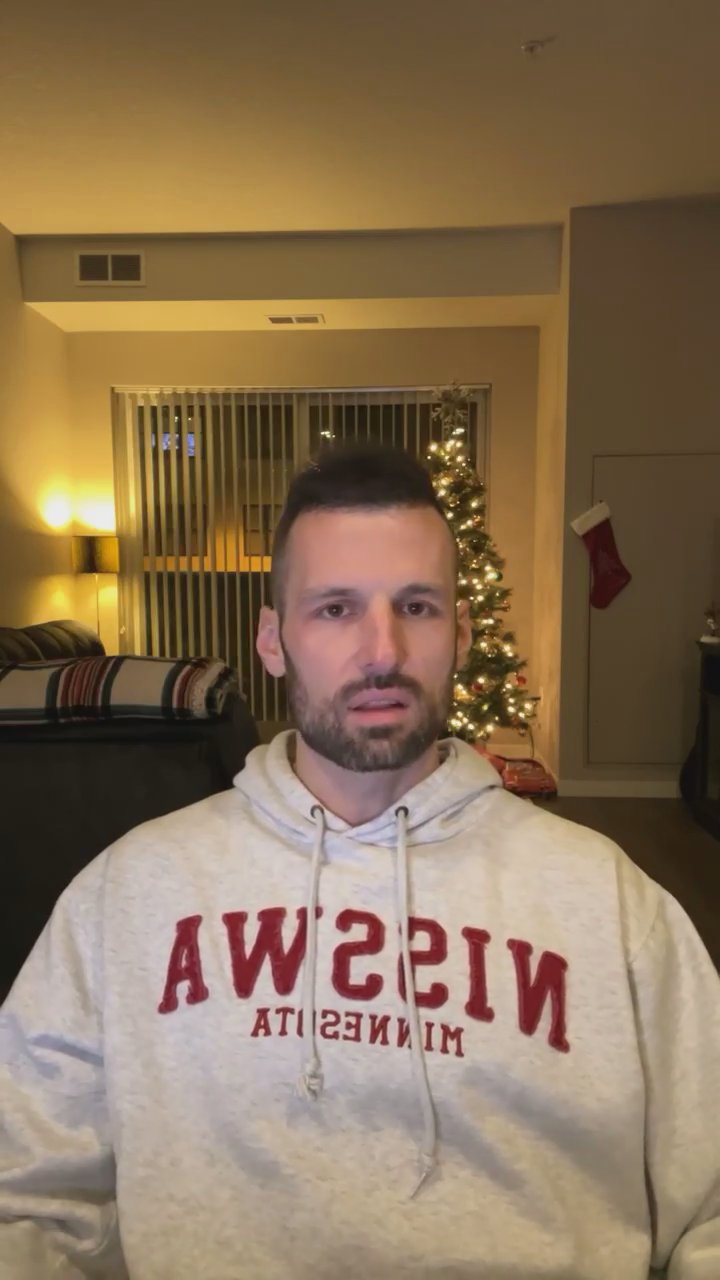
Jason Lennox is your resident recovery champion here to talk about all things recovery, mental health, well, being God. And you know, again, it all starts with purpose. And even the hardest of times. Look forward to doing it again next Sunday maybe a little bit warmer.
Jason Lennox is your resident recovery champion here to talk about all things recovery, mental health, well, being God. Still cold temperatures in the comments, but we're gonna try to warm it up here tonight. Feel free to warm us up with like 40 or 50 degrees.
This week, Jarrett ponders what happens when things go south in our lives. Have you thought about drinking or doing drugs? Have any of those thoughts come to your mind? How do you get rid of all this pain?
"I've got something big I have to show up here for. God forbid something happened to my little brother. And I need to be the person that's actually gonna stand up and do so anyhow, " he says. " purpose keeps me going that way instead of sitting in it "
Kathy. Tough times develop empathy for others, right? We turn and then we start to give. And you know, again, it all starts with purpose. How do I find purpose? And even the hardest of times. Look forward to doing it again next Sunday maybe a little bit warmer.
Good evening and happy Sunday to the Cadresphere. Everyone tuning in now, maybe a little bit later. I know the timing is off. Appreciate the flexibility, but my name is Jason Lennox and I'm your resident recovery champion here to talk about all things recovery, mental health, well, being God. Coming to you on this Sunday evening from a very cold Minnesota. I think it was negative six on my car when I was driving in this evening and it feels something like negative 30 or 40. So we're cold here. But again, Jason Lennox, resident recovery champion, here to talk about everything, recovery, and you know what that means for me is again like Sunday Serenity is the.
The title of my Sunday sessions. And I think I think about serenity as kind of one of the core components to me not going back to the life I once lived. I struggle with drugs, alcohol, mental health, just many forms of addiction. And I think the primary driver of that was I didn't have any peace in my life. I was always seeking something outside of Jason. And so I wanted to talk. I talked a little bit last week. Good evening, everybody. Good evening, Jules, Kathy. Yes. You're in Pennsylvania. You've got the polar vortex.
How cold are you there in Pennsylvania? We've got negative 5, 10 with wind chills of negative 40 here. It's cold everywhere. Good evening to you too. Sherry, by the way, would love to hear you in the comments. Oh, negative 17 for Jules. Wow. Would love. Anyone warm? Do you have anyone? There we go. Luke. Good to see you, man. And Luke, I know you're cold. And Luke, even though it's negative five, could very well have been in the lake today doing a cold plunge for all we know he doesn't miss it. So anyone warm?
Feel free to warm us up a little bit with like 40 or 50 degrees, 60, 70, wherever you are. But also if you want, drop in the chat comments and related to last week where I was talking about habits and consistency and how that creates such a, such a stable foundation for us as we, as we go through recovery. So still cold temperatures there in the comments, but we're gonna try to warm it up here tonight. 33 degree water. See Luke's, he's got a good way of looking at it. It's negative five out there.
It's 33 in the water, so we probably should all be jumping in. But habits and consistency, they were so important to me and I talked about those, is because we come through to the new year and the reason we have what they call quitters Friday is because we set these ambitious, massive goals like Maybe I'm not working out, and I'm just gonna. We're gonna. I'm gonna move to, like, five days a week, or I'm gonna do the 75 hard, for example. It's just such an extreme swing. And so if we can build habits and consistency, we have a foundation.
And then all I'm doing each year or month or whenever I decide to is just moving and adjusting a little bit. That tends to be how I do it. And it's so important. It keeps me stable, keeps me in a good place, which has been necessary for this year. And I think I wanted to talk a little bit tonight about a question I was asked. And we'll get into some of the context as I can, but also last week, because we talked about those habits and consistencies. Really interested in your comments about what. What are your best habits?
What are your most successful habits, and how do you actually build them? So drop those in and I'll try to jump back into those. But what I want to talk about this week is a question that I was asked, and it was just a couple weeks or a couple hours ago, actually, and the question was, you know, have you. It really is around, like, what happens when things go south in our lives. And I'll actually back up a little bit. Like, I want to talk about when danger hits, what happens? And I was asked this question that really made me think, like, have you thought about drinking or doing drugs?
Like, is it. Have any of those thoughts come to your mind? Now I'll back up and give you the context, because I feel like I finally can the beginning of this year, and I'm doing this a little bit transparently, a little bit vulnerably. But we. This is what we do in recovery, and this is lived experience. This is me sharing with you as I go through life, as we all do. This is how we get to share. We get to share what's working, what's not. So at the beginning of this year, I get a horrifying call from my brother.
He's in the hospital. He's 34 years old. He tells me they found cancer on his lungs. I'm, like, so confused. I can't understand it. On my way back from the gym, I just pack up. I don't even know what I'm packing up. I'm just throwing stuff. He's an hour and a half away. He's going to Rochester. I get down there. Throughout the weekend, they learn a little more. He's got, you know, masses, lesions on his eyes. Also Plenty on his brain as well. And so it's this entire year. The last few weeks have been very chaotic, up and down.
I just can't even begin to explain it now back to the question that I was just asked a couple hours ago through all this. So he's stage four lung cancer at 34 years old. And you just, like. I start to go down the path of looking at all the things my little brother always kind of like, he's been the closest one in my family. And it's just. None of it makes sense. There's so much pain, confusion, all the questions, have you thought about using? This is the third person that's asking, have you thought about going back to drugs and drinking?
I said, I don't think so. I don't think that thought has come to mind. What's come to mind is there's been so much pain involved in some of those moments. And just seeing him and thinking about him and how he might be feeling and what could happen and all the things that lie ahead, and it's just been so painful. And the question that's come or the. I guess the desire that's come is, how do I just get rid of that pain again? Like, thankfully, because of habits, because of consistency, because of people in my life, I haven't thought that the drinking and drugging is a good direction to go.
But it doesn't mean that we still don't get into these moments and go, how do we deal with this? How do I just get rid of this pain? Like, I can't. I'm not exercising as much. Some of these habits I've been talking about, I don't have access to because I'm bouncing back and forth. I'm sleeping here, I'm sleeping there. I'm trying to do what I can, but there's this overwhelming pain. And how do I just get rid of that? That's the question. And so that was my answer just a couple hours ago. And this person said, what?
So what is the answer? How do you get rid of that? And it occurred to me then, something that I talk about regularly and something that ties back to Maslow's hierarchy of needs. And if you look at samhsa, Substance Abuse Mental Health Services Administration is a federal entity that funds a lot of research. They do just a lot of resources for our industry. They have four pillars, and one of them is purpose. Purpose is the word that came to mind. How do you get rid of all this pain? And I talk a lot about purpose.
In fact, the memoir I wrote is Find a Perfect Tragedy. But the subtitle Finding Purpose in Pain, Loss, and Addiction. So how do we find purpose in that? Because ultimately, purpose for me was with the lifesaver. Because we think about kind of the Maslow's hierarchy of needs. We've got these immediate needs. The housing, the shelter, the things that we just have to meet. Otherwise, it's unlikely that we're going to continue to move to the next phases. And. Right. Like, if I can't get enough food or I don't know where I'm going to sleep, it's going to be hard for me to address addiction and mental health and things like that.
If I can get those met, I've got that. And then I start to think about addressing the conditions. And so we do this really well in treatment. We make sure people have the resources, and then we make sure that we start to treat the underlying conditions. But then what happens after that? Like, let's treat the person. And then what? Ultimately, for me, it was finding a career. It was finding the purpose. That gave me something to look forward to, that gave me something to wake up to and really start to drive and put all my energy into.
Yes, Sherry, we turn pain into purpose. And that's so exactly what I wrote about. And so as I thought about this, I went back to this idea. And so where did that come from? I'm sitting here in the hospital with my brother. Last Monday, actually, is an outpatient clinic and an appointment in Rochester. And then again on Wednesday, Tuesday, when he was readmitted. And they were having some serious conversations, like, what's going to happen, man? Like, who in this room are we going to turn to if something happens here?
We need to know who's going to make decisions here. And my little brother immediately looked over and said, it's got to be him. He's going to be the one that can keep emotion to the side as much as possible, and it's got to be him. And it struck me then that I went from all this, like, God, I don't know what, the pain and kind of the just the, like, sadness and the depress, like, just that desperate feeling to, oh, my gosh, like, I've got something big I have to show up here for. God forbid something happened to my little brother.
Now I have to actually do something about it. And I need to be the person that's actually gonna stand up and do so anyhow. I tell you all of that. To say it lit this purpose inside me. And then. And then that kind of trickled into, like, okay, well, how. What kind of game plan are we gonna put together? How can I do this? And how can we do a fundraiser? How can we. All the things that have to happen and how can I start to focus some attention on that? And. Because I was able to do that, yeah, I'm still kind of up and down and staying up way later than I should, waking up earlier than I should, kind of losing a lot of.
Lot of my mind, it feels like. But I'm thinking about all those things, and I'm looking forward. I'm trying to plan for this and this and this, and how do I address this? And that's all purpose. And purpose keeps me going that way instead of sitting in it and thinking about all the things that could go wrong and thinking about all the things that I wish could have happened. And all of our path, like, all of that is going to take me down a dark path. So how do I get through. How do we get through all of these painful moments, the things that happen in our lives?
Because inevitably they do. Sherry, thank you. Like the prayers and all the people. Sherry's going through a lot of things. She's had a few big losses, and we have to deal with these things. But how do we turn those things? How do we flip that. How do we flip that perspective a little bit, which is really, really hard. But that's why we have each other. That's why these conversations happening. That's why I've got Luke reaching out all the time. And so I've got Sherry doing what she's doing. And so many people in life that are willing to kind of have that conversation, but internally, mentally, I've got to find a way to turn some of what's going on and it's not good into I need to show up.
Because I know that if my little brother stands a chance at something, then I got to believe that he does. And if I believe that, then I better be doing things to try to help that happen. And so it just really made me think. And when I was asked that question for a third time, I knew tonight that this is what I needed to talk about. And again, it's. It's probably the first time that I could talk about this without losing my composure. And so I wanted to just, again, be raw and vulnerable with you.
All that we go through these things. And right now, I tell you, I'm going through it, and there's still a path because of the recovery, because of the gift we have, because of that, I am here and I'm thinking, you know, with a state of mind that's free of drugs and alcohol, and I have the ability to step up and say, okay, how do I take past us? How do I take what's hurting right now and turn it into something that I can. That I can, you know, use as purpose and as drive and as a way to get up? And it really just changed the cadence for me.
It really changed my mindset and really allowed me to step into being somebody and being there for my brother. I've got this group that I connect with every morning. We'll type in our this is what our intentions are for the day. This is my possibility. This is what I hope to be one day. A couple weeks ago, I'm like, you guys, can you please give me something? Because I got nothing. I cannot think of something that I could share with you that feels like a possibility or an intention today. And they started talking and going, and it was like, okay, what about for your brother?
This, this and this? And it was immediately clear, like, yep. We get in these moments and we get so stuck in our heads. I'm thinking about possibilities and intentions. For me, perhaps I need to be thinking about somebody else sometimes. And that's what we do in this recovery thing. We learn to focus our attention out there and start to think about how we can be and do and show up for other people and for this world. And for that, I'm so grateful that, you know, I've got people in my life that are willing to kind of check in and ask those questions.
And the people, like I said, the Lukes, the Sherry's and the other people are just regularly checking in because that's what we do in this recovery community. That's what we do with these training. True friendships and partnerships that we have is we look out for each other and that's what keeps us going. I wouldn't be in the position I am in today. I wouldn't be alive if it weren't for these kinds of things. But certainly in the first few weeks of this year, I would not be in a position to even have this conversation with you or probably even be here with you if it weren't for the people that are willing to take time out of every single one of their days to say, hey, how's it going?
What's going on? What can we do? How do we do this? So that's all purpose. And you all and the people that do that, you know, you're taking a tough situation and finding purpose in that too. And when we can do that and we can show up for other people, boy, we can take even the toughest times and turn it into drive, into motivation and really changing the perspective. And I know that's been incredibly helpful for me. So purpose, I think the habits and the consistency are kind of the baseline. They keep that foundation.
But boy, when it hits the fan and something big drops, I think purpose is what I know I need to lean into. And they talk about that in some of the recovery literature. Boy, if something gets hard, then we lean into really finding how we can contribute that much more because we know and we can get out of ourselves and we have to take care of ourselves too. But when we can get out there and we can do that, it's, you know. Yeah, and. Exactly. Kathy. Tough times develop empathy for others, right? Like, we start to understand these things and like, I get it a little bit more with other people I've seen have to go through something like this, like, understand just a little bit more, unfortunately.
And so we start to lean on that. And the biggest thing that we do is, I'll end with this. We do this purpose and we start to help other people. And guess what? We receive all this help and what we do when we on the receiving end of that is, is we turn and then we start to give. I said that, like, all the things that have happened over the last week with my brother have just been like the level of support I never could have imagined. And you know, my promise back is that's going to turn around and that's going to be paid forward someday.
And that's how this thing keeps going. We go through the tough times, we reach out, we do something for others because we felt so much of that love and that help coming in and we return that favor, right? And then when we return that favor, the people on those ends receiving that are going to turn and do that someday, hopefully. And so it's just the way that cycle goes. And you know, again, it all starts with purpose. How do I find purpose? And even the hardest of times. So I'm grateful that I got to spend this cold Sunday evening in January in Minnesota with you inside.
And yes, I know I still get the Christmas stuff up, but gotta at least let me off the hook for another week or two. I haven't been here for most of the year, so. Plus, it is still kind of nice to look at, but I'm grateful that we get to spend time with you and look forward to, of course, doing it again next Sunday maybe a little bit warmer and as always, look forward to hearing from you and hearing your thoughts about habits, consistencies, and how you deal with this, this. These really tough times that we can.
We can tend to go through. So I'll be thinking about all of you. Sherry, I know you've got a lot of things that have happened and always thinking about that and appreciate you all returning that. And like I said, I look forward to doing it again next weekend, Sunday evening, God willing, we'll be here and we'll. We'll give it another whirl. Hope you all have wonderful weeks and again find that purpose even in the toughest of times.