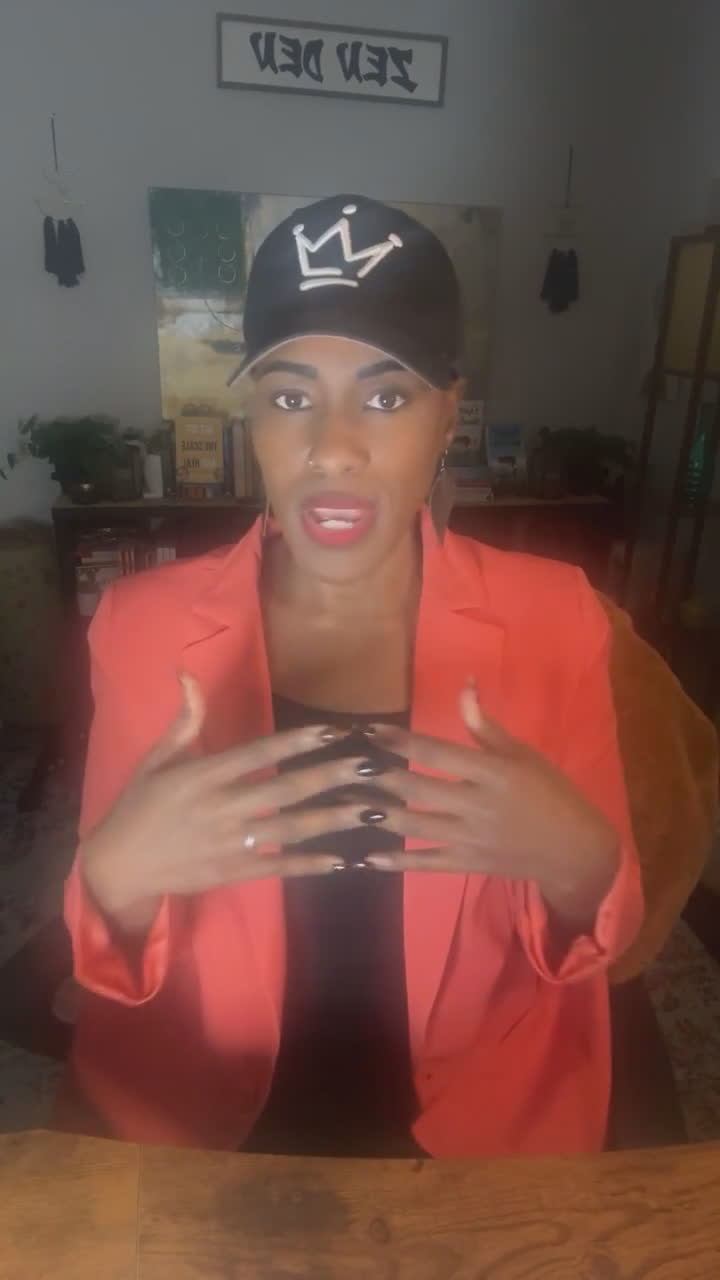
Doctor Charryse Johnson is a licensed clinical mental health therapist, mindfulness practitioner, and author. Her heart goes out to those struggling with the after effects of Hurricane Helene. Going to go through five signs you're overwhelmed and how to fix them.
Doctor Charryse Johnson is a licensed clinical mental health therapist, mindfulness practitioner, and author. On Fridays, we traditionally focus on our grief experience, but also in terms of the things, the identities, the parts of our self that we may feel disconnected from. Her heart goes out to those struggling with the after effects of Hurricane Helene.
Our focus for today is around overwhelm. How do I know when I'm overwhelmed? Going to go through five signs you're overwhelmed and how to fix them.
If you're taking notes lined out of the middle, sign of overwhelm. Your heart is racing, and it's difficult to breathe. Slow down your breathing. Instead of getting overwhelmed, focus on the moment.
Another sign that you might be overwhelmed are aches, pains, dizziness, or an impaired immune system. Relaxation exercises are extremely helpful, even meditation and movement.
Number three, five signs you're overwhelmed and how you can work through them. Find a trusted person to talk through your stress. Reframe what you're thinking about your mood and your habits. Difficulty focusing and following through on specific tasks can be a sign of overwhelmed.
We have to do what we always do. Draw a big circle. Write in all the people, the situations, the worries, the concerns. And then that second circle is all about how do you notice these things impacting your appetite. How can you work on releasing that and moving that off?
What's up, consciousphere? It is Friday, and this is if your plate could talk, which is just a weekly opportunity for you to kind of check in and go, what's on my plate? Tangibly. What's on my plate, metaphorically, and everything in between. If this is your first time here, I'm Doctor Charryse Johnson. I'm a licensed clinical mental health therapist, mindfulness practitioner, and author, and I come into this space a couple times a week to talk to you about all things, life and health and balance.
On Fridays, we traditionally also focus on our grief experience, and not just in terms of the people that we've lost, but also in terms of the things, the identities, the parts of our self that we may feel disconnected from. Let me also say, I am so excited that we have our app upgrade and that I can see your comments. I missed you guys. So do me a favor. Continue to use your emojis to engage, but also, where are you in the world right now? I just love kind of anchoring us in that dynamic and allowing, you know, us all to see kind of where we are, how we're holding space all across the world in different ways.
I as you can see, I'm back home. I've been all over recently, but currently at home in Charlotte, North Carolina. So hello to everyone in the southeast, and specifically, if there's anyone here who's able to get back on that experience. The really difficult storm Helene, and you're still struggling with all of the after effects. My heart goes out to you. I've not forgotten about what you are navigating, and maybe you're in a completely different part of the world and country, but you're also experiencing the after effects of many things.
Either way, I'm glad you're here and that you chose to show up. Our focus for today is around overwhelm. You know, one of the things about what we're grieving and feeling lost and even, let me say this, sometimes we have feelings of griefs and loss around what we're anticipating. So when you know that there's a big change or transition coming, then you can find that you might be in a situation where there's part of you that knows there's about to be a big family change. Maybe it's a good change.
Maybe it's a hard change, but good. Maybe it's hard but necessary. Could go on and on, but there can be the part of us that looks around and thinks, oh, but am I going to be okay with this big adjustment? I was actually talking to one of my oldest and best friends. She and I have been friends since we were eleven years old. I'm not going to tell you how old I am now, but we were talking about a transition, you know, that is coming to, and I love the way that she framed it. And she said, yes, this change will be overwhelming.
However, it's not the biggest change in transition that you've ever experienced. You have support and you have tools, and it's something that you're choosing for the long run. Now, let's acknowledge sometimes we're overwhelmed by things in life that we did nothing choose necessarily, or they necessitate a change that we wouldn't have chosen for ourselves. How we get there doesn't completely matter. What's important is that we pay attention and really notice what subtle signs and sometimes non subtle.
But what subtle signs let us know we're overwhelmed. So that's one thing that I want you to do off to the side, like, how do I know when I'm overwhelmed? Going to go through five signs you're overwhelmed and how to fix them. And I use the word fix very loosely. But what I want you to do to make this personal is I really want you to kind of acknowledge and reflect on what are your signs and symptoms that you're overwhelmed. These are general, but you want to take what I'm giving as general signs and really make it specific to your nature.
I for sure know the direct signs that I'm overwhelmed. I know what that looks like for me physically. I know what that looks like for me emotionally. And I know what that looks like in terms of my appetite and sleep patterns as well. So those could be the four areas, mentally, physically, appetite and sleep patterns that you reflect on. How do I know that I'm overwhelmed? And here's why that's so important before I go into these five. We can be so busy caring for other people, so busy paying attention to the needs of other people, that we completely check out, dismissed and don't even recognize our own signs of overwhelm.
Oh, I've had a headache for three days. I don't know why. And then we stop and go because my mind is going a million miles an hour and I feel like it can't ever slow down. Or maybe you've been in a situation where you have been constantly giving to someone or something, or it's a stressful time in your job. It could be a number of things, but it is absolutely crucial for you to recognize that and really make sure that you're in a dynamic where you pay attention to yourself. All right, so five signs.
You're overwhelmed and how you can work through them. Number one, if you're taking notes lined out of the middle, sign of overwhelm. How to address it could be the way you organize it. Your heart is racing, and it's difficult to breathe. Sometimes heart racing, if we're really busy, isn't something that we notice. But you will often notice when there's part of you that's like, it's hard to breathe, or you're kind of going through the day and you feel like, hey, I'm breathing shallow, or it feels a little difficult to catch my breath.
Please pay attention to those subtle moments. Another one could be that you're doing really light activity, like walking up the steps, and you're like, wow, that really winded me in a way that it doesn't normally, because the constriction in our chest and our heart rate are big indicators of our overwhelm. So how can you support yourself if that's something that you experience? Slow down your breathing. One of the simplest ways to do that is equal breathing. Or maybe you inhale for a count of four, hold it for a moment, and exhale for account of four being intentional.
Box breathing. When you inhale, hold, exhale, and then breathe normally, even for 60 seconds, is a way to slow that down. The other thing that you might want to consider is that heart racing and difficulty to breathe. Difficulty breathing can also occur when we start looking at our checklist, when we start paying attention to the millions of things that we have going on, instead of getting overwhelmed by all the things that you feel like you need to do or all the things that you feel like you're not doing, then just focus on the moment.
Focus on, this is the activity and task that I am working on right now. That's where I want to keep my attention and not getting overwhelmed by the entire list. Another thing I'll just say as a caveat that could be helpful is if you have a really long list of things, take three of them and work on those off to the side. So you might have one exhaustive list, and then you have a mini list of, like, top three priorities over the next three to 5 hours, or top three priorities today. And then you just move to focusing on those three, because we feel a lot better when we see less on the list, and then we see ourselves marking those off little by little.
Another sign that you might be overwhelmed are aches, pains, dizziness, or an impaired immune system. That's a sneaky one. I have a client. And it never fails that when she's at the height of her emotional stress, she starts to get what seems like a cold or a sinus infection. Like the body begins to break down. It doesn't mean that every ache or pain is a sign that we're overwhelmed. However, there's a lot of correspondence and a lot of parallel between feeling overwhelmed. The body increases inflammation, and as a result of that, little injuries that we have in the past show up or we see those little white, blurry spots, which can be signs of other things.
But that's just giving you an example. What can you do if you notice that relaxation exercises are extremely helpful, even meditation and movement. So you can get a free app that's centered around meditation. I know that there are some phenomenal meditations that are right here on the Cadre app. You could go into a Spotify, an iTunes, a YouTube, and find some type of guided imagery or something that's going to specifically help bring your mind and your brain into a different state and really help reduce the level of overstimulation that you feel and movement, movement, movement.
Let's say that you notice that you're overwhelmed. You feel like, I don't have the energy to move. It doesn't mean that you have to go out and run. But what might be helpful is to actually stretch or to dance or rocking or bouncing. So amazing for you, it impacts your entire parasympathetic nervous system. So rocking if you have a chair around you, or just sitting and rocking, or if you have an exercise ball, listening to music while lightly bouncing on that ball is a phenomenal way of soothing your nervous system and bringing down that sense of overwhelm.
If you don't believe me, I dare you to try it. Number three, five signs you're overwhelmed and how you can work through them. If you notice some emotional and behavioral changes, let's pause here. You can put it in the chat if you would like to, or personal reflection. What are you noticing about your mood and kind of habits and patterns recently and not what are you noticing? Like, I'm great, right? What are you noticing is a little off or a little different than what you normally would experience from yourself?
Are you noticing that you're constantly on the edge of tearfulness? Are you noticing that it feels like a little bit more of a fight in order for you to stay baseline to your happy? Are you irritable? Are you withdrawn? And here's a big one. Are you overthinking? Are you spending significant amounts of time in your head over processing your recent experiences and conversations. That could be a sign of overwhelm. And sometimes our overwhelm can be triggered by something good and a new situation, but it can still be mentally too much.
So it's just as important to pay attention to that. If you find you're there, find a trusted person. Maybe it's a friend, maybe it's a colleague, depending upon where appropriate. Maybe it's a therapist or a coach or a peer. And try to talk through your stress. If you're a person that's open to verbally processing what you're experiencing, if that's not something that you want to do, of course you can always move to some type of written reflection. But the goal is for you to create an alternative appraisal or in other words, reframe what you're thinking about your mood and your habits.
So if things feel very negative and you're honing in all that's going wrong, then what we want you to do is we want you to really navigate and instead think about how can I look at this from a completely different lens? That doesn't add to my overwhelm? Because the thing about feeling overwhelmed is then we have thoughts that add to our overwhelm. So when you can cognitively reframe those thoughts, which means you alter them and shift them just enough to make them more neutral or opposite of those negative thoughts, then that helps bring you back down into a like, okay, now that I've looked at this from multiple angles, it's not as big as it seemed a little while ago.
Or let me wait and see. Because sometimes what we're thinking has more to do with the assumptions that we're making than what's actually happening. Number four, difficulty focusing and following through on specific tasks can be a sign of overwhelmed. So one of the ways that you can work through that use list. Sometimes we are resistant to wanting to come up with a system to hold information. But the reality of it is it does not matter how smart you are. At a certain point in your life, depending upon how busy you are or age and maturity, it's going to be helpful for you to move to a different system to help you remember all of the things that are on your plate so that nothing falls through cracks.
Find a system that works for you. You might want to consider setting up a schedule that means that you know you have a specific time each day or on your days off. Where you commit, when I'm off from one to three are the days that I'm going to work on completing tasks, or I'm going to leave and work on doing errands. Create a better routine for yourself so that you're more accustomed to addressing things. Because when we're overwhelmed, we can also kind of get caught in just sitting and sleeping and numbing and doing nothing and continuing to delay productivity.
And then the last one is, you resent your responsibilities. And this can happen for a number of reasons. And we can go through ebbs and flows. There can be moments where we're like, okay, I accept all of these responsibilities and I'm good with them. And then there's other moments where we're like, I'm over it. I'm exhausted. I'm tired of all of this. It feels like too much pet is normal, let me say that. But if you find that you're there, that's the time to look at where can you delegate as appropriate, and then where is it important or helpful for you to shift the demands that you're placing on yourself self?
So there's always some level or some responsibility that you can shift, but you have to give yourself permission to do so. Now, how do you move this from thought to action? Look at these five things and see where you notice yourself, and then kind of move over to how you can work through it and look at where you can implement that in your life. Also, take the time, if you choose, to really go through and ask yourself, what are the other signs and symptoms that you recognize or know are possible for when you're feeling overwhelmed?
You might be in a state right now that you're not feeling overwhelmed, and that's phenomenal. But this can still be very helpful work because that could change in a moment. And so you're kind of doing some pre work so that if you find yourself there, you can go back and go, okay, I know I have information on this. Let me look through my notebook. Or however you're keeping up with things or coming back to replay this in any way that's helpful to you. Either way, I hope that you found something helpful and useful before we leave.
We have to do what we always do. Draw a big circle. Right? You can do this in reflection, draw the circle in your mind or on a piece of paper. And I truly want you to identify what's on your plate. Write in all the people, the situations, the worries, the concerns, the changes. Be as honest as you can with yourself. And then that second circle is all about how do you notice these things impacting your appetite, how you're spending your time energy and resources, how you're nourishing yourself, the kinds of foods that you crave.
And then once you have those two circles and you give them a really great look, ask yourself, what am I willing to do about it? What can I take off of my plate over here? Or put on pause? Or what's on my plate that doesn't need to be? What did I put there that doesn't really belong there and isn't mine to hold? And how can you work on releasing that and moving that off so that you can balance out the way that you're nourishing yourself in mind, in body, and in spirit? I hope you have an incredible week.
I'm so glad that you chose to come and connect in this space today. Take care of yourself, encourage yourself, and I'll see you again soon.