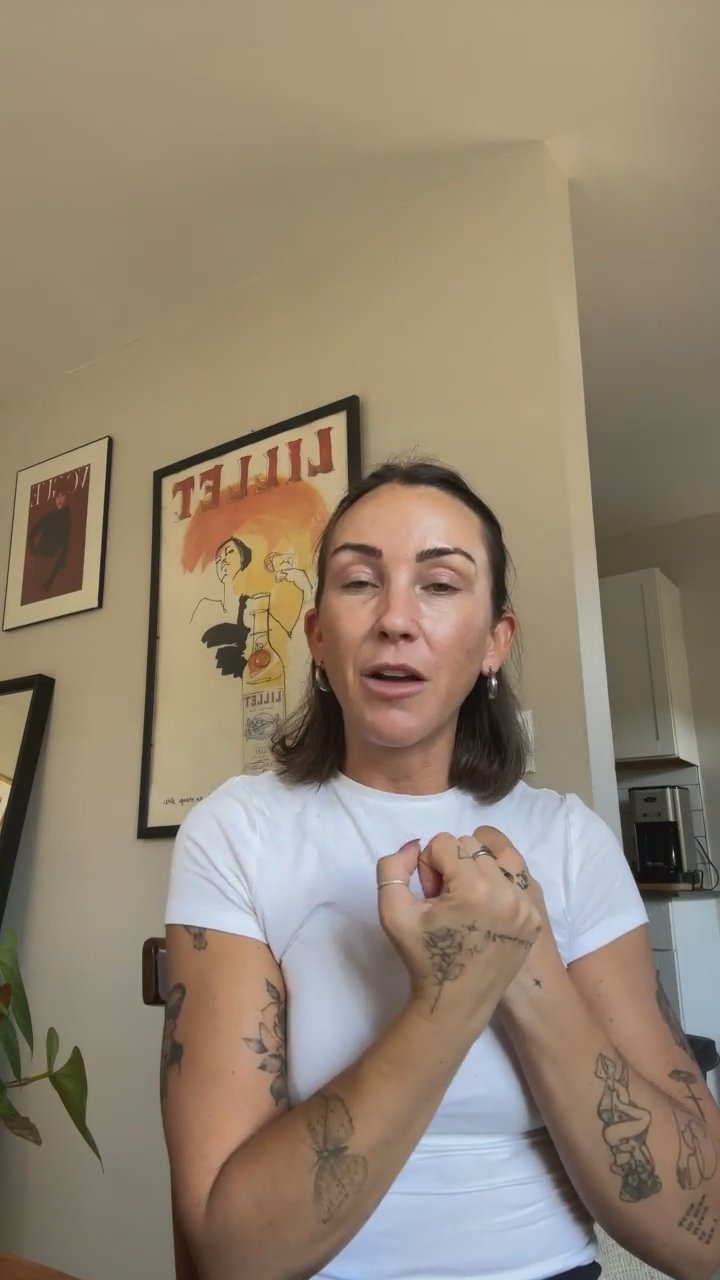
Another one is noticing urges to seek validation externally and instead giving it to yourself.
Hello. Happy Wednesday, Cadre crew. Just turning my music down a little bit. I am gonna talk about coping with rejection today. My music is still way too loud. Please hold.
Russell: Rejection is a huge trigger for my eating disorder and for my depression. The first time I ever experienced what felt like real rejection was when I was 14. I didn't know how to cope with it. And I have done a lot of work in therapy to sort of recognize how that contributed to the onset of my disorder.
When I don't feel like I'm enough, I project that into everything else. To counteract that, we can work with gratitude. Gratitude is the appreciation for what we have and the appreciation of it being enough.
Another one is noticing urges to seek validation externally and instead giving it to yourself. The next one that has been really helpful for me is just naming my emotions and verbalizing it. Once we can sort of name our emotion, then we can better direct ourselves around how to cope with that feeling.
Hello. Happy Wednesday, Cadre crew. Just turning my music down a little bit. Dee dee dee. Hello. Hello. It is Wednesday. It is August. We're still here. We're still doing the thing. Good work. I'm gonna give folks a few minutes to enter the room. Hi, Rachel. My other reliable Rachel. I love that you're always here. It makes me so happy to see you. I am gonna talk about coping with rejection today, so hang on. My music is still way too loud. Please hold. Actually, I'm just gonna turn it. Oh, I can turn it down like that.
Oh, lovely. Okay, so today I'm gonna talk to you a little bit about coping with rejection. Hi, Russell. Which is something that I have discovered in therapy, is a huge trigger for my eating disorder and for my depression. The first time I ever experienced what felt like real rejection. Hi, Jules. I was probably 14, and I took a road trip to Vancouver, which is like a two hour, three hour drive from where I live with my. He wasn't my boyfriend, but he was someone I was. I was kind of dating in high school, and I really.
I really liked him. And we got up to Vancouver, and we went on this long walk along the boardwalk. We really weren't talking very much. Like, it just didn't. There wasn't really, like, a good flow of conversation. And I remember distinctly at the end of the walk, he was like. We kind of looked at each other like, well, what should we do next? And he said to me, well, I think we should just drive home. And after that, he. He stopped making effort to hang out with me. And I took that as a sign of, oh, I must not be interesting enough, otherwise he would have wanted to keep seeing me.
And it sort of was my first experience of rejection, and I didn't know how to cope with it. And I didn't feel safe or comfortable talking to my parents. I didn't know how to talk to my friends. Therapy wasn't a thing people were just normally just doing. And so I didn't want anyone to talk about that feeling of rejection. And it just. I turned it inwards. And I have done a lot of work in therapy to sort of recognize how that contributed to the onset of my eating disorder in a time when I felt like I wasn't good enough.
And now I have been able to recognize, as an adult patterns in my life since then when rejection has been a trigger point for a relapse or a depressive episode, because it sort of stirs up this old belief that I never got to cope with for the first time around not being good enough. So I wanted to talk about that today because I recently, recently experienced rejection. Yay. We love that. Rejection is just redirection. That's what I'm telling myself. And I noticed myself kind of going down this place of I'm not good enough.
I'm never gonna be good enough. I'm not pretty enough, smart enough, interesting enough. All of that not enough has started to pour in, and I started to notice symptoms of my eating disorder coming back in. I started to experience depression, depression, depressive symptoms again. And so I started to do a lot of sort of inner dialogue, work and journaling, and working with my therapist around how to cope with rejection this time in a way that would set me up better for the future and differently than I did in the past.
So I wanted to share with you some skills that I've been using that have been really helpful. Like, seriously helpful, because last week I was feeling really, really low, and this week I'm feeling like myself again. So I wanna share with you some of these tools that I've been using. So the first one, which is gonna sound super annoying, trust me, I know. Like, I get so I get so resistant to doing this, and it's so effective. Gratitude lists. So this idea of not being enough pours into my life. Okay?
So when I don't feel like I'm enough, I project that out. I project that into everything else. My finances aren't enough. I don't have enough things. I'm not doing enough. I don't have enough friends. My social life isn't enough. The person I'm dating or have attraction to isn't being a good enough partner to me. They're not doing enough or showing up for me enough. I start to project this not enoughness everywhere in my life. And what that does is just create a lens of scarcity to which I approach everything.
So to counteract that, we can work with gratitude. Gratitude is the appreciation for what we have and the appreciation of it being enough. It doesn't have to be an overflow or surplus. It is simply enough. And we are grateful for what is not looking at what's not. And in doing that, in expressing gratitude externally for the things in my life, I start to ease in that scarcity, and I start to soften that feeling of things outside of me not being enough. And then I can start to focus on myself. So doing a gratitude list every morning can be a list of ten things that can be as simple as I'm grateful for the cup of coffee, I'm holding.
I'm grateful that the sun is shining today. I'm grateful that I have a path I can walk on with my dog. I'm grateful that I have food to eat in my fridge. I'm grateful that my hair is healthier than it was a year ago. I'm grateful that my body is working and I can move. We find things to be grateful for, and that's enough. And so then we start to create a lens for ourselves where our mind's not focusing on the things we don't have or the things that aren't enough. It starts to see the things that are.
So we're training our mind to have a new lens, and that lens is enoughness. So gratitude list is a big one. Another one is so noticing this one's really hard, but noticing urges and I don't know if anyone else does this to seek validation externally and instead give it to yourself. So oftentimes when I'm feeling like I'm not enough, my sort of attention seeking and validation seeking behaviors ramp up. Whether that's dressing a little bit more in a way that attracts attention, whether that's provocatively or more colorfully, or getting hyper fixated on having a really cute outfit.
So someone compliments me, that might mean fixating on my appearance in general. That might mean really thriving on a comment someone gives me, and really hyper fixating on that, or hyper fixating on criticism and thinking that that's a sign that I'm not doing enough. So, noticing urges to seek validation externally and again, and instead giving it to myself. So if I'm seeking validation for my appearance by focusing on my dress, I start to do affirmations around being really stylish and telling myself like, I have the best style.
I love what I'm wearing today. I'm wearing this cute little white cropped tee. I love my classic look today, my little half bun. I'm a stylish little lady. So, like, trying to give myself the affirmation that I'm seeking, or the validation I'm seeking externally and focusing on being able to provide that for myself, the next one that has been really helpful for me is just naming my emotions and verbalizing it. So oftentimes when I get into a depressive episode or get kind of lost in my eating disorder or anxiety, I have a tendency to really avoid my feelings.
So I start to either move really fast and do as much as possible to kind of run away from my internal world, or I numb and sort of dissociate as another way to kind of remove myself from my feelings, and neither of those allows me to actually deal with what's happening inside of me. And then it builds up and it comes out in other ways. So I have to take a pause sometimes and go and, like, literally say to myself, Rachel, what are you feeling right now? I'm being really nice to myself. Right. Rachel, what are you feeling right now?
And naming the emotion, if you're not good at naming your feelings, that's okay. I used to think that the only way to answer how my feeling is good or bad. There's a thing called a feelings wheel, which you can google. I'll show you when I have one. In this. This is one of the journals that I publish. This is the self healers journal. It's available on Amazon, and it has, like, daily prompts with. With gratitude and affirmations. But I put a feelings wheel on the front of it because a lot of people don't know how to name their feelings, and that's okay.
A lot of us didn't learn how to do that. I didn't learn how to do that. But you can just. You can just Google feelings wheel. Okay, hang on. Where is it? And it'll look like this. And it shows you sort of, like, the core emotions here and then some sort of more detailed words on the outside. And that's a really great way to kind of check in with yourself and go, okay, what am I feeling? Right. Maybe I'm feeling discouraged. Maybe I'm feeling overwhelmed. Maybe I'm feeling trapped. And once we can sort of name our emotion and get more clear on it, then we can better direct ourselves around how to cope with that feeling, because feeling trapped is really different than feeling scared.
And both of those might live under the core emotion of fear. But if I'm feeling trapped, then what I might need is to feel like I have freedom. The opposite of that would be freedom. So what can I do to feel the sensation of freedom? Maybe that's moving my body. Maybe that's getting outside in nature. Maybe that's singing, right. How can I express myself and get some freedom? Hi. Hi. Steve wonder. But if I'm feeling. If I'm feeling scared or fear, then it might not be in my best interest to go out in the world and do something really big and experience that freedom, because I'm in a place of being, of being afraid.
So what I need is safety, right? So I might need to do things that make me feel safe. So when we can get really specific on our emotion and name it then we can get really specific on how to cope with it as well. So the last thing I will tell you, and this one, it might not seem like it makes any sense at all in terms of coping with rejection. And I promise you, it is so helpful. If you follow me on Instagram or TikTok, you will have seen me do this many times. But I love to dance. Dancing for literally five minutes to one song, getting up, moving your body, shaking, jumping, smiling, singing with the lyrics to an uplifting song is such a great way for us to get out of our heads and into our bodies and build a sense of relationship to self and confidence that we often feel like gets lost when we're rejected.
A lot of times when we are rejected, we feel like we lose a part of ourselves because we lose the reflection of ourselves in the other person. We might feel unlovable because we're losing love that we've been getting from that person for a really long time. We might lose confidence because we might feel like, oh, this person doesn't want to be with me, or this person doesn't want me for this job, or whatever it is, it can inhibit our confidence. And dancing and being connected to our bodies and music is such a beautiful way for us to build that confidence back up and reconnect to ourselves in a really, really loving way.
I have a lot of dance playlists on Spotify, so if you have a Spotify account, you can just google Rachel Havoc, or not Google. You can search Rachel Havocost, and you'll see I have, like, probably 20 different dance playlists. And those are really great songs to uplift you and dance to if you don't have songs that you'd like to dance to. And again, you only have to do this for, like, one song. I only dance for one song every day. And that song lifts me up out of my. Out of my blues for just enough time to kind of get me reconnected to myself again.
Okay. I hope that was helpful. I am so happy that you all are here. I'm so grateful for all of you. You are on my gratitude list today, and I hope that you have a lovely rest of your day and week, and I will see you here next week at the same time, same place. See you next time.