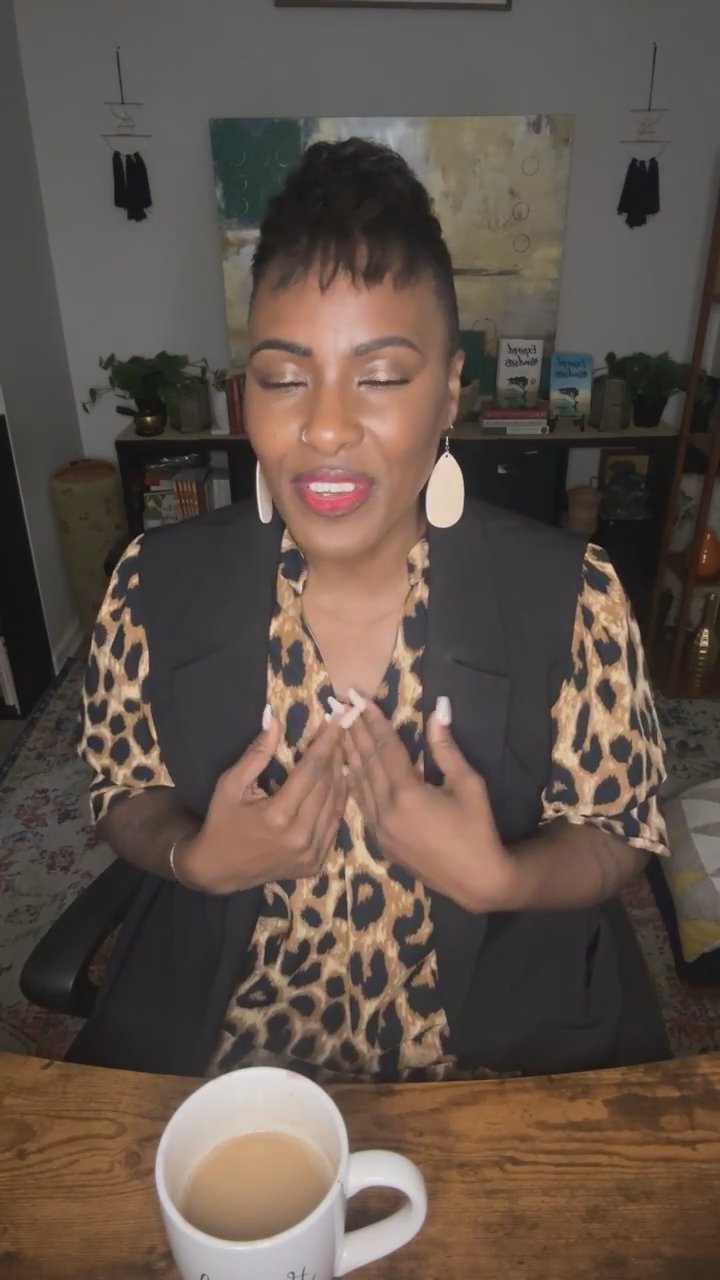
Whether it be weight stigma, health issues, or dysregulated eating, grief and loss can often be centered around the relationships we have with ourselves. “If My Plate Could Talk” explores the connections between food, weight, health, and trauma and frameworks for understanding the conversations we have with ourselves, thus begging the question: “If my plate could talk, what would it say to me?”
Doctor Charryse Johnson is a licensed clinical mental health therapist, mindfulness practitioner, and author. On Fridays here on Cadre, we focus on grave. Focus on the intersection of grief, trauma, body image, life.
Let me know where you are in the world. I'm still here in Charlotte. What's up, Georgia? Hello, Virginia. Funny story of the day. Before we talk about grief and our focus of today.
Maria Cardona gets all these crazy emails from Instagram. Today, she wants to focus on delayed grief. Cardona: We can have hard moments and still find ourselves laughing.
What we eat is a messenger into what we're feeling. Take about 60 seconds and identify what's on your plate right now. Let's normalize the things that are on our plate and be willing to put it out there.
We store delayed grief in our heart, hearts, and our chest. We can feel it through heavy limbs and fatigue. Sometimes there's no symptoms in terms of, like, the physical ones. But we may still know this situation is there. It changes how we feel about ourselves and our purpose.
What are some symptoms of delayed grief? You might notice things like appetite changes and a persistent longing. Here are three things that you can do to move through or work with yourself through your delayed grief.
Conscious fear. What is up? I see this weird message at the bottom, so hopefully that is just something different. All that being said, welcome to if your plate could talk. If this is your first time here. I'm Doctor Charryse Johnson, a licensed clinical mental health therapist, mindfulness practitioner, and author. And on Fridays here on Cadre, we focus on grave. And in particular in our time, we focused on purpose, focus on not just grieving a person, but the intersection of grief, trauma, body image, life, and the things that we grieve about ourselves.
But before we get into everything, let's do two things. One, say good morning, good afternoon, or good evening, depending upon when you're listening to someone else who may be joining at the same time. Two, let me know where you are in the world. Hello, Sherindria. You made it. Hello, Lisa. And all those who are coming in, let me know where you are in the world. I'm still here in Charlotte, and it feels really good to say that. Hello, Ken. Hello. Speak wonder, because those of you who are connected with me know that I travel quite a bit, and I am really enjoying this season of just being home for a while.
So is my family. What's up, Georgia? Hello, Virginia. Funny story of the day. Before we talk about grief and our focus of today. Hello, Tennessee. Hello, Minnesota. Charleston, eastern North Carolina. Ohio. What's up? I feel like we haven't seen too many Ohio's. You've never seen me with longer nails. I don't typically do longer nails. I started them maybe a few months ago at my son's graduation, and I'm getting used to them. There are some things that are still very difficult to do, but we'll see how long it lasts.
It'll last until I break it. Funny story for the day. Thank you for rating your week. Hello, California. California and Minnesota. Lake Erie, Mount Pleasant. So I get all these crazy emails from Instagram, right? From different people. Oh, we want to honor you for this, and we want to honor you for that. And you really can't ever think too highly of yourself. Really. I don't recommend. It's okay to think appropriate of yourself, but don't get in your head. So I get one this morning, and it's like, we want to honor you.
We've been looking at your Instagram page, and we want to honor you for behind bodybuilder. Behind what? And then the paragraph goes on to say, you know, we want to look behind the scenes from people who are on the top of their game. Sorry, I'm making myself laugh and being sculpted in their physique. I fell on the floor. I was like, this is definitely spam. I love myself. Completely love myself. Hello, Columbia, South Carolina. Hello, South Jersey. But what I do know is I am not sculpted. I have not been sculpted since birth.
So hilarious. That made me laugh. And guess what? We can really have hard moments and still find ourselves laughing. Hello, Maria. I thought you guys would get a kick out of that. Today, I want to focus on delayed grief. Yeah, sculpted in their physique. Right? Like, you haven't been on my IG page because you have me mixed up with someone else. I'm sorry. That just tickled me to death. And I'm like, if y'all are gonna send spam, at least be honest about it. You know what I mean? Like, maybe my hair is sculpted, maybe my eyebrows, but nope, not a bodybuilder.
Fun fact. I do have. And for those of you who are like doctor Charisse, get with it. Breathe. Chill. We'll get there. I do have a brother who is a professional bodybuilder and has been a bodybuilder for years, for most of my life, because we're significantly, there's a significant age gap, and he has won mysterious olympia a couple times or mister Atlanta or something, and he is the real deal. I don't have that kind of focus and commitment at that level. Not a desire of mine, but anyway. Delayed grief.
Delayed grief is something that occurs when the busyness and the responsibility of surviving a situation slows down. And maybe you're a person who, in this moment, you don't necessarily feel like you are grieving something. And if so, I want you to parallel delayed grief and delayed stress or delayed emotions. They really all go hand in hand. The kind of title of our time is called if your plate could talk. So I want to start off with asking you the question. I usually ask it at the end, but I want to ask now what's on your plate?
And I want you to take about 60 seconds and identify what's on your plate right now. I want you to think about that physically in terms of all of the different things that you've noticed yourself eating and how you're nourishing yourself and what foods you've been plating this week, because what we eat is a messenger into what we're feeling. Or has there not been anything on your plate? The other thing I want you to consider is what is on your plate in terms of metaphorically. So what are you dealing with?
What are you holding on to? What are you responsible for? What are you carrying? And to the degree that you're comfortable, share. Right. Let's normalize the things that are on our plate and be willing in the space to kind of put it out there. If I think about my plate this week in terms of how I have nourished myself, my appetite has been way down. When I am grieved by life, I have a tendency to withdraw and to back away. And my appetite usually goes one of two ways. And when things are significant, then my appetite blunts and becomes very numb.
So, you know, yesterday on the couch, my husband was like, have you eaten today? What? Have you eaten today? And I just looked at him, and he was like, go get food and go. And I wasn't even doing anything that would signal that I hadn't. But he recognized, like, something's off, your energy's down, something's different. Right. And so then if I parallel that to what's metaphorically on my plate and what I'm carrying, I am coming off of a season of managing the stress of loved ones, which is sometimes necessary.
I'm not picking up anything that isn't mine to carry, but I'm coming off of managing the stress of some loved ones. And so, in the moment, we often go in, we deal with things, we handle it, and then we don't realize that after we survive the moment for several days after that situation or that experience, then we can be feeling the delayed grief, the heaviness, the stress of, wow, that's a lot. And, yeah, you may be experiencing a lot of sugar. I'm seeing some yawn. So it might be like a fatigue that you're noticing about yourself.
That's what I want Fridays to consist of in our time, is you always putting together those parallels of what are my nourishment patterns telling me about my life patterns and the things that are weighing on me that I may not recognize. And, yeah, not eating a lot of candy and then noticing that you want it, and cravings just pivoting for a moment, are a huge sign that something's a little different than are normal and what we typically expect out of ourselves. So, when we are experiencing delayed grief, there's two things, two or three things that I want to kind of highlight today about that.
Number one is, let's talk about where delayed grief is stored in the body. So we actually know from neuroscience that we destroy that we store delayed grief in our heart, hearts, and our chest. And I thought that was so powerful. We can feel it anywhere. We can feel it through heavy limbs and fatigue. And tightness and joint pain. Yeah, I see some others are saying, yeah, appetite is changes. Not really eating a lot, but we store it in our heart and our chest. Sometimes we can feel that. Sometimes our heart feels heavy.
Sometimes we feel chest pain. Sometimes we feel like we're shortness of breath. We have shortness of breath, or our breathing is shallow. Understanding those physical aspects, but sometimes there's no symptoms in terms of, like, the physical ones. But we may still know this situation is there. Let me first say that if you are listening to the sound of my voice and you were here and you showed up and your heart is heavy, even if it's something that hasn't happened yet, or even if it's something that is in process or something that you just came out of, I am so sorry.
And not sorry in terms of pitiness, but I'm sorry that it is something that you are having to hold. And sometimes we need to hear that. Sometimes we just need to hear. Man, I hate that you're having to go through this right now, but I'm also really glad that you chose to come and that you're still showing up, because it is really challenging when you're in the middle of that letdown, when you're in the middle of that delayed grief. Yeah. Ken, my heart goes out to you dealing with an aging mother and experiencing that mom, a parent, in ways that, man, are so different than we're used to.
And there's a lot of heartache in that. Yeah. And I love that what you're noticing is that you're able to try to separate that. You're working to separate what you're feeling from your focus on how you need to nourish yourself, because that is also important, that responsibility doesn't change. So. Yeah. Three things about delayed grief. One, it exists and is stored in the body in many areas, but particularly in our chest and our heart. Two, when you're experiencing delayed grief and you're going through a really heavy season in your life, or you're even supporting someone who's going through a heavy season in your life of life, it changes how we feel about ourselves, our purpose, and our identity.
Have you ever experienced that? Right. Have you ever been in a situation where you're like, man, things are really heavy right now? Life feels hard in some areas, and because of it, you struggle a little bit to feel good about yourself. You don't wake up and have that same level of motivation, that same drive. You don't feel like the purpose that you're walking in is even as fulfilled as it once was. And it does also have an impact on our identity. And then, yeah, Rachel, you add that the health concerns exist for ourselves and it becomes an absolute rollercoaster.
So again, for all of you that are choosing to acknowledge and share, we honor your share. And for those of you who are like, I am not ready to share, but I am. I am doing the work. I'm here, I'm processing. Stay in that moment. You choose whatever is for you. And honey, don't know your real name, but that's your tag name. Hugs to you. As you are recognizing that is where I am. And it's such a powerful thing to recognize because we have moments that we're like, I felt okay the other day. What happened today?
How did I get here? And usually that's the moment to step back and go, what am I coming out of? Or what am I anticipating going into? Because that was me, and that has been me. I was coming out of stress and anticipating a big change in a stressor that was grieving my heart and my spirit. And I felt like I was frozen. Which brings me to the third aspect that I want to bring to your attention is what are some symptoms of delayed grief? How do you know this is you even aside from what you've already heard me share?
So you might notice things like appetite changes, which we talked about a little bit. That can be an increased appetite craving for sugar, carbs, things that are going to bring you up and create dopamine in the brain. You may notice that you constantly are eating and doing some emotional eating that even moves towards binge eating because you're trying to feel fill, fill the hole and the numbness that you're feeling from the letdown, from the stress and the busyness and the situation that you just survived, or you're trying to survive and feel like you're just looking for something good.
And it can always go in the opposite direction where you see your appetite diminishing and you notice you're not eating very much. You can even notice you're not hydrating a lot. So those are all signs and symptoms. Other things, difficulty concentrating, knowing that there are so many things that you need to get done and sitting down and really feeling like it's hard to focus on those things, making little errors and mistakes that you wouldn't normally make. You even may find a persistent longing.
And I think this one can be tricky. That persistent longing can be for reprieve. It could be for something to change or shift. It can be for a relief to come through a situation or someone else. And there can be guilt around what we long for. Like, let's be honest. Can we be really honest? Let's say, for example, we are navigating being a caretaker, and there is a persistent longing for it not to be so hard. But then we can feel guilty about that. And guilt is another symptom of delayed grief. We could even just feel guilty about the fact that we aren't handling the situation the way that we think that we should.
So also, let me pause and let me acknowledge that however you notice yourself handling life at this moment is don't beat yourself up. You just want to be able to observe and notice what do I see? How do I feel about what I'm seeing in myself? Where do I need to extend myself? Compassion? And where do I need to push a little bit so that I don't get stuck in the pattern that I'm in right now? But however, you're navigating this season of grief in your life and the things that have grieved you and that are weighing on you is okay.
But notice the places where you may not need to pigeot. You may also notice as symptoms of delayed grief, mood swings, some apathy, feeling like you aren't as interested in things that you used to enjoy. That's a natural process of things. Some disbelief around how did I get here and how long will this last? Some sadness and then emotional numbness. An emotional numbness can be tricky. Here's how you can be emotionally numb and still having conversation, still find something actually funny and laugh at it, still be out and engaging with other people.
But internally, there is this numb hollowness that you are still carrying inside. So what's important is to not think about these things in extremes and recognize that they can coexist with all of the things that you need to do that go, you know, that are a part of you going through life. That being said, if you notice yourself here, here are three things that you can do to move through or work with yourself through your delayed grief. One, take breaks as needed. Breaks from life. Breaks from responsibility.
Don't be afraid to change your plans when you recognize, I'm just too heavy right now to go into that situation and be what's needed or what's desired. So give yourself permission that you don't have to constantly show up. Show up in the ways that are absolutely necessary, but also pull back and pause when needed. Two, I actually encourage you to be more mindful of what you're eating than you would be in other times. So often when we feel good, we eat well. My encouragement is that when you're feeling bad, for you to eat even better, because we know that there is a direct intersection between what we crave and what we're taking in that can layer on to our emotions.
So if we're already heavy and overwhelmed and stressed and then ingesting things that are not good for our particular body, and that's going to be unique to each of you, then it complicates those emotions, because now we have the emotions of a dysregulated gut and a dysregulated heart. And that is a really tough combination. So be even more mindful about how you're nourishing yourself and think about eating in ways that are going to be very nourishing for you. High micronutrients and light. So when you feel heavy, eat, but eat lighter fare so that your body doesn't have to work so hard on digesting and processing the food that you're taking in.
And then it can reserve that energy to support you emotionally. And then number three is, increase your sleep during the evening. Now, if you do find that during the day you are exhausted, we highly recommend again, in the world of neurobiology and neuroscience, a 29 minutes nap is most optimal, right? So we don't want you sleeping 2 hours, because then you may find that it's difficult to sleep at night. Some people love a 15 minutes nap. If that's you, go for it. But most optimal for the brain and for energy and for reducing cravings, especially through stress and traumas, is a 29 minutes nap.
So if you have the time and you have the opportunity and you feel the need, set an alarm and sleep away. But otherwise, maybe back up the time that you go to bed so that you're getting that excess sleep that you need to recover, because mental and emotional drain takes a physical toll on your body. All right, come back to this moment. Listen to it as much as you needed. Biggest thing that I want you to take away from this moment is that if you're heavy, if you're going through a tough situation, if you're coming out of one, anticipating, going into one, wherever you are, is okay, keep showing up, keep coming back to this space, keep sharing and communicating your truth and what's happening.
Don't isolate to the point of internalizing everything and remind yourself that you don't have to walk through these things alone. We want to be a part of your moment to the degree that you want us to. As you continue throughout the day. Marigold will be on at eleven, Shannon will be on at one. There may be a few others that pop on throughout the day to just continue to focus on pouring into yourself and looking at all the various elements of grief. For those of you who are pretty regular joining me here on Cadre, this is my Saturday to talk about change the narrative, which is mental fitness for athletes.
So that's tomorrow morning at 930 EST if you want to join. Otherwise, I will see you next week and I hope that you have a phenomenal and incredible, incredible weekend. Talk to you soon. Bye. Cheers.