Tales from a life of battling pain—physical, mental, emotional, spiritual. I’ve faced it all. Now, my purpose is to turn my experience into a roadmap to healing for others.
The host greets viewers, introduces a dog guest, and explains wanting to take advantage of a sunny morning to do some movement. This chapter sets the tone and purpose for the stretch practice.
The presenter describes a history of injury, inflammation, and setbacks after rushing care, leading them to seek out the creator of a stretch book and attend an intensive to learn a new modality. This chapter explains the motivation to learn resistance flexibility to avoid surgery and heal.
The host shares who Bob Cooley is and his work with elite athletes, then explains how dense fascia stores trauma and how assisted stretches can break it up without excessive pain. This chapter gives background on why the modality is powerful and how it differs from other therapies.
The presenter introduces a specific gallbladder meridian stretch, connecting it to traditional Chinese medicine and listing physical benefits like improved lateral strength and flexibility, plus psychological benefits such as increased decisiveness. This chapter frames why the stretch matters for both body and mind.
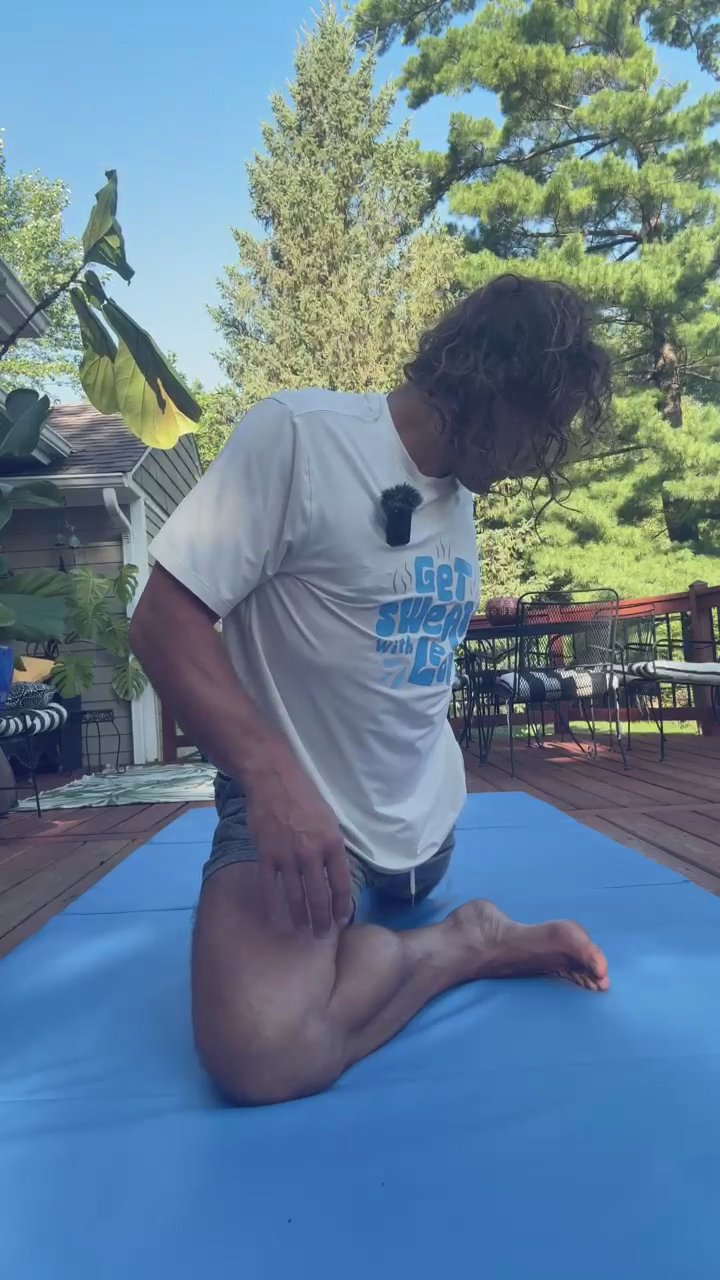
A practical demonstration of the pigeon-like position with detailed cues about foot and knee placement, muscle engagement, cantilevering, reps, and sets. Viewers learn how to perform the stretch safely, feel which muscles should fire, and how often to do it.
The host explains why resistance flexibility is preferable to static stretching, offers tips for better movement mechanics, and points viewers to related YouTube videos and community offerings. The video wraps up with encouragement to practice, contact information, and a friendly sign-off.
Good morning, cadre. Beautiful, sunny day. It's going to be hot as can be, but not yet. So that's why I'm sitting out here and do a little movement here for you. I've got a special guest. This is Roger. Roger, would you like to say hello to the camera? Roger wants belly rubs instead. So we're going to give him some belly rubs and he's just going to enjoy that. But so the last two mornings I wanted to be, or I was on here, I had, it was a little rainy, right? So didn't have the opportunity to be out here to stretch and move my body a little bit.
So I'm gonna do that today. And this is, these are, I'm just gonna start with one stretch. because there are so many layers to resistance, flexibility, and strength training. This modality that I came across about three years ago, and it is literally the greatest healing modality and really just performance modality that I've ever come across. So when I hurt my knee on Thanksgiving of 2024, and That was after about a year and a half of doing stretches in this book where I was able to get my body back to playing condition for hockey.
I didn't play for probably like 12 years. And I was able to get back on the ice and have a lot of fun. And one thing led to another and I didn't wake up with enough time on that Thanksgiving morning skate. And kind of just rush through the process. And like anything, it's not good to rush. We need to be very intentional and do things the right way, do things slow, do things methodical. And my body paid the price. So I got hurt and my knee just didn't get better. And then it manifested throughout my whole body in the form of inflammation.
I couldn't raise my arms above my head for a few weeks and my wife Melissa was rolling me out of bed. It was tough. And I ended up seeking out the person responsible for this book that I had been following these stretches. And this is a book right here. And the gentleman is Bob Cooley. And so I was like, I'm going to go and find this guy. I'm going to go and find Bob Cooley. And there was a week long intensive course in Santa Barbara, California. And I just thought to myself, this is gonna be perfect.
I'm gonna go and learn this modality so that I can heal myself and fix my pain 'cause I didn't wanna have surgery. And I was thinking my knee was so bad that I was concerned I might have to have a knee replacement. That's how bad it was. And then just the inflammation pain throughout my body was very uncomfortable. Little did I know it was probably a precursor to my appendix rupturing. So lots of layers to cover here. But I'm going to just kind of dive into this stretch here and I'll continue to tell the story of resistance flexibility and strength training and about Bob Cooley.
because he's amazing. He was literally just with a Norwegian soccer team throughout the World Cup, specifically working with one player, Antonio Nusa, who he's been working with for the last year and a half, elevating his game. And then a byproduct of that is working with some of the other top players. Erling Haaland, you know, the beast Viking from Norway. So Bob is amazing and I'm very grateful that I have the connection to him through this modality. So what I'm going to do here to start though is we're going to do a stretch that is going to work kind of the outside of the thighs and the glutes.
And the outside of our body is where we hold the most dense fascia in scar tissue. So it's very important to stay on top of working those muscles so that we don't continuously have dense fascia buildup. And when you think about it, let me show you this, well, the stretch that we're gonna be doing is gonna focus on the gallbladder meridian. So this modality is also associated with traditional Chinese medicine. That's what makes it really special in my mind. And you can see here that the gallbladder meridian, which is green, I want to bring this closer, it runs all the way from the foot all the way up to the head.
And what I like to, through my own pain experiences, this green line that essentially travels from your glutes down to your foot is where I experienced an incredible amount of nerve pain for really the better part of two years before I got introduced to this ARP machine that you'll eventually see. And then in 2016, I had my worst bout of nerve pain from herniated discs where I was completely immobilized for four weeks. I couldn't lift my foot. I couldn't sit down. I couldn't lay down. You couldn't suspend me in space and have me feel comfortable.
That's how That's how bad it was. And when you have dense fascia in your body, that's essentially physical or emotional trauma that is stored in your body as a memory, right? And when you have dense fascia, that's like, think of a traffic jam, a bottleneck, or moving through sludge. You can't move quickly. So we have to eliminate this dense fascia through movement. And when you're doing these solo stretches, it's incredible and it really helps your body and your mind. But when you have the ability to be assisted in this process, the force generated from the assisted stretch literally just rips apart dense fascia and it's not even painful at all.
It actually feels quite amazing, especially compared to a technique like ralfing, which is an external force that is going at the dense fascia. It hurts really bad. But it's almost like a good hurt because sometimes when you're in pain for such a long time, you don't just erase it with 10 minutes of gentle massage. You kind of have to attack it and feel pain to erase pain. So I'm going to do this gallbladder stretch here. The benefits of this stretch, I haven't memorized all this stuff, so I'm going to follow my manuals over here.
I've got notes that I take in here to develop my knowledge about resistance flexibility. I've got my book here with tons of different stretches. And then I have three different manuals because I am technically a level 3 certified resistance flexibility trainer. So that's pretty cool. So let me tell you about the benefits of this stretch. You're gonna love this. So this stretch can help to increase the flexibility and strength of your lateral leg, torso, neck, and head muscles, can improve the health of your gallbladder and tendons, improve your fat metabolism, and improve your ability to turn from side to side.
psychologically, this stretch can help increase your devotion to others, help you to be more decisive, help you to step up to the plate when the going gets tough, and it can help dismantle dependency problems. So there's a psychological component to physiologically healing yourself. And we're all here for mental health, right? And It is my belief and my experience that fixing the body will help fix the mind because you can't just, your brain is an organ. It's one of the organs that we would stretch in this modality.
And you can't get your brain functioning properly if you don't stretch the muscles that are associated with it. And that goes for the whole entire body. So I like to stretch as often as I can. Let me back up here so you guys can see me a little bit better. And this is essentially, this is pigeon pose. So if you'd like to do yoga, this should be very similar. yeah, that feels good. So how I'm going to do this is I have, I turn my foot out, I'm pressing down, my whole knee to my ankle is pressing down into the mat.
And my left leg in the back here is sticking straight out. And as I come up into this position, And I'll turn to the side here in a little bit too. I have a lot of pressure from this knee going down here, all pushing against the mat. I don't feel any stress on my knee. So if you are getting into this position and it's really difficult, you might wanna use your hands to just try to assist you. And in this position, I'm pushing up with my hands. I don't have much stress on my leg and I can feel a real nice pull.
in my glute right here, kind of going down this outside part of my thigh. So when I'm doing this, I'm going to come up into this kind of position. I am pushing down with my quad and hamstring and my whole entire left leg is kind of acting as a lever to keep me up. And then I'm pushing into the mat with my shin here. And now I'm going to kind of just hold up, be in this position just like this. And instead of, I'm not going to bend forward, I'm going to like cantilever forward. So as I go down, I have, I am contracting these muscles on the outside of my thigh by pushing down into this mat.
And I'm going to move real slow through this contraction. And even if I have the opportunity, I'm going to extend my left leg back even further. So I'm engaged this whole entire, my whole leg is engaged and I'm contracting as I move through this motion. Oh man, it feels amazing. I always like to check my glutes to make sure everything is firing. And I'm going to come up. So I like to do this three to four reps per side. And I try to get two to three sets in depending on how much time I have or depending on how much I need this stretch.
But this is a stretch that always hits home for me because of all my injuries and just the nature of life. I seem to build up a lot of fascia. on the outside of my legs. So this stretch right here not only helps me just feel better, but I can do this stretch when I'm going into a tough meeting or I have a tough day that's going on. Like this will help me feel psychologically prepared and ready to tackle a big task. it's like I mentioned earlier, it helps me be more decisive. And as I'm going through a change right now, a big change in my life, this helps me decipher the right move.
Like what do I need to do? So I'll try this side right here, maybe. I'm just dancing on this mat now. I think I'll maybe just keep it because this is how the camera is. Now I actually have a video on my YouTube channel, Get Sweaty with Letty, where I talk about this stretch pretty extensively, show a demonstration from multiple angles. So if you want to take a look on my YouTube channel, Get Sweaty with Letty, go check it out. I have filmed a bunch of stretches. but I got delayed in putting everything out there when my appendix ruptured and that needed to be my focus as opposed to putting out content.
So I'm still getting used to a routine here and of putting out content on my own platforms, putting out content on here. I want to make this a regular thing for me. And every single week I get a bit closer to that reality. So again, You can kind of see right here, no stress on my knee. All the pressure is on my shin here, pushing down. I'm engaged from my quad all the way down to my knee over here. And we're going to cantilever down. I like to turn my hands like that. I think for some reason that motion allows me to cantilever a little bit better.
And you'll notice that it might be easier on one side than the other. It might feel a little bit different. And that's totally expected because your body's not going to be identical on each side. So when I'm coming up here, that's actually, I'm actually strengthening. So that's why this is called resistance flexibility and strength training. So as I contract and move down, I am stretching these muscles on the outside of my thigh and my glutes. So they're getting a really good stretch right here.
Still contracting, still holding. And then as I come back up, that's where the strength comes into play. And really the slower, the better all around when you're doing these types of movements. Speed is not your friend. You want to be very in tune with the movement here. And these moves, if you're someone that likes yoga, these stretches will help you become better at yoga because it will create a different relationship with how you move into a stretch. And it's all focusing on your actual muscles.
So traditional stretching, static stretching, a lot of what we're used to seeing That is only stretching our ligaments and our tendons. It's actually not stretching our muscles. So we're arguably doing more damage to our body by doing static stretching, you know, dynamic stretching, stretching through movement. That is, you know, a much more beneficial form of stretching. But you also need to be thinking about the movement that you're doing. And if I'm going to do, you know, like toe touches like this, just static stretching.
I want my legs, I don't want my legs to be locked and just pounding down. They need to be slightly engaged. And I want to engage my hamstrings, pull up with them, but also pull down, kind of like, it's like a lever, you know, working with each other. So I'm not hyper extending my knees. but I'm engaging my hamstrings and my glutes as I'm moving down. So, you know, that's a better form of stretching your hamstrings than just doing like this and pulling. Like that is no bueno. No bueno. Well, all right, this is my first crack at showing you some resistance flexibility move.
And yeah, you'll see more. You'll see more stories. You'll learn about this modality. One of my second most viewed video on my YouTube channel is my interview with Bob Cooley, the man responsible behind resistance, flexibility and strength training. That's not him in the photo. He's A 77 year old, just amazing dude. So yeah. You'll be hearing more about this. You'll be seeing more about this. But if you want more before I pop back on here, go check out my YouTube channel. Go look at the videos I have with Bob Cooley, even the videos with Richard Gregston, one of the elite trainers who I've become good friends with and bring to Minnesota on a semi-regular basis to help stretch people.
So trying to build a community out here. And yeah, so if you're interested in that, give me a shout sometime. and maybe we'll figure out a day to stretch or sweat or do all the things. So stay cool out there on this steamy Wednesday and stay tuned for all the good stuff, all the good things. So take care, love you all, and we'll chat soon.