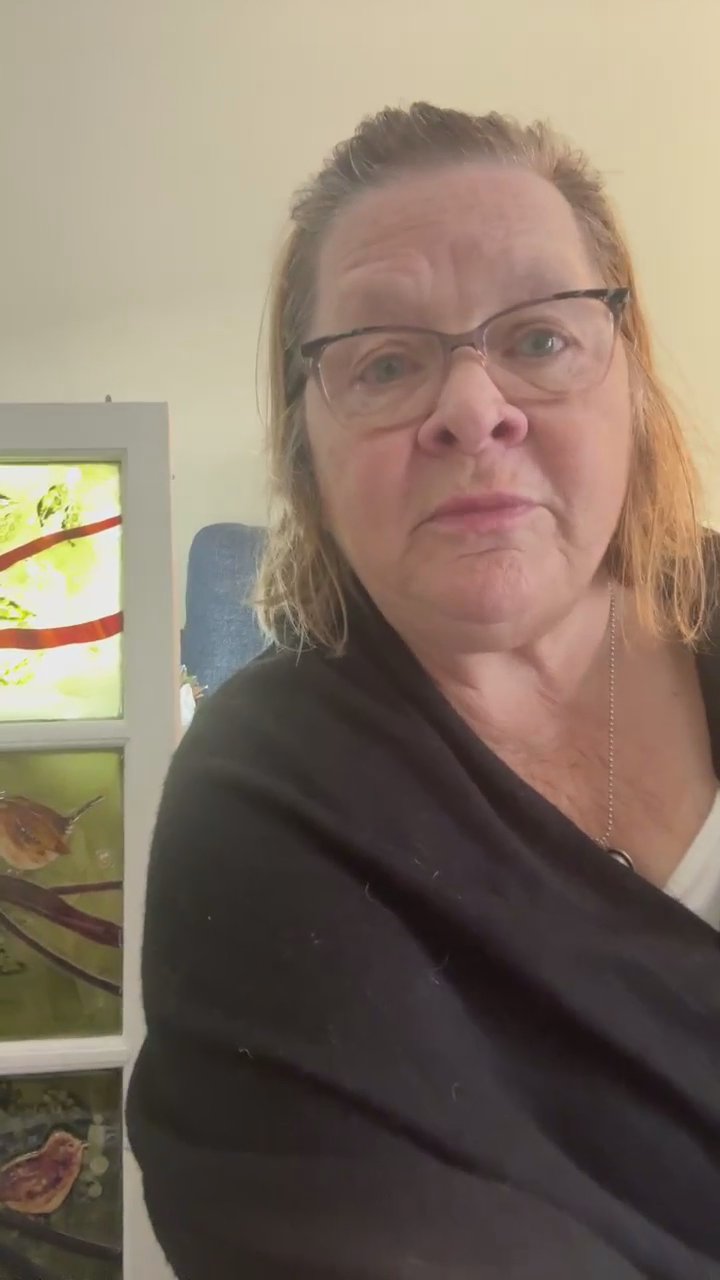
Kathy opens the live session, welcomes viewers to Quadrosphere Caregiver Day, and introduces her Thursday theme and personal background as 'Speak Wonder'.
Kathy describes what harbor pilots do and relates their role—guiding ships through hidden hazards—to the way caregivers and experienced guides help others navigate difficult seasons.
She talks about living near Dobbins Landing and Presque Isle, reflects on a roller-coaster summer, nostalgia, and unexpected visits that illustrate life's seasonal changes.
Kathy narrates her decades-long relationship with her mother June, the progression of care from home to skilled nursing at the Rouse Estate, family support, and how roles shifted between caregiver and cared-for.
She recounts moments like Clara urging her to pamper herself and a nurse aide using endearing names to calm residents, highlighting unexpected acts that brought connection and care.
Kathy displays a stained-glass-like piece left by her late friend Shirley, describes its panels with Carolina wrens, and reflects on the gift and its meaning.
She introduces Mary Oliver's influence, reads her poem 'Feathered Rescue,' and ties the bird imagery to memories, emotions, and gentle consolation.
Kathy previews the next caregiver segment, thanks listeners, reminds them they're 'harbor pilots,' and says goodbye until next week.
And we're live. Hello. I hope you're going to join me. Send me some hearts. Let me know you're here. It is Thursday in the Quadrosphere Caregiver Day. I have some things to share with you today. And. Whenever I go live, I find it difficult. It's my own challenge. The technology is there, but I find it hard to flip the camera. Therefore, I'm sitting on the floor next to a piece of artwork that I want to share with you in a minute. My name is Kathy Joy. And my name in the cadre is Speak Wonder because I love to find words and bend them into something wistful and meaningful and magical and life-giving.
I love poetry. I love to make poetry. I've written a couple books and I'm working on another one. And I happily landed in the cadre sphere pretty much right after its inception a few years ago. So I've been with y'all for a while, and if you're new to the Quadrosphere, welcome, welcome, welcome in. Every day, there's something that is available to you in this mental health and wellness forum. There are things to help you physically, spiritually, mentally. Resources, abundant, abundant resources right here.
My theme on Thursdays when I go live is harbor pilots because harbor piloting is a job that I would do if I were starting out in life. I'm retired. But you know, people do come out of retirement. Anyway, it's a demanding job and it's not for the faint of heart. It is a job that men and women do in the harbors in the United States and around the globe. And that is basically to give you a quick sketch of what a harbor pilot does is they are on call and they drive a small boat equipped to get them through a harbor pretty quickly.
When the big ships and the cargo ships and the larger boats and the boats that don't know the local waters, when they come sailing in, the harbor pilot motors out, climbs up the rope ladder, and takes over the wheel to guide the ship and its captain safely in. And I think that is so meaningful on so many levels because truly the captain of that ship is surrendering his or her autonomy in favor of someone who knows the water, who understands the undercurrents, the hidden rocks and the possible hazards, knows the waters.
And that's what happens in caregiving. We lean heavily on people who have traveled this path and we learn from them. And if we've been at it long enough, the caregiving that is, we become our own harbor pilot. We start to understand the local waters and what to avoid and what to embrace and how to get home safely. So harbor pilots to me is very symbolic. And I live near a harbor. I live within pretty much driving distance, quick drive over to Presque Isle State Park, the Erie Peninsula on Lake Erie, and also the harbor, which is called Dobbins Landing.
At one time it was a fishing harbor and we had a lot of sturgeon, which is the fish that yields the caviar, the eggs, the roe for caviar. I'm glad to be here today. It's been very roller coaster summer, emotionally, if you will. Yeah, summers can get that way. I think there's, I don't know, for its own reasons, the summer season has a touch of nostalgia to it. I think many of us think of ourselves when we were kids and we were free to just do what we wanted to when the school was done. They're just layers of nostalgia for me for summertime.
I had company. At one point back in July, I had unexpected company and I took a trip that I wasn't expecting to take. felt like I didn't really have a say-so, but we all go through seasons that we can't even articulate until after they're over. And sometimes we can't even appreciate the good things about those seasons until they are past. Today in Harbor Pilots and caregiving, I would love to speak to you about surprises and remind you and remind myself to look for them and to be aware of them to be in a heart place where you can receive surprises because they're there.
And I wonder how many I miss in the task of getting the thing done, checking the list off. You know, you know what I mean? Good morning, Jules. Hi. So good to see you have you listening in today. It's great to be part of a conversation, isn't it? Yeah. I notice the way the light's shining. I'm a little bit mysterious in the image. I'm a woman of mystery and a little bit blurry. So surprises. Yeah, I took a few notes down because I didn't want to forget something. So it's been a long haul, my caregiver journey.
I've been caregiving my mom for some years now. Her name is June. She's 95 years young. And I've traveled with her in this caregiving picture from assisting her in the home, showering her, toileting her, personal hands-on care, watching her decline. She developed some difficulties walking and then eventually we were with a walker and then a wheelchair and then it became impossible for her to be safe living alone as a widow in her home. My family helped me with the caregiving and we did what we could and almost three years ago she had to go to a facility and it's called the Rouse Home.
It's the Rouse Estate. Little side note, there was a fella, we're in oil country here in Northwest PA. This is where Drake, I'm forgetting his first name, but Drake's Wells. If you ever come back east, you need to visit that in the little town of Titusville. But Henry Rouse was an oil tycoon and he died tragically in his early 40s, I believe, from an oil well fire. How ironic is that? He became rich on oil and died from oil. He was not only an entrepreneur, but also a, what do you call someone who gives to the community?
Philanthropist. Yes. So Henry Rouse. loved the community and wanted to gift his estate to the community and had the foresight to do so. all of his estate, which is acres and acres, was developed back in the 40s into a campus and became a place for all the levels of care that are needed. The independent living, the assisted living, the memory house for dementia and the skilled nursing. My mother is in the skilled nursing. building and she's well cared for. I feel good when I'm not there. It takes me an hour and some to get to her one way and I go once or twice a week.
So it occurred to me that over these years as I recount them with mom and her progressive decline physically that she has always been my caregiver. When I was a kid and she was in the role of mom Manager and then when I became a young adult. She became more like an ally, a mentor, a friend. And then after I raised my family and I too became a widow, I became an ally to mom in her widowhood and then a caregiver. But she's still caregiving me. The other day when we said goodnight, she said, honey, I just want you to know you've been a good daughter.
You've been so good to me and I treasure you. And those words were what I needed and I didn't even realize it, just that affirmation and just knowing that I too am cared for in this caregiving scenario that we find ourselves in, seasons of life. Some people are caregiving a spouse or a child. Or maybe you are a professional and you go into people's homes and assist them with their care. There's so many ways in which we are walking each other home. So many official ways and unofficial ways as well.
So something happened to me a couple years ago with mom's roommate that she had at that time, and her name was Clara. And I remember Clara looking at me as I was getting ready to leave to drive the hour and a half home. And she said, Kathy, can I just say something to you real quick? I said, well, sure. Very soft spoken lady. She's a lovely person. She said, now I want you, she got a little bossy. She said, I want you to go home and take a bath. And on your way home, stop somewhere and get some spa things, you know, like bath beads or fizzy bath balls and I want you to have a spa night because you have earned it.
I didn't even know she saw me in that way as someone who needed some TLC but she saw that and she kind of in a cute sweet way lectured me on the importance of pampering myself and taking time for me. I did it a couple nights later. I did give myself a spa night and a nice relaxing, refreshing spa night and I did my nails and my toes. It was great. Because another person who is in the position of being cared for told me to care for myself. That was a surprise and a delight. Another one came just last evening I was with mom and assisting her in eating her evening meal.
And I noticed the nurse's aide, who was at the same table as mom and me, was assisting two different residents and she called one of them Grandma and the other one Pops. And I said, you know, I looked over at her and I innocently said, it's kind of cool that You get to work here where your grandparents are. She said, they're not my grandparents. They're not my grandparents. And she went on to explain. She said, I find that the residents calm down when I give them a familiar name. And if I say grandma, these green beans look real good.
She relaxes and wants to eat more. And when I say pops and we're trying to get him ready for bed and he's maybe combatant, if I say pops, which is what she called her grandpa, if I say pops or papa, the demeanor shifts and they calm down. That surprised me. It's probably a tool of the trade, something I'd not heard of before, but in particular with somebody who's struggling with dementia, to have that connection, to hear a human voice call you grandpa or pops or grandma must feel a certain way. And I also think it takes a very mindful professional to think of those things and apply them in order to make a resident feel more human, more connected and more loved.
That was a surprise to me. when she gave an endearing name to the residents. Oh, I printed it off. It's over there. I have a poem I'm going to read you. And in order to, hey, Hazard, I like your handle there, Hazard. Come sliding in. Hello, I want to show you a beautiful picture that I acquired. It's artwork. And then I want to read you a poem about birds. I had a loss earlier this year in January. A lifetime friend of mine, Shirley, died. And I went to her memorial service and her sister came over to me and said, Shirley left some things for you.
She was a prolific photographer and she left albums upon albums of me, my children, my husband, my wedding. treasure those. And she also left a picture or a piece of art and it is this. And it is mine now. And it's kind of like stained glass. It's called glass art. And that's the top panel you're looking at. Those are branches and leaves. Then the middle panel is a Carolina wren. And the last and third panel, there are two Carolina Wrens. It is called Glass Art, done by a woman down in the Harrisburg, Pennsylvania area.
And I was actually with Shirley when she bought this piece. She adorned her house with beautiful, original, pieces of artwork and she herself was a painter. Imagine how thrilled and surprised I was to receive this gift. The Carolina Wren preserved in kind of a stained glass artwork. I don't know yet where it will live in my house. I'm going to try and fit it into a window, but I'm not sure. If not in a window, I definitely want to illuminate it and have it on display, maybe on an easel. Those are Carolina Wrens.
I am a bird enthusiast and I wrote a poem about birds just yesterday. and I think I'm channeling the late poet Mary Oliver. Are you familiar with her work? She was always encouraging her readers to notice nature and how nature itself is life-giving. And in my theme today is a caregiver of our souls. This one I titled Feathered Rescue. And I'll leave you with this. Feathered Rescue, surrendering your heart to birds. Your memories will settle like birds on a branch. Let them perch and warble. You will hear them sing friendship.
You will hear them sing regret. You will hear them sing mysteries, unanswered questions. You will hear commotion in your heart. And then each little bird will rise and fly, carrying bits of all you feel right now, a kind of silent, feathered rescue. Later today on Caregiver Day, you'll be hearing from Shannon Paul, comedy through the chaos. She always has something for us to ponder. And I love the organic, edgy way that she introduces her humor and keeps us laughing throughout, even in the difficult times.
Remember, you're walking somebody home. And you're a treasure. You're a harbor pilot. I'll see you next week in the cloudosphere.