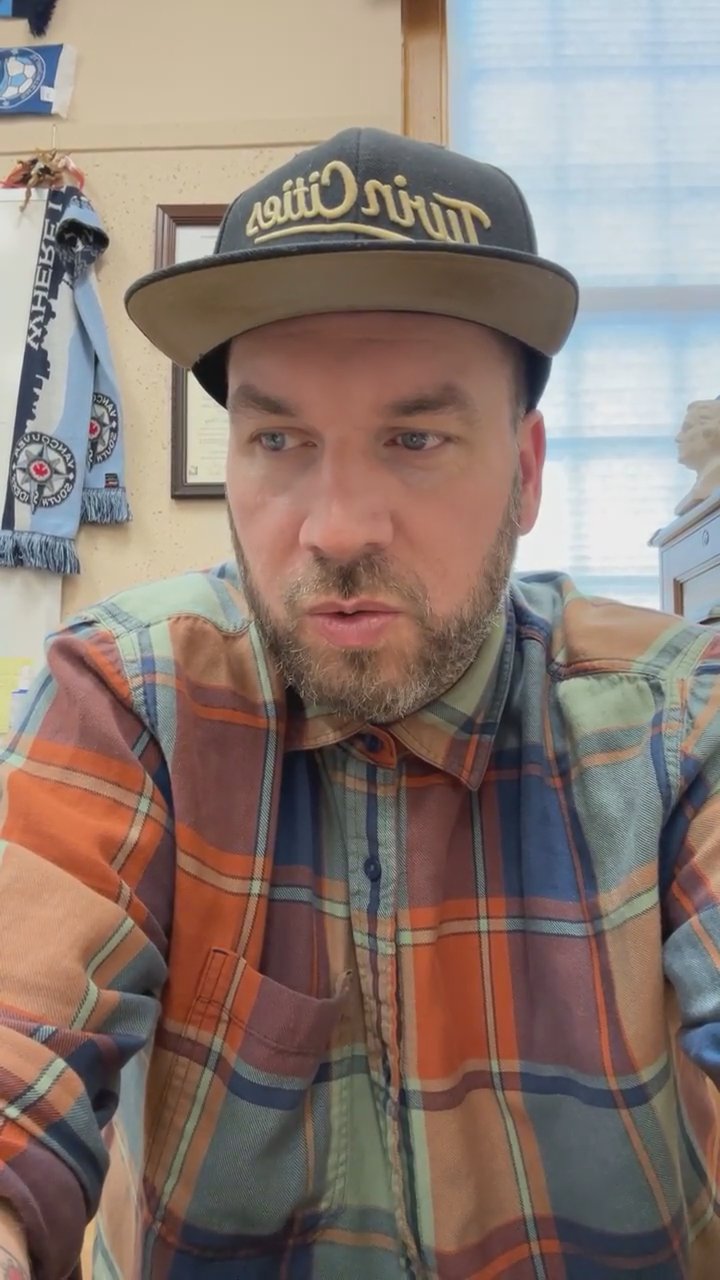
What do faith leaders need to say to make people feel safe in a mental health crisis?
Pastor Seth Perry greets viewers, names the series Talk Stigma, and briefly describes his Our Stigma docuseries while sharing key aspects of his identity and lived experience. This orients viewers to his perspective on mental health and faith.
Seth describes meetings he had after church, a sermon about community, a baptism reception, and responding to a family emergency that brought relatives together at a hospital and bedside prayer. These anecdotes show how community practice plays out in his pastoral work.
Seth narrates a hospice visit at a farmer's home and demonstrates his approach of making simple observations about a person's life to open conversation. He gives concrete examples of questions and topics that helped the person share memories, illustrating a practical way to create safety and connection.
Seth reflects on meeting people where they are and credits a chaplain from his treatment for modeling listening and validation. He closes by expressing gratitude for the conversations he gets to have and wishing viewers a good week.
Hello, everyone. My name is Pastor Seth Perry, and this is Talk Stigma. So if you don't know about me, I have a six-part educational docuseries called Our Stigma. It's an audio docuseries that talks about mental health stigma in faith communities. I'm a pastor. I'm a recovering addict. I live well with bipolar disorder. And a lot of my work ends up being Like the meeting that I just had right here in this office with someone after church about a loved one. Jules, welcome. So yeah, I was just talking about codependency, mental health, and addiction with someone right here in this very office after church today.
And I've had a week that has shown me an amazing spectrum of experiences. Hello, Andy Mack. So what's something that you want to hear from a faith leader that's going to make you feel safe? If you're someone that's struggling with addiction, if you're someone that's struggling with a mental health condition, what's something that you want to hear? Or maybe what's something that you've heard in the past that has been stigmatizing from a faith leader? I want to hear that from you, so just type it in the comments.
You can type it in quotations, you can type it in just as an observation. But my whole sermon today was about community and bringing people together. And after the week that I've had, it has been a week of trying to just bring people together. And why? I mean, let's start with last week. Last week, I baptized an infant kid And we had a big reception here at the church afterwards. That was bringing people together. And then shortly after that, this week, I got a call on Friday that someone's health was failing.
And I said, yeah, we better hurry on this. Let's bring the family together. and I brought the whole family together and unfortunately I just received word that that person has moved on, has passed on. But on that Friday we had absolutely every single family member out at the hospital and we all joined hands around the bed and prayed. So there, that's another way that I've been able to bring people together this week. And so how about you? How are you bringing people together in your life? And I'll start with, I'll start with a little bit of a, a little bit of a story.
So, so just last Sunday, I remember I shared with you that I was going out to do a hospital, or not a hospital visit, but a hospice visit. And it was something that was absolutely amazing for me because I drove 30 minutes north to a place I'd never been. And I was so north of where my own town was, my own town where I'm a pastor. And I was so north of where I lived. I had driven all the way into Wisconsin in the middle of a farm field at a farmer's home. And I pulled in and there I found the whole family.
And really the person who was on hospice had never met me before. And so I was kind of thinking about like, What is it specifically, what have I learned to say to people to kind of disarm them that this random new pastor with tattoos has just sort of come into their house to pray with them, to talk about end of life care and maybe give them a little bit of hope in their life. And I think that what I have learned is to really talk to anyone in a very simple way. And that is by making observations about what you can see in their life in that moment.
And so, I looked at the man's property, his farming equipment, and just started going into that. I said, tell me about it. Tell me about Tell me about what you used to farm. What was the crop? What crop did you use to farm? There you go. He started talking. Yeah. How many days, how many hours a day would you work? There you go. More to talk about, you know. See, did you work with any of your neighbors on any of these projects? On any of your farming? Oh, yeah. Started talking about who lived there, who lived there, who lived there.
recalling all sorts of memories from his time farming, 'cause it's been quite some time before, but since he's been farming. And so that's something that really was in the forefront of my mind this week as I went through a week helping people and being a pastor is How can I speak to their experience? How can I meet people where they're at? And good afternoon, Jules. And the key really has always been to make people feel safe, look to their interests, look to their personality, look at what you can see in them.
And that's what's carried me through my life as a pastor, I think. And when I think about the people that have really set my life on the correct course, and I think a lot of this goes back to a chaplain that I met with back when I was in treatment. All the way back when I was in treatment, he was able to help me by listening to my story, validating who I was, letting me know that I was a real person. Because when I was in treatment, I did not feel like I was a part of society, I was a part of my family, I was a part of anything.
And after I spent time with that chaplain, sharing all the things that had happened in my life. He just said, yeah, you have to know that a lot of people go through ups and downs just like what you told me. And that's what I'm grateful for. I'm grateful that I get to have those conversations with people now too. So that's what I have for you all today. And I'm grateful that you've tuned in. And I hope you have a wonderful week. And I'll see you again next Sunday.