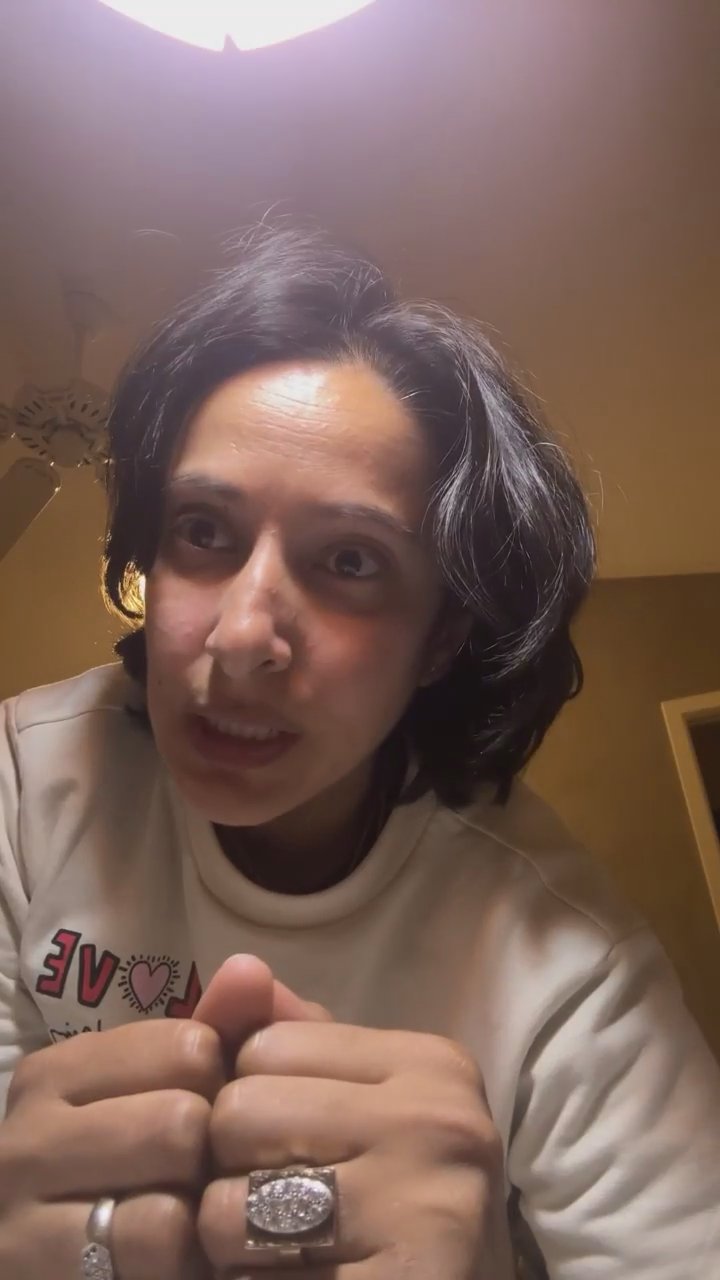
Anila opens the video, reintroducing herself as a returning contributor and greeting viewers. She sets a warm, informal tone and shares that she took a brief hiatus while working on her memoir. Anila chats casually about food cravings, tangents, and her dog to build rapport and ease into the topic.
Anila opens the video, reintroducing herself as a returning contributor and greeting viewers. She sets a warm, informal tone and shares that she took a brief hiatus while working on her memoir.
Anila chats casually about food cravings, tangents, and her dog to build rapport and ease into the topic. These personal moments make the talk relatable before moving to the main theme.
She introduces September's theme—feeling safe to be oneself—and explains how early messages from parents, teachers, and society shape identity. She emphasizes how judgment and expectations can silence children and how undoing that takes time.
Anila traces identity development through high school, college, and midlife, sharing examples like wardrobe choices and career decisions. She reflects on 'midlife clarity' and how many choices were influenced by others rather than by her true self.
She vulnerably reveals struggling with trichotillomania and hiding aspects of herself, explaining the shame and isolation that came with self-soothing behaviors. This personal anecdote underscores why safety to be oneself matters.
Anila argues that adults must create environments where kids feel safe to share mistakes and fears, using a hypothetical about her son to illustrate how reactions can break trust. She emphasizes balancing discipline with unconditional support so children don't withdraw.
Responding to a tragic school incident, she advocates creating spaces that celebrate diverse identities and thoughts. She defines leading with love as allowing people to be themselves and listening without judgment.
Anila wipes away tears, thanks the audience, and promises better lighting next time. She signs off warmly and invites viewers to return for the next talk on leading with love.
Hello Cadre Sphere! My name is Anila Idnani and I am leading with... LOVE! I am a former Cadre contributor and took a little hiatus for about three to four months as I was working on my memoir, which is almost done. Yay! Hello, D Beckett. Welcome, welcome, welcome. I am a former Cadre contributor rejoining the Cadre Sphere, and September is Safety Month and talking about being safe in oneself. And oof, I have so much to say about being safe in oneself. Hi, Shannon. Hi, Speak Wonder. Oh, I want to give hearts back.
I was about to hit the stop button by accident. It's good to see your smiling little tiny iconography. Hi, junk food junkie. I would love to know what junk food's your favorite. That's a question for everybody. Mine is Snickers bars. I cannot say no to them when I'm at Walgreens. It's very difficult. I go in for something else and then inevitably Gotta have a Snickers. That's not their tagline. Gotta have a Kit-Kat? I don't know. No, break me off a Kit-Kat. Alright, sorry, anyway. I go off on tangents.
Well, I am good to be- I feel good to be back. I'm very happy to be back. It's been a long hiatus. Ooh. Einstein's here. Einstein is my sweet doggie. I think he missed me because I ran out today. to go to the gym to, and I didn't say bye to him. And so now look at him. He's like, he's been kind of cuddly and needy since I got home. Cutie pie. So September, we're talking about safety and specifically safe to be me. Okay, now y'all making me hungry with Ritz crackers and jalapeno potato chips. I've already eaten.
Now, tomorrow I'm going to eat both of those things. I'm so suggestible when it comes to food. Safe to be me. When I hear that, I kind of like get a visual and a visceral reaction to that idea of being comfortable in one's skin. And I think when we're very, very young, we're trying to figure out who we are. And unfortunately, we let the world tell us who we are. We let our parents tell us who we are. You're a good girl. You're a good boy. We let our teachers tell us who we are. You're studious. You're never going to amount to anything.
You can sit in the back and be quiet, you can go to the principal's office, right? The way that we are talked to, not just what's said to us, but how it's said, can either give a child hope in themselves or hurt in themselves. And ultimately, all of that is judgment. Good girl, yeah. Are you telling me? But all of that is judgment, right? All of that is someone else having this rubric of expectation, and when a child fits into it, that is how they're learning their identity, right? That like, I may feel this way, but oh, I can't say that because then I won't fit into this box that they want me to fit into, and so therefore I will shut up and wear the dress.
Like when I was a kid, I hated dresses. I was a tomboy, right? And so we are learned and we are taught and we are conditioned to not trust ourselves, to not feel safe in ourselves, to do what is going to make everyone else around us feel safe. And so we have to unlearn that. We have to break that. And it takes decades to do it. In childhood, we are letting other people tell us who we are, from our parents, our grandparents, our teachers, our friends, our bullies. And then in high school, we're starting to figure out a little bit of who we are.
In college, again, we have different pressures. And then somewhere in your 30s and 40s, you start saying, what? Wait a minute. How did I get here? All of these decisions I've made have not truly been mine to get to this point. I went to that school because of the prestige, or I went to that school because of whatever someone else had in their mind. And so this idea of being safe Safe to be me. I don't know, do you feel safe to be you? I think a lot of us have fear of not wearing the right thing.
You know, today I had an interview and I forgot and I was wearing my, this shirt and a hoodie on top of it because it was cold out and I was like, oh my god, I didn't, I didn't dress up. Right? And the person in front of me on the Zoom was like decked out and I was like, oops. But I was safe to be me in that. I didn't feel like I needed to dress up. But then when I got to that moment, I was like, oh. Then I started feeling scared. I'm glad that speak wonder that you feel safe to be you. I'd love to know what you think about my sentiment of it takes time.
That were you always safe to be you? Or did it kind of unravel over time and different life experiences that taught you? Oh yeah. Yes. That idea of how experiences shape us, right? Whether it's the regular routines, but then also the adventures we have, how those shape our identities, and how those shape what other people think about us, right? Like if I tell you I have a few tattoos, you'd be like, what? You look so innocent. Or I've jumped out of an airplane three times. What? You look so innocent.
Or I've written on the outside of a dump truck at 4 in the morning in New York City. Having crazy adventures, right? Those are things that I've done in my life because I do have a little like excitement adventure. I want to live up every moment. I part of my identity, but to other people in the rest of the world, when they see me, they see someone who's somewhat quiet, somewhat Demure, shy. Maybe I don't seem so shy right now because I'm rambling and being open with you. Mid 40s, I feel like. mid 40s is the is the ding ding ding of the new life.
they call it the midlife crisis, but I think it's like the midlife clarity of hold up. This is actually not how we need to be living. But coming back to that idea of safe to be me, there's one thing that I was, I mean, you know, I hid a lot of things when I was a kid. I hid kind of being a tomboy. I kind of went along with what other people were wearing, even though, I mean, like I dressed kind of like baggy jeans and t-shirts and stuff, but I never really fully allowed myself to express that side of me.
And then even with a mental health condition that I've suffered from since my teens called trichotillomania, which is hair pulling disorder, I didn't feel safe to be me. I pulled and pulled and pulled and pulled and pulled my eyebrows and eyelashes because it felt good. It is a self-soothing mechanism, but it caused me a lot of debilitation, a lot of shame, a lot of guilt, a lot of fear such that I hid. So I didn't feel safe to be me. I didn't feel safe to share that with anyone. And I think... That's where we need to start, is we need to start with how we set our children up to feel safe to be themselves.
And I don't think as a society we are doing a great job of that. I think we are trying to box children in. We are not letting them, it may look like from the outside that we are, but I don't think we are giving them the opportunity to feel safe with us. the opportunity to feel safe with their parents, to come and tell them anything, anything, right? Because if you think about my son's 12 years old, if he came here and told me now, mama, I was outside playing baseball and we hit the neighbor's window, I just might flip the shit, right?
My reaction would be like, what? What are you doing? Instead of, okay, well let's go talk to them, go say sorry, right? Like, let's help you through that. And so we break down the trust between a parent and a child. And that feeling of safety that, yeah, even if you do something wrong, I'm still gonna love you, I'm still gonna protect you, I'm still gonna be there for you. we have to somehow figure out how to discipline and how to be there for our kids in a way that doesn't backfire to the point where they stop talking to us and stop telling us what's on their mind.
Because when a child doesn't feel safe to be themselves, they start ruminating, they start journaling, they start finding other spaces, other places, other people who may not have their best interests at heart and it gets to be a really scary trajectory. And I know this because I was one of those kids that did not feel safe. And I had my journal and I had my writing and I had my scribbling under the covers, pulling, pulling, pulling and writing, writing, writing. And it was all these secrets that were making me sick.
And that's not to say my parents were terrible parents. My parents were loving parents. They were just busy parents. They were hardworking immigrant parents. They were, you know, Indian parents with different disciplines, different modes of discipline and culture and the struggle of two cultures. And so It just wasn't something to, we didn't know back then that, okay, if your kids kind of always in their room and only writing and only journaling and only, and I don't mean to single out the journaling, but, kind of on their own all the time, go knock.
Go be with them. Go try to figure out how to make them feel safe with you. I'm rambling here, but I'm just... I just, um... I don't know. I just feel like one of the lucky ones that got out of not feeling safe. As I'm sitting here quietly, but now, and almost tears in my eyes, I think of the tragedy here in Minneapolis at the school, the Annunciation School, and yes, that adult, but also a child who I don't think felt safe to be them. And I think that could be prevented. if we create more safe spaces for everyone to be themselves and to celebrate not just the diversity of culture and race but the diversity of thought and creativity and love within each other so to me safe to be me means ensuring that there's safe spaces like Cadre where I can say what I want and not feel judged back and instead feel heard and feel supported and feel closer, even if you disagree with all of the rambling I just went through, that you still can say, I hear you, Anila.
I may think differently, but I hear you. That is what it is to be safe to be me. And with that, as both my eyes and my nose are running now, I will leave you. And next time I promise I will have a better lighting setup. My phone is charging right now. This is was a little last minute, but I don't think it matters too much. Hi, Andy Mac. I hear you. I hear you. Thank you. I see you. Well, that's what I believe leading with love is. It means allowing people to be who they are, even if it's not what you want them to be.
Yes, the boxes. We have to break the boxes down. Yeah. So thank you. Have a beautiful night. And I'll see you same danger time, same danger place to talk about leading with love next week. Good night.