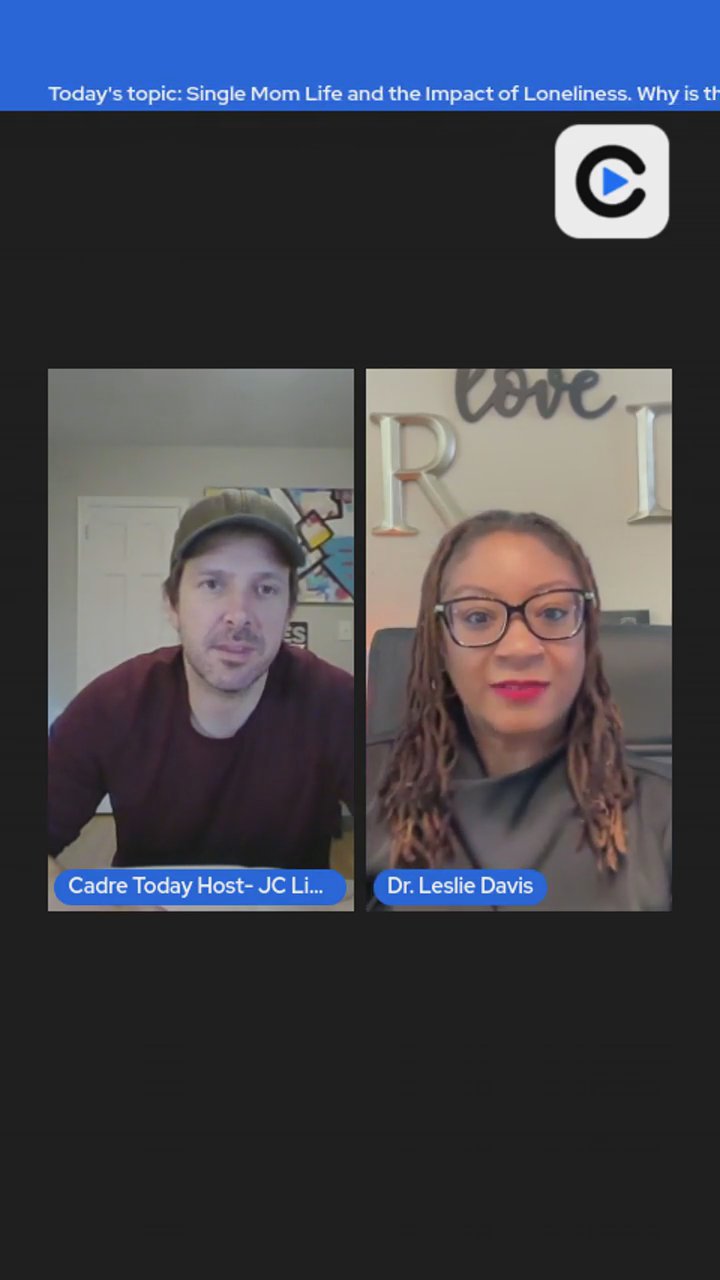
Cadre today coming at you a little bit later in the morning. You're still in the right place. Dr. Leslie is a relationship therapist and founder of Hearts and Faith. She also has a son who has a congenital heart defect called hypoplastic left heart syndrome.
Sa. Well, hey, good morning there, Cadre. Cadre today coming at you a little bit later in the morning. So I'm really hoping that the start of your day has been powerful and poignant and purposeful. But if you are not doing great, guess what? You're still in the right place.
You may see it is a Cadre Today interview day and we have the wonderful Dr. Leslie Davis with us. If you're listening right now or listening later, feel free to throw questions in the chat and I will relay them to Dr. Leslie in real time.
Dr. Leslie is a relationship therapist and founder of Hearts and Faith. She also has a son who has a congenital heart defect called hypoplastic left heart syndrome. Leslie wanted to build a community of support for other single mothers.
How do you feel when you get asked these questions? There's so many ways you can go. Sometimes I think about how other people are going to receive what I have to say. Not because I'm afraid to expose myself, but because I don't want to overwhelm someone else.
Dr. Leslie's topic chosen was the single mom life and the impact of loneliness. When people think about single moms, they immediately go to the negative aspect of being a single mom. She says there is no support for single moms.
Dr. Leslie: How has the impact of loneliness been in your world, Dr. Leslie? She says she first recognized loneliness when she was a single mother. Now, her son is in college, and they still spend a lot of time together. How does a single mom navigate loneliness?
There is a difference of being alone and loneliness, the experience of loneliness. If you are experiencing loneliness, don't be afraid to reach out and tell someone that you're experiencing loneliness. Check out Dr. Leslie's regular livestream on Tuesdays.
Sa. Well, hey, good morning there, Cadre. How are you doing? Cadre today coming at you a little bit later in the morning. So I'm really hoping that the start of your day has been powerful and poignant and purposeful and all the things you'd want it to be. But as we always remind you, if you are not doing great, if you're not having the best start of the day, guess what? You're still in the right place. Right? Cadre is always reminding you there's many ways to being well and that if you're not doing well, you still have worth, you still have capacity, and you're still in exactly the right place.
Good morning, Colleen. Good morning, Luke. Ray. Ray, good morning to you as well. You may see it is a Cadre Today interview day and we have the wonderful Dr. Leslie Davis with us. Dr. Leslie, how are you doing? C. i am not a morning person, but I got my coffee, so I'm okay. And this is like, this is the screenshot right here. I got my she matters Dr. Leslie Mug, came in the mail, packaged, I understand, by the only Dr. Leslie Davis. So how wonderful. That's right. Yeah. So I am, I'm here with my coffee.
This gives me life every day throughout the day, but I'm doing well. Thank you. Awesome. Well, everybody, as you know, if you've tuned into an interview before, this is a relatively new and maybe not relatively new to some of you format and how we invite you into the conversation here at Cadre. You know, you can find prerecorded content, you can jump into live streams. Myself, Dr. Leslie, you can find us throughout the week, the community feeds where you can add your ideas, your comments, your pictures all day long.
But also we know the power of conversation. So in this efficient interview, right, we get to go and meet one of Our contributors today, Dr. Leslie in, in a way that's, that's personal and conversational. And if you're listening right now or listening later, feel free to throw questions in the chat and I will relay them to Dr. Leslie in real time. So, Dr. Leslie, we always get started with this collection of questions. Who are you? What do you do? And how does it make you feel when you get asked those questions?
The first question, who are you? Is loaded. So I would say I am a tiny but fierce woman. I do many things, but who I am at the core is I'm just a very authentic person. I tell everyone that I meet. I'm never sugarcoated. So you will never have to guess what I'M thinking, because I'm going to tell you straight up and I'm not going to sugarcoat it. I'm going to tell you exactly what I'm thinking and what I'm feeling. But the things that I do, which is many things. So I'm a licensed clinical professional counselor and I'm licensed in Illinois and Missouri, and I specialize as a relationship therapist, which I enjoy working with.
Not just couples, but I also work with women who struggle with toxic relationships. I work with college students that are just navigating life. And I also work with teens that are just navigating transitions in their life, like going from middle school to high school and then approaching the college years. That's one thing that I do. I'm also a non profit founder called Hearts and Faith. And so that non profit is located in O'Fallon, Illinois. And it's like a hidden gem where I get to help other single moms.
And I started that nonprofit out of my own experience of being a single mom and not necessarily having community of other moms that understand the journey of being a single mom. So I know a lot of people, a lot of people know me, but there's not always connection. And so I wanted to build a community of support for other single mothers. So that's another thing I do. I'm also a board member of a special organization called Ali Hinkle Heart Foundation. And so if anyone knows me, if I've talked about it on this platform here, that I have a son who has a congenital heart defect called hypoplastic left heart syndrome.
And with that condition, he has half a heart from birth. I found out when I was pregnant with him that there was something wrong. And he's had four open heart surgeries and a pacemaker. And he's one of the rare people who have survived that heart condition who has reached adulthood. So we are in this really weird stage of life where we don't know how long he's going to live, how long his heart's going to last on his own, and we're just navigating life together. So me being a heart mom is a big part of who I am as well.
And there's many more things I do, but that's enough, including jiu jitsu, Leslie, about not only her jiu jitsu journey, but the way that she's supported many people who she's met in that journey as well. Ray Ray says that that they love your content. Dr. Leslie as they chime in. So the last part of that question is how do, how do you feel when you get asked these questions? I mean, and I'll just say you can go more ways than most in answering those questions. Okay, so how does it make you feel when you get, you know, often ask that question that seems like it should be a short answer, but, you know, there's so many ways you can go.
Yeah. If I reflect on how that question made me feel a few years ago, I always used to get stuck on how do I answer that because I know who I am, but how do I want people to perceive me? And so I got stuck on using the right words. And then over time I was like, you know what, I don't care how it comes out my mouth, I'm just going to say it. And, and sometimes when I think about answering that question, I think about how other people are going to receive what I have to say. Because most times when I talk about all the things I do, other people get overwhelmed by that.
So I try to, I'm very careful with how I answer that in whatever space I'm in. So I just listed just a few of the things that I do. There's so much more that I do on a consistent basis. And some people can't manage that the way that I do. And so I think that's another part of who I am. So when I think about how do I feel answering that question, I feel a little guarded sometimes. Not because I'm afraid to expose myself, but because I don't want to overwhelm someone else who's hearing that spoken like a true servant and called individual on this planet.
You know, if you're listening at home and that resonates, you know, we have the opportunity to not only protect ourselves, you know, how much do we open the spigot and expose? But again, there's also this true servant mentality of how do we make sure that the people that we're making a connection with right now can take what we're given. Right? Because sometimes people want the hey, what do you do? They want the answer or how are you doing? They want the answer to be five words or less to be followed with a smile so they can go on their day going, okay, I just gave them something and they gave it back.
Well, Dr. Leslie, you already kind of spoke about one part of your life, and that's the single mom life. If you're listening at home, you know that in these interviews I always go, hey, contributor, what would you want to talk about? And that's as vague as I allow it to Be because the conversation whether you are a single mother, whether you have, you know, grew up in a home where your mom raised you independently, whether your neighbor, your friend, your sister. Right? These topics touch everybody in some way.
Right. So Dr. Leslie's topic chosen was the single mom life and the impact of loneliness. So why is this a front of mind conversation for you and then go ahead and dig on it? Yeah, Well, I think when people think about single moms, they immediately go to the negative aspect of being a single mom. You know, I've asked this question to several people when we're doing research for my nonprofit, like, how do we find single moms? You know, who is she? How would we know that a woman that we're approaching is a single mom?
And the majority of people answer that question by, you know, saying that, oh, she's probably struggling, she probably looks tired, you know, she's probably exhausted or irritable. Like, all these negative words came up. And my board, my board members really challenged me that that's an automatic thought other people have, but me being the forefront of my nonprofit, when people see me, they don't see that. They don't see the struggle. They don't see that I'm poor, I'm highly educated, so I don't fit the statistics of what most people think a single mom looks like.
And so they challenged me to put myself out there in the world and say, hey, you might be a single mom, but you don't have to struggle. You might be a single mom, but you don't have to be uneducated. You can get your degree. So for my personal journey, I did start out, you know, before I got pregnant, I did get my bachelor's degree, so I was proud of that. I got pregnant a month later, though. And that journey, it took me, I think having a special needs child also was part of my personal journey that was a struggle or a challenge.
But I started to notice the negative words that were spoken over me, like, oh, it's going to be hard, you know, And I didn't accept that, and I didn't experience that. It was hard. There were moments that were challenging. But I always had faith in God. And God kept me grounded and. And he always provided for me. So even if there were times where maybe financially I was not doing well, for those that don't know, I worked in child welfare. And so working in child welfare, you are poor because they don't pay you enough.
And I didn't realize how poor I was because I was just grateful for what I had. And I had everything I needed. So I wasn't worried about the dollar amount that I was making in my career because I was just focused on helping people. And so that that struggle of, you know, sometimes I had to call my parents, like, hey, can you help me with this bill? I need gas for the week. I get paid Friday, but it's Wednesday. Can you give me $20 just to get to the end of the week? And I'm grateful that I had my parents to support me in that.
I know a lot of people don't. And I think that's part of the struggle, too, is that there is no support for single moms. But going back to what I think a single mom is, a lot of people think or assume that a single mom is someone who's just not married and is not in a relationship. And for my non profit, our definition of a single mother is just a mother who is unmarried, Whether that's, you know, she has a boyfriend or her father is. The child's father is in the picture and they're helping, or maybe they are still in a relationship, but they're not married.
So when you're filling out government forms, you have to check married or single. And so if you are not married to your child's father, you are single. And that's how we decide. That's how we're supporting the single moms in our community. But getting back to my personal story of being a single mom, the struggle to others is evident when they see me doing all these things that I mentioned. So when my son was younger, I was in a master's degree program while he was getting heart surgeries. There were two summers that he was in the hospital for weeks at a time, almost a month or two, where I was also in school and doing an internship, and I was a boss at my job, but I was also at my son's bedside every single day, every single night.
Right? That is a struggle. It's a challenge. But I did it, and I did it with God's grace. And so I think God has used my life to show other single moms that you can get your education, you can do hard things, you can do multiple things. You don't have to stop your life just because you have a child, or you don't have to stop pursuing your dreams because it's challenging in the moment. I think we have to learn how to push through those challenging times, not for ourselves, but to show other people that they can do it too.
And that's what my life has been About. Well, and again, Dr. Leslie, like, pushing through because you feel like you're supposed to, you know, like, like, like, like, like I always make the point, you know, adding the words if you want to or with purpose at the end of statements. Because we know there are some people who, who push through because they think they are supposed to rather than because they feel called, they feel led, they feel, they, they, they, they, they, they feel like that's where they're being guided towards, and that's the reality.
Because, you know, the other half of what you wanted to talk about today is this impact of loneliness, which, you know, imagine everybody like that. You feel called to be in study and in work and in community, as well as caring for the life you're bringing into this world. Naturally, that removes you from maybe the space where the connection or the support happens with the neighbor, with the friend, with the social group. So, so how, what, what has the impact of loneliness been in your world, Dr.
Leslie? And how does, how, how do you navigate that? Yeah, I think I first recognized loneliness very young. So I was raised by a single mother, and I'm an only child, so I was always by myself. That was normal for me. But when I became a mother and a mother of a child with a heart condition and with his development, because he was in the hospital so many times and so long, his development was different. So there were times where kids his age were crawling and walking where he could barely sit up.
And so the loneliness of we couldn't go to different birthday parties or we couldn't hang out with people because of his heart condition, I had to stay home and make sure he was healthy and safe. So I wasn't able to connect with people, people that I was already close to, because I had to be a mom. I had to make sure my child was okay. Or if I was very strict with his bedtime, because if he was, you know, off just 30 minutes, it would mess up his heart. So there were times where we would be out and I'm like, it's 8:00.
I got to take him home. I gotta go. And everyone else, you know, other friends didn't have kids at the time or their kids were different, you know, or normal, and we just had to live life differently. So there was a natural separation there. And over time, that became a lonely experience. And as he got older, when he was in school and going to different functions and I would be in the room, and there's two parents in the room everywhere, and it's just me and him, you Know, that was a clear indication, like, I am alone.
I didn't feel lonely until I walked in the room and I see other people partnered up. I'm like, where is my partner? You know, and getting questions, you know, where's his dad? Is his dad in his life? I'm like, yeah, he is, but he just doesn't live here, you know, that. That loneliness kicked in pretty early in my stage of being a mom. But I think over time, the loneliness was, I guess it was heightened as I got more educated, and my friends and family, they weren't elevating themselves. And there's this natural separation and there's judgment of, why are you doing all this?
You're doing too much. You need to slow down. I'm like, no, I have a purpose. I have things to do. And being challenged. How can you do all this when you're a single mom? You need to focus on your child. Your child is growing up and you. He's getting older, and you need to spend more time with him. You're going to lose these years. But what people don't know unless they were with me behind the scenes. Everywhere I went, my child was right by my side. Exactly. Any youth group that I taught or any speaking engagement I had, he was literally right by my side.
And there's photos to prove it. He was always there. Like, we were inseparable. The only time that I didn't spend time with him is if I had to travel and he couldn't go with me for work. And that was very minimal. But we spent every single day together. We had our own time together. I took him to school, picked him up from school, every single day. And now he's in college, and we still spend a lot of time together. Well, I mean, and everybody. I want to. I want to replay one moment because it hit me and it made me smile.
And Dr. Leslie, you altered the statement, but originally you said, you know, I looked around and everyone else was different. And I think that's the first time I've ever heard someone who is. Who is othered. You know, it's like single mom, mother of differently abled like you, you did to others with. With joy and clarity, with. With the words. Meaning what the words mean. Everybody else was different. In reality, how does the world look at who's different? You're the different one. But to you, everybody else is different.
Like, you say you weren't lonely until you walked in the room where all the people were and they were all different. You know, like in that moment, like, you're living on the, on the flip side of the coin. And because they don't understand or experience your reality, they do one or two things. They either move themselves away or they move themselves closer and they get really, really critical. So that, so the loneliness lens almost seems to exponentially grow itself. You know, if people get to know you more, they go, well, why are you doing this?
Why are you doing this? Why are you doing this? Or they go, I don't want to be around the different. So then they, so then they move away. So if you were going to, you know, and again, everybody, we always try to make these conversations reach a crest, reach a peak, and then go, all right, let's move on with our days. Let's go ahead and take this moment, take this ripple and let it impact us in the way that it naturally impacts us. Like, like, Dr. Leslie, if, if you were going to provide what we call a take home prize or a headline or, you know, that, that, that, that moment from this conversation that, that you want people to carry with today, what would it be?
And I'll go and say really quick speak. Wonder in chat said, you're right. There's an automatic narrative around single moms and it needs to be rewritten. And you're rewriting it with gratitude coming from Everybody around you. Dr. Leslie, we see you, we hear you, we benefit from the work that you're doing. What would be that take home price that you would leave with people? I think I've talked about this on a Cadre coffee chat before, but what comes to mind in this moment is recognizing that you can be physically alone, but you don't have to feel lonely.
And there is a difference of being alone and loneliness, the experience of loneliness. And when you experience loneliness, you can be in a room full of people. You can have all these friends and family and people that say they love you, but inside you feel disconnected from them. And so that's the part that I want people to recognize when they experience that part. If you are experiencing loneliness, even when you have people surrounding you, don't be afraid to reach out and tell someone that you're experiencing loneliness.
That's the only way we're going to get help. No one can see that we're experiencing loneliness. Yeah, they can see that we're physically alone. They can see that we're not partnered. They can see that we're a single mom, but they can't see our loneliness experience. So we have to talk about it. Yeah, those, those two things are independent from one another. We see Some people who seem to have the cloud of witnesses surrounding them, and they are the loneliest person on the planet. And we see people who walk through the park alone with their head hung low, and they are the most connected individual within, within what they need.
And they have their daily bread, you know, so, so, so, so just as you raised. It's like everybody, Dr. Leslie, someone who says it like it is, and, and, and, and I think that's, that's one of the beautiful examples that you set for us. But also this, this takeaway today, recognize that you can be physically alone and not be lonely and vice versa. So use your voice to let people know what you need. Ray Ray gave you a double exclamation point. 3s. Yes. Difference between. Well, everybody, thank you so much for joining our conversation today.
It means the world to us to have you be within that sphere of people, making us see that we aren't alone here in the Cadre sphere. And you can check out Dr. Leslie's regular livestream on Tuesdays. At what time, Dr. Leslie? It's noon Central Standard Time, so I don't know what that is. Everywhere else, wherever you are, do the translation of time and check out Dr. Leslie's regular livestream. Otherwise, you know, we're here all the time for you. Have a great rest of your day, everybody, and we will see you soon.
Thanks, Dr. Leslie. Bye. Cheers.