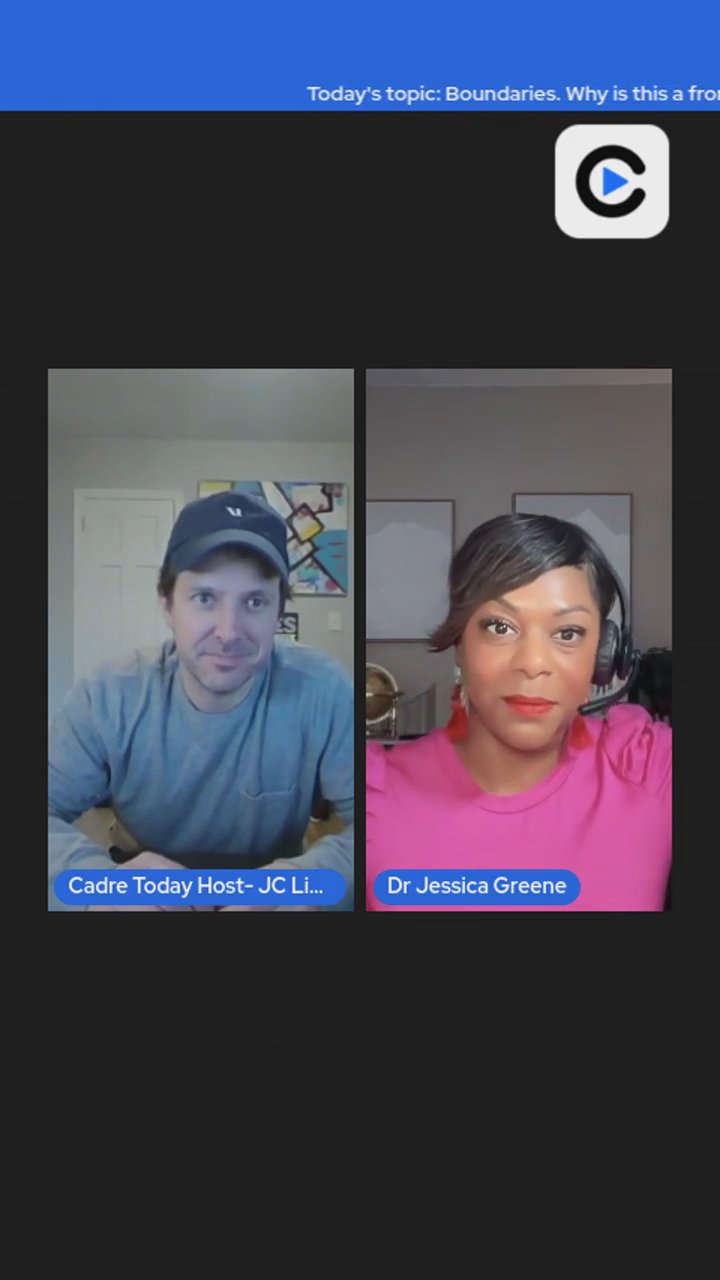
Cadre is the place that meets you, where you are, no matter how you are doing. Jessica Johnson's father died active duty when she and her twin sister were 15 months old. After college, she went into education.
Cadre is the place that meets you, where you are, no matter how you are doing. This is an interview format where I get to be in conversation with all of y'all. Dr. Jessica is coming to us from Myrtle Beach. I'll ask three different questions, and they will go to town.
Jessica Johnson's father died active duty when she and her twin sister were 15 months old. After college, she went into education. She was a professional school counselor for 14 years before she ventured into private practice. She wants to help people who struggle with grief.
So I mentioned in the water, private practice, and it's been wonderful. I'm also a CE provider through the licensing board here for South Carolina. So I offer CEU opportunities for our counselors. There's such a shift from being in a system to being in private practice.
Many people struggle with answering the question who are you? And what do you do? Where you flip that to sharing the joy associated with your story. The power of choosing how much you share with individuals is in setting boundaries with yourself.
Dr. Jessica: When we focus on boundaries, we have to remember that they are non negotiable. They determine how we function in relationships at work, but also the importance of self care. We have to take care of ourselves before we can worry about taking care of anybody else.
Some cultures ask what do you do in your free time? Before they ask what work relevant to you. We often think we have wasted the day when it was really spent in self care. These conversations are always the things that start people's days.
When we talk about setting boundaries, it doesn't mean we're shutting people out. What I want them to think about is forming what I like to call your personal board of directors. Boundaries don't end relationships. They just refine them because it allows you to be the best of you.
So many morsels today. Setting boundary doesn't mean we are shutting people out. You don't have to make yourself uncomfortable to make people comfortable. Life happens through us, not to us. Dr. Jessica, I hope you have a great vacation next week. Stay warm out there.
Foreign. How are you doing this morning? Dr. Jessica and I hope that you are doing great, but we also understand that you may not be doing great, but either way, we are here with you. And our tone doesn't change whether you're great or whether you're not. Cadre is the place that meets you, where you are, no matter how you are doing. And we bet that spending some time with people that you don't know know yet is going to change the way that you're feeling. Dr. Jessica, how are you doing this morning?
I am doing wonderful this morning. Had a couple of hiccups. We had it. A vehicle hit a utility pole. My light started blinking. The Internet went out. So you know how it made me, you know, feel with the anxiety. But you know what? We had a plan B. We said, we're not going to allow that moment to determine who we are and where we're going. So we focused on those things that we could control and the things that we couldn't control. I controlled my reaction to it, so it didn't get the best of me. And here we are.
Oh, my gosh. So. So we got to chat for a couple minutes before we went live, everybody. And Dr. Jessica was talking about how last week the snow showed up and the kids were out of school and they would play in the snow, then go to the beach and Myrtle Beach. It's like all the things happen, y'all, which is why we take time to do things like this and be in conversation with each other amidst life that's happening through us and not to us. A couple Good Mornings Rhapsody 1913 Good Morning. Speak Wonder with the cowboy hat on.
Howdy to you as well, Jules. Nice to see you, my friend. Sunshine, everybody, no matter where you are, no matter what's going on, this makes our days to get to spend some time with you, Cadre. Today, we're here every single day to remind you what Cadre is doing in this world. Bringing together professionals and peers to remind you that there's many ways to be in. Well, we're not going to say, hey, here's a thing you need to do. But what we're going to do is we're going to simply say, when people spend time together, talking about this human experience, as Dr.
Jessica said, we have the ability to be malleable and to maneuver and to consider different things in that to live this life that we get to live. And every once in a while, you get to see two of us. This is an interview format where I get to be in conversation with all of y'all, through the comments and with one of our wonderful contributors. And today, that contributor is the wonderful Dr. Jessica, coming to us from Myrtle Beach. So the format of these interviews is pretty simple. I'll ask three different questions, and they will go to town.
And the day today, as I say, is the one and only Dr. Jessica. So we'll get things started. Dr. Jessica, the first question that we always ask is, who are you? What do you do? And when you're asked those questions, which humans are asked all the time, how do they make you feel? Go for it. Yes. And that question is. I love that broad question because there are so many things that encompass who we are. So if we think about my journey and how I got to this point in my life as far as who I am, it goes back to when I was 15 months old.
So when I was 50 months old, my father was in the military and stationed at Fort Stewart, Georgia. I have a twin sister. We're three minutes apart, identical. So you. It's a wonderful experience. She has children, and I don't have any children. But guess what? Her children are my children. And they know because I'm that aunt where I'm a part of pto. I attend field trips like I'm. I'm that aunt, you know, so we talk about who I am. That's me. But he died active duty when my twin sister and I were 15 months old.
My brother was. Oldest brother was 11, and my middle brother was 9. So in that moment, when we think about our identity and who we are, I'm a product of a single parent. Not by choice, because life happened, you know, but I didn't allow that experience to allow me to become a statistic. I didn't allow that experience to determine the negativity of what could come with that. But I took that experience as, you know what? My father died active duty. But what can I do to make sure I continue to breathe into his legacy and become the best in me?
So my twin sister and I, we ran track in high school. We ran track in. In college. And best believe it was a package deal because, you know, we're. We're that close. And she's actually here with me. Well, lives in. In the Myrtle beach area. And it was a package deal. So when I started college, I told myself, you know, what. What is it that I want to do? So with my dad, he began that educational journey for me with the GI Bill and the stipend we received because he passed away active duty. But it was up to Me how I finished it.
So I told my dad, hey, you know what? I'm going to take it as far as I can. And. And that's what I did. So when we talk about who we are and what we do, for me, it's personal. Yeah. Because I live through that journey. And my mother, she's a woman that we respect, we admire, and we look up to because she didn't see mental health as a sense of shame, that, that sense of stigma or, or that sense of bias. She said, hey, you know what? This is what happened to us, and we're going to walk through it.
We're not going, going to avoid it. So that created who I am and what made me decide to go into the profession to help people who struggle with grief, to help people who suffer in trying to navigate that, that personal growth. So when we talk about that journey again, about who I am. When I graduated college, I went into education. So I was a professional school counselor for 14 years before I ventured into private practice. And you talk about that leap. You talk about boundaries and accountability, where you go from a sense of stability and you go into private practice.
So that was a huge jump for me. And I loved what I did in the educational realm, but I wanted to spend more time with my students. And, you know, in the educational world, you know, we're. We're there for that instructional time, but then also we are there to help those students. And it was more that brief counseling I wanted to give a little bit more. So I mentioned in the water, private practice, and it's been wonderful. I am also currently a supervisor for supervisees who are obtaining their license for South Carolina.
And I'm also a CE provider through the licensing board here for South Carolina. So I offer CEU opportunities for our counselors That's. Well, I mean, and again, like you say, there's such a shift from being in a system. You know, that's why when I was here, it's like when you're in a. When you're part of the system, the amount of time you get to spend is dictated by the system that you're in, as opposed to the private practice where you have more freedom, but also then you're the one who's having to create the system and the support.
More freedom, more responsibility. Exactly. Yep. Yep. So when you're, you know, and again, like, you took a big inhale and then a joyous exhale when you had the opportunity to talk about your history, your story, your narrative, and there is joy associated with that. And in the midst of you sharing that story, you shared how there's often a stigma with sharing the mental reality and the residue that is often associated with that story that a lot of people, they struggle with answering the question who are you?
And what do you do? Where you flip that to sharing the joy associated with your story. So, so what do you say to those people who really struggle with answering the who are you? What do you do? Questions? Because they, because they, because they see the negativity, they see the my story is different. And with that, it, it reminds me of. We call it the layered nature of your identity. Because many people struggle with this question. Because identity isn't just one thing. You know, the pressure to define yourself by your job, your achievements, or your roles in others lives.
You know, we're that parent, we're that caregiver, we're that aunt, you know, we're that co worker. And when we think about the emotional reactions to that question, we look at, you know, feeling pride as opposed to feeling boxed in by those titles. And this can cause some discomfort. It can, you know, it can be defined by work or even those external expectations. You know, are you able to be your true, authentic self when we don't, when we're not able to set those boundaries? Is it that sense of fitting in or that sense of belonging and realizing it doesn't matter who you are, where you come from, your ability to triumph, it begins with you.
So when we talk about personal accountability, that's going to be extremely important and the power of choosing how much you share with individuals, you know, setting that internal boundary with yourself. And when we talk about, you know, how do we feel when we have to answer that question? I want you to think about, you know, these three questions. Do you feel obligated to answer in a certain way? That makes me think of, you know, imposter syndrome, when I feel like I have to answer in a certain way, you know, are you worried about the perception of others?
What are they going to think about me if I answer this way? Am I going to fit in with this group? And then are you able to protect parts of yourself that you don't want to explain? You're able to write that narrative. And when we talk about, you know, not having to explain yourself, I want you to ask yourself, do you feel guilty when your answer does not fit in that societal norm? So again, we're talking about imposter syndrome, you know, with those boundaries, are they healthy boundaries, are they rigid boundaries, or are they porous boundaries?
You know, are we Letting people in our circle that shouldn't be there. Are we sharing too much information and we're just telling them, you know, what they, what they need to know just because we feel as if. Okay, I don't feel like I have that intimate relationship with them. Yeah. And being able to share what we feel we would like. Like to share. Well, and, and again, it's, you know, Dr. Jessica, you know, just as you were talking about the, the authenticity that. That's galvanized when we provide those boundaries for ourselves.
You know, that's, that's Speak Wonder said, you know. Right, right. When you were saying that, you know, I love. So this is Speak Wonder. I love that your grief steered you in your chosen career path. Yours is an authentic voice. You know, it's the reason why I wanted to shout and share that. You know, those listening, it's a direct correlation. Right. Sometimes when we're in that hopeless or that reactive space, we go, wow, I can hear in Dr. Jessica's voice, calm amidst the storm, a presence amidst the static.
And we go, it's like, well, that must just be something that Dr. Jessica possesses somehow, magically. It's like, no, it's through processes like boundary setting that we forge these types of presences or elements within our personhood. So see that? And again, even Dr. Jessica, how you laid out these questions to ask yourself in self assessment. These are really tactical and practical ways of implementing that. So keep going, everybody at home, I always ask our contributors, it's like, hey, if you're going to talk about something on the interview, what would you talk about?
Dr. Jessica said, set boundaries. And you can already hear Dr. Jessica raising up these ideas of boundaries. So, Dr. Jessica, what else about this topic of boundaries? What would you like to share today? So when we focus on boundaries, we have to remember that boundaries are non negotiable. You know, they are non negotiable. They determine how we function in relationships at work, but also the importance of self care. And sometimes when we think about self care, we're thinking, oh, my gosh, I have to spend money for self care.
But we do not. You know, Self Care can be listening to that podcast. You know, Self Care could be listening to Cadre. Self Care could be going for that walk with, you know, yourself, your spouse or your children. But without them, we're definitely going to feel burnt out. We're going to feel resentment and that sense of frustration and the sense of frustration and that irritability when we do not set those boundaries. Because sometimes we try to be everything for everybody. And we can't do that.
And realizing it's okay to say no. And when we say no, we can say, hey, I'm not able to help you, but why don't, you know, you ask Sarah, she may be able to help. So I'm telling you no. But I'm also giving you a recommendation, so I'm not leaving you out in the cold. In a sense, yeah. 1, 1, 1, 1 no is, is, is another step closer to yes. You know, it's, it's, it's, it's that type of is, it's that type of progression. We're always afraid that, that our no is going to be seen as, as a negative when in reality our answer is another step closer for them.
That's right. And when we have that since irritability and sense of frustration, we become like that soda bottle, you know, whenever you shake a soda bottle, it's gonna, it's gonna blow, you know, so that's how our emotions feel when we tend to tell everyone yes, but in the same breath we tell ourselves no. When we're writing things in our calendar, we tend to write our to do list for ourselves in pencil and for others, we write it in pen and guess which one's harder to erase. You know, that, that pen.
Because we settle ourselves and say, hey, you know what? No, they need me to do this, I'm going to do that. But then realizing we have to pour into our cup before we pour into any other cups. And we have to make sure that we're taking care of ourselves before we can worry about taking care of anybody else. And that comes with setting those boundaries in a healthy way and remembering again, we can't be everything, you know, for everybody. And it's okay to take off that Superman cape and it's okay to take off that superwoman kite.
Yeah, yeah. So, so on, on chat right now, Becky's said, you know, some cultures ask what do you do in your free time? Before they ask what work relevant to, you know, where I live, where everyone is retired, we don't ask what, what they did. We often think we have wasted the day when it was really spent in self care. I'm going to use that, that, that, that, that term more often. Yeah, like it's, it's, it's really flipping the script on, on, you know, where we place the stigma. You know, we often go, we're supposed to be selfless and we're supposed to hide when we're selfish.
But of course, if we do both of those things we end up like it's the whole cup filling. You know, at the end of the day, if we're, if we got one full cup and one empty cup, sooner or later we got one broken cup and one cup that can't hold any water anymore. Oh, Jessica, these conversations are always the things that start people's days and, and send them on course and to the point, we always say we aren't providing people the answer to the question, but we're starting them on their course. And over the last 18 minutes here, so many little morsels and connections and to the point we have to fill ours first.
You and I have had the opportunity to connect with each other through the midst of trucks hitting poles and flashing lights and cold weather and all of the things. If you're going to share one thing today from this conversation, whether something that you had prepared that now resonates more or something through us connecting, what would be the take home prize that you would offer people today? And then everybody, I'm going to share this in the community feed later for you to see again and again.
But doctor, just what would be the take home prize from today's conversation that you'd want people to remember? Well, after today's conversation is done, Absolutely. And there are a couple of things that I want, you know, everyone to keep in mind. When we talk about setting boundaries, it doesn't mean we're shutting people out. It just means we're forming healthy communication between others. So what I want them to think about is forming what I like to call your personal board of directors. So with your personal board of directors, these are going to be three to five individuals who are your go to people.
But when I say your go to people, there's a criteria for them. You know, they have to be worthy of hearing your story, meaning when you speak with them, they don't blabber to other people. They keep it between, you know, the two of you. They tell you what you need to hear and not what you want to hear. And they have to know there they sit on your personal board of directors. And lastly, they're those individuals. When you call them, they pick up. But if they're not available, they'll at least text you and say, hey, I can't pick up right now.
Give me a couple of minutes and I get back with you as soon as I can. If there's that individual and you send them a text and they have their read receipt on their cell phone. So, you know, they read that message but they did not reply. That is not an individual who you want on your personal board of directors. You know, these are those individuals. Whenever we get into that fight, they armor up. Yeah. And they join us and they tell us what we need to hear, not what we want to hear. So when we think about those interactions with individuals, if you're talking to someone or someone calls your phone and you look at it, you're like, oh, my gosh, Lacy's calling me, then maybe we need to rethink about that relationship with her, you know?
But some nuggets that I want you to take away is that you don't have to over explain your. No. Yeah. A simple that doesn't work for me is definitely enough. And you are not required to make yourself uncomfortable to make others comfortable. You don't have to make yourself uncomfortable to make others comfortable. Boundaries don't end relationships. They just refine them because it allows you to be the best of you. Hey, this is when you get the best of me. This is when you get the worst of me. This is what I bring to the table.
But then this is what I need from you so we can set those boundaries and be our best selves. Yeah. Again, like we mentioned, boundaries are not selfish. People who love you and respect you will honor your limits and honor your boundaries. So if JC says, hey, you know, I'm not able to do that today, I don't say, oh, my gosh, jc, I can't believe you can't do that. They have that sense of understanding. When I was working on my doctorate degree, there were moments where I couldn't attend events because I'm in the library all day.
But I was able to acknowledge, hey, I hope you have a wonderful birthday celebration. And I'm mailing you a card. So my. I'm acknowledging, acknowledging it, but I may not be able to attend, but I'm able to send you something. Or if you have something going on and you can't attend, hey, I can come in via Zoom for a couple of minutes to see everyone and say hello, but you're acknowledging it. And if those individuals understand your boundaries and respect your boundaries, they will love you regardless and want the best for you.
So many morsels today. Setting boundary doesn't mean we are shutting people out. You don't have to make yourself uncomfortable to make people comfortable. I mean, again, like, these are things that I think hit people with love in the right places and the things that we need to say to each other every, every, every day. So no matter where you are, no matter what's going on, everybody know that you have people right here in the Cadre sphere to continue to remind you of these things because we promise you right, life isn't something that you figure out.
It's not something where you go oh there's the answer. And now we, and now we, now we just move on knowing that we have everything figured out. Life happens through us, not to us. And I'm grateful that we have people like Dr. Jessica right here to go ahead and help us move on through. Dr. Jessica, thank you for everything within this conversation and everything that you do. Luke said earlier on today in chat how much he appreciates your lives and your pre recorded and I second that. Dr. Jessica, I hope you have a great vacation next week.
We will see you soon. Stay warm out there. And everybody the arctic chill is leaving soon. Have a good one everybody. We'll see you later. Thank you. See you later.