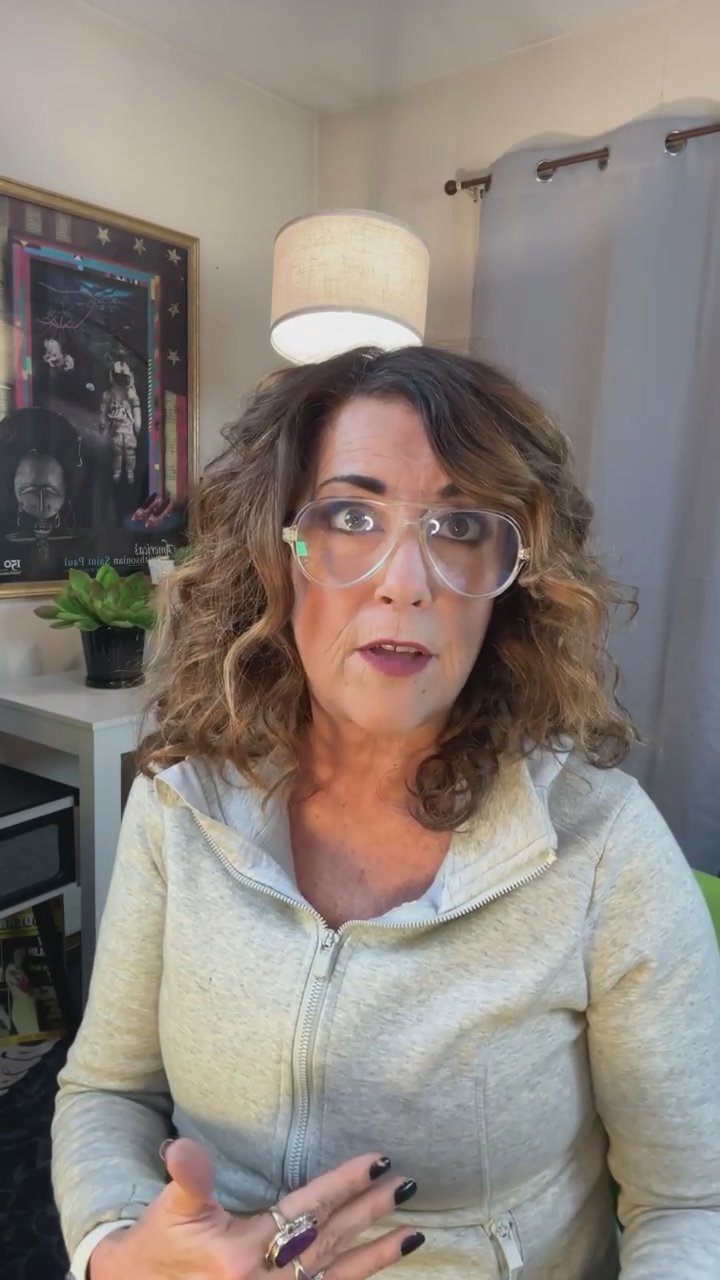
Tiffany Norton returns to Comedy Centered. Three if they were just not your favorite. It was the smallest Christmas ever that Jules has ever experienced. A lot of those secretive behaviors showed up with drinking. Instead of pointing the finger, you gotta use the thumb. Charting a new path forward.
Tiffany Norton returns to Comedy Centered. How was everybody's holiday? Mine was not gonna lie. Definitely some challenges. I didn't pre announce what my subject was going to be. I kind of prepared on the fly.
Drop a one in the chat if your holidays were spectacular and you loved them. Three if they were just not your favorite. It was the smallest Christmas ever that Jules has ever experienced. I don't wanna give my number out until I hear other. numbers.
A lot of those secretive behaviors showed up with drinking. The biggest thing I have is, is. rebellion. I am extremely non compliant in a lot of regards. Even though I've made the decision to reframe my, my relationship with alcohol, I rebel against myself about it anyway.
Tiffany: My problem is with goal setting. My inner judge is saying, you should be like this or you should not be like that. Instead of pointing the finger, you gotta use the thumb. Charting a new path forward.
You're putting yourself in the path of change just by passively listening to me. Sometimes that's all we can do is put ourselves in front of new conversations. Think of how many brushstrokes go into a masterpiece painting.
Raymond: I definitely don't let people in, and I definitely keep a lot of stuff to myself. The concept of secret drinking, secret behaviors, there's not shame in the behavior. The only thing that you can really do is try to interrupt it.
Ray, at those times I have to ask, what are the feelings? Yeah, that I don't want to feel. Because it's. a neural pathway that has been set. It doesn't mean that it cannot be rewired, but, you know, it's a groove.
Bob Greene picks three quotes from a 1969 book on psychology. The main thing is that there is in fact no judgment. These relationships with others will be social amenities and nothing more. Maybe we'll do more if you guys like them at a different one.
Tiffany Norton: New Year winner, winner, chicken dinner. 1 5, 2025. In numerology, what is that? 12, 7, 3, 1, 14, 5. We will see you next Sunday on Comedy Centered.
Hello, everyone, it's Tiffany Norton. Welcome back to Comedy Centered. Actually, I should thank myself for coming back. Hey, good job, Tiff. I'm just kidding. Hey, how was everybody's holiday? Mine was not gonna lie. Challenging. Definitely some challenges. Oh, welcome in. Hi, I'm Tiffany. Come on, we're just getting things kicked off. Hopefully you had a whole. A good holiday. I didn't pre announce what my subject was going to be, mostly because I'm. I kind of prepared on the fly. Like, I knew roughly what I wanted to talk about, but I wasn't exactly sure how I was going to get into the subject matter.
Hey, welcome on in. So those of you that have already arrived in the chat. I don't know why all of a sudden my nose is itching. Because I'm on camera. Of course. Because I'm camera. Hey, Ms. Jules. What's up? You are right on time as usual, my dear. So I was thinking, drop it in the chat. One a number one if you had a really great holiday season. Drop a two in the chat if it was meh. Three if it was the worst. I'd love to hear. I wanna. I wanna. I don't wanna give my number out until I hear other.
I want to see other people's numbers. I mean, I don't. I don't. I don't necessarily. Who cares, right? I can. I could build some suspense, but it was. It was. It was. You know what? I know. I know in my heart I'm gonna look back on this. This challenging time, and I'm gonna realize that I learned a lot too. Good. We got a 2. 5. I like that. 5. And I'm glad to hear it because that's the. That's the thing. I know that I get stuck in my own, you know, And I like knowing that other people are. That are.
They're in a good spot, you know, I wouldn't say mine was a 33 either, but it was definitely small. It was definitely quiet. Welcome in. Shannon. Drop a one in the chat if your holidays were spectacular and you loved them. Two if they were meh. They were all right. Three if they were just not your favorite. Right. I'm taking a poll, but it was the smallest Christmas ever that I've ever experienced. And due to a lot of different circumstances, people weren't available or people didn't really feel like joining in.
And that's okay. You know, it was. It was hard getting over that expectation stuff, expecting things to be kind of one way, and then there was some last minute day of, you know, cancellations at my mom's and she was bombed and solid two. Good. We're getting two and a half. I love it. But you know what, because it was small, we sat and had a very low key day and conversation and it didn't really matter when the food came out, it didn't matter if it was all hot. And at the same time, we have some eaters in the family that are particular about their temperatures and the serving order and things like that, and they weren't there.
And so, you know, we missed them, we love them, but you know, it was actually kind of okay. Right. And so, yeah, but one of the things that really came up and I'm not going to get into exactly how just because there's a family member and it's kind of sensitive and personal, but we got into a little bit of a subject about secrets in our family and secrets has been a conversation that we've had several times on comedy centered. Right. And secrets are one of the things that I really struggle with and I think a lot of others do as well.
Especially if you maybe grew up in an environment where you really could never safely, 100%, all the time show up as yourself. Right. Like you had to read the waters a little bit. And so if something was kind of on the line or whatever, I would keep it to myself. I would kind of keep it secret. Right. Well, in struggling with alcohol, my relationship with alcohol, you know, a lot of those secretive behaviors showed up with drinking. Trigger warning, maybe. I'm sorry if anybody's refraining. I should, I should.
I don't want to romanticize it or anything, but I, I learned something about myself. I was sitting in a meeting, a group, group therapy meeting for alcohol misuse and someone said something and it occurred to me and I put it in the chat. I'm like, you know what? I'm an all purpose drinker. If there's an emotion I have, I have the solution. Right. And what I'm finding is that I'm very much attached to outside things making me feel good. Those family members showing up I thought was gonna make me feel good right in advance.
And so them not coming made me think, well, now I won't have a good time. Right. I was prejudging it. And so when I've interacted in most of these holiday celebrations over the last 30 years, since I've been old enough to drink, I mean, I've been drinking. And so the fact that we could actually have a low key kind of conversation and start talking about some of the stuff that I wanted to share about my own recovery journey and all that. It was really good. But it's the same thing with trying to keep the emotions down, right?
Reaching for something, reaching for a cocktail, reaching for a vape pen or whatever or, you know, or a gambling website on your phone. So the secrets. Why do we do that? So annoying, right? Like, we know we don't want, no one wants to be a liar and we don't want to think that we're liars. But like secrets seem like that kind of like that's my. But that's my special little thing that's mine. You know, it can feel rebellious, it can feel good, forbidden, you know. And the biggest thing I have is, is.
Is rebellion. I am extremely non compliant in a lot of regards. Right. I have a very low rate of conformity. I'm very much to my core non conformist. And so even though I've made the decision to reframe my, my relationship with alcohol, even though I've decided it, I rebel against myself about it anyway. So I'm trying to take ownership with you guys and for myself. And hopefully it, it makes people feel less weird about it because I think we all do it. But one of the behaviors I've. I've really noticed too, especially in relationships, getting a little bit personal, as if the other stuff wasn't.
But I'm noticing that because I'm always wanting that exterior hit, that, that dopamine hit of like something on the exterior of me. Like I always feel like I. In the past at least, I've always had something simmering. I was always kind of keeping something on simmer, right? Some kind of action over there, this and that. I'm not talking about being unfaithful. I'm not talking about a romantic thing at all, but just certain aspects of my personality and my behavior and my preferences. I just didn't feel like sharing.
And maybe it's fear, but maybe I just didn't like sharing. You know, I. I feel like my Teflon is not an exterior coating. It's more of an interior coating at times. And so it's slippery. But I'm sorry, I'm looking back down at my notes, but. But one of the books, and I think I've got, I lent it to somebody, so I've got to go get my copy again or get another copy. But if you've not read it, I encourage you to do it. I can't really type into the chat right now. Otherwise, I drop it in there. But it's called.
It's written by a man named Don Miguel Ruiz, and it's called the Four Agreements. And they're very. It's a very interesting book. It's a very easy read. I think we talked about it before. Very short. But one of the main agreements is, you know, and if you basically, if you can follow these four things in your life, you know, you will live within. Within yourself in authenticity. You will have authentic relationships, blah, blah. But one of the things that he talks about a lot is that you've got to fire your inner judge and how judgmental behavior is.
Well, let me, Let me, Let me, Let me back up. One of the four agreements is be impeccable with your word. Being impeccable with your word means you mean it, not only you mean it. It's honest, it's truthful, and you're not trying to. Lying sometimes isn't even what we're doing. It's. It's almost like when you hear someone is charming. Charming is a verb, right? And it comes from, like, to charm a snake, right? It is. To charm someone is to get someone to act in a behavior. They wouldn't necessarily act on their own because you're charming them.
Right? You see the, The. The verb in it, right? The action in it. And so being impeccable with your word, it's a really freaking hard one. Especially when you've had super secret fun drinking behavior like I have for all these years. So I'm trying the. Oh, good. Okay. Oh, I just saw that pop up in the chat. Oh, okay. I'm gonna read out from the book. Oh, my God, love that book. Shannon said. Oh, awesome. Oh, off work this week. Looking forward to staycation. Fantastic. Yeah. Charting a new path forward.
This is, of course, this is the time of the year to do that, right? To really, like, set some goals and stuff like that. My goal is. Honestly, my problem is with goal setting. I'm sorry, I'll go back to the original point, but I. I think it's a. It's just really, honestly, pick one. Don't try to quit drinking, smoking, working, you know, start working out, doing all the things all at once, right? Really, really, really. Just pick one. At least for me. But again, I already just told you, like three minutes ago, I'm super rebellious and I rebel against myself.
Even when I know that something's good for me and I actually want it, I'll be. That's. That. That is what I call my alter ego. Her name is Patricia. Patricia is like, nah, Patricia's kind of. Anyway, but she. And she is actually is a decent lead in, because she is my inner judge. That's kind of what I've. I've identified her as. She's kind. And, you know, when you're judging others, like, I grew up in a family where love. People gossiped all the time. People love to gossip. I mean, you know, no offense to my mother, and I don't think she's a bad person or anything like that, but she would always just, like, I would call her and she'd be like, what's the gossip?
You know, it's not, but. And I mean, I'm not saying she was mean, but it was one of those things where, you know, I grew up in an environment where a lot of people had a lot of judgment. And so I kind of figured that if everybody's judging everybody like this when I'm in the room, what are they saying about me when I'm not there? Right? And so. But that inner judge. That's where that comparison comes from. You know, that's what comparison is, you know, because the judge and you. Your inner judge is saying, you should be like this or you should not be like that.
You know, and when it hit me about the judgment thing and being judgmental, it hit me in a different recovery meeting. And I'm sitting there and, you know, sometimes you have to just listen to what a jerk your brain is and go, really? What was that? Where'd that come from? I'm sitting there, and this person is telling this very empathetic story about, you know, a hard time that they had gone through, and they were newly, you know, six, eight months onto the program, you know, and. And struggling and all that.
And I caught myself in my mind, just judging their trauma, just like, yeah, I hear you. But, you know, it's not as bad as what I had. I. That doesn't sound that hard. Like, I see you on Zoom. Your house looks nice. You're probably fine. You probably have insurance. You probably have money. And I found my. I'm like, whoa, whoa, whoa, whoa, whoa. Tiff. Holy crap. Where did all this come from? And, you know, you gotta hold up that mirror. Instead of pointing the finger, you gotta use the thumb. Usually whatever you're looking over here at is really over here.
And I was like, well, maybe because you don't think you're getting enough empathy for the changes you're trying to make in your life. So you're not having empathy for others. That's one. Maybe. Maybe I'm not getting enough pads on the back for abstaining from alcohol. Because guess what? You don't. The reward is you don't make your life catastrophically worse. That's the reward of not drinking and a lot better sleep, right? And there's a lot of great health effects. And in fact, I can't believe that they actually came out this week and said that they want to put warning labels finally on alcohol, that they're cancer causing, because they are.
They've known it for years. Big alcohol ain't nothing. Big tobacco. Everybody thought big tobacco was the thing. Big alcohol, Big tobacco never sponsored the NFL. So anyway. But it is, you know, but when you're, but when you are a person, like I said at the beginning, that constantly seeks outside validation and approval. Doing the right thing for yourself, doing the healthy thing, like not going out, staying at home. Friday, Saturday night, you know, I worked New Year's Eve. I had comedy New Year's Eve, which was great because I had something to do, but, you know, my New Year's kiss, I went like this at midnight in my car, driving home from a gig, which I was happy to have.
I definitely needed the money and it was a fun show and great people, but, you know, oh my God, I don't even know why. I sure do all that. I don't even know why I went all that way. But anyway, the, the judgment, you know, I, I, I, I, I should have had someone here for New Year's Eve. My, my holidays should have been this, they should come this, that. Well, maybe Tiffany, maybe. You know what? Maybe you haven't been all that terribly pleasant lately, because you haven't. Maybe not everybody wants to hang with you right now.
So whose problem is that, right? So, you know, it's hard not to completely beat yourself up while you're going through all this stuff. And like I said, pretty much every time, like the fact that you're even here, the fact that you're even showing up, you're putting yourself in the path of change just by passively listening to me. You're changing something. You know you are. And sometimes that's all we can do is put ourselves in front of new conversations, in front of new ideas. Because it, it, it gets in there.
You know, the work isn't one brush stroke. Think of how many brushstrokes go into a masterpiece painting. I mean, not that modern art stuff that looks like anybody could do it, like a Zoro Z, but anyway. Okay, all right, so since I've laid up the premise since I've laid up the stuff. All right. I want to do. I want to go back to the chat. We're gonna have a different subject, though, so drop it in the chat. One. A one for you. If you do not believe you have any secretive behavior, that's, you know, number one.
Number two, if you think you have some secret secretive behavior. Right. 3. People don't even want to know. You might not actually want. People are attached to their name. I suppose you might wanna. Let me. Let me rephrase what 3 is. I didn't really think this out. All this too well. Maybe three is. Three is. Three is your. You know. But. But I would. If I was listening in this shot, I would be a three, because I. I definitely don't let people in, and I definitely keep a lot of stuff to myself. It's not just necessarily stuff that's bad for me or stuff that's addictive, but I.
I definitely hold a lot of stuff back. I. I want to say that I'm an honest person. I want to. I think the person I'm truly the most dishonest with is myself. And the only way I can get real about that is this, you know, talking about it. Because the concept of secret drinking, secret behaviors, you know, maybe it's. Maybe it's relationships, all that kind of stuff. There's not shame in the behavior. There shouldn't be, necessarily. The behavior is an attempt for you to solve whatever problem you have.
The only thing that you can really do, though, to try to interrupt it. I think a lot of times, at least from my experience, I'm not a psychoanalyst or anything like that, but when you have that urge to do something that you've. You've. You clearly set forward that you do not want to do anymore, or maybe like, let's say you're. This year, you've decided you want to moderate your drinking. Right? Because that's how I started, was on a moderation path at first. And when you go off the moderation, or when you go off the wagon, as they say, where you.
Where you drink again after a period of sobriety that didn't just come from nowhere. There was a feeling before that. What was it? That's the work. That's. That's how you actually start unlocking some of this stuff. So trying to interrupt and trying to. And trying to see what that. What that thought was like. When I start craving stuff, when I start craving alcohol really, really badly, or when I find myself in a car and I'm just, you know, like, that judges cut me off, you know, that judgmental stuff.
And I'm like. And, and. And then I want to. And then I wanna, I want an exterior thing. I want something to change this mood. And I just have to sit back and ask myself. Sometimes I try to remember, interrupt myself. Like, who are you mad at, lady? Someone else or you, it's probably you. Who are you really mad at? Like. And this is. You know, you hear these words thrown around a lot in therapy, but I think, I think a psychologist would agree with me. That's projection. I'm projecting on other people what I don't want to face about myself.
Right. So anyway, we're getting low on time, so it always goes so fast. I love it. Okay, let me catch up on the chat. Okay, let's see. T dots. I think that's what it says. The font is tiny. You can see my eyes right there. Oh, yes, good. Staycation. Right. We got an update. Routines, hectic schedule. Yeah. Big goals at work. You know, it, it. So it's nice to. I find it nice to have this little kind of calm night, calm down time on Sunday. You know, Sundays are always. Sunday nights are always a night of anxiety for me.
Work wise, I don't know. I'm always getting ready. My mind's always thinking about Monday already. But yeah, yeah, absolutely. It looks like. Ray. Ray, at those times I have to ask, what are the feelings? Yeah, that I don't want to feel. Right. Because it's. You're just. It's. It's a. It's a neural pathway that has been set. It doesn't mean that it cannot be rewired, but, you know, it's like a. It is, you know, it's a groove. This has been a. This has been a problem solving technique that you may have used for a very long time.
And the thing about all these secretive behaviors, if you're someone like me who is attention deficit disorder and on Ritalin, Ritalin is essentially dopamine. I'm. I have a depletion. My brain does not produce the levels of dopamine that others enjoy. So what happens often with people in that situation, they're dopamine deprived. So they like action. They like stuff. Doing stuff outside to get the dopamine inside. So that's the other fun part about working on things. Right. So. But before we wrap up, I have this book and I don't even know if you can get it.
And I swear I think I've had it since college and I was rearranging my bookshelves. And I came across it, so I'll hold it up. Okay. It's called why am I afraid to tell you who I am if you can see it. Okay. And it's a teeny book and it's just jam packed with gems, I'm telling you. Okay, So I got a couple things that I want to read. So this is a book on psychology and you know, rough introduction. This is really early on at the beginning of us talking. This was published in 1969. So this was right.
Kind of in the height of flower power, you know, there was a lot of upheaval and turmoil in our country. Can't relate anyway, so. But a lot of this stuff weren't a lot of books on this for the average person. Of course there was a lot of books in psychology for people that wanted to study psychology. So anyway, so I'll just jump in. Oh, and the author, if you want to know, is John Powell. P O W E L L. And then it says sj And I'm not sure what SJ stands for, but okay, so here's a couple of things I had bookmarked back in college.
Let's see how these age 30 years later. Right. The philosopher Martin had in Hetager. There we go. In discussing the unions of love, points out two pitfalls which can stifle human growth. A complacent satisfaction which settles for what already is. And at the other extreme, a restless activity which goes from distraction to distraction in search of something beyond. The result, Hittinger says, is always self estrangement. Self estrangement. In love we must possess and savor that which is and simultaneously be reaching out to possess.
And he and in parentheses says to love the good more fully. This is the balance achieved when the fully human being between what is and what is to become. I love that. So that's one. I dig it. Okay, I only have three. Bookmark. Maybe we'll do more if you guys like them at a different one. This is why psychologists such as Erich Fromm say that we cannot love anyone without loving everyone more. If I can communicate with you and you with me only on a subject object level, we'll probably communicate with each other.
On the same level. We will remain isolated subjects. So if I speak to you subject object, you're doing the same backwards to me, right? So we're going to have that same level of interaction. He doesn't say that. I'm just explaining it a little deeper. He's very brief with his. His. His wording, which I appreciate. Okay, so I'll Read that line again. If I can communicate with you and you with me only on a subject object level, we will probably both communicate with others and even with God himself.
On the same level we will remain isolated subjects others and God will remain merely objects in our world, but not experiences. Unless a person has been opened up by such an encounter, he will have so called friendships and will perhaps retain a so called religious faith, a kind of relationship with God. Mostly because these are things that are somehow expected. These relationships with others will be social amenities and nothing more. There will be no personal meaning in them. Dang right. He goes hard.
Okay, last quote. Of course the main thing is that there is in fact no judgment. Maybe now you'll see why. Got the quote quotes. Okay. Of course the main thing is that there in fact is no judgment. If I am in the habit of judging the intentions or motivation of others. Another I should try very hard to outgrow this adolescent habit. I simply will not be able to disguise my judgments no matter how many disclaimers I make. On the other hand, if I am really mature enough to refrain from such judgments, this too will eventually be apparent.
If I really want to know the intention or motivation or reaction of another, there's only one way to find out. I must ask him. Do not pass by this lately. You do not have X ray classes either. Love it. And it's so true, right? If we interact with each other I I When he says subject object I I would, I think in more modern speak it's what we would refer to as a transactional relationship. I'm friends with you for this reason. When that reason ceases to appear or be necessary, then the relationship's kind of.
So it's impersonal, you know, you're not really getting to know the other person. And so that's one of the things I'm going to try to work on in 2025. Like I've always tried to think. I've always thought I was a good listener. But you're really not listening if you're only thinking about what you're going to say the whole time. And that's something I know that I really want to work on because I know for a fact that when you really, really are listening to someone and you're really connected to another human being, you forget yourself.
You're not thinking about what comes next or anything else really, any other thought. You're just present and listening to them. And that's, that's, that's how we can heal some big, some big feels and meet some new friends, hopefully. 2025. All right. Oh, my God. 6:30 already, you guys. Fantastic. New Year winner, winner, chicken dinner. 1 5, 2025. In numerology, what is that? 12, 7, 3, 1, 14, 5. I don't know. I'm not good at numerology, but it seems fun. Again, if anybody's interested in this book, why am I afraid to tell you who I am?
Like I said, you probably have to get it to use bookstore. It was printed and publicated in 1969. 25. 5 million copies sold at that time, though? So pretty good. I'm Tiffany Norton. We will see you next Sunday on Comedy Centered. As always, stay safe. Try to stay centered. And remember, new Year, new us, I guess try.