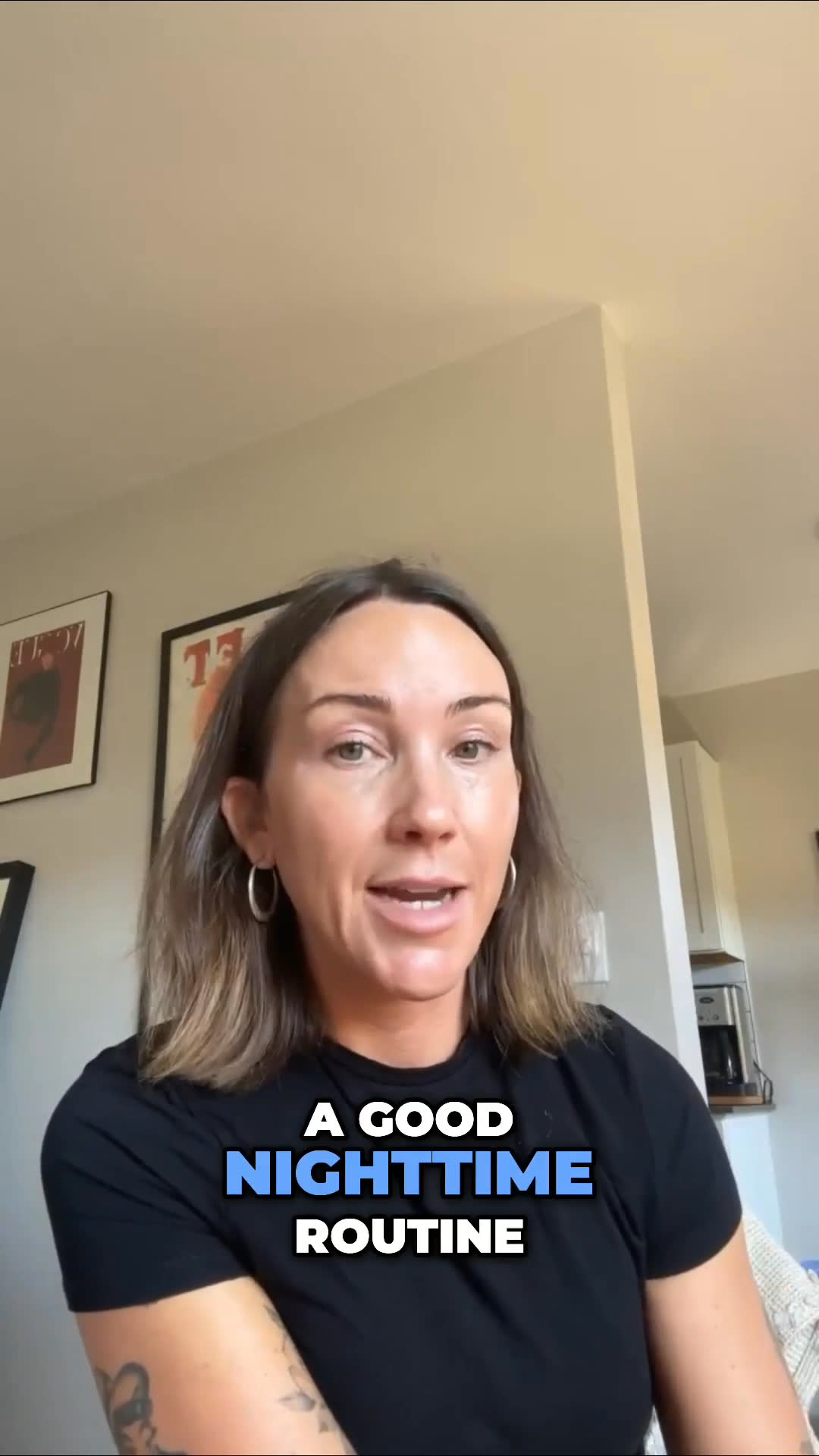
Join Rachel as she shares some tips to set yourself up for better sleep!
When our sleep schedules get amok, it gets really hard to get them back in line. There are some things we can do to trick the system to support us getting back into a regular sleep schedule. Getting sunlight first thing in the morning also helps sort of get our cortisol churning and moving.
To journal for like five to 10 minutes before I sleep is also really helpful. I like to think of my thoughts as leaves floating on a river. Giving myself permission to notice if the thought comes up and remind myself that the only thing I have to do in this moment is sleep.
I've been struggling with insomnia for several weeks now. A lot of that is due to some grief I'm moving through and just difficulty falling asleep because my thoughts are racing, or sleeping a lot because I've been feeling sad. And the other part of it is poor sleep hygiene. So in the same ways that my eating might get kind of messed up, or my movement might get kind of messed up, or my ability to socialize or relate might get messed up, if I'm going through something stressful like grief or big change in transition, my sleep will get messed up too.
And I still have to love myself enough to try and create some kind of routine and structure and hygiene for my sleep so that I can care for myself, especially in this extra difficult time. And, you know, oftentimes when our sleep schedules get amok, it gets really hard to get them back in line because it kind of interrupts so many other things happening physiologically, like our cortisol levels, like our circadian rhythm. So there are some things we can do to sort of like, trick the system to support us getting back into a regular sleep schedule and just some sort of, like, gentle practices that we can do to take care of ourselves in times when we might have sleepless nights.
So the first thing I want to talk about is just some sort of, like, logistics, strategic things to implement. And then the second thing I'll talk about are some just sort of ways that we can treat ourselves and talk to ourselves about our sleeplessness as a way to cope with the reality of even when we set something in schedule, it might not go perfectly. So I'm sure a lot of you have heard a lot of these things already. But just to reiterate, our bodies do respond physiologically to the natural changes of the daylight and the darkness.
So our bodies have a tendency to react to things like, oh, sorry, a little butterfly just flew through my window. I feel like that was good luck. I've never seen that before. So in the morning when you read, like, if you read things, a lot of times people will say, like, get sunlight first thing in the morning or get outside first thing in the morning. And this might seem a little bit trivial and like, what is this going to do? And getting sunlight on our eyes, on our skin, is a way for our bodies to recognize, like, from a survival back, like, biologically, that it is time for us to awake.
It is time for us to be alert and engage with the day. It is daytime. It's time to wake up. And this also helps sort of get our cortisol churning and moving first thing in the morning, which we want. We want our cortisol levels to start rising in the morning because that's. It's technically a stress hormone, but it activates us, it energizes us. So oftentimes, if we have a lot of stress, we might have a lot of cortisol flowing through our bodies. So we might experience high levels of energy all day long or at times of day that don't make sense.
And that's usually a sign that we're experiencing a lot of stress in our lives. So our cortisol is all out of whack. So if we're getting good cortisol in the morning, that's great. But if we're getting cortisol all day long or in the evening, then our bodies think, I have to stay awake, I have to stay alert, I have to stay awake, I have to stay alert. So, number one, getting sunlight in the morning does help that cortisol go, oh, yes, it's time. Time for me to wake up. So if you struggle with, like, feeling really lethargic in the morning or sleepy in the morning, that could be a sign that your cortisol is not necessarily doing what it needs to.
It's totally not the end of the world. It's totally possible to rewire that same thing. If at night, if you're feeling really, like, alert and, like, you can go write a book or do a lot of things, those cortisol levels might be sort of not in the right space. Something that I've also been practicing, and this again, might seem really trivial or simple, is if you're a coffee drinker or a caffeine drinker, is having a little bit of something to eat before having caffeine. I don't know the exact science behind this, but I went to a nervous system reset retreat several years ago, and there were a lot of nutritionists and neurologists there who taught me a lot about the nervous system.
And one thing they taught me was caffeine in the morning is spiking that cortisol even more than it needs to be, which can create some imbalances. And by putting food in our body, that sort of, like, softens the effect of the caffeine instantly going out into our systems. Again, I'm not a doctor, so don't quote me on this. This is just something that I've been practicing that has helped me. Okay, so that's the morning time. And then in that same vein, if we're talking about our cortisol levels or things on a biological level.
We really want to try and create an ease at the end of the evening and let our bodies know it's okay and safe to unwind. So for me this means cutting off caffeine after 12pm and making sure that I'm not g my system more energy than it needs and then also trying to reduce any stressors in the evening or anything that might activate me. So this is the thing I struggle with the most, is having a good nighttime routine. This also means giving our brains cues of darkness. So this does mean things like reducing screen time like an hour before bedtime, reducing height, like big bright lights an hour before bedtime.
And it was hard because like we live inside of a home. It's 10:00 at night. I'm, you know, I've been awake for an hour because it hasn't been bedtime. I have a light on, a light on in my house. Like obviously it's not, you know, completely feasible to just be in the dark as soon as it gets dark outside. And there are certain things that we can try and create some boundaries around, whether that's our phones or TVs or really, really bright lights in our, in our homes, like an hour before bed. And again, that's just giving our brains an opportunity to say like, okay, it's dark, I'm supposed to start winding down.
And then the third sort of like logistics logistical thing is regardless of whether or not I'm tired and regardless of whether or not I feel rested, going to bed and getting up at the exact same time. So that means starting to give myself a schedule of at 10 o'clock, I'm in bed, my lights are out, my phone is off and my sleep music is on. And even if I'm laying there for an hour and not falling asleep, I am encouraging myself to treat that as bedtime. And even if I have a crappy sleep that night, the next morning at 7:30, I wake up.
And when I fail, I don't want to say fail because it's just trial and error. But when I struggle to get back into a good sleep routine, it's usually because I ignore that schedule I've set for myself. So I allow myself to scroll until like 11:30 instead of trying to just close my eyes at 10, I allow myself to sleep in until 9 because I'm exhausted and I didn't sleep well and I don't want to lose out on that sleep. And so I try to remind myself it's almost like I'm Trying to cure jet lag. So if I go across the world to Europe and it's a 16 hour time difference, I'm obviously going to feel sleep deprived for the first couple of days.
I'm obviously going to try and stay awake all day long. Maybe I'll take a nap, but I'm going to try not to because I really want to make sure I get a good sleep that night to reset my schedule to that time zone. That's technically what I'm trying to do when I make a new sleep schedule for myself. I'm trying to reset myself to this time zone, to a good time zone of good sleep. So that means even though I'm really, really tired, I still wake up in the morning because I want to be awake during the day.
Even though I'm not necessarily tired yet, I still go to bed at 10 o'clock and eventually after a few days my body will start to adjust. So those are just like some logistical, technical things. And then in terms of just being kind to ourselves like that I think has been the biggest thing because oftentimes when I can't sleep, I beat myself up or I get anxious about it. And then once I'm anxious about not sleeping, then I'm really not sleeping because I'm stressed. And if I'm stressed, then my cortisol goes up like we talked about and then I'm really not sleeping.
So I try to remind myself that I'm doing the best I can. If I'm laying awake at night for an hour and I'm still not sleeping, I might get up and make myself a hot cup of tea and I treat myself like a child. Like if I had a four year old girl who was not able to sleep, what would I do? Would I scold her? No. Would I tell her, screw it, you can put on the tv, just watch tv, you'll be fine? No. Would I say, I'm so sorry sweetheart, that must be awful. Why don't we get you a hot cup of milk or a hot cup of tea maybe let's try a different sleeping position.
Curl up, I'll put on a different set of sound sleeps for you and we'll try again. And just so you know, if you don't fall asleep tonight, it's okay, we're gonna get to try again tomorrow. And talking to myself and treating myself like I'm a little girl and I find that when I'm able to have a lot of compassion and gentleness for myself while I'm trying to create a new Routine that I don't have full control over because a lot of it is physiological. I need to be gentle with myself because as soon as I beat myself up, as soon as I'm anxious, as soon as I get stressed about the thing I'm not doing, the harder that thing becomes.
And we want to create a safe environment for us to try and increase our ability to have good sleep. And then the other thing. Oh, what was the other thing I was going to say? Oh, I. So this is sort. I don't know if this is like a logistical thing, but I know for myself something that I struggle with at night is I. I start to like, list off all the things I need to do the next day or I start to like play out scenarios in my head, like what ifs and all that kind of stuff. So I find having a journal next to my bed and trying to.
To journal for like five to 10 minutes before I sleep is also really helpful. And this could be like a to do list for the next day. It could be like, these are all the things running through my head that I don't want to forget. This could be a list of gratitude for what happened during the day. So I go to go to bed feeling thankful. It can be anything that comes to mind. But I find that having that little pre bed dump helps me get out of that space of like, shoot, I want to forget this tomorrow, or crap, I forgot I was supposed to do this.
Like, it gives me a chance to let that out so that it's not ruminating while my brain is trying to fall asleep. And to that same effect, if I find that my brain is doing that while I'm laying in bed and I notice it trailing off, I like to do a little mindfulness activity that I learned years and years ago. I don't know if it has a name, but essentially I think of my thoughts as leaves floating on a river. So any thought that comes up, I notice it and I go, oh, there's that thought. And I watch it float by.
Oh, there's that thought. And I watch it float by. And I remind myself in this moment, all I have to do is sleep. Oh, there's another thought. I'm gonna let it pass by. Right now, all I have to do is sleep. There's another thought, watch it float by. All I have to do right now is sleep. So giving myself permission to notice if the thought comes up and remind myself that the only thing I have to do in this moment is sleep. So that's sort of what I'm gonna try practicing starting today is getting back on my sleep schedule, trying to get outside in the morning.
Luckily, I have a dog, so I have to go outside first thing in the morning, which really helps. And in the evenings, this is gonna be the hardest one for me, honestly, because I've become seriously addicted to my phone. I will admit, I scroll all day long. And so creating a routine where I don't have my phone out for an hour before bedtime, that's gonna probably be the most challenging. And I'm gonna. I'm gonna try. So hopefully you can hold me. And then trying to have a little bit of a chance to journal before I go to bed and just mind dump.
So let me know if that was helpful.