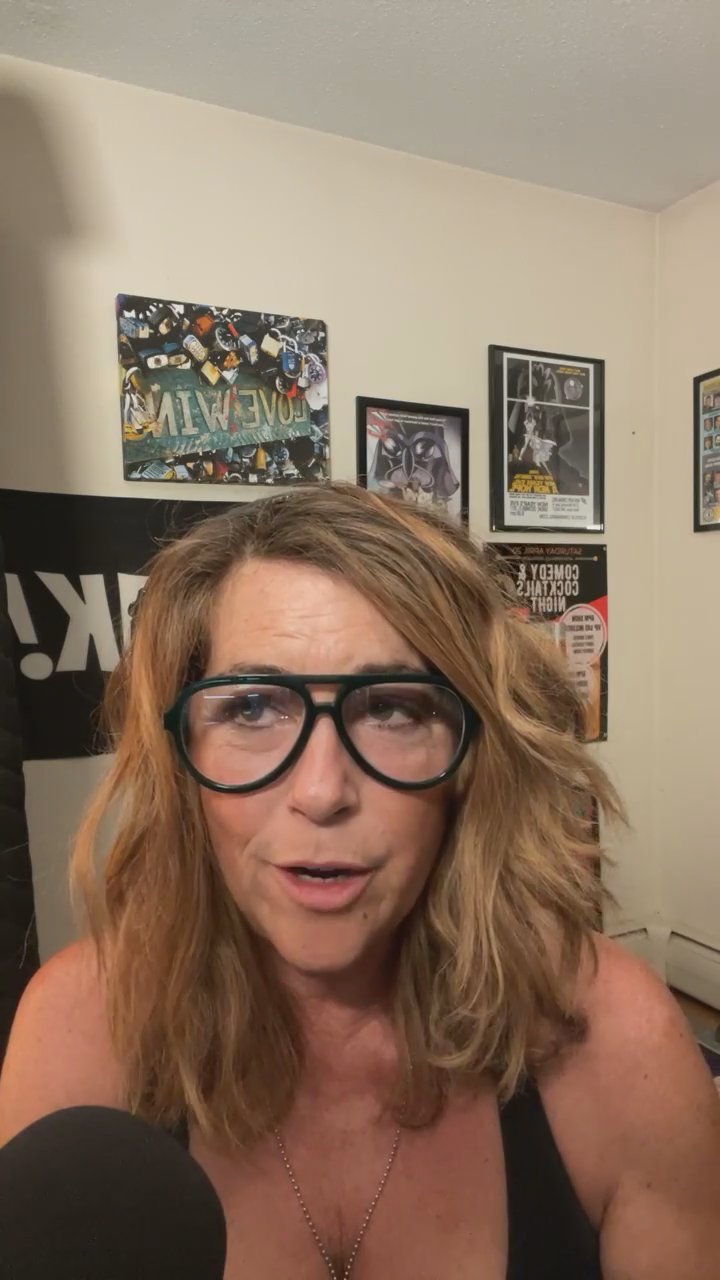
Tiffany Norton is broadcasting from Hudson, Wisconsin. Today on comedy centered. It's been beautiful this whole weekend. Comedian Tiffani Thiessen talks about imposter syndrome. The term comes up a lot in conversations about stand up comedy. It is not a diagnosis, it's not part of the DSM.
Tiffany Norton is broadcasting from Hudson, Wisconsin. Today on comedy centered. It's been beautiful this whole weekend. You know, I'm a little all over the place about my content.
Comedian Tiffani Thiessen talks about imposter syndrome. The term comes up a lot in conversations about stand up comedy. It is not a diagnosis, it's not part of the DSM. It's a reaction to certain stimuli and the way we view ourselves.
A lot of times, people with anxiety and depression have imposter syndrome. What, in what ways are we not showing up authentically as ourselves? What are we hiding because we think it's too icky or socially unacceptable?
Jules: We buy into the idea that we should be an imposter. She says it's dangerous to be caught in between who you are and who you think you should be. When you start showing up for yourself in an authentic way, other people will notice.
Tiffany: Stop being an imposter. Just cast aside all of society's norms real quick and do whatever the hell you want. Jules: The real winning is finding out who you are. You have to pick and choose your battles.
I should talk about this next week. The 47 laws of power. One of the main rules is never outshine the master. All right, y'all have a great week. Stay centered.
Hey, everybody. Welcome. It is comedy centered, and that must mean it's Sunday. And that also must mean that I'm Tiffany Norton, your host. Hello. Hello. Hope you guys had a great weekend. Not sure where everybody's gonna be tuning in from. I am broadcasting from Hudson, Wisconsin, and it's beautiful today. It's been beautiful this whole weekend. And, like, low humidity, it's that sweet spot in the midwest where there's about two weeks of fantastic weather, and we're right in the heart of it. Hey, welcome in Valmore.
And, yeah. So today on comedy centered. You know, I'm a little all over the place, I guess, to a certain extent about my content, but it's kind of like whatever's a bit on the top of my mind going on, like, in the past week or something like that. And there's one thing I've been thinking about quite a bit, and that's imposter syndrome. Have you heard that term before? Imposter syndrome? It came up, like, three or four times in a row in different conversations with different people. And I'm a performer.
I do stand up comedy. I've been a comedian for about 17 years. And this is a conversation that happens a lot, at least lately, with performers, is that, you know, even though you may have credits, maybe you've sold out a big show, maybe you just had a fantastic set, but it doesn't really feel real, right? It doesn't really feel like you earned it. Like there's an imposter. Right? And I, like, you know, I always get curious about words and the fact that this kept coming up, I'm like, you know, what is actually imposter syndrome?
Like, I have a rough idea. I mean, it's pretty self explanatory, but, you know, is this actually, like, a medical condition? Is this a. Like, a real thing? And so I did a little quick deep dive. And that's a little contradictory. A quick deep dive. Anyway, Tiff. And it is not a diagnosis, right? It's not a medical diagnosis. It's not part of the DSM, if you're familiar with that, the diagnostic blah, blah, blah book. Hey, Jules. Welcome in. Good to see you. We're talking about imposter syndrome.
And so I'm looking up the definition of what imposter syndrome is, and basically what Wiki says is that it is not a disorder, and it is actually a reaction to certain stimuli and the way that we view ourselves and how well we're living in our own authenticity. Because these conversations I had this week, it was a friend who was saying that they felt like an imposter in their life, that they felt like an imposter on stage when they were performing stand up. And I said something that I could tell probably hurt their feelings a little bit.
I'm neurodivergent, and so sometimes I don't realize the question I'm asking a literal question, maybe is kind of. I don't know. Anyway, I'll just spit it out because I kind of stepped in it a little bit. But I just challenged the person. I said, do you maybe feel like the reason you have, or you're saying that you have the symptoms of imposter syndrome is because you are actually acting as an imposter? You know, because it was within the context of someone doing a standard performance, and some of the material in the standard performance wasn't really.
Not necessarily, like, 100% true to the person who they were. And I hear that a lot. You know, I feel like imposter syndrome, and I've felt that myself, for sure. Like I said, I've been doing stand up for 17 years. But when you do stand up for that long and you haven't gotten a Netflix special or you haven't been on HBO, or you've never been on a late night talk show, people, you do feel like an imposter. You're like, no, seriously. Like, when people come and see me alive, they laugh. They like it.
I'm not famous, but, you know. But this idea, though, that we're showing up maybe in an inauthentic way, that's. I feel like that. That I want to delve into that a little bit. I know that I have put on my mask, a social mask. Like, we all have to put one on at work, right? Like, you have to get along. You know, you have to put on a mask when you go to church, you have to put on a mask at social functions. Right. Funerals, weddings, things like that. I mean, these are. These are natural things where you have to table whatever you have going on in favor of what the group dynamics are.
And in this exploration, you know, I think a lot of times, basically, okay, I'm getting lost in my own thought, but the anxiety levels and having an anxiety disorder, they have concluded that you have a high likelihood of having also imposter syndrome. Also, people that fall into the range of perfectionism and people with depression and things like that, where no matter what you do, either it's not really you, or the only reason why the good thing happened to you was love or some outside force. Not really accredited to you.
And, I mean, that makes sense. I mean, there's, to a certain extent, that sounds like humility, that sounds like being humble. But if you really don't feel like the things that you've achieved in your life are actually your achievements, it could be some of those other factors, like anxiety and depression, but it also could be that the success is coming to you, but it's not coming through you. It's coming to your mask. It's coming to whatever social mask you've. You've put on. And so when the mask has a win, when the.
The socially constructed personality has a win, you know, you don't feel it as well because it doesn't feel like you, because it really, you. You are being kind of an imposter. Do you know what I mean? I know this is a one way conversation. You can't really answer me back. But it just got me thinking, you know, maybe if we're feeling that we are an imposter. Well, let's think about it. What, in what ways are we not showing up authentically as ourselves? And what are we hiding because we think it's too icky or socially unacceptable or we'll be rejected?
Or maybe, you know, there could be a real world cost. Like, you know, I have PTSD, I have post traumatic stress disorder. I, you know, on job applications, I don't throw that on there because people, you know, some people have some ideas about that. Like, oh, she could just snap one day, or, oh, she's mad, you know, she's got PTSD, watch out. You know, so we make a lot of these assumptions, right? But that's why I think it's important to talk about these things and get out there, because one of the things I hate is feeling inauthentic.
I hate feeling like an imposter. And part of my neuroses is that I overshare. I over tell people. I always over tell people the bad stuff about myself. I always point out my own flaws and things like that. And that's not healthy either. You know, it's. It's kind of gravelly. Like, ugh, I don't really deserve it, you know? But you can legitimately feel that way. But, like, in what ways are we not showing up in an authentic way? And I've talked about this subject before in a different episode, but it's kind of like the difference between, like, let's say, LinkedIn and, I don't know, Facebook or TikTok.
Okay, LinkedIn. That's your professional business card, essentially, right? So if you go and interact on LinkedIn, it's all hashtag positivity. Everything is hashtag positivity. There's. I've put in some contrarian arguments. I've put in some dissenting points about the economy and things of that nature. No one wants to have a discussion about anything on LinkedIn. They only want to see pictures of you next to an award. They only power down to say, congratulations. I have friends on there that I've had since LinkedIn was brand new when I started using it back in my real estate days in the early two thousands.
And all I've ever heard from these people for years, and I know them in real life, but, like, on LinkedIn, it's just like, congratulations on your one year anniversary of your promotion. You know, they don't even know what job I'm at. They just see that the prompt. Right? And so this push, especially in corporate America, to make everything super sanitary and super clean and super, like, nothing offensive, nothing edgy, nothing. Nothing that. That's not helpful either. You know, toxic positivity is just as bad as toxic negativity, because toxic positivity, basically, you're shutting out everything that just doesn't align with the color of the sky in your world.
And I'm not saying that you shouldn't march to your own drummer. I'm not saying that you should go with the crowd. But, you know, you can get stuck. Like, it's, like, literally, like you're. There's rain clouds gathering, the storm's coming, and you're out here. Like, I don't need an umbrella because I'm. You know, I'm positive, I'm thinking positive, and it drives me insane. I mean, like, look, I don't go on LinkedIn anymore because it's just. It's too. I don't know, it just feels. It feels like.
It feels so much more braggy. We used to rag on Facebook so hard about it, only people only highlighting the good qualities of their life and the good stuff, you know? But LinkedIn is way worse. And so. But if you. If you're somebody like me and you're sitting there, like, I went through, I'm starting a new job on Tuesday, but, like, I got laid off from my day job early this winter, and so I've had a lot of free time. And then you go on to, like, a LinkedIn and things like that, and you're seeing, oh, well, so and so won an award.
So and so is going on a sales trip. So and so just started a new business. And you're sitting there thinking, oh my God, why can't I make anything happen? Why am I nothing? You know, getting the stuff, you know? Right. But we don't really see the full picture. We're really only seeing the cleanest, most sanitary version of their life because it's essentially a business card. But we've mistaken that for being someone's life. And that's not an accurate representation either. Now, like, Facebook used to be more, you know, clean and whatever, like more professional, I guess, but now it's kind of a dumpster fire as far as political stuff.
So I'm trying to ignore it for a couple months, but. So I think that this is where we inadvertently buy into this concept and this idea that we should be an imposter. We should suck it up, we should just go with the flow. We should do what everybody else is doing because look at, look at. They're getting the stuff, they're getting the stuff. Stuff I'm not getting, you know, so maybe. Maybe I do have to show up in an unauthentic way. Maybe I do have to, you know, be a brown noser and an a** kisser or whatever, right?
But that also is you acting outside of your own autonomy. If it's not really the way that you feel and, you know, keeping your mouth, you know, shut in an instance where maybe a coworker is dead wrong or has their facts wrong, but you just want to keep the peace, you're actually showing up in an inauthentic way. And when you're doing that, any success that comes to you, when you're in an imposter state, you're not going to really feel like you did it because you didn't earn it. Not you. Your imposter did.
Your imposter got the award. You know, I don't go in too deep on religion, but I think I've mentioned before, I've been studying. Practicing is maybe a little too strong, but studying Buddhism for, you know, since my twenties. And one of the things that, you know, is very dangerous is to be constantly caught in between who you are and who you think you should be. Right? And so if you go into those spaces like that where you're just seeing everybody having all this positive stuff happening to them, you're never seeing the reality of the negative, the backside of it.
You know, it can really mess with your head and it can make it seem like the way to get what you want is to be less authentic. And I hope to God that's not the case. Although I'm not terribly successful. So maybe that was. Maybe that's it. Maybe if I could just keep my mouth shut, I would have had more success. But it, again, also with the neurodivergence and attention deficit disorder, I found out one of the symptoms of that is that I have a hyper vigilant sense of right and wrong and injustice.
And so I am. It's like I'm compelled to challenge things if I feel like they're being unfair and someone's being overlooked or left out. I'm very sensitive to that, and I don't want to lose that. And I don't think we can lose that. As people, we have to be able to, obviously, dissent and disagree with people, but also, too, just pretending to note just. Just ignoring someone and letting things roll by, you know, because, you know, you want that promotion and you don't want to make waves and you want to fit in, and you need the money, and you want this and you want that.
I mean, you can play that game, and I've played it, but, you know, real talk, it led me to a freaking nervous breakdown at 50, and I had another. And I had another nervous breakdown at 35, where I was literally an imposter in my own life. And I'm like, I don't see myself in my own life. I don't see myself anywhere here. I'm just a combo. I'm just this combination that I put together of a socially acceptable personality that, you know, society likes, my mom likes, my dad likes, my brother, you know, like everybody likes.
I didn't like it. It wasn't me. I wasn't standing up for what I really believed. I wasn't speaking out when I should have. I was letting people get away with behavior because I really just didn't. I don't know. I wanted acceptance more than I. Than I wanted, you know, the correct outcome. And it led me both times to being in a place where I felt like an imposter in my own life. So I get the imposter syndrome. I do. But when you start showing up for yourself in an authentic way and you start showing up for other people in an authentic way, a, they'll notice, b.
Oh, Jules, what are you saying? I agree to disagree. Yeah, exactly. Agree to disagree. Right. You have you. Because there's that social line. You have to maintain order in the group. Remember, we're all just monkeys running around here on this rock that's hurtling through space, right? So you got to preserve the group dynamics. But, you know, if you. If you constantly let that kind of stuff happen. You can end up in some unethical corners of business. You can find yourself in situations that. That aren't healthy or good.
I know I did. And so, yeah, I. Showing up as yourself is in and of itself an act of courage. And that's been the gift of me going back to therapy, me, you know, getting my late diagnosis, getting on the proper medication, doing my own research, doing my own journaling, doing my own work, and figuring out, like. Because now I know, because I've basically stripped down so much of myself, I'm kind of like a raw nerve at this point. But anything I can achieve from this point on, I will know that I earned it, and I will know that it is not an imposter achieving it.
I did it because it's been a lot of g****** hard work. And so when success comes this time, I firmly believe again that I will believe it. But, you know, you're pretty dope. Everybody's dope the way they are. You know, you don't have to pretend to be someone else, and you wouldn't want to anyway, you know? And if you're feeling like an imposter, too, you might be just also in a work situation or in a relationship or a dynamic that's unhealthy where you. Where there is danger for you, showing up as your true and authentic self.
And if you're in that kind of situation, well, then, you know, then you kind of know what you got to do. But that's scary, too. So. I don't know. It was just. It was something that got me thinking, and I. This week, and I could. I could tell I threw my friend off when I was like, well, yeah, but do you think it's because you're being an imposter in your own life? And they looked at me like, you. You know, a b word. I'm gonna say, like, why do I talk to you? I'm like, I don't know. I don't know why anybody talks to me.
But. But, yeah, that's the other. The other part of the neurodivergence is I will literally. I take things extremely literally. Like, literally what you said, like, I have imposter syndrome. Well, stop being an imposter. Is it just that simple? Just. Just cast aside all of society's norms real quick and do whatever the h*** you want. Simple, right? There's no negative consequences to those kinds of words. Right, Tiffany? But, yeah, but I mean, if it's. If it. If it resonates, if it, um, you know, just remember, like, most, most of that stuff.
Like, there's this one girl who I've known for years, and she's on LinkedIn, and, I mean, every time I see her, it's. It's a beautiful new dress. Her hair is to the nines, the nails are to the nines, and it's another award, or she's got another client, or she's given herself some roses, or she's done this or she's done that. And it's. And it's. It's you. You would imagine from her thread that, like, this, literally, this woman only just wins. And it's like, come on, we know that that's not true.
We're all having a, we're all having a creative existence in a very unpredictable world. And you can't always win. Not everybody. No one always wins. You know, the real winning is finding out who you are. And the real winning is as scary as it is, you know, showing up truly as who you are, you know? And when you start doing that, you're gonna cause some waves, and you're gonna maybe upset a few people. But those were people that were probably already imposters as well. And when you stop acting like an imposter, other people feel uncomfortable around you.
If they are wearing their social masks in public and all that stuff, because they know that they're not showing up in an authentic way. And that's all we can really do. That's all we can really do. And. But the work thing is hard to navigate, Jules. Yeah, yeah, yeah. Well, and it depends too. It depends. Like, there's also, like, I always, you know. You know, do you want them win the battle or the war? Right. Sometimes you got to let some stuff go, but I. Yeah, I mean, yeah, I've gotten myself into some bad situations by just going with the flow, being too scared to stand up against about something that I didn't think was right.
And so, you know, if anything, if my recovery journey has done anything, I think that's. That's probably the main takeaway. So, anyway, hope that helps. Uh, if not, it always helps me. I love it. Every week. Jules, good to see you, girl. I want to see you in real life. I know. We need have, like, a Cadre up because I think you're out in the east coast. We all. We all need to get the cadres fear together or something, but, yeah, yeah, yep. You have to pick and choose your battles. You do. You do, you know, and also, too, like, have you ever.
Maybe that's what I'll talk about next week. I should talk about this next week. The 47 laws of power. Or is it the 48 laws of power? Something like that? 47. 48 laws of power? 48, I think. But one of the most important lessons in that book, and if you want to read it, it is fantastic. But it's a historical analysis of people who rose to power throughout history. And they go back like ancient Greece, it's all over. But one of the main rules is never outshine the master. So when you're talking about choose and pick your battles.
Yeah, it's one thing to battle with someone who is lateral to you in the company structure, but someone who's a above you. Yeah. Be careful. Ever outshine the master? All right, y'all have a great week. Stay centered and, yeah, I'll see you in what, seven days. Bye. Have a good night. Bye.