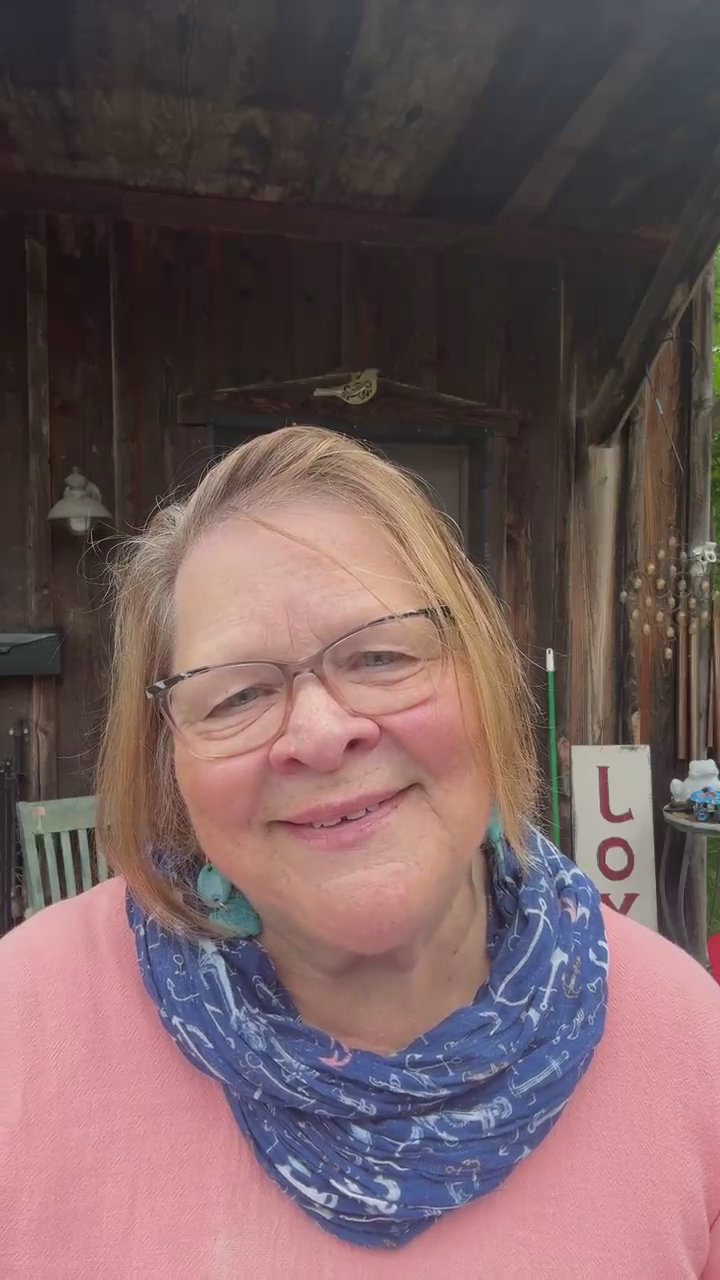
The host greets viewers, introduces herself (Cadre name Speak Wonder), and reflects on Thursday as a caregiver day and feeling overwhelmed. This brief opening sets a compassionate tone and orients listeners to the live stream's purpose.
Using her local Lake Erie harbor and Presque Isle as a metaphor, the host describes the setting and announces the episode's focus on listening and the power of pausing. She connects place to practice to help viewers settle into the theme.
Drawing on a guest (Hank) and the phrase 'exquisite attentiveness,' the host describes how silencing oneself allows deeper listening. She shares anecdotes and poetic language to illustrate what attentive listening feels like and why it's restorative.
The host recounts Hank's recordings—barnacles, iceberg 'burps,' loons—and how such sounds can echo in memory, especially for people with dementia. These stories highlight how nature's sounds can reconnect listeners to past experiences and emotions.
The host suggests simple actions—playing familiar bird calls, turning off phone alerts, and mindfully attending to ambient sounds—to help caregivers connect with loved ones. She offers concrete examples from her own family to show how listening can provide comfort and bridge memory gaps.
The episode wraps with a poetic reminder that life's sounds are everywhere and that listeners often serve as safe harbors for others. The host thanks caregivers, previews upcoming contributors, and signs off.
And here we are, another Thursday. We've gone through another week. Randy is in the room. Hello. This is Cadre and my name is Kathy. My Cadre name is Speak Wonder. Because I like to do just that. Speak wonder. Into a weary world. And certainly on Thursdays we can be weary. As caregivers, Thursday is caregiver day in the cadre. I'm on my back patio, my front patio, whatever, and somewhat unprepared. There's a lot of things going on. Somebody in the cadre recently said that when our nervous system is jiggled around and we've got a lot on our mind and heart and things are swirling around us, problems are waiting to be solved that it's as though we are a laptop with too many applications open or phone for that matter and too many apps are open and we're simply overwhelmed.
That's where I find myself today and that's why Cadre is so grounding for me. My template if you will, my symbolic Cadre talk is all around harbors and harbor pilots. I live in Erie Pennsylvania so I'm on Eastern time wherever you're tuning in from it um it's a little bit after 11:30 in the morning and I'm not far I'm about maybe less than a 10 minute drive from the harbor of Lake Erie in Erie beautiful Harbor and Presque Isle is a national state park and that's a national park and that's a really nice place it has 11 beaches so you can be on a beachfront or you can be on the harbor side watching the sailboats and the pleasure boats and the fishermen.
And it's just inspiring to be there. You can walk through some of the wooded areas of the peninsula and it is a bird sanctuary. The reason I'm coming to you on the live stream from outdoors is because today's talk is about Listening. It's about the power of the pause. I'm learning a lot about how the nervous system gets kind of out of whack and how we need to protect it. I'm learning that from different mentors in my life and from CADRE contributors as well. And one of the ways we protect our nervous system and develop a sense of calm is to Enter into the pause.
Enter into the quiet. I listened to a podcast called Constant Wonder recently and the guest on there, his name is Hank Lentfer. You know, this always happens when I broadcast from outside. My landlord just drove in. He's probably gonna come over and talk to me and he wonders why I'm talking to my phone, I bet. Gracie, you do not have to be on watch. It's okay. High alert is not necessary when I'm doing my live stream. This guest said, listen to your world with exquisite attentiveness. And that appeals to me as a poet.
Exquisite attentiveness. And exquisite does not suggest to me that you're trying hard to pay attention. It means that you have silenced yourself and the molecules in your body to a place of quiet where you feel your shoulders go limp and you can listen with exquisite attentiveness. This particular fellow, Hank Lintfer, is the author of a book which I want to acquire from my library. It's titled Faith of Cranes, and in there he talks about the Sandhill Cranes. He lives in Alaska, the very uppermost part of the tip of Alaska.
Pretty cool. But he encourages us to be attentive to the wonder of the world. And for this fellow, and I think for many of us, careful listening is. Okay, I'm going to get my dog in the house. Gracie, Gracie, get in here. Hello. Careful listening is not only necessary, it's a blessing. It's a gift. I'm framing it today a little bit for part of my presentation in the picture of caregiving. Now we are all taking care of each other. We're all sailing into safe harbor and we're all coming in and throwing the rope onto the pier so we can have some respite in some way, shape or form.
Maybe you're not officially a caregiver per se, but to the degree that you care about someone and you wish the best for somebody and you make a meal for somebody, you write a letter, make a phone call, you are a caregiver. You don't have to have a person under your wing and you don't have to be the POA, that's what I am for my mom. power of attorney that's both medically and financially. And I have often said here on this live that I'm her emotional caregiver. She's in very good hands at the nursing home where she is a resident and she has a lovely, fabulous roommate who looks over her, takes care of her and watches out for her.
My mom's name is June and she's known there as June Bug or Junie Bug. When she worked for the US Fish and Wildlife Service, she was known as the head fish. Some days she was calling herself the miner minnow. We can hear and hold space for people when they want to tell their stories. I'm getting to page two of my notes already, so let me go ahead and go in order because I don't want to miss anything, you guys. This guy, Hank Lintfer, he is an expert at acoustic ecology. In other words, he goes out into nature and he records bird song, whale calls.
He has recorded a bear eating barnacles. Didn't know bears ate barnacles, but yeah, they do. And he's recorded so many things. And he says that when he's attentive to wonder in the world and when he uses his special acoustic equipment to record nature sounds, he's hearing the world singing. And I love that idea. He also says, when you hear something once, it will long echo in the walls of memory. Okay, so hold a bookmark there because that's gonna play right into how we listen to other people's stories when they are no longer verbal sometimes.
He says, too, that when barnacles, okay, when barnacles clench up, they make a rolling hiss across the entire colony of barnacles. And we don't have barnacles in Erie. We are a freshwater lake. In the sea, the barnacles will sense danger even if a shadow passes over them like a human walking by or even a cloud coming over and they'll clench up even tighter and it makes this whispering hiss. And it transforms ordinary natural sounds into moments of ah and connection, which he has experienced in nature.
He also, living in Alaska and wherever we live, even if we're not rural, especially when we're not rural. When we're in the city, there are still atmospheric sounds that can come into our awareness and give us awe and connection. He talks about atmospheric burps. That's when an iceberg releases air bubbles. Glacier Bay, Alaska is where this fellow lives. He says icebergs will hold air bubbles for eons. And so when they release those, it's like a burp. And then he's very lyrical. He's definitely a.
a guy with a poet's heart he says atmospheric burps from another time bubbling by the bow of your boat he was in a boat uh listening to the icebergs in the wild you feel so small and it's what he calls a blessed insignificance do you ever feel blessedly insignificant He talks about the childlike quality. The smallness in a big, vast world is what allows you to feel a part of the bigness. And then when you feel that smallness inside of the bigness, you feel joyful and you feel childlike. He also mentioned, which I never knew this.
Maybe my body knows this, but we can hear through our fingertips. through our hands. There are about a dozen different touch responders in our hands and fingers and we can detect vibrations in nature. So he goes on to say that even after dementia compromised both memory and communication for his mom, his late mom, her auditory sense can still build a bridge to the past. And that's where I want to revisit that phrase, If you hear something once, it will long echo against the walls of your memory.
When his mama became non-communicative and she was no longer speaking but she was still hearing and connecting in the auditory way, he would come in with his nature sounds that he recorded in the wild and played them for her. And one of the most meaningful connections, the music of nature that he played for his mom was the loons. And her face would brighten up and she would remember the loons when she and her husband and family would go camping along the waterway. And the music of nature was echoing in her memory.
And it was recalled when she heard that recording. Connection, communication. My mom is doing well in that category. She does not have Alzheimer's. I'm grateful for that. She does have some onset of memory loss where she goes back to her past is what she can best recall. That's typical. for someone who's 95 years of age. So I have learned from this acoustic ecology guy named Hank Lintfer that I can probably take my little cell phone, which is basically a computer, and Google or YouTube bird calls that she loves.
She loves a red-winged blackbird. And we can connect that way by talking about our memories of watching birds at her bird feeder. in the house where I grew up. So I leave you with these thoughts, whether you're a caregiver officially or a caregiver incidentally, as you walk through your world and your circle of influence, the people with whom you rub elbows, be aware of wonder. There's birdsong all around me, but I also love the voices of my grandchildren. I can't really keenly hear these things or be exquisitely attentive unless I mindfully turn off some of the bells and whistles.
And with that in mind, I have silenced my phone on some occasions. I have taken away some of the audible dings and text tones and ringtones or made them less noisy in an effort to be aware of the nature sounds around me. The author of the book Faith of Cranes, Hank Lemper says this, Our lives are embedded in a rich sea of sounds, music, wind, laughter, and birdsong, sobs, and sea surf. poems and snowfall, stories and crane calls. See how he did that? He merged the sounds of humans, of our loved ones with the sounds of nature that envelops us all.
Recently, I was out in the field behind the barn and I saw my first glimpse of fireflies. It was the summer solstice, it was Sunday evening. Fireflies are magical and they have no sound. But I sensed them before I saw them. I sensed them as I headed toward the field. I knew it was about time for them to show up as they do annually here in the northwest part of the state of Pennsylvania. This morning inside my apartment I sensed the presence of a hummingbird before I saw him. I don't know if I was so keenly aware that I could feel the vibrations of his wings.
I rather doubt that. But when we start paying attention, it's almost like we're aware of something before it's really presented. In the wild, we feel so small. We are blessedly insignificant. Of course, I started writing a haiku. I don't have the third line. A haiku is a Japanese practice of writing verses in five syllables and then seven syllables and then five syllables. Three lines only. Typically a haiku does not have a title because you want to take up the syllables. Thank you for the hearts, you guys.
You want to be very intricate and small with your pen strokes for the haiku. So I have the first two lines. I will come up with the third line and I'll post it in the conversation stream that we have here in the cadre. The wave of whispers, blessed insignificance. Stay tuned for the third line of this haiku by yours truly, Speak Wonder. in the harbor in the neighborhood at the mailbox in the grocery store as the neighbors using some kind of power thing to split wood chips there are nature's acoustic sounds and there are the voices of your loved ones there's a sound of your size and the echoes of the world singing.
Pay attention. It's wonderful. It's wonderful. I did not look ahead to see who's on today. I do know that at 3 o'clock Eastern, I'll get to listen to my friend Shannon Paul in Comedy and the Chaos. She's a caregiver to her son, who's a real character. He's so much fun. I love it when he comes on camera with her. And she always has a message that is of value and practical. And of course, being a comedienne, it's very humorous. Comedy in the chaos. There are other contributors coming up. I just didn't look to give you the whole list.
Remember, today you are somebody's safe harbor. And they're sailing into the waters near you because they know that you will calm their nervous system in some way maybe they don't verbalize that and maybe they don't even appreciate it but you are providing safety and comfort respite and calm to somebody who needs you today thank you for the good work you're doing as a caregiver as a human being and I'll see you next week here on Harbor Pilots in the cadre